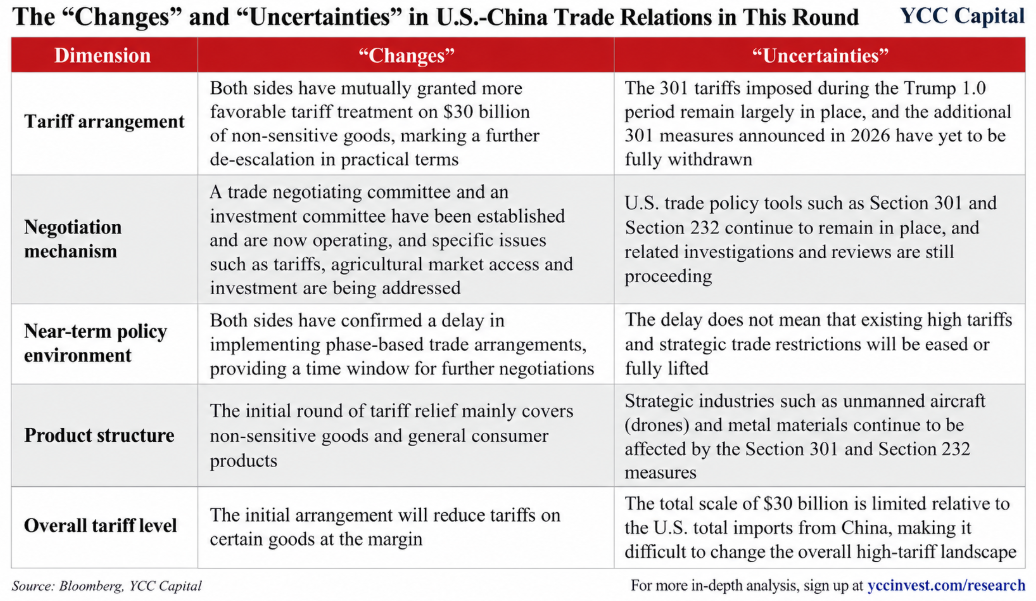
YCC CAPITAL Geopolitical Strategy September 29, 2026 The latest U.S.–China trade understanding is best viewed as a pressure-release valve, not a demolition crew. Washington and Beijing have moved toward preferential tariff treatment for $30 billion of non-sensitive goods in each direction, while bilateral trade and investment councils have shifted from institutional design toward actual operation. The negotiating window has also been extended. These are meaningful changes at the margin. They are not a normalization of the U.S.–China economic relationship. For investors, the distinction matters. A shopkeeper cares less that one shelf has gone on sale than whether the rent on the entire building has fallen. Here, the headline concession covers only about one-tenth of annual U.S. imports from China. The much larger architecture of Section 301 and Section 232 restrictions remains standing, particularly around advanced manufacturing and strategically sensitive industries. Our central conclusion is therefore straightforward: the direction of travel has become somewhat less confrontational for ordinary consumer goods, but the strategic economic rivalry remains deeply embedded in U.S. trade policy. A $30 Billion Opening, but Not a Strategic Reset The bilateral arrangement advances three areas. First, both sides have agreed in principle to more favorable tariff treatment for $30 billion each of non-sensitive bilateral trade. U.S. exports potentially covered include agricultural products, fish and seafood, logs and wood products, cosmetics and medical devices. Chinese exports include small household appliances, toys, holiday decorations and child car seats. The complete tariff-line list, precise reductions and implementation timetable have not yet been disclosed. That missing detail is crucial: $30 billion of trade receiving a five-percentage-point reduction is a very different economic event from the same basket receiving a 20-point reduction. Second, the bilateral Trade Council and Investment Council have begun operating. The Trade Council is addressing tariff implementation and agricultural market access, while the Investment Council provides a formal channel for discussing investment opportunities and barriers. Institutionalized communication does not eliminate rivalry, but it can make policy shocks somewhat less arbitrary. Third, the interim trade arrangements have been extended, creating additional negotiating runway. The practical effect is to reduce the immediate risk of another abrupt tariff escalation while negotiations continue. The market should nevertheless distinguish between better process and better fundamentals. Dialogue is improving. The underlying strategic conflict has not disappeared. The Tariff Wall Is Still Above 20% The clearest way to understand the relationship is through the effective tariff rate rather than headline statutory rates. In July 2026, the effective U.S. tariff rate on imports from China stood at 21.5%. That is substantially below the 48.1% peak recorded in May 2025, but it remains nearly twice the roughly 11% level prevailing before the second Trump administration. The comparison with other trading partners is even more revealing. In July, the effective U.S. tariff rate was approximately 7.3% for the European Union, 10.6% for Japan, 4.7% for South Korea, 6.2% for Vietnam, 8.2% for India, 1.8% for Canada and 4.6% for Mexico. Across all U.S. imports, the effective rate was 7.6%; excluding China, it was only 5.9%. China therefore remains an unmistakable outlier. Today’s burden consists of several layers. Pre-trade-war MFN tariffs represented roughly 2.7% effective taxation. The first Trump administration then built a large Section 301 tariff structure, much of which survived both the Biden administration and the subsequent change in government. By the end of 2024, before the newest tariff rounds, China’s effective rate had already reached approximately 11.2%. Additional measures followed. In July 2026, a new Section 301 regime applied a 12.5% additional tariff to China, subject to exemptions. Section 232 measures meanwhile cover strategic products including steel, aluminum, copper, automobiles and components, heavy vehicles, advanced computing chips, drones and selected polysilicon-related products. Depending on the product, rates can reach 25%, 50% or, for certain drone categories, 100%. These rates cannot simply be added because coverage and exemptions overlap. But the message from the effective-rate data is difficult to miss: China continues to face a structurally higher U.S. trade barrier than most major economies. Source: Bloomberg, YCC Capital Why $30 Billion Changes Less Than the Headline Suggests U.S. goods imports from China totaled approximately $308.65 billion in 2025. A $30 billion concession therefore covers about 9.7% of annual imports. The arithmetic puts the announcement in perspective. Holding the trade mix constant, if tariffs on the covered goods fall by an average of 10 percentage points, the overall effective U.S. tariff rate on Chinese imports would decline by roughly one percentage point. Even a 20-point reduction would lower the aggregate rate by only about 1.9 percentage points. Starting from July’s 21.5%, that would still leave the effective tariff burden near 19.5%. That is why YCC Capital views the agreement as directionally important but quantitatively modest. Its real significance is that Washington has acknowledged room for targeted relief on non-sensitive Chinese goods. If that principle later expands through additional exclusions, exemptions or larger product baskets, the cumulative effect could become meaningful. For now, however, the wall has acquired a few gates. It has not been torn down. Where Tariffs Could Fall—and Where They Could Rise The most plausible area for additional relief is ordinary consumer merchandise with little direct connection to national security or technological competition. Products for which U.S. domestic supply is insufficient are also natural candidates for exclusions, particularly when tariffs impose costs on American households or downstream manufacturers without materially advancing strategic objectives. This resembles everyday household budgeting. A family may willingly pay more for something it considers essential, but paying an ideological premium for every toaster, toy and seasonal decoration eventually becomes difficult to justify. U.S. policymakers have similar incentives to distinguish strategic dependence from ordinary commerce. The harder problem for China lies at the technology frontier. A separate Section 301 investigation into alleged structural overcapacity and production issues encompasses sectors including steel, aluminum, automobiles, batteries, chemicals, machinery, robotics, semiconductors, shipbuilding and solar products. The final measures remain uncertain, but the scope illustrates how broad the next tariff front could become. Section 232 creates another risk. U.S.
The Long Road to Peace: U.S.–Iran Swiss Talks Open a Framework, but a Durable Settlement Remains Elusive
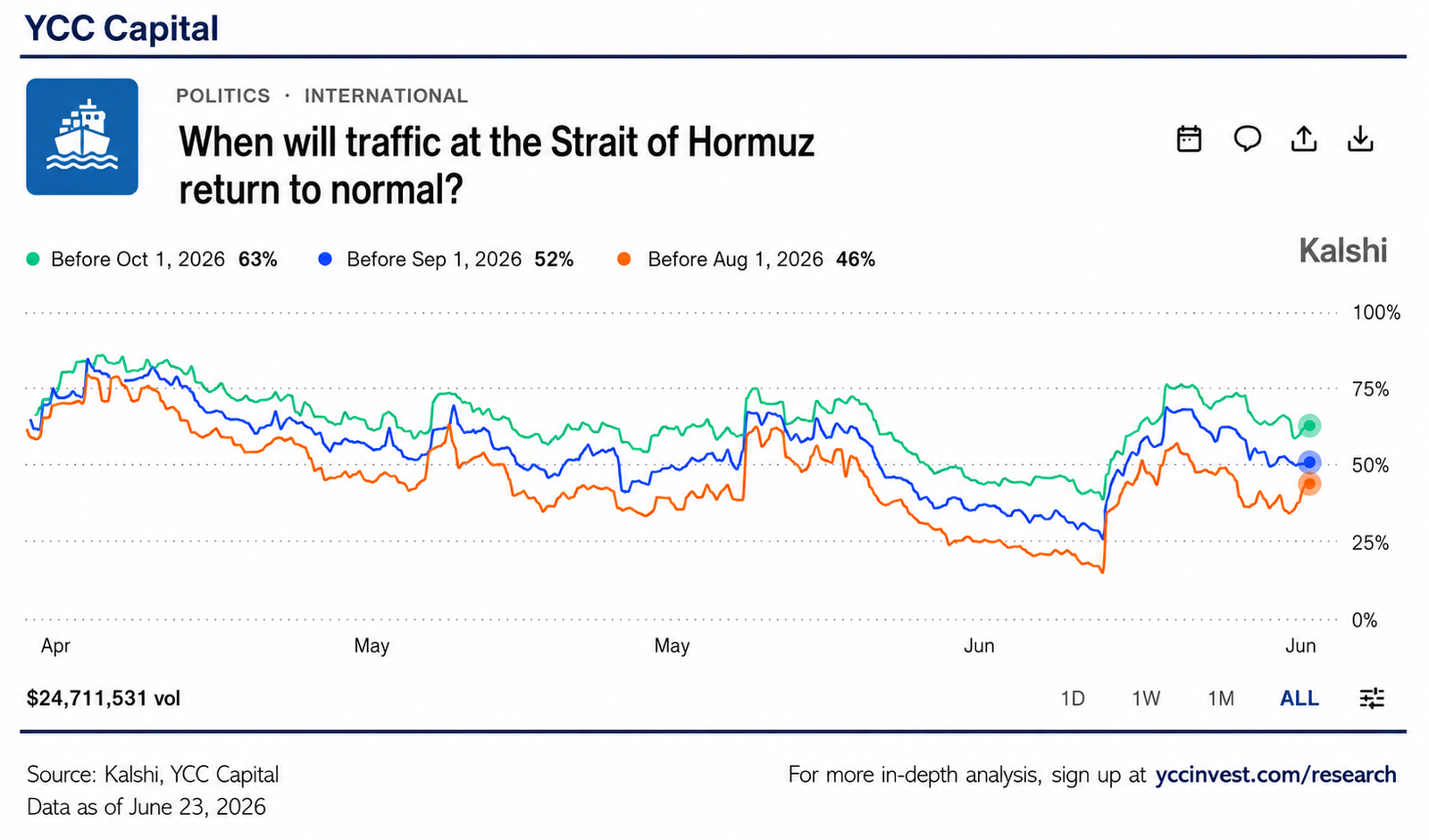
YCC CAPITAL Geopolitical Strategy June 24, 2026 Executive Summary Financial markets are eager to price peace. History suggests that peace is usually much harder to negotiate than a ceasefire. The latest high-level U.S.–Iran talks in Switzerland represent the most important diplomatic breakthrough since the recent escalation in Middle East tensions. Markets interpreted the meeting as a constructive step toward de-escalation, pushing crude oil prices below recent peaks and easing inflation concerns. Yet investors should be careful not to mistake the opening of negotiations for the conclusion of negotiations. Our assessment is that the Swiss talks primarily established a mechanism for implementing the previously agreed Memorandum of Understanding (MoU) framework rather than resolving the fundamental disputes at the heart of the conflict. The two sides have created communication channels, established a 60-day negotiating timeline, and reaffirmed commitments to maintain commercial navigation through the Strait of Hormuz during negotiations. However, the most contentious issues—including Iran’s nuclear program, sanctions relief, and the future governance of the Strait of Hormuz—remain unresolved. The most likely outcome over the next several months is not a comprehensive peace treaty. Rather, it is an extension of the current fragile détente. Both Washington and Tehran have strong incentives to avoid renewed escalation, but neither appears politically positioned to make the concessions required for a permanent settlement. For energy markets, this means the immediate risk of a catastrophic supply shock has declined. However, structural geopolitical risk remains elevated, suggesting that energy risk premiums are likely to remain embedded in oil markets even if prices continue to retreat from crisis highs. From a longer-term perspective, one of the most important developments may not be the negotiations themselves but the accelerating search for alternatives to the Strait of Hormuz. The longer the conflict persists, the stronger the incentive for governments and energy producers to build infrastructure that reduces dependence on one of the world’s most strategically sensitive chokepoints. YCC Perspective Every global energy crisis eventually becomes a logistics story. Consumers experience it through gasoline prices. Investors see it through inflation expectations. Governments feel it through strategic vulnerability. But beneath all of those effects lies a simple reality: energy must move from producers to consumers. The Strait of Hormuz has long functioned as one of the most critical arteries of the global economy. The recent U.S.–Iran confrontation reminded markets that when a single waterway carries roughly one-fifth of global petroleum consumption, geopolitics and economics become inseparable. The Swiss talks matter because they reduce the probability of immediate disruption. Yet they do not eliminate the underlying strategic competition that created the crisis in the first place. A Diplomatic Breakthrough After Months of Escalation On June 21, 2026, U.S. and Iranian representatives met in Switzerland under the coordination of Pakistan and Qatar. The meeting focused on implementation of the previously negotiated 14-point Memorandum of Understanding that established a preliminary framework for ending hostilities. After approximately eighteen hours of discussions, mediators released a joint statement outlining the initial achievements of the talks. Markets responded positively. Oil prices retreated from recent highs. Inflation expectations eased. Rate-sensitive assets benefited from reduced concerns over a prolonged energy shock. Investors interpreted the talks as evidence that both Washington and Tehran preferred negotiation over escalation. This reaction was understandable. The meeting marked the first substantial face-to-face diplomatic engagement between the parties in roughly two months and represented a clear departure from the military-focused dynamic that had dominated recent headlines. However, market optimism should be viewed in context. The Swiss meeting was less a peace agreement than the creation of a framework designed to make future negotiations possible. What Was Actually Achieved? The Swiss talks produced three major institutional outcomes. First: A Formal Communication Architecture The parties agreed to establish a high-level committee responsible for supervising negotiations and ensuring continued dialogue on key issues. In many geopolitical conflicts, communication breakdowns create escalation risks that exceed the underlying policy disagreements. By establishing permanent negotiating channels, both sides reduced the probability of accidental confrontation. Second: A 60-Day Roadmap Negotiators agreed to pursue a final agreement within a 60-day window. The timeline is important because it creates political momentum while also providing markets with a defined period during which both sides are expected to prioritize diplomacy. Third: Protection of Commercial Shipping Perhaps most significant for investors, the parties agreed to maintain commercial navigation through the Strait of Hormuz during the negotiation period. Given the Strait’s central role in global energy transportation, this commitment immediately reduced fears of a near-term supply shock. Additional statements from both governments reinforced the positive tone. U.S. officials indicated that Iran had agreed to permit nuclear inspectors access to facilities and continue technical discussions on frozen assets and ceasefire implementation. Iranian officials emphasized progress toward ending hostilities in Lebanon, obtaining exemptions for energy exports, securing partial asset releases, and initiating economic reconstruction discussions. The U.S. Treasury subsequently issued a temporary 60-day general license permitting Iranian oil production, delivery, and sales under specific conditions. Collectively, these measures signal a meaningful reduction in immediate tensions. Why a Permanent Peace Agreement Remains Difficult The central challenge is that the negotiations have not yet resolved the issues that matter most. In effect, the talks addressed process rather than substance. The largest unresolved issue is the future status of the Strait of Hormuz. The Memorandum of Understanding states that Iran will engage with Oman and other Gulf states to determine future governance arrangements for the Strait in accordance with international law and the sovereign rights of coastal states. This language appears constructive but masks a deep legal and geopolitical disagreement. Iran maintains that its authority derives from principles associated with innocent passage and sovereign security considerations. Tehran argues that it retains the right to intercept vessels deemed threatening to national security. The United States, by contrast, insists that the Strait operates under the principle of transit passage, a framework that guarantees uninterrupted movement of international commercial shipping. This disagreement is not merely legal. It strikes directly at the balance between Iranian sovereignty and the global