YCC CAPITAL
Geopolitical Strategy
September 29, 2026
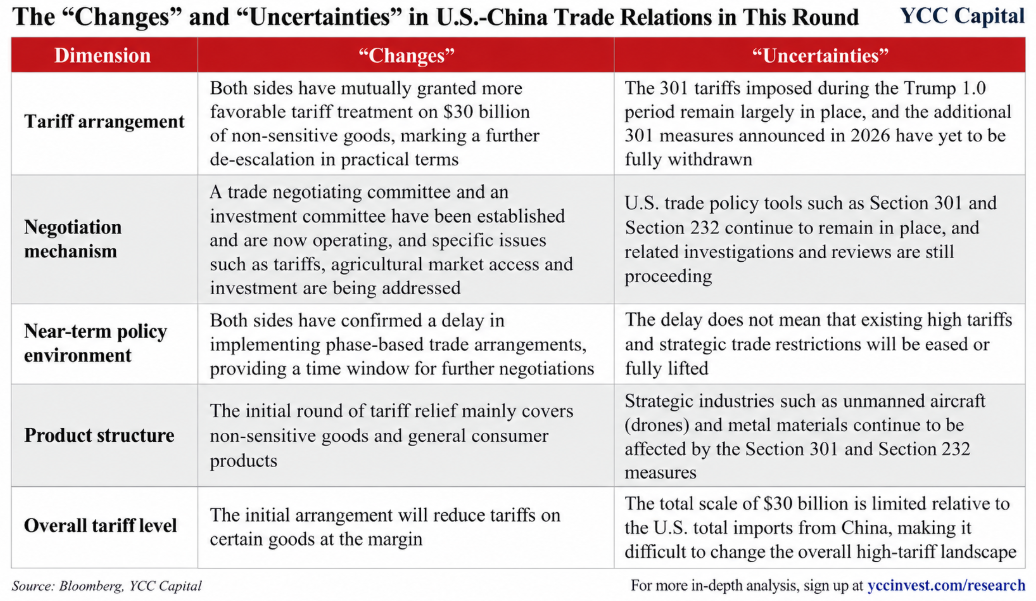
The latest U.S.–China trade understanding is best viewed as a pressure-release valve, not a demolition crew. Washington and Beijing have moved toward preferential tariff treatment for $30 billion of non-sensitive goods in each direction, while bilateral trade and investment councils have shifted from institutional design toward actual operation. The negotiating window has also been extended.
These are meaningful changes at the margin. They are not a normalization of the U.S.–China economic relationship.
For investors, the distinction matters. A shopkeeper cares less that one shelf has gone on sale than whether the rent on the entire building has fallen. Here, the headline concession covers only about one-tenth of annual U.S. imports from China. The much larger architecture of Section 301 and Section 232 restrictions remains standing, particularly around advanced manufacturing and strategically sensitive industries.
Our central conclusion is therefore straightforward: the direction of travel has become somewhat less confrontational for ordinary consumer goods, but the strategic economic rivalry remains deeply embedded in U.S. trade policy.
A $30 Billion Opening, but Not a Strategic Reset
The bilateral arrangement advances three areas.
First, both sides have agreed in principle to more favorable tariff treatment for $30 billion each of non-sensitive bilateral trade. U.S. exports potentially covered include agricultural products, fish and seafood, logs and wood products, cosmetics and medical devices. Chinese exports include small household appliances, toys, holiday decorations and child car seats.
The complete tariff-line list, precise reductions and implementation timetable have not yet been disclosed. That missing detail is crucial: $30 billion of trade receiving a five-percentage-point reduction is a very different economic event from the same basket receiving a 20-point reduction.
Second, the bilateral Trade Council and Investment Council have begun operating. The Trade Council is addressing tariff implementation and agricultural market access, while the Investment Council provides a formal channel for discussing investment opportunities and barriers. Institutionalized communication does not eliminate rivalry, but it can make policy shocks somewhat less arbitrary.
Third, the interim trade arrangements have been extended, creating additional negotiating runway. The practical effect is to reduce the immediate risk of another abrupt tariff escalation while negotiations continue.
The market should nevertheless distinguish between better process and better fundamentals. Dialogue is improving. The underlying strategic conflict has not disappeared.
The Tariff Wall Is Still Above 20%
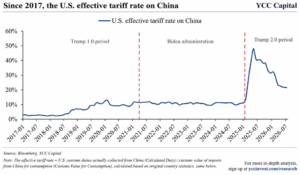
The clearest way to understand the relationship is through the effective tariff rate rather than headline statutory rates.
In July 2026, the effective U.S. tariff rate on imports from China stood at 21.5%. That is substantially below the 48.1% peak recorded in May 2025, but it remains nearly twice the roughly 11% level prevailing before the second Trump administration.
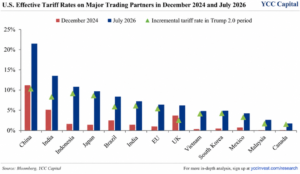
The comparison with other trading partners is even more revealing. In July, the effective U.S. tariff rate was approximately 7.3% for the European Union, 10.6% for Japan, 4.7% for South Korea, 6.2% for Vietnam, 8.2% for India, 1.8% for Canada and 4.6% for Mexico. Across all U.S. imports, the effective rate was 7.6%; excluding China, it was only 5.9%.
China therefore remains an unmistakable outlier.
Today’s burden consists of several layers. Pre-trade-war MFN tariffs represented roughly 2.7% effective taxation. The first Trump administration then built a large Section 301 tariff structure, much of which survived both the Biden administration and the subsequent change in government. By the end of 2024, before the newest tariff rounds, China’s effective rate had already reached approximately 11.2%.
Additional measures followed. In July 2026, a new Section 301 regime applied a 12.5% additional tariff to China, subject to exemptions. Section 232 measures meanwhile cover strategic products including steel, aluminum, copper, automobiles and components, heavy vehicles, advanced computing chips, drones and selected polysilicon-related products. Depending on the product, rates can reach 25%, 50% or, for certain drone categories, 100%.
These rates cannot simply be added because coverage and exemptions overlap. But the message from the effective-rate data is difficult to miss: China continues to face a structurally higher U.S. trade barrier than most major economies.
Source: Bloomberg, YCC Capital
Why $30 Billion Changes Less Than the Headline Suggests
U.S. goods imports from China totaled approximately $308.65 billion in 2025. A $30 billion concession therefore covers about 9.7% of annual imports.
The arithmetic puts the announcement in perspective. Holding the trade mix constant, if tariffs on the covered goods fall by an average of 10 percentage points, the overall effective U.S. tariff rate on Chinese imports would decline by roughly one percentage point. Even a 20-point reduction would lower the aggregate rate by only about 1.9 percentage points.
Starting from July’s 21.5%, that would still leave the effective tariff burden near 19.5%.
That is why YCC Capital views the agreement as directionally important but quantitatively modest. Its real significance is that Washington has acknowledged room for targeted relief on non-sensitive Chinese goods. If that principle later expands through additional exclusions, exemptions or larger product baskets, the cumulative effect could become meaningful.
For now, however, the wall has acquired a few gates. It has not been torn down.
Where Tariffs Could Fall—and Where They Could Rise
The most plausible area for additional relief is ordinary consumer merchandise with little direct connection to national security or technological competition. Products for which U.S. domestic supply is insufficient are also natural candidates for exclusions, particularly when tariffs impose costs on American households or downstream manufacturers without materially advancing strategic objectives.
This resembles everyday household budgeting. A family may willingly pay more for something it considers essential, but paying an ideological premium for every toaster, toy and seasonal decoration eventually becomes difficult to justify. U.S. policymakers have similar incentives to distinguish strategic dependence from ordinary commerce.
The harder problem for China lies at the technology frontier.
A separate Section 301 investigation into alleged structural overcapacity and production issues encompasses sectors including steel, aluminum, automobiles, batteries, chemicals, machinery, robotics, semiconductors, shipbuilding and solar products. The final measures remain uncertain, but the scope illustrates how broad the next tariff front could become.
Section 232 creates another risk. U.S. restrictions have expanded beyond traditional metals into automobiles, advanced computing chips, drones and polysilicon-related products. Semiconductor measures are especially important because the existing 25% tariff on a narrower group of advanced computing chips could be followed by broader restrictions on semiconductors, manufacturing equipment and derivatives.
This leaves China in an uncomfortable position. Relief may arrive for low-sensitivity consumer products while barriers remain high—or increase—precisely in the industries Beijing considers central to upgrading its manufacturing base.
Three Policy Windows Investors Should Watch
The first is implementation of the $30 billion arrangement. The tariff-line list, size of the reductions and effective dates will determine whether the announcement materially changes trade flows.
The second is the negotiating window through January 10, 2027. Further agreements could broaden tariff relief, but the present framework does not guarantee a larger settlement.
The third is Washington’s ongoing Section 301 and Section 232 process. These investigations matter more for the strategic trajectory than concessions on toys or small appliances because they touch manufacturing capacity, semiconductors and supply-chain security.
For China, the longer-term challenge remains uncomfortable: export diversification can reduce dependence on the U.S., but it does not eliminate the growing use of anti-dumping rules, countervailing duties, origin requirements, technical standards and procurement restrictions across major developed markets.
YCC Strategic View
The market should resist treating every diplomatic improvement as the beginning of normalization. U.S.–China commercial relations are becoming more compartmentalized: ordinary trade can receive selective relief while strategic industries remain fenced off.
For the United States, targeted tariff reductions can lower unnecessary costs without abandoning the broader emphasis on supply-chain security. That creates room for cautious improvement in bilateral commerce while preserving Washington’s strategic restrictions.
For China, the picture is less comfortable. The country can gain breathing room in low-value and non-sensitive exports, but the sectors most important to its industrial ambitions remain exposed to persistent policy barriers. Export-market diversification may soften the blow, yet it cannot fully substitute for access to the world’s deepest consumer markets and leading technology ecosystems.
The key question is therefore no longer whether U.S. tariffs on China are simply “going up” or “going down.” The investable question is which walls are being lowered, which are being reinforced, and where capital will reroute when the gates move.
Source: Bloomberg, YCC Capital
Editorial Board
Ken Cao, Chief Strategist, Global Investment Strategy; Le Gao, Managing Analyst; Yui Nabeshima, Strategist; Mai Ikeda, Research Analyst.
IMPORTANT DISCLAIMER
This research report is provided for informational and educational purposes only and does not constitute an offer to sell or a solicitation of an offer to buy any securities, financial instruments, or investment products. It is not intended as investment, legal, accounting, or tax advice and should not be relied upon as such. The views, opinions, and projections expressed herein are those of YCC Capital Management and its research personnel as of the date of publication and are subject to change without notice. Past performance is not indicative of future results.
YCC Capital Management, its affiliates, principals, and employees may hold long or short positions in securities or instruments discussed in this report and may trade for their own accounts or for client accounts in a manner inconsistent with the recommendations herein. This report is based on publicly available information and data believed to be reliable, but YCC Capital makes no representation or warranty, express or implied, as to the accuracy, completeness, or timeliness of such information. Forward-looking statements involve risks and uncertainties that could cause actual results to differ materially from those projected.
Recipients of this report should conduct their own independent due diligence and consult with their own financial, legal, and tax advisors before making any investment decisions. YCC Capital accepts no liability for any loss or damage arising from the use of or reliance on this report or its contents.
This report is intended solely for the use of the intended recipient(s) and may not be reproduced or redistributed for commercial purposes without the prior written consent of YCC Capital. © 2026 YCC Capital. All rights reserved. YCC Capital’s flagship vehicle, the YCC International Value Fund, LP, maintains a concentrated global macro value strategy with a focus on capital-flow-driven mispricings and asymmetric hedging opportunities. The Fund is registered in the State of Delaware, U.S and structured as a 506(c) fund. Performance data, where referenced, has been verified by independent third parties including NAV Consulting; however, individual investor results may vary.
Contact Us
For research and investor-relations inquiries, contact ir@yccinvest.com. Sign up for free daily market insight at yccinvest.com.
YCC Capital Research | Sign up for free daily market insight at www.yccinvest.com
For more related research:
The Hidden Force Crushing the Japanese Yen is About to Reverse(Opens in a new browser tab)