YCC CAPITAL
Emerging Markets & China Strategy
Date: June 23, 2026
YCC Perspective
A useful way to think about China’s housing market today is to imagine a city emerging from a long winter. The first signs of spring do not appear everywhere at once. The sunny hilltops thaw first, while the shaded valleys remain frozen.
China’s property market is displaying a similar pattern. After several years of deep correction, the market is no longer moving as a single asset class. Instead, a pronounced bifurcation has emerged. On one end, low-priced, high-yield apartments are stabilizing as affordability improves. On the other, luxury properties in technology-driven cities are finding support from wealth effects tied to AI and capital markets. Between these two poles sits the broad middle market, which remains under pressure.
The key question for investors is whether these divergences represent the beginning of a sustainable recovery or merely a temporary fragmentation within a still-challenging macro environment.
Executive Summary
China’s housing market is undergoing two important structural splits:
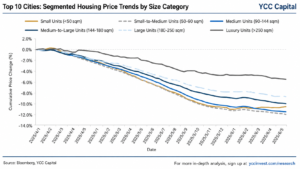
- A divergence between “Top-Tier” assets, “Bottom-Tier” assets, and the middle market
- Small, affordable apartments have been the first segment to stabilize.
- Luxury housing in technology-oriented cities such as Shenzhen has also begun recovering.
- Mid-market properties continue to face weak demand.
- A divergence between transaction prices and listing prices
- Listing prices continue to decline modestly.
- Actual transaction prices have largely stabilized and, in many cities, have begun recovering.
The broader implication is that China’s property market may have entered a bottoming process rather than continuing a uniform decline. However, recovery remains highly uneven and heavily dependent on policy support, household confidence, and the ability of new economic sectors to offset weakness in traditional industries.
The First Divergence: Luxury and Distressed Assets Outperform the Middle Market
Affordable Housing Leads the Recovery
The earliest stabilization has occurred in small apartments with low total purchase prices.
These units generally offer:
- Higher rental yields
- Lower entry costs
- Stronger owner-occupier demand
- Less dependence on speculative investment
After years of price declines, much of the financial speculation embedded in these assets has already been eliminated. What remains is housing’s consumption value—people buying homes because they need a place to live.
In practical terms, many young families and first-time buyers are increasingly prioritizing affordability over prestige. Instead of stretching for larger apartments through leverage, buyers are choosing smaller homes and reducing mortgage exposure. This behavioral shift is becoming one of the defining characteristics of China’s post-bubble housing market.
Luxury Housing Benefits from the AI Economy
At the opposite end of the market, large luxury properties are also beginning to stabilize, particularly in cities with strong exposure to technology industries.
Shenzhen stands out as the clearest example.
Unlike affordable housing, luxury properties do not benefit from attractive rental yields. Their recovery is being driven by two different forces:
1. Falling Real Interest Rates for Technology Wealth
The report highlights a growing divergence between AI-related industries and the broader economy.
While much of China’s traditional industrial base continues to face pricing pressure, AI-linked sectors are experiencing strong growth. This creates a form of localized inflation among technology workers, entrepreneurs, and investors.
As incomes and asset values rise within these sectors, the effective real cost of borrowing falls, making high-end property purchases more attractive.
2. Wealth Effects from Capital Markets
Strong performance in technology-related equities and AI-linked businesses has supported income growth among a relatively small segment of the population.
The beneficiaries include:
- Technology professionals
- Financial industry employees
- Entrepreneurs
- Equity holders
This wealth effect is concentrated rather than broad-based, which explains why luxury housing recovery remains limited to a handful of cities rather than becoming a nationwide phenomenon.
Why the Middle Market Is Struggling
The recovery of low-end and high-end housing highlights a weakness in the middle segment.
Households remain cautious toward leverage.
Even when buyers maintain similar down payments, many are reducing mortgage sizes and purchasing cheaper homes than they would have considered previously.
This means demand that once supported mid-priced properties is increasingly migrating toward lower-priced units.
In effect, China’s housing recovery is not yet being driven by renewed confidence. It is being driven by selective affordability and selective wealth creation. That distinction matters.
The Second Divergence: Transaction Prices vs. Listing Prices
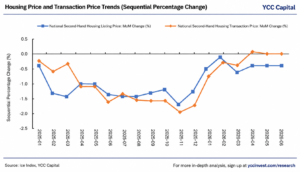
One of the most important developments is the growing gap between asking prices and actual transaction prices.
Many observers continue focusing on listing prices, which remain under pressure.
However, transaction prices tell a different story.
According to the report:
- National transaction prices stabilized in April.
- Stabilization continued in May.
- An increasing number of cities have recorded positive month-over-month transaction price growth.
Why This Matters
Housing bottoms rarely occur when sellers become optimistic.
They occur when distressed inventory gets absorbed.
The current market appears to be experiencing exactly this process.
Throughout early 2026, transaction volumes increased enough to gradually remove the most attractively priced inventory from the market.
As these discounted properties disappear:
- Listing prices may continue falling.
- Negotiations may remain aggressive.
- Yet actual executed prices can still rise because buyers are purchasing increasingly higher-quality inventory.
This dynamic is consistent with many historical housing recoveries globally. Transaction prices tend to bottom before public sentiment improves.
Shenzhen: The Most Important Housing Market Signal
Among China’s major cities, Shenzhen appears to be advancing furthest through the stabilization process.
The report uses a leading indicator called the “up-down ratio,” which compares the number of communities raising asking prices versus those lowering them.
Drawing comparisons with Hong Kong’s recent housing recovery:
- A ratio around 0.6 suggests a bottoming phase.
- Around 0.7 suggests stabilization.
- Above 0.8 suggests entry into a recovery phase.
Shenzhen has approached the 0.8 threshold, placing it closest to a potential transition toward sustained recovery.
Shanghai has also improved but appears less advanced.
Beijing and Guangzhou remain in the earlier stages of stabilization.
Lessons from Hong Kong
The report draws extensive comparisons between mainland China and Hong Kong.
Many conditions that preceded Hong Kong’s housing rebound are already present in mainland China:
- Deep price corrections
- Relaxation of housing restrictions
- Improving rental markets
- Better affordability metrics
However, one critical difference remains.
Hong Kong experienced a dramatic decline in HIBOR during 2025, which temporarily pushed mortgage rates below net rental yields.
That shift created a powerful confidence shock and encouraged buyers to return to the market.
China has not yet experienced an equivalent catalyst.
The Policy Wildcard: Housing Provident Fund Rates
The most significant policy opportunity may lie in China’s housing provident fund system.
Recent regulatory proposals would provide greater flexibility in setting provident-fund mortgage rates.
The report argues that:
- Large reductions in commercial mortgage rates are unlikely.
- Provident-fund rate cuts remain a realistic option.
- Local policy experiments have already demonstrated effectiveness.
According to the analysis, a reduction of 30 basis points or more could potentially push mortgage borrowing costs below net rental yields for many properties, creating conditions similar to those seen during Hong Kong’s recovery.
Strategic Outlook
At YCC Capital, we continue to view China’s property market through a cautious lens.
The era of nationwide, debt-fueled housing appreciation is unlikely to return. Structural demographic pressures, weaker household confidence, and the economy’s difficult transition away from property-led growth remain significant headwinds.
However, markets do not move uniformly.
The evidence increasingly suggests that China’s housing market is evolving into a highly segmented landscape:
- Affordable, cash-flow-oriented assets are stabilizing first.
- Technology-linked luxury assets are benefiting from concentrated wealth creation.
- The broad middle market remains vulnerable.
The ultimate direction of the market will depend on whether China’s new growth engines can generate sufficiently broad income gains to offset continuing weakness in traditional sectors. Until then, investors should expect a prolonged period of uneven recovery rather than a synchronized national rebound.
Editorial Board
Ken Cao — Chief Strategist, Global Investment Strategy
Le Gao — Managing Analyst
Yui Nabeshima — Strategist
Mai Ikeda — Research Analyst
IMPORTANT DISCLAIMER
This research report is provided for informational and educational purposes only and does not constitute an offer to sell or a solicitation of an offer to buy any securities, financial instruments, or investment products. It is not intended as investment, legal, accounting, or tax advice and should not be relied upon as such. The views, opinions, and projections expressed herein are those of YCC Capital Management and its research personnel as of the date of publication and are subject to change without notice. Past performance is not indicative of future results.
YCC Capital Management, its affiliates, principals, and employees may hold long or short positions in securities or instruments discussed in this report and may trade for their own accounts or for client accounts in a manner inconsistent with the recommendations herein. This report is based on publicly available information and data believed to be reliable, but YCC Capital makes no representation or warranty, express or implied, as to the accuracy, completeness, or timeliness of such information. Forward-looking statements involve risks and uncertainties that could cause actual results to differ materially from those projected.
Recipients of this report should conduct their own independent due diligence and consult with their own financial, legal, and tax advisors before making any investment decisions. YCC Capital accepts no liability for any loss or damage arising from the use of or reliance on this report or its contents.
This report is intended solely for the use of the intended recipient(s) and may not be reproduced or redistributed for commercial purposes without the prior written consent of YCC Capital. © 2026 YCC Capital. All rights reserved. YCC Capital’s flagship vehicle, the YCC International Value Fund, LP, maintains a concentrated global macro value strategy with a focus on capital-flow-driven mispricings and asymmetric hedging opportunities. The Fund is registered in the State of Delaware, U.S. and structured as a 506(c) fund. Performance data, where referenced, has been verified by independent third parties including NAV Consulting; however, individual investor results may vary.
Contact Us
YCC Capital Research
Email: ir@yccinvest.com
For free daily market insights and macro research, visit and subscribe at:
YCC Capital Research | Sign up for free daily market insight at www.yccinvest.com