
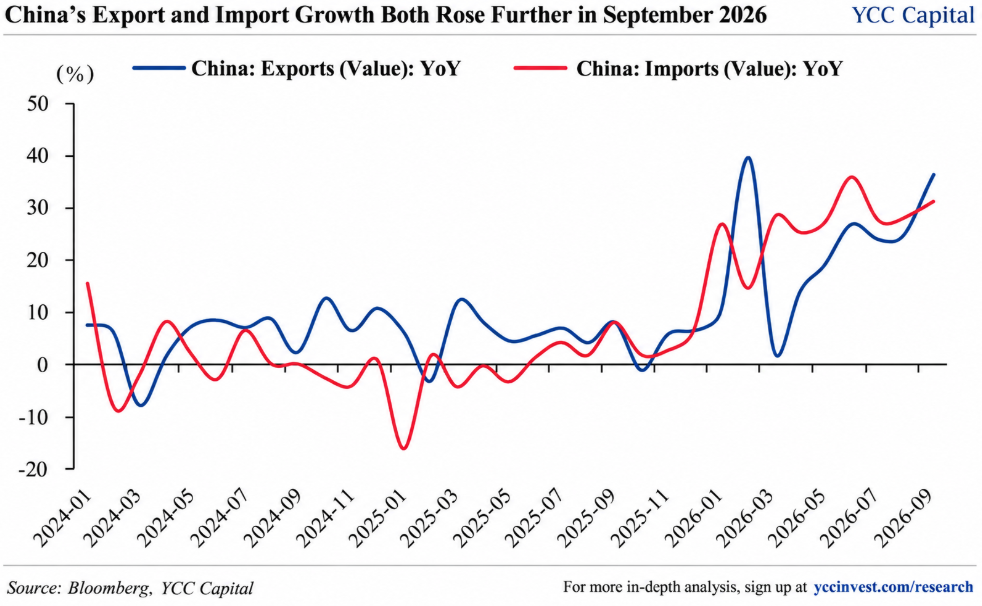
October 17, 2026 YCC CAPITAL | Emerging Markets & China Strategy Executive Perspective: A Record Month, but Not a Clean Bill of Health China’s export machine has shifted into a higher gear. September merchandise exports surged 36.3% year over year to a record $447.18 billion, accelerating 11.3 percentage points from August. Imports rose 31.0% to $313.65 billion, leaving a monthly merchandise trade surplus of approximately $133.53 billion. During the first nine months of 2026, exports increased 21.3%, approaching $3.4 trillion. At first glance, these numbers suggest extraordinary economic strength. We see a more complicated story. China is benefiting from three powerful external forces: the global artificial intelligence investment boom, rising semiconductor prices, and a recovery in traditional manufactured exports. Yet these developments should not be mistaken for a broad-based domestic economic revival. Our central argument is that China’s export strength increasingly reflects global technology spending and pricing effects rather than a durable improvement in its underlying economic model. The distinction matters enormously for investors. A country can export more while its households, property market, and domestic businesses remain under pressure. For anyone who has operated a business, the difference is familiar: higher revenue does not necessarily mean more customers, healthier margins, or a stronger balance sheet. 1. Global Demand Is Accelerating, but Growth Is Uneven China’s export performance has benefited from improving global manufacturing activity. September’s global manufacturing purchasing managers’ index reached 53.0, up 0.7 points from August and marking the fourteenth consecutive month in expansion territory. The geographical breadth of China’s export growth is impressive. September shipments to the United States increased 39.6% year over year, while exports to South Korea rose 68.2%, ASEAN 52.3%, the European Union 25.3%, and Russia 51.1%. These markets, however, tell different economic stories. The rebound in American demand partly reflects favorable comparisons with 2025, when tariff disputes disrupted trade flows. The late-September understanding involving approximately $30 billion in reciprocal tariff reductions may also help stabilize purchasing decisions, although implementation and political durability remain uncertain. We remain cautiously constructive on the U.S. economy. American consumer demand, corporate innovation, and investment in computing infrastructure continue to create opportunities for global suppliers. China’s export recovery is partly a reflection of that American economic resilience. Asia’s strength is more directly connected to technology manufacturing. During January–August, China’s AI-related exports to South Korea increased 104.4%, contributing 28.4 percentage points to overall export growth to that market and accounting for more than 80% of its incremental expansion. Comparable products represented approximately 74% of the increase in exports to Vietnam. Russia presents another dynamic. Bilateral trade reached $214.3 billion during the first three quarters, increasing 30.6%, as Russian import substitution and the withdrawal of some Western suppliers created additional opportunities for Chinese manufacturers. Europe remains a more contested market. Chinese manufacturers are expanding in electric vehicles, industrial equipment, and green technologies, but growing trade-defense scrutiny could limit the durability of that expansion. 2. The AI Boom Is the Real Engine—and Prices Matter More Than Volumes The most important feature of September’s export data is the extraordinary performance of AI-related products. Integrated-circuit exports increased 136.0% year over year, while automatic data-processing equipment exports climbed 92.9%. Together, these categories contributed approximately 13 percentage points to China’s overall export growth. But the composition of semiconductor growth deserves closer examination. Integrated-circuit export prices rose 133.7%, while export quantities increased only 1%. In other words, almost the entire increase in semiconductor export value came from higher prices rather than significantly greater physical shipment volumes. That is an important warning against treating nominal export growth as equivalent to industrial expansion. Imagine a neighborhood electronics shop selling nearly the same number of memory chips as last year, but charging more than twice as much per chip. Its revenue would soar, even though customer traffic and unit sales barely changed. China’s semiconductor export statistics are displaying a similar phenomenon. Pricing pressure is also spreading into consumer electronics. September smartphone export values increased 14.2%, supported by a 30.6% increase in average prices despite a 12.6% decline in shipment quantities. This suggests that higher component costs and product upgrades are lifting export receipts even as unit demand weakens. We view this as a potentially fragile source of growth. Semiconductor pricing cycles can reverse, and higher selling prices eventually test consumer affordability. 3. Traditional Consumer Goods and Automobiles Are Recovering September also brought a noticeable improvement in labor-intensive exports. Clothing exports increased 23.8%, footwear 20.2%, luggage 22.5%, toys 40.8%, and furniture 22.0%. Together, these five categories contributed approximately 1.9 percentage points to overall export growth. The recovery partly reflects weak comparisons with the previous year and improving U.S. trade conditions. During January–August, China’s consumer-goods exports to America, excluding cross-border e-commerce parcels, increased 6.9%, with apparel exports rising 17.5%. Automobiles remain another important contributor. September vehicle exports increased 62.0%, while automotive parts exports grew 24.3%. During the first three quarters, electric-vehicle exports advanced 72.3%, lithium batteries 36.4%, and wind turbines and related components 22.4%. These figures demonstrate China’s considerable manufacturing capabilities. Yet they also reveal growing dependence on overseas markets to absorb industrial production. For investors, the question is whether Chinese manufacturers can preserve profitability as trade restrictions intensify and overseas competitors respond. Shipbuilding provides a more durable order-book story. September ship exports increased only 2.7%, slowing 18.3 percentage points from August, but Chinese shipyards held approximately 150 million compensated gross tons of outstanding orders at the end of September, representing 68% of the global order book. Unlike consumer electronics, shipbuilding has long production cycles, making monthly export fluctuations less informative about underlying demand. 4. Imports Reveal Both Technological Demand and Strategic Vulnerability China’s September import growth of 31.0% might suggest strengthening domestic demand. However, the composition points toward a narrower expansion. Imports of copper ores and concentrates increased 27.1%, integrated circuits 74.7%, and automatic data-processing equipment 296.5%. Together, these categories contributed 22.6 percentage points to import growth, representing approximately 73% of the total increase. This concentration suggests that AI infrastructure and industrial inputs, rather than broad household consumption, are driving
China–Europe Trade: The New Battleground for Global Manufacturing
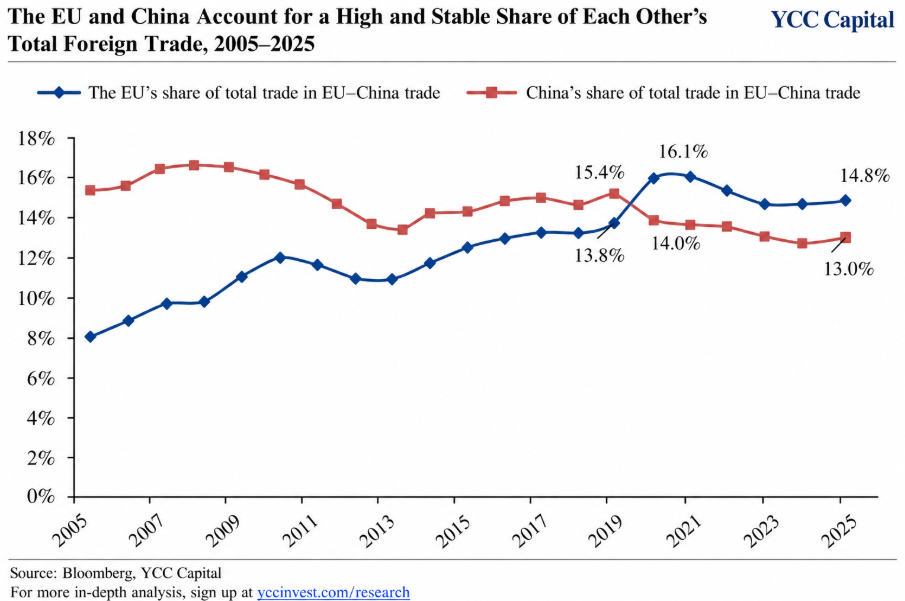
YCC CAPITAL | EMERGING MARKETS & CHINA STRATEGY October 13, 2026 | YCC Capital Macro Research China and Europe are no longer simply trading partners. They are increasingly industrial competitors, fighting over the same customers, technologies, and manufacturing capacity. The relationship is entering a more confrontational phase, but neither side can afford a complete separation. The YCC Perspective: A Trade Surplus That Conceals a Deeper Problem The China–European Union economic relationship has reached a strategic turning point. What once resembled a complementary division of labor—European technology and premium manufacturing exchanged for Chinese consumer goods and lower-cost industrial production—is becoming a contest over industrial leadership. On October 8–9, Beijing hosted the second meeting of the China–EU Trade and Investment Consultation Mechanism. Negotiators reached 16 understandings covering trade and investment imbalances, export controls, intellectual property, and World Trade Organization reform. These developments provide useful diplomatic breathing room, but they do not resolve the underlying conflict. Our central assessment is that China’s growing manufacturing competitiveness is simultaneously strengthening its export position and intensifying its geopolitical vulnerabilities. Europe increasingly regards Chinese industrial capacity not merely as a commercial opportunity, but as a threat to domestic employment, technological sovereignty, and strategic autonomy. For investors, the critical distinction is between export competitiveness and sustainable economic prosperity. China can dominate selected manufacturing industries while still struggling with weak domestic consumption, industrial overcapacity, and declining returns on capital. 1. An $828 Billion Relationship With a Growing Imbalance 2025 China–EU goods trade $828.1B 13.0% of China’s total trade Average annual Chinese surplus, 2021–25 $248.7B 86% above the 2011–20 average In 2025, bilateral merchandise trade reached $828.1 billion, representing 13.0% of China’s total foreign trade and 14.8% of the EU’s external trade. China was the EU’s largest import supplier and third-largest export destination, while the EU remained China’s second-largest export market and import source. Yet the relationship has become increasingly asymmetric. Between 2020 and 2025, China’s exports to Europe grew at an average annual rate of 6.2%, compared with just 0.6% growth in imports from Europe. China’s share of EU merchandise imports reached 22.4% in 2025, while China’s share of EU exports stood at 7.5%. Meanwhile, the EU’s share of China’s imports declined from 12.5% in 2020 to 10.4% in 2025. The resulting imbalance is substantial. China’s annual trade surplus with Europe averaged $248.7 billion during 2021–2025, compared with $133.7 billion during 2011–2020. Initially, pandemic-related supply disruptions and Europe’s energy crisis helped explain this divergence. However, the persistence of the surplus suggests something more structural: Chinese manufacturers have expanded into industries once dominated by European producers, while China’s domestic economy has struggled to absorb imports at a comparable pace. This is the paradox of China’s export model. The more successfully China exports its industrial capacity, the more aggressively its trading partners may resist. 2. Western Europe Remains the Anchor; Central Europe Becomes the Factory Floor Germany, the Netherlands, France, Italy, and Spain accounted for 65.3% of China–EU trade in 2025. These established markets remain the commercial foundation of the relationship, but the fastest-growing opportunities are increasingly concentrated in Central and Eastern Europe. Between 2016 and 2025, Chinese exports to Germany, the Netherlands, Italy, France, and Spain recorded compound annual growth rates of 6.1%, 5.0%, 6.9%, 6.8%, and 7.9%, respectively. Exports to Poland and Hungary expanded at annual rates exceeding 10%. In 2025 alone, Chinese exports to Hungary jumped 43.3%, reflecting investment in electric vehicles, batteries, and related industrial supply chains. This illustrates an important mechanism: Chinese overseas investment frequently generates additional exports of Chinese machinery, components, and intermediate goods. A factory established in Europe does not necessarily eliminate dependence on Chinese supply chains; it may simply relocate the final stage of production. European policymakers face a difficult trade-off. Chinese investment can support local employment and industrial development, but excessive dependence on imported Chinese inputs may weaken Europe’s ambition to establish autonomous manufacturing ecosystems. 3. Germany’s Automotive Challenge Signals a Broader Industrial Transition Perhaps the clearest evidence of changing industrial competitiveness comes from automobiles. China’s passenger-vehicle trade balance with the EU shifted from deficit to surplus in 2024, with the surplus widening in 2025. The reversal carries considerable symbolic significance: Europe’s premium automotive industry once represented one of China’s most important sources of imported industrial technology. Between 2023 and 2025, China’s imports of passenger vehicles from Germany fell 59.9%, reducing total Chinese imports from Germany by an estimated 8.7 percentage points. Meanwhile, European semiconductor and pharmaceutical exporters have maintained stronger positions. Chinese imports of semiconductor-manufacturing equipment from the Netherlands rose 34.7% during 2023–2025, contributing 15.4 percentage points to growth in imports from that country. The distinction matters. Germany’s exposure to automotive substitution contrasts with the Netherlands’ position in advanced semiconductor equipment, where technological barriers remain exceptionally high. China’s manufacturing advances should therefore not be confused with comprehensive technological independence. The country remains dependent on foreign expertise in strategically important segments of advanced manufacturing, even as it becomes increasingly competitive in downstream products. 4. The Export Basket Has Changed—and So Has the Competitive Threat China’s European export portfolio has moved decisively toward batteries, electric vehicles, electrical equipment, and semiconductor components. In 2025, automatic data-processing equipment represented $32.08 billion in exports to the EU, followed by batteries at $30.36 billion, mobile phones at $29.05 billion, cross-border e-commerce parcels at $27.26 billion, and passenger vehicles at $19.11 billion. Between 2016 and 2025, batteries increased their share of China’s EU exports by 5.0 percentage points to 5.4%. Passenger vehicles rose by 3.3 percentage points to 3.4%, while transformers gained 0.9 percentage points to reach 2.0%. China’s imports from Europe increasingly reflect the opposite pattern: dependence on specialized technologies and higher-value products. In 2025, EU-origin integrated circuits accounted for $17.01 billion of Chinese imports, selected chemical products for $15.13 billion, semiconductor-manufacturing equipment for $13.14 billion, and vaccines and related immunological products for $8.78 billion. For investors, this resembles two businesses competing for the same customers while relying on each other for critical supplies. Their commercial incentives encourage continued cooperation, but their strategic ambitions increasingly pull
China’s Tourism Boom, Consumption Bust Why Record Travel Is Failing to Revive Domestic Demand
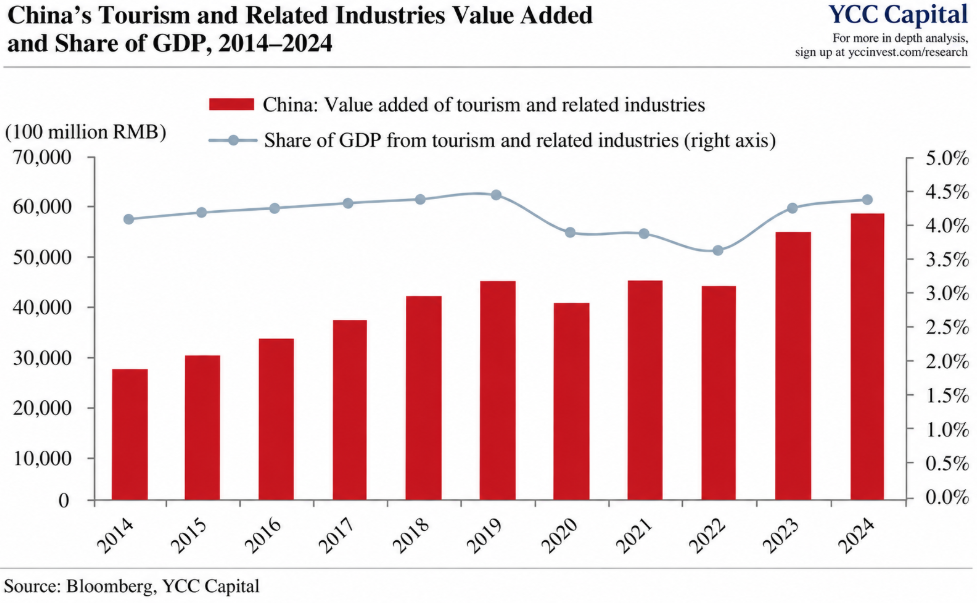
YCC CAPITAL Emerging Markets & China Strategy October 8, 2026 MACRO RESEARCH | CHINA CONSUMPTION & STRUCTURAL REFORM Executive Perspective: Crowded Destinations, Cautious Wallets China’s tourism economy presents a striking paradox: more people are traveling, yet each journey is generating less spending. Railway stations are crowded, highways are congested, and popular destinations attract millions of visitors. But beneath the excitement, the financial picture is considerably less encouraging. During October 1–5, 2026, China recorded approximately 1.55 billion cross-regional passenger movements, up just 0.8% year over year. The numbers demonstrate that Chinese households retain an appetite for leisure. What remains uncertain is their willingness and ability to translate that appetite into sustained discretionary expenditure. We see this as a revealing symptom of China’s broader economic imbalance: strong supply capacity confronting structurally constrained household demand. Tourism is no longer simply a leisure industry. It has become a useful barometer of household confidence, institutional efficiency, and the limitations of China’s domestic-demand strategy. Our central conclusion is that China does not lack tourists. It lacks the conditions necessary to turn tourism into durable, profitable consumption. 1. Tourism Is Expanding, but Its Economic Yield Is Weakening In 2025, domestic tourism reached 6.52 billion trips, an increase of 16.2% from the previous year and above the 6.01 billion recorded in 2019. Average annual travel frequency rose to approximately 4.6 trips per person, compared with 4.3 before the pandemic. Yet domestic tourism revenue increased only 9.5%, substantially slower than visitor volumes. Average expenditure per trip declined to RMB966, from RMB1,024.8 in 2024 and RMB1,004.6 in 2023. This divergence matters. A growing number of transactions does not necessarily translate into stronger economic value creation. Consider a family that previously spent three nights at a destination but now chooses a one-day excursion. The family still contributes to visitor statistics, but its spending on hotels, restaurants, entertainment, and shopping may decline dramatically. China’s tourism sector increasingly resembles a busy restaurant where every table is occupied but customers order less. The industry remains economically significant. Tourism and related activities generated approximately RMB5.9 trillion in value added in 2024, equivalent to 4.35% of GDP, an increase of 0.11 percentage points from 2023. At the end of 2024, cultural and tourism organizations employed 4.631 million people, including 1.653 million directly employed at A-rated tourist attractions. Nevertheless, employment capacity and economic potential should not be confused with profitability. The fundamental challenge is improving spending intensity, overnight stays, repeat visitation, and commercially sustainable services. 2. Three Consumer Trends Are Reshaping the Market More Frequent Travel, Less Concentrated Demand Tourism is gradually becoming part of everyday life rather than an activity reserved for major holidays. In 2025, travel during the five principal holiday periods totaled approximately 1.95 billion trips, representing 29.9% of annual domestic tourism, down from 33.3% in 2024. Weekend travel is increasingly important. In 2023, weekends accounted for just 28.6% of calendar days but generated 41.1% of domestic tourism trips. This creates opportunities for regional hospitality and entertainment businesses, but shorter journeys can constrain expenditure per visit. The Rise of Short-Distance Tourism In 2024, approximately 74.9% of domestic tourist movements occurred within travelers’ home provinces. Regional concentration was especially pronounced in major metropolitan clusters: 83.5% of Shanghai’s urban visitors originated in the Yangtze River Delta, 60% of Beijing’s came from the Beijing–Tianjin–Hebei region, and 90% of Guangzhou’s came from the Pearl River Delta. China’s transport infrastructure supports this pattern. By the end of 2025, high-speed railway mileage exceeded 50,000 kilometers, while charging infrastructure covered 98.8% of expressway service areas. Better connectivity reduces travel costs, but it also makes same-day returns easier, limiting hotel demand and overnight consumption. Increasingly Fragmented Consumer Preferences China’s tourism market is dividing into distinct demographic segments. Generation Z, representing approximately 280 million people, increasingly prioritizes concerts, sporting events, cultural experiences, and social engagement. Travelers aged 34 or younger accounted for nearly 80% of bookings associated with festivals, performances, exhibitions, and sporting events in one major travel-platform study. In 2025, large commercial performances generated RMB32.45 billion in ticket revenue. Their estimated spillover effect was substantial: every RMB1 of ticket sales was associated with approximately RMB6.85 of additional spending, generating more than RMB220 billion in related consumption. Middle-aged households emphasize safety, quality, family experiences, and educational travel. The 1981–1994 birth cohort recorded average household tourism expenditure of RMB5,223 per person, the highest among the surveyed generations. Older consumers increasingly favor wellness, cultural tourism, and off-peak travel. Flight bookings among travelers aged 55–70 rose 52% in the week following the 2025 National Day holiday compared with the holiday period. These differences suggest that standardized destination development is becoming less effective. Operators must understand specific customers rather than merely maximize visitor numbers. 3. China’s Tourism Economy Has a Monetization Problem Tourism demand is not translating efficiently into hospitality revenue. In 2025, the average room rate at star-rated hotels declined 3.1% to RMB360.2, while occupancy fell 2.4 percentage points to 46.8%. This suggests that higher visitor traffic is not necessarily creating stronger accommodation demand. Tourism destinations also remain heavily dependent on basic services such as transportation, parking, food, and admission-related activities. Although admission fees represented only 18.3% of tourist-attraction operating revenue in 2023, the transition toward higher-value experiences remains incomplete. A destination that charges separately for shuttle buses and parking has increased its revenue opportunities. It has not necessarily created a compelling reason for visitors to stay longer or return. Repeat visitation is particularly important. Shanghai Disney Resort reported an 85% intention to revisit among its 2023 visitors, illustrating the commercial advantages of continuously refreshed experiences and recognizable intellectual property. International tourism exposes another weakness. China ranked eighth globally in the World Economic Forum’s 2024 Travel and Tourism Development Index and possessed 60 World Heritage sites by the end of 2025. Yet international visitors represented only 13.2% of approximately US$1.025 trillion in combined domestic and international visitor spending in 2025, compared with roughly 30% in established destinations such as France and Italy. China also recorded approximately US$253.8 billion in travel-service imports against just US$55.2 billion
China’s Growth Engine Is Losing Traction: Oil, Property and the Consumer Squeeze
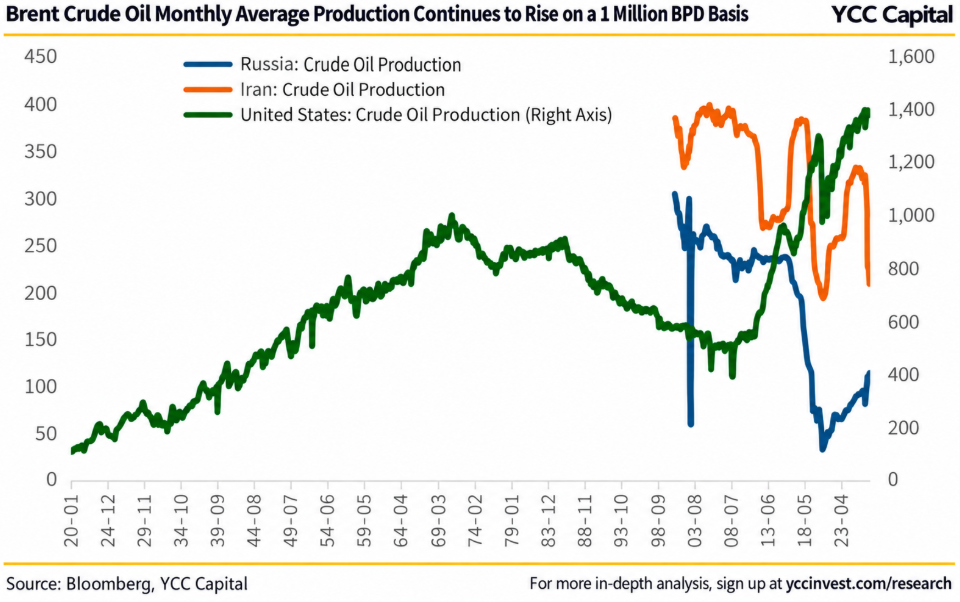
YCC CAPITAL Emerging Markets & China Strategy October 2, 2026 China’s August data present a familiar but increasingly uncomfortable picture: industrial production retains pockets of strength, especially in advanced manufacturing, while property, household credit demand, employment and consumption remain conspicuously weak. The economy is not falling off a cliff. The more important problem is that several of its traditional transmission mechanisms are no longer working with their old force. For investors, we see four macro variables worth watching. Oil is unlikely to sustain a move above $150 per barrel; China’s industrial output should remain positive but faces increasing pressure; the property downturn has not yet reached a convincing investment inflection point; and softer employment conditions, slowing money growth and restrictive global financial conditions continue to constrain Chinese consumption. Recent U.S.-China talks have reduced some near-term trade friction, including a $30 billion reciprocal tariff-reduction arrangement and a new bilateral AI dialogue. These are useful stabilizers, but they do not resolve China’s domestic demand and balance-sheet problems. Investing.com Oil: $150 Looks More Like a Tail Risk Than a Base Case Oil has remained elevated around $90–100 per barrel amid supply disruption associated with the U.S.-Iran conflict and a stronger U.S. economy. Yet we see limited scope for crude to establish a sustained move above $150 between late 2026 and 2027. The reason is straightforward: very high oil prices eventually become their own demand-destruction mechanism. Consumers can absorb expensive fuel for a while, just as a household can temporarily tolerate a larger electricity bill. But if that bill stays high month after month, discretionary spending adjusts. At the global level, sustained triple-digit oil prices similarly erode real income and ultimately reduce petroleum demand. Supply is also responding. Venezuela’s monthly crude production rose progressively from above 1 million barrels per day between April and August, reaching its strongest level since early 2019. U.S. crude production remained above 13.5 million barrels per day and generally trended upward. Saudi production, after falling sharply from 10.112 million barrels per day in February to 7.626 million in March and 6.755 million in April, subsequently recovered to 7.276 million barrels per day in August. This matters because the longer elevated prices persist, the stronger the incentive for producers outside the Persian Gulf disruption zone to fill the gap. The monetary-policy implication is also important. If oil fails to make another dramatic upward move, U.S. inflation pressure should become less acute into 2027. That would reduce the need for additional Federal Reserve tightening after the first quarter, although historical experience argues against expecting an immediate pivot from tightening to easing. Our base framework therefore allows for restrictive U.S. rates to persist, with the next easing cycle potentially not beginning until late 2027. For the United States, that represents a difficult but manageable adjustment rather than an inherently recessionary outcome. For China, however, high global rates arrive at an awkward moment because domestic demand is already fragile. Industry Is Holding Up—but the Headline Conceals the Divide August industrial production increased 5.2% year over year, beating the 4.7% expectation and improving from 4.5% previously. Month-over-month production rose 0.54%, the strongest August sequential reading in nearly three years. Year-to-date industrial production growth held at 5.3%. Manufacturing was the principal support. Manufacturing value-added growth accelerated to 6.1%, while mining remained weak at -1.4%. Electricity, gas and water production and supply increased 4.9%. The brightest spot remains high technology. High-tech industrial value added expanded 16.7% year over year in August, marking a seventh consecutive month of double-digit growth and one of the strongest readings since 2021. But investors should resist extrapolating that strength indefinitely. Historically, China’s high-tech manufacturing PMI has tended to lead high-tech industrial output. Previous PMI troughs led corresponding industrial-output troughs by roughly four to eight months. With U.S. monetary conditions tightening at already elevated interest-rate levels, the external financial backdrop is becoming less supportive for capital-intensive and duration-sensitive technology investment. The September U.S.-China summit created some sector-specific relief. The two governments agreed to establish an AI dialogue, with another exchange scheduled for November, alongside an AI-incident communication channel. They also endorsed a reciprocal tariff-reduction arrangement covering $30 billion of trade. State Council of China We view these developments as tactical positives rather than a change in China’s broader macro trajectory. Improved trade communication cannot by itself repair weak household demand, property balance sheets or subdued credit appetite. Industrial growth can therefore remain respectable while becoming progressively harder to sustain. Property Has Not Found Its Floor Property remains the clearest structural drag. Cumulative real-estate development investment fell 19.9% year over year through August, deteriorating another 0.7 percentage point and reaching the weakest reading since the data series began in 1999. Investment growth has now remained negative for 49 consecutive months. Sales offer little evidence of a durable reversal. Floor area sold fell 12.1% year over year on a cumulative basis, worsening for a fourth consecutive month. Sales value declined 13.0%. Unsold floor area, by contrast, decreased 1.1%, suggesting some inventory improvement. Yet falling inventory is not enough when new demand remains weak. Household borrowing makes the problem particularly visible. New medium- and long-term household loans were -RMB82.2 billion in August, RMB102.2 billion weaker than a year earlier. Cumulative January-August borrowing was only RMB18.8 billion. Both readings were extraordinarily weak relative to the history of the series. Personal mortgage funding available to property developers also remained deeply negative, declining 22.4% year over year through August. In everyday terms, developers can discount apartments and banks can advertise mortgages, but the transaction still requires a household willing to sign a 20- or 30-year commitment. That willingness remains scarce. One useful turning-point indicator is second-hand home prices across China’s 70 major cities. Their year-over-year decline narrowed to 5.1% in August, the best reading in roughly 30 months. First-tier cities were comparatively stronger at -2.7%, versus -4.9% in second-tier cities and -5.6% in third-tier cities. We would treat an eventual return to positive year-over-year resale-price growth—particularly if it spreads from first-tier into second-tier cities—as an important confirmation
China’s Trade Boom Has a Narrow Foundation AI Hardware, Price Inflation, and the Risks Hidden Behind 25% Export Growth
YCC CAPITAL Emerging Markets & China Strategy September 10, 2026 YCC Capital Perspective China’s August trade numbers look spectacular at first glance. Exports surged 25.0% year over year to $401.44 billion, imports climbed 28.2% to $282.36 billion, and the monthly trade surplus reached $119.09 billion. Yet this is one of those macro prints where the headline tells only half the story. The underlying picture is considerably less comfortable. Much of the acceleration is concentrated in AI-related electronics, semiconductors, computing equipment, and selected capital goods. Meanwhile, traditional exports are growing much more slowly, European demand is weak, and some of the strongest technology categories are being driven primarily by higher prices rather than rising shipment volumes. In everyday life, there is a difference between earning more because you sold twice as many products and earning more because the same product suddenly became twice as expensive. China’s current trade boom increasingly resembles the latter. That distinction matters because price-led growth can look extraordinary right up until pricing power fades. Headline Strength Is Real, but the Base Is Narrow August exports rose 25.0% year over year, accelerating from 23.9% in July. For January through August, exports increased 19.4%, compared with 18.5% during the first seven months of the year. Three forces contributed to the strong result. First, comparison effects were unusually favorable. Exports had risen only 4.2% in August 2025, mechanically magnifying this year’s year-over-year reading. Second, global manufacturing activity remained resilient while the AI investment cycle continued to support demand for semiconductors and computing hardware. Global manufacturing PMI edged higher from 52.1 to 52.3 in August. China’s position within the Asian electronics supply chain therefore continued to generate substantial export value. Third, earlier port disruptions created some temporary catch-up. Operations at major eastern Chinese ports, including Shanghai and Ningbo-Zhoushan, normalized after weather-related interruptions, allowing previously delayed cargo to move through the system. None of these supports should be dismissed. But neither should they be extrapolated mechanically into 2027. AI Is Carrying an Increasing Share of the Load Technology exports dramatically outperformed the aggregate. Integrated-circuit export value jumped 129.8% year over year. Automatic data-processing equipment exports rose 76.5%, mobile phones increased 29.6%, and automobiles and chassis climbed 43.0%. Refined petroleum-product exports increased 80.5%. Traditional manufactured goods were far less dynamic. Toy exports increased 15.3%, footwear 11.4%, and luggage 11.1%, all substantially below the overall 25.0% export growth rate. Ceramic products fell 25.7%. Geographically, exports to the United States rose a striking 34.4%, up sharply from 17.0% in July. Exports to South Korea increased 49.3%, Russia 38.7%, and ASEAN 30.2%. Europe is the obvious weak link. Exports to the European Union grew only 6.6%, down from 16.0% in July. The divergence reinforces our view that China is not experiencing a broad-based renaissance in external demand. Rather, unusually strong performance in a limited number of products and markets is carrying the aggregate number. The Semiconductor Numbers Deserve More Scrutiny The most important statistic in the August trade data may not be 25.0%. Integrated-circuit export value increased 129.8%, yet export volume declined 7.9%. Implied export prices therefore rose roughly 149.7%. That is an extraordinary divergence. It suggests that China’s semiconductor export boom is being powered by a changing product mix, tight supply in higher-end components, and sharply higher unit values rather than an equivalent expansion in physical demand. This does not mean AI demand is collapsing. Higher-value chips can legitimately generate much greater revenue without requiring proportional volume growth. But from a macro perspective, value growth driven by price is inherently less reassuring than synchronized growth in both prices and quantities. For China to demonstrate that the current external-demand cycle has truly broadened, we would prefer to see today’s “lower volume, higher price” pattern evolve into rising volumes alongside firm pricing. Until then, the headline numbers deserve a meaningful discount. Source: Bloomberg, YCC Capital Imports Tell the Same AI Story August imports reached $282.36 billion, increasing 28.2% year over year, up from 27.6% in July. January-August imports rose 26.9%. Again, the strength was heavily concentrated. Imports of automatic data-processing equipment surged 209.1%. Integrated-circuit imports increased 83.6%, while electrical and mechanical-product imports climbed 51.7%. Imports from South Korea jumped 108.1%, consistent with aggressive semiconductor procurement and continued investment throughout the AI hardware chain. Commodity imports were more mixed. Coal and lignite imports increased 48.6%, unwrought copper 28.5%, and copper ores and concentrates 24.7%. Energy told a different story. Crude-oil imports fell 8.8%, while refined-product imports declined 13.4%. Restrictions affecting traffic through the Strait of Hormuz, elevated tanker freight rates, and longer transit times constrained arrivals from the Middle East. Automotive imports were also weak. Automobile and chassis imports fell 32.4%, while auto-parts imports dropped 34.6%. Imports from India increased 49.5%, Russia 47.0%, ASEAN 35.0%, and the United States 17.8%. Imports from the European Union grew only 0.7%. Again, this is not the profile of a broadly accelerating domestic economy. It looks much more like concentrated industrial procurement centered on electronics, AI infrastructure, and selected raw materials. The Fourth Quarter Gets Harder We expect export growth to remain comparatively firm in the near term, but the arithmetic becomes less forgiving as the fourth quarter progresses. The favorable base effect will diminish because China’s AI-related trade acceleration began gaining momentum in late 2025. That means increasingly difficult year-over-year comparisons. The second risk is profitability. The global AI investment cycle currently follows a familiar chain: financing supports capital expenditure, capital expenditure builds computing capacity, and that capacity eventually has to produce sufficient revenue and cash flow to justify the investment. The spending side of that equation has moved much faster than the profit side. For the current cycle to remain durable, hyperscalers and major technology companies need to keep raising AI capital-expenditure guidance, data-center occupancy and GPU utilization must remain high, and AI applications must generate sufficient revenue to cover depreciation, electricity, infrastructure, and financing costs. China is particularly exposed to any interruption in this chain because so much of its recent trade acceleration is concentrated in precisely those
China’s Export Engine Is Roaring, but the Domestic Economy Is Still Idling
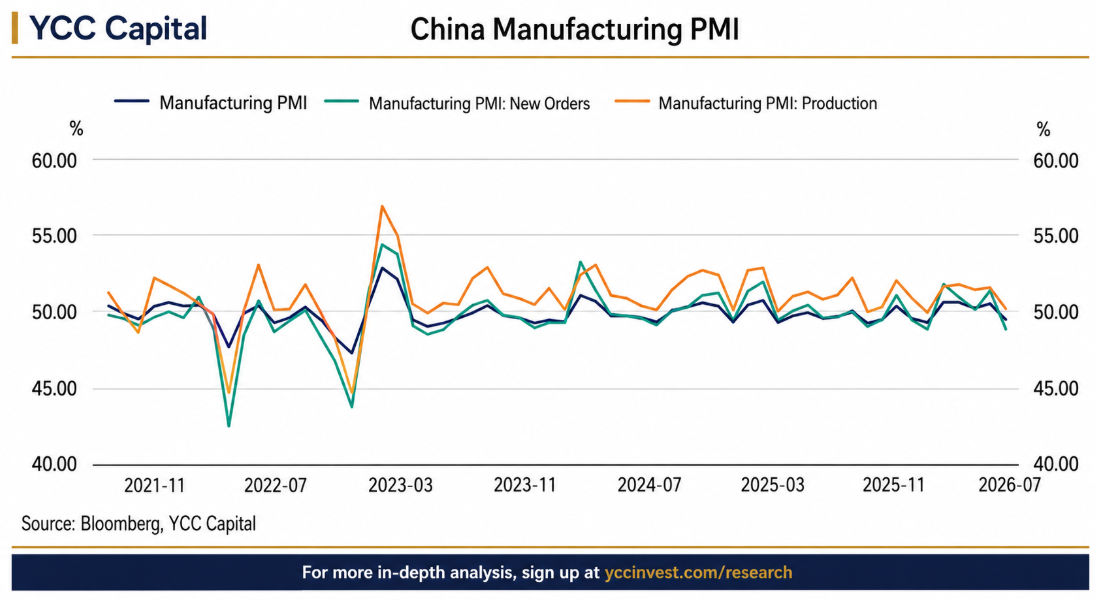
YCC CAPITAL Emerging Markets & China Strategy August 19, 2026 China’s July data tell a remarkably consistent story: the economy is producing more effectively than it is consuming, exporting more convincingly than it is investing, and generating industrial momentum without generating comparable confidence at home. The result is an increasingly pronounced K-shaped economy. Export-oriented technology and AI-linked manufacturing remain energetic, while property, private investment, household credit demand, and discretionary consumption remain weak. For investors, the distinction matters. Strong headline trade numbers should not be mistaken for a broad-based domestic recovery. China can continue winning export orders while households remain cautious, developers retrench, and private businesses hesitate to borrow. That is exactly what the July data suggest. Manufacturing Momentum Slips Below the Surface China’s manufacturing PMI fell to 49.2 in July, down 1.1 percentage points from June and below the 50 threshold separating expansion from contraction. The deterioration was broad-based. PMI readings for large, medium-sized, and small enterprises stood at 49.5, 49.7, and 47.4, respectively. The production index declined to 49.9, while new orders fell more sharply to 48.5, a 2.7-point monthly decline. Raw-material inventories remained subdued at 48.3. Employment improved modestly to 49.0, but that was not enough to offset the broader weakening in demand. Non-manufacturing activity was similarly soft. The business activity index fell to 49.0, with construction at 47.0 and services at 49.3. This is the central tension in China’s economy today: factories retain significant productive capacity, but the domestic order book is not keeping pace. It is the economic equivalent of a restaurant with a fully staffed kitchen and plenty of ingredients, but too many empty tables. Inflation Is Being Imported More Than Created at Home Consumer inflation remained subdued. July CPI rose 0.5% year over year and declined 0.1% month over month. Food prices fell 1.5% from a year earlier, while non-food prices rose 0.9%. Services inflation was firmer at 0.7%, but goods pricing remained restrained. Pork prices fell 13.3% year over year, contributing to a 6.0% decline in livestock-meat prices. Housing-related consumer prices declined 0.3%. Producer prices told a different story. PPI rose 3.5% year over year, although it declined 0.7% sequentially, while industrial input prices increased 5.5% from a year earlier. Energy, petrochemicals, coal and non-ferrous metals provided much of the inflationary lift, while AI-related investment supported pricing in electronics, computers and communications equipment. The gap between stronger producer inflation and muted consumer inflation is revealing. China does not currently have a classic demand-driven inflation problem. Instead, higher upstream prices are colliding with weak downstream pricing power. Companies can face rising costs without having sufficient consumer demand to pass them on. Trade Remains the Brightest Part of the Picture China’s external sector remained exceptionally strong in July. Total imports and exports reached $683.2 billion, up 25.3% year over year. Exports rose 23.9% to $397.85 billion, while imports increased 27.5% to $285.35 billion, producing a trade surplus of $112.5 billion. Technology-linked trade was particularly powerful. Integrated-circuit exports increased 116.6%, following a 121.9% rise previously, while exports of automatic data-processing equipment and components climbed 67.4%, accelerating from 53.1%. Exports to major markets also remained firm. During the first seven months of the year, exports to the United States increased 17.0%, exports to the European Union rose 16.0%, shipments to ASEAN economies expanded 38.4%, and exports to Japan advanced 14.0%. We remain cautious about extrapolating this strength indefinitely. China’s export performance is increasingly dependent on global capital expenditure, especially the AI infrastructure cycle, while its domestic economy remains unable to provide an equivalent second engine. Our base case for the United States remains cautiously constructive, which should support external demand, but any moderation in U.S. or global technology investment would expose how dependent China has become on foreign rather than domestic momentum. Credit Data Show a Confidence Problem At the end of July, outstanding aggregate social financing reached RMB463.27 trillion, up 7.4% from a year earlier. Yet the composition remains weak. During the first seven months of 2026, aggregate social financing increased by RMB22.25 trillion, RMB1.74 trillion less than during the same period last year. RMB loans to the real economy increased by RMB10.17 trillion, but that was RMB2.14 trillion less than a year earlier. Household borrowing was particularly weak. Household loans fell by RMB460.3 billion in July, including a RMB340.0 billion decline in short-term loans and a RMB120.2 billion decline in medium- and long-term loans. That combination points directly to soft consumer borrowing and weak mortgage demand. Corporate lending was also subdued. Corporate loans declined by RMB130 billion during the month, including declines in both short- and medium-to-long-term borrowing. Money growth reinforces the message. M2 increased 7.7%, while M1 rose only 4.0%, leaving an M1-M2 gap of -3.7 percentage points. Liquidity exists, but willingness to deploy it remains limited. Consumption and Investment Continue to Lose Altitude Industrial value added increased 4.5% year over year in July and 5.3% during the first seven months. Consumption was far less impressive. Retail sales rose just 0.6% in July and 1.2% during January-July. Weakness was concentrated in economically sensitive categories. Automobile sales fell 17.0%, building materials dropped 14.2%, furniture declined 8.8%, petroleum products fell 7.6%, and household appliances decreased 1.9%. Fixed-asset investment fell 6.7% during the first seven months. Private investment declined 9.4%, manufacturing investment fell 1.7%, infrastructure investment declined 3.6%, and investment in electricity, heat, gas and water supply contracted 5.3%. These are not the fingerprints of an economy entering a vigorous private-sector expansion. They are the fingerprints of businesses and households still protecting balance sheets. Property Is Stabilizing Only in the Loosest Sense Property remains the most important domestic drag. Real-estate development investment fell 19.2% during January-July, with residential investment down 19.1%. New-home sales area fell 11.8%, while sales value declined 13.1%. Construction activity remained even weaker: floor space under construction dropped 12.7%, new starts fell 24.0%, and completions declined 23.2%. Inventory offered one modestly better signal. Commercial housing available for sale totaled 759.11 million square meters at the end of July, down 0.8% year over year.

Beijing’s Housing Reset: Policy Can Stabilize Transactions, But China’s Property Repair Remains Fragile
YCC CAPITAL Emerging Markets & China Strategy August 17, 2026 China’s housing market is beginning to show a familiar late-cycle pattern: transaction activity is trying to stabilize before confidence has truly recovered. Beijing’s latest round of property easing is therefore important, but investors should distinguish between a stabilization of turnover and a genuine repair of the housing system. The former is increasingly plausible. The latter remains a much higher bar. For households, this distinction is intuitive. A family may decide to attend more apartment viewings because mortgage terms improve, but that does not automatically mean it has regained confidence in future income, home prices, or the broader economy. Housing markets usually turn first in activity, then in pricing, and only much later in sentiment. Beijing appears to be entering that first stage. New-Home Weakness Is Moderating, While Resale Activity Finds a Floor During August 1–7, new-home transaction area across 47 tracked cities totaled 2.181 million square meters, down 34.6% from the previous week and 18.4% from a year earlier. The headline remains weak, although the pace of deterioration appears to be slowing. The divergence between city tiers remains significant. First-tier cities recorded a 31.8% year-over-year increase in transaction area, while second-tier and third-tier cities declined 32.5% and 23.2%, respectively. That contrast reinforces a broader theme we have emphasized for China: national averages increasingly conceal a highly uneven housing economy in which stronger cities can stabilize while lower-tier markets remain burdened by excess supply, weaker demographics, and poorer household confidence. The resale market is somewhat more constructive. Across 22 cities, secondary-home transaction area fell 10.5% week over week during August 1–7 but still increased 5.1% from a year earlier. Transaction volumes remained near the strongest seasonal levels seen over the past five years. Supply pressure is also easing marginally. Since the beginning of August, resale listings have declined 0.04% from end-July levels and are 0.5% lower than a year earlier. The move is small, but direction matters. A market cannot stabilize sustainably when new listings continually overwhelm transaction demand. The recent moderation suggests that the pace of forced or precautionary selling may be losing momentum. Higher-frequency activity looks stronger still. From August 1 through August 9, real-time secondary-home transactions across 26 major cities increased 19% year over year, an improvement from July’s overall performance. Source: Bloomberg, YCC Capital Beijing’s Policy Package Lowers the Friction of Buying On August 7, Beijing introduced seven measures covering purchase restrictions, housing transfers, and the housing provident fund system. The measures are designed to reduce the practical cost of entering the market rather than attempting another broad credit-driven property boom. One of the most consequential changes concerns non-Beijing households. The required period of social-security or individual-income-tax contributions for purchasing a home in the capital has been standardized at one year, eliminating the previous distinction between properties inside and outside the Fifth Ring Road. Beijing also substantially increased maximum provident-fund mortgage limits. For households in which both spouses contribute to the housing provident fund, the maximum first-home loan has doubled from RMB1.2 million to RMB2.4 million. The maximum second-home loan has risen from RMB1.0 million to RMB2.0 million. The city also adjusted the relationship between contribution history and borrowing capacity. For dual-contributor households, a contribution period of five years and one month can now qualify the borrower for the full RMB2.4 million ceiling. This matters because mortgage affordability is not an abstract variable. Imagine a young Beijing couple considering a RMB3 million resale apartment. Under the previous framework, the gap between the maximum subsidized provident-fund loan and the purchase price could feel prohibitively large. Raising the subsidized borrowing ceiling does not make the apartment cheap, but it can materially change the monthly-payment calculation. Housing decisions are often made at the kitchen table, not on a macroeconomic spreadsheet, and reducing that monthly burden can convert hesitation into a transaction. Why Beijing May See a Meaningful Near-Term Response The policy architecture resembles the seven-measure easing package introduced by Shanghai earlier this year: relax restrictions for non-local residents while reducing financing costs through more generous provident-fund lending. The timing also matters. Beijing’s package follows the Politburo’s call for stronger countercyclical policy support and arrives before the traditional September–October sales season. That sequencing gives policymakers an opportunity to amplify the impact of seasonal demand. There are five reasons Beijing may respond relatively well. First, aggregate demand has already stopped deteriorating at the pace seen last year. During the first seven months of 2026, combined new- and secondary-home transaction area in Beijing was essentially flat from a year earlier, rising approximately 0.002%. That compares with a 6.1% decline in total demand last year. Flat growth is hardly a boom, but in a prolonged property adjustment, the transition from contraction to stability is meaningful. Second, resale supply has contracted. Listings at major brokerage platforms have fallen to roughly 118,000 units, down 17% year over year and 0.1% from the previous month. Reduced inventory pressure creates a better foundation for price stabilization. Third, Beijing’s provident-fund system has unusually broad coverage. Approximately 42.7% of the city’s permanent population is eligible for provident-fund lending, the highest coverage rate among major Chinese cities. The latest increase in household borrowing capacity—up by as much as RMB1.2 million—is also larger than the RMB800,000 increase previously introduced in Shanghai. Fourth, Beijing’s resale market is dominated by practical, lower-priced purchases rather than speculative luxury demand. In July, homes priced below RMB3 million represented 49% of secondary transactions, while homes between RMB3 million and RMB5 million accounted for another 28%. Nearly four-fifths of transactions therefore occurred below RMB5 million, with the median transaction price around RMB3 million. A RMB2.4 million provident-fund mortgage can cover a substantial portion of the financing requirement for the median buyer. Fifth, transaction prices have started to rebound. Although asking prices remain under pressure, actual resale transaction prices have recovered approximately 1.9% from their recent low. This divergence suggests that Beijing’s immediate problem may increasingly be one of confidence and liquidity rather than a complete absence of
China’s Growth Engine Is Losing Altitude: Exports Still Fly, But Domestic Demand Is Running on Empty
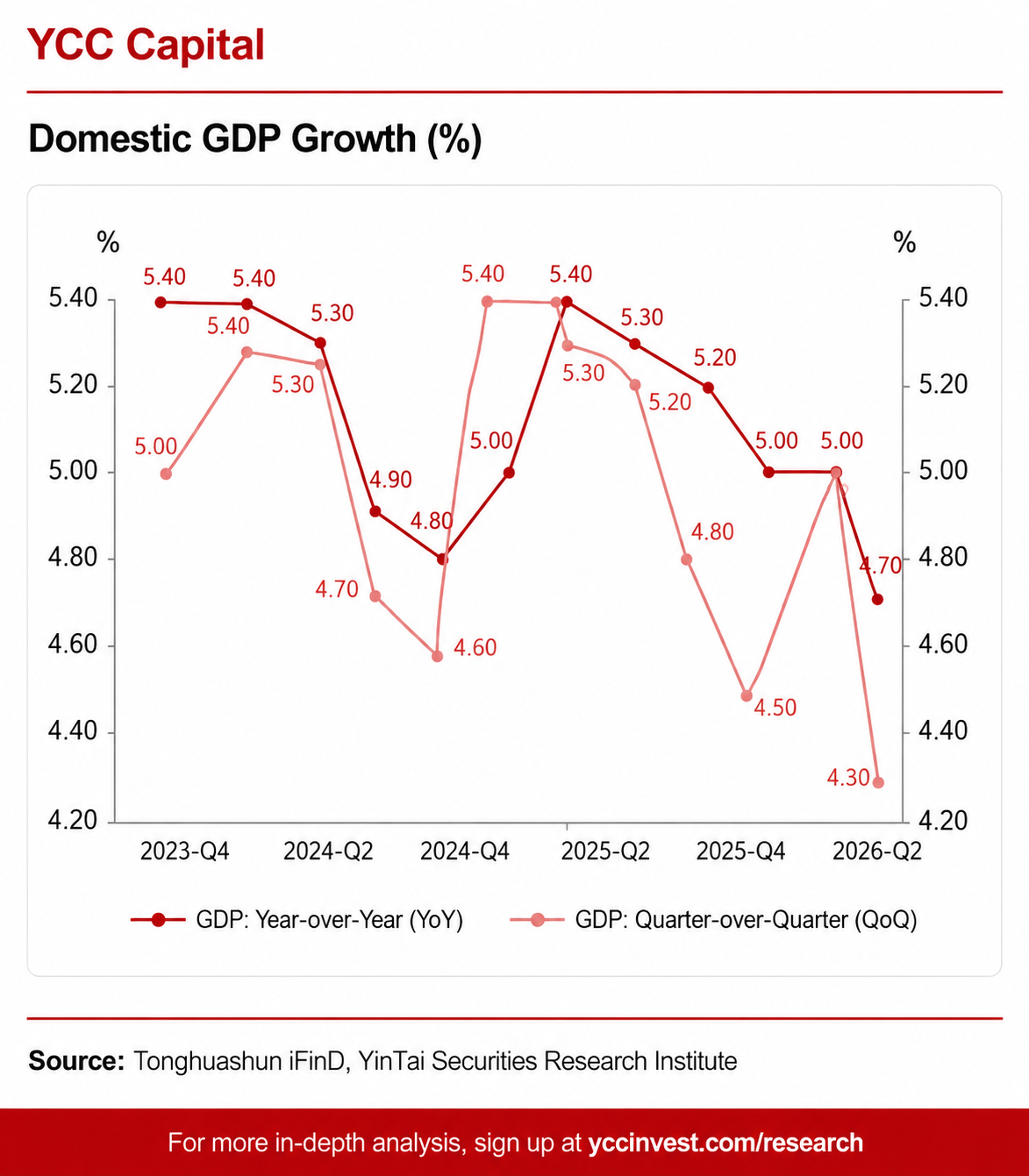
YCC CAPITAL Emerging Markets & China Strategy July 27, 2026 Executive Summary A traveler can coast downhill for a surprisingly long distance even after stopping the pedals. China’s economy today resembles that rider. Export momentum continues to provide forward motion, industrial production remains resilient, and high-end manufacturing still attracts attention. Yet beneath the surface, the domestic engines that ultimately determine sustainable growth—household consumption, private investment, and property activity—continue to lose strength. China reported first-half GDP growth of 4.7% year-over-year, remaining technically within the government’s official target range. However, the composition of growth has become increasingly unbalanced. Second-quarter GDP slowed sharply to 4.3%, the weakest quarterly expansion in more than three years and below market expectations. While exports continue to surprise on the upside, domestic demand is clearly deteriorating. Consumption remains subdued, fixed asset investment has weakened further, manufacturing investment is fading, infrastructure spending is losing momentum, and the real estate downturn continues despite tentative stabilization in housing prices. At YCC Capital, we believe the headline numbers increasingly mask a deeper structural reality. China is becoming more dependent on external demand precisely when geopolitical fragmentation and trade tensions are making export-led growth less reliable over the medium term. The policy challenge is no longer simply generating growth—it is rebuilding confidence across households and private enterprises. That objective remains far more difficult than delivering incremental fiscal or monetary easing. Our base case is that Beijing will continue introducing targeted policy support during the second half of the year. However, because official GDP growth remains close to target, authorities are unlikely to launch another large-scale stimulus package comparable to previous cycles. Instead, policymakers will prioritize accelerating implementation of existing measures while attempting to stabilize consumption and investment. In our assessment, these measures are likely to soften—but not reverse—the underlying structural slowdown. Sources: Bloomberg, YCC Capital. China’s Economy Remains Within Target, But Momentum Has Clearly Softened According to the National Bureau of Statistics, China’s economy expanded 4.7% year-over-year during the first half of 2026. Quarterly data, however, reveal a much more concerning trajectory. First-quarter GDP grew 5.0%, while second-quarter growth slowed to 4.3%, with quarter-on-quarter growth of only 0.9%. Although the annualized pace technically remains within the government’s stated target range of approximately 4.5%–5.0%, investors should avoid focusing solely on the headline. Growth quality matters far more than the aggregate figure. The slowdown was primarily driven by weakening domestic demand. Since April, exports have remained exceptionally strong, but consumer spending and investment both deteriorated materially. As a result, external demand has increasingly become the economy’s primary growth pillar—a configuration that is difficult to sustain indefinitely. From our perspective, this imbalance represents one of China’s most important macro vulnerabilities. Economies ultimately cannot rely forever on selling more abroad while households become increasingly cautious at home. Sources: Bloomberg, YCC Capital. Services and Technology Continue to Offset Traditional Weakness Not every component of the economy weakened during the second quarter. One encouraging development was the continued expansion of China’s service sector. The tertiary industry contributed 66.1% of total economic growth during the first half, with its contribution reaching nearly 70% during the second quarter, representing a meaningful improvement over the previous year. At the same time, newer sectors—including advanced manufacturing, digital technologies, artificial intelligence, and modern services—continued expanding rapidly. Official estimates indicate that these emerging industries contributed more than 40% of overall economic growth during the first half. Another notable development was the recovery in nominal GDP growth. Supported by modest improvements in domestic pricing, higher global commodity prices, continued AI-related investment, and Beijing’s campaign against excessive industrial price competition, nominal GDP growth accelerated to 5.9% in the second quarter. Most importantly, China’s GDP deflator turned positive for the first time in roughly three years, reaching 1.5%. While encouraging, we view this primarily as a cyclical improvement rather than evidence that China’s broader deflationary pressures have been fully resolved. Industrial Production Continues to Benefit from Robust Export Demand Industrial production remains one of the economy’s strongest-performing sectors. Industrial value-added increased 5.3% year-over-year in June, exceeding consensus expectations and accelerating from May. During the first half of the year, industrial production expanded 5.4%. The explanation remains straightforward. China’s exports, measured in U.S. dollars, surged 27.0% year-over-year in June, while export deliveries by industrial enterprises increased 14.8%. Strong overseas demand continues providing manufacturers with sufficient orders despite weakening domestic conditions. This divergence has become increasingly visible across industrial sectors. Manufacturing output rose 6.0%, significantly outperforming mining, which contracted 2.2%, partly reflecting stricter mine safety inspections following recent accidents. Utilities continued expanding steadily. High-tech manufacturing remains especially impressive, growing 14.1%, substantially outperforming broader industrial production. Transportation equipment manufacturing accelerated sharply, while computer, communications, electronics, and automobile production all maintained relatively strong growth. The message is clear: China’s factories remain competitive internationally. The more difficult question is whether overseas demand can continue carrying the broader economy if domestic demand continues weakening. Consumer Spending Shows Only Modest Signs of Stabilization June retail sales offered a modest positive surprise but remained far from robust. Retail sales increased 1.0% year-over-year, improving from May’s decline and exceeding market expectations. First-half retail sales nevertheless expanded only 1.3%, highlighting the persistent weakness in household spending. Both goods consumption and restaurant spending improved modestly during June. Excluding automobiles, retail sales increased 3.0%, suggesting that vehicle-related weakness continues weighing heavily on aggregate consumption. Several discretionary categories—including cosmetics, tobacco and alcohol, office supplies, and communications equipment—recorded stronger growth, partly reflecting favorable base effects. However, major household purchases remained soft. Sales of home appliances continued contracting, jewelry sales remained negative, and automobile sales fell 16.1%, showing virtually no improvement. Household confidence continues to face significant headwinds. When families become uncertain about employment prospects, income growth, or housing wealth, they naturally postpone large purchases. China’s consumers appear to be behaving precisely this way. This cautious mindset represents one of the biggest obstacles to achieving a durable domestic recovery. Investment Is Becoming an Increasingly Serious Concern If consumption is weak, investment looks even weaker. Fixed asset investment fell 5.7% during the first
China’s Fiscal Engine Is Losing Power: Shrinking Policy Firepower Raises the Stakes for Growth
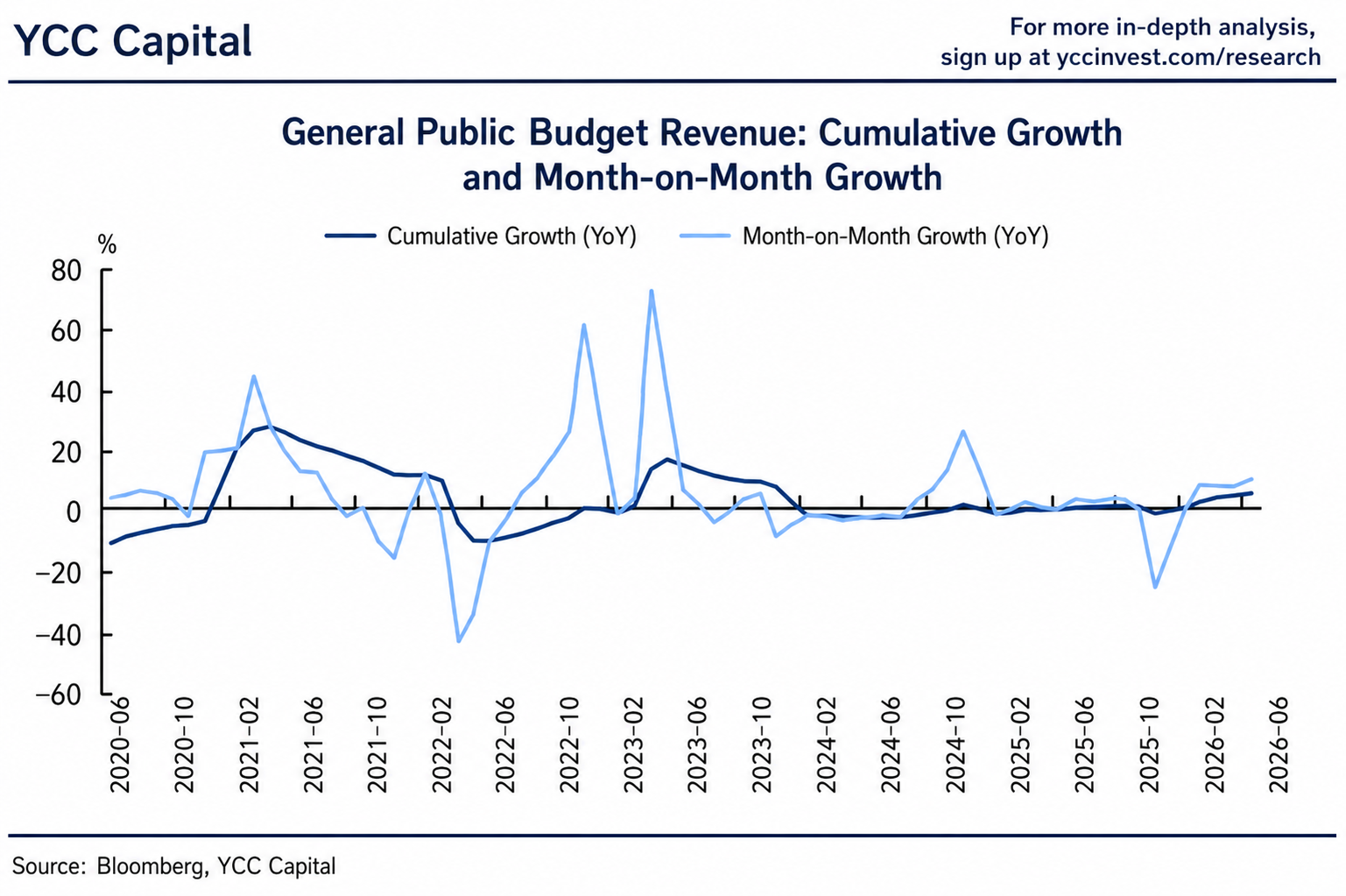
YCC CAPITAL Emerging Markets & China Strategy Date: July 24, 2026 Executive Perspective Every economy eventually reaches a moment when policymakers must decide whether to spend today to preserve tomorrow’s growth, or conserve resources at the risk of a deeper slowdown. China increasingly appears to be approaching such a crossroads. The latest June fiscal data reinforce a message that has been quietly developing throughout 2026: despite pockets of improvement in tax collections, the government’s overall fiscal impulse continues to weaken rather than strengthen. Beneath encouraging headline tax revenues lies a much more concerning story—persistent weakness in land-related revenues, slowing government fund expenditures, and a broad contraction in China’s consolidated fiscal position. At first glance, stronger corporate income tax receipts may suggest improving economic conditions. Yet a closer examination indicates that much of the improvement reflects cyclical price stabilization, stronger tax enforcement, and better profitability among a relatively narrow group of enterprises rather than a broad-based recovery in domestic demand. Meanwhile, the continued collapse of land-sale revenues—a cornerstone of local government financing for more than two decades—illustrates that one of China’s most important growth engines remains under severe structural pressure. These findings are consistent with the underlying source report’s emphasis on the divergence between the general public budget and the government fund budget. From YCC Capital’s perspective, this matters well beyond China. The country’s fiscal policy has become one of the primary determinants of commodity demand, regional capital flows, Asian corporate earnings, and global manufacturing activity. If fiscal policy continues to underdeliver, markets expecting a synchronized rebound in Chinese growth may once again be disappointed. Much like attempting to accelerate a vehicle while easing off the accelerator, fiscal policy is still providing forward momentum—but at a diminishing rate. Investors should therefore focus less on headline tax revenue improvements and more on whether government spending begins translating into real economic activity during the second half of the year. Fiscal Data Tell Two Different Stories June’s fiscal report presents an unusually sharp divergence between China’s two principal fiscal accounts. The general public budget—which captures ordinary government revenues and expenditures—showed noticeable improvement. Revenue growth accelerated, tax collections strengthened, and public expenditures returned to positive year-over-year growth after previous weakness. In contrast, the government fund budget, heavily dependent upon land sales and infrastructure-related financing, deteriorated considerably. Both revenues and expenditures contracted more sharply than in previous months, resulting in an overall decline in China’s broad fiscal support. This divergence is perhaps the single most important takeaway from the latest data. Investors focusing solely on improving tax receipts risk overlooking the far larger story unfolding within China’s financing model. The broad fiscal stance, which combines both accounts, therefore continued to weaken despite encouraging developments within the ordinary budget. According to the source report, broad fiscal expenditures fell while the fiscal policy intensity index continued to decline. General Budget Revenue Continues to Improve During the first half of 2026, China’s general public budget revenue reached approximately RMB 12.1 trillion, representing 4.7% year-over-year growth. June alone recorded an even stronger 8.7% annual increase, extending several months of steady improvement. Tax revenues grew even faster, increasing 10.8% year over year during June, marking the fourth consecutive month of robust expansion. Several factors contributed to this acceleration. First, producer prices have stabilized after prolonged weakness, mechanically lifting tax collections. Second, corporate profitability improved modestly across parts of the industrial sector. Third, tax administration and collection efforts appear to have become more effective, increasing compliance and boosting realized revenue. Importantly, these developments should not necessarily be interpreted as evidence of a broad domestic demand recovery. Tax receipts can improve for reasons unrelated to expanding household consumption or stronger private investment. Indeed, the composition of revenue growth suggests a recovery that remains highly uneven. Corporate Taxes Strengthen While Consumption Remains Uneven Among major tax categories, corporate income tax delivered the strongest improvement. Corporate income tax surged nearly 30% year over year, becoming the largest contributor to total tax revenue growth. Personal income taxes also remained relatively robust, reflecting continued labor income resilience among higher-income households. Securities transaction stamp duties likewise maintained elevated growth, supported by healthy trading activity in China’s equity markets. However, several consumption-related taxes painted a less encouraging picture. Value-added tax growth slowed compared with previous months, while consumption tax revenues continued to contract. Real estate-related taxes remained deeply negative, including property taxes and farmland occupation taxes, underscoring ongoing weakness throughout China’s property sector. This divergence illustrates one of the defining characteristics of China’s current recovery: isolated pockets of resilience coexist alongside persistent structural weakness. Corporate profitability may be stabilizing, but household demand and property-related activity continue to lag considerably. Government Spending Recovers—but Not Where Markets Want It On the expenditure side, June marked an improvement after previous softness. General public budget expenditures increased 4% year over year, reversing earlier declines. Yet the composition of spending deserves closer attention. The strongest gains occurred within social and livelihood-related categories. Education spending improved. Healthcare expenditures remained solid. Social security and employment spending accelerated significantly. These categories collectively accounted for most of June’s expenditure rebound. Infrastructure spending, however, remained notably restrained. Transport investment improved modestly. Urban development spending stabilized. Agricultural and water-related expenditures, traditionally important drivers of rural investment, continued to contract and remained among the largest drags on total spending. Environmental protection expenditures also remained weak. For investors hoping for an aggressive infrastructure-led stimulus similar to earlier cycles, the latest data offer limited evidence that such a strategy has yet materialized. The source report specifically notes that infrastructure-related spending had not yet become the primary growth driver despite improvement in overall expenditures. China’s Property Downturn Continues to Reshape Public Finance Perhaps no figure better captures China’s ongoing structural adjustment than land-sale revenue. Government fund revenue declined over 30% during June, while land-sale income itself plunged more than 40% compared with a year earlier. During the first half of 2026, land-sale revenues totaled approximately RMB 978 billion, falling below RMB 1 trillion for the first time since comparable monthly records began in
China’s Debt Reckoning Inside Beijing’s Expanding Government Balance Sheet and the Limits of Fiscal Firepower
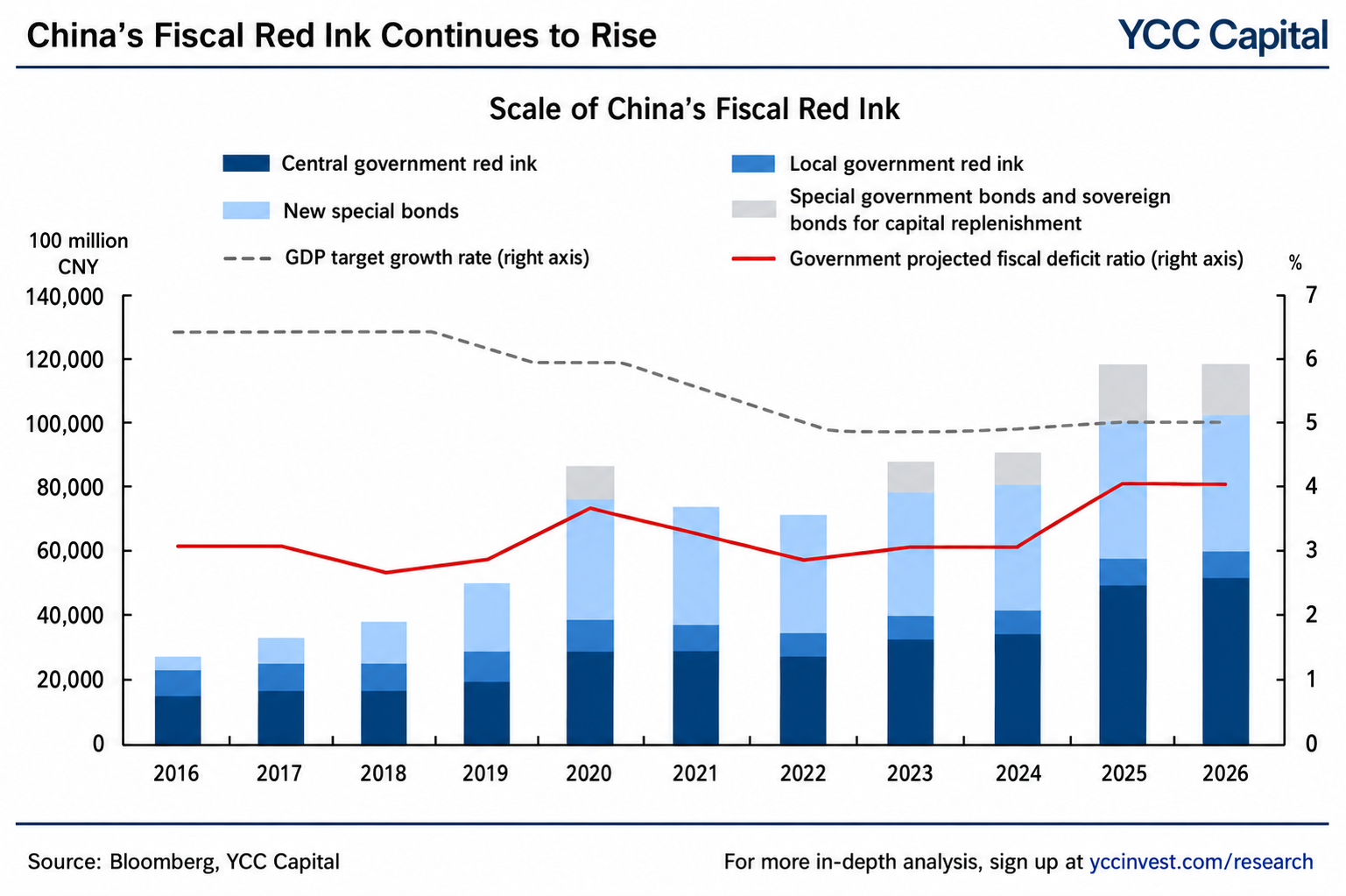
YCC CAPITAL Emerging Markets & China Strategy 22 July 2026 YCC Capital Perspective Every economic cycle eventually arrives at a moment when policymakers have to answer a deceptively simple question: if growth slows and the private sector refuses to borrow, who steps in? For China, the answer has increasingly become the government. Over the past five years, government borrowing has transformed from a supporting policy instrument into the dominant engine sustaining economic activity. What once served as a temporary counter-cyclical buffer has gradually evolved into a structural pillar supporting demand, infrastructure investment, local government finances, and financial stability itself. Yet debt is much like borrowing time from the future. Initially it creates flexibility. Eventually it begins to reduce it. Imagine a household repeatedly refinancing its mortgage while income stagnates. Monthly cash flow remains manageable for years, but each refinancing leaves less room to absorb future shocks. China’s public finances increasingly resemble this dynamic. Borrowing continues to stabilize the present, but each additional round delivers progressively smaller gains while future obligations quietly accumulate. This report examines China’s evolving government debt architecture, the shifting balance between central and local government borrowing, and the implications for investors across fixed income, currencies and global asset allocation. Our conclusion is straightforward. China still possesses significant fiscal capacity compared with many developed economies. However, expanding debt is no longer generating the economic multiplier it once did. Fiscal policy is increasingly preventing deterioration rather than creating sustained acceleration, implying that government leverage can stabilize the economy but is unlikely to restore the high-growth model of previous decades. Executive Summary China’s government debt has entered a new phase of expansion. Outstanding government bonds now exceed RMB 100 trillion, accounting for nearly half of China’s domestic bond market. By year-end 2026, total government debt is projected to approach RMB 110 trillion, with central government bonds reaching roughly RMB 47.5 trillion and local government bonds approximately RMB 62 trillion. The rapid increase reflects persistent weakness in private-sector demand. Household deleveraging, subdued corporate borrowing and a prolonged property downturn have forced fiscal policy to shoulder a growing share of economic stabilization. Government borrowing now contributes more than 40% of China’s total credit expansion. Yet despite its increasing scale, its effectiveness has steadily diminished. Every additional unit of government borrowing now produces less than one-tenth of a unit of incremental GDP, compared with more than one unit before 2015. The implication is clear: China is experiencing diminishing fiscal returns. Government Debt Has Become the Backbone of China’s Credit System China’s bond market has undergone a remarkable structural transformation. Government securities—including both sovereign and local government bonds—now represent approximately 49.8% of the entire domestic bond market, totaling approximately RMB 102.1 trillion as of June 2026. This expansion has not occurred accidentally. Fiscal revenues have weakened as land sales collapsed and domestic demand softened. Meanwhile, policymakers have remained reluctant to pursue large-scale household income transfers comparable to Western fiscal responses during recent crises. Instead, Beijing has relied on debt-financed investment. This approach has allowed authorities to sustain infrastructure spending, support strategic industries, stabilize employment and contain financial risks without fundamentally changing the country’s state-led development model. However, there is an important distinction between expanding balance sheets and expanding productivity. Debt can finance bridges. It cannot guarantee traffic. Fiscal Sustainability Is Becoming Increasingly Challenging China’s government leverage ratio has now climbed above 70% of GDP, continuing an upward trajectory that has accelerated since the pandemic. The underlying drivers are straightforward. Government revenues have struggled to keep pace with spending commitments. Property-related revenues have deteriorated sharply. Land-sale income, once the cornerstone of local government finance, has fallen by more than half from its 2021 peak. At the same time, infrastructure commitments, industrial policy initiatives and debt servicing obligations have continued expanding. As a result, borrowing increasingly determines fiscal spending capacity. Instead of tax revenues financing expenditures with debt filling temporary gaps, the sequence has effectively reversed. Debt issuance increasingly determines how much fiscal spending can occur. This marks an important institutional shift. Government financing is no longer simply supporting fiscal policy. It has become fiscal policy. The Declining Efficiency of Fiscal Expansion Perhaps the most striking development is the steady deterioration in fiscal efficiency. During earlier periods of rapid urbanization and infrastructure expansion, government borrowing generated substantial economic returns. Roads connected manufacturing hubs. High-speed rail improved logistics. Utilities expanded productive capacity. Today’s environment is fundamentally different. China already possesses one of the world’s largest infrastructure networks. Demographic aging reduces housing demand. Private-sector investment remains cautious. Consumer confidence has yet to recover meaningfully. Consequently, incremental borrowing increasingly finances refinancing, debt restructuring and maintenance rather than creating entirely new productive assets. According to the report, the GDP generated per unit of new government debt has fallen below 0.1, compared with levels exceeding 1 before 2015. This is perhaps the single most important statistic in understanding China’s current macroeconomic trajectory. The country is not running out of financing capacity. It is running into diminishing economic returns. Central Government Bonds Remain Beijing’s Primary Counter-Cyclical Tool Among China’s fiscal instruments, sovereign bonds continue to serve as the central government’s principal stabilization mechanism. For 2026, net sovereign bond financing is expected to reach approximately RMB 6.7 trillion. Issuance accelerated early in the year before slowing during the second quarter, suggesting heavier supply during the second half as ultra-long special sovereign bonds and recapitalization bonds are brought to market. Special sovereign bonds occupy a unique position within China’s fiscal framework. Unlike ordinary government bonds, they finance specific strategic objectives outside the standard fiscal deficit. Historically they have funded bank recapitalizations, sovereign wealth fund creation, pandemic response measures and national strategic initiatives. Today’s issuance continues that pattern. Ultra-long bonds finance national infrastructure priorities, advanced manufacturing and strategic modernization, while recapitalization bonds strengthen the financial system. From a market perspective, sovereign bond yields continue to reflect three primary forces: First, monetary policy determines short-term funding costs. Second, economic fundamentals shape long-term expectations. Third, structural demand—including persistent demand from banks, insurers and institutional investors—continues compressing
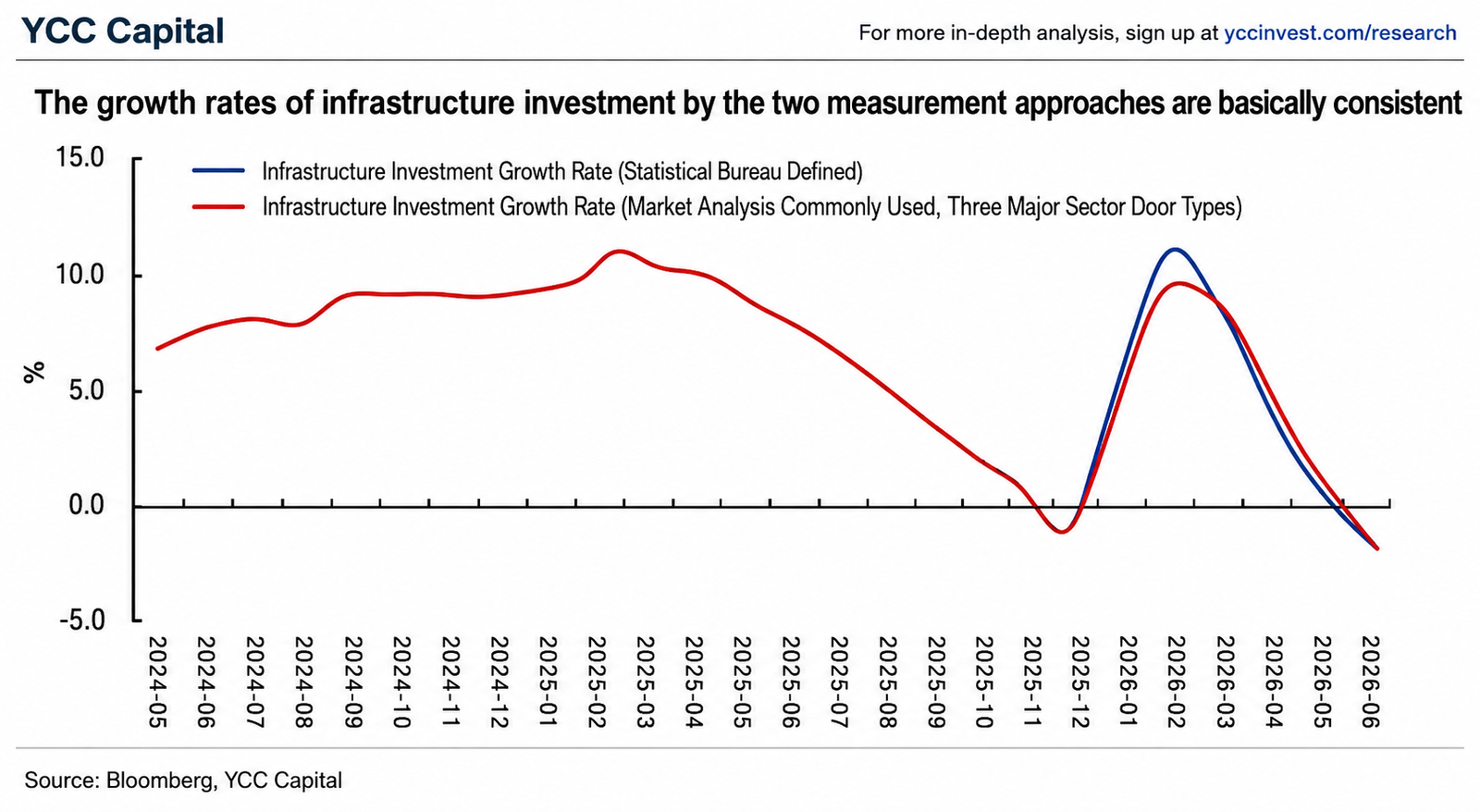
China’s Infrastructure Slowdown Is More Than a Funding Story: Why Growth Has Stalled—and Why the Second Half May Still Deliver a Tactical Rebound
YCC CAPITAL Emerging Markets & China Strategy July 20, 2026 Executive Perspective Infrastructure investment has long been one of China’s most reliable macroeconomic stabilizers. When private demand weakens or the property cycle turns lower, Beijing has historically reached for infrastructure spending as its preferred countercyclical tool. It is tangible, politically visible, and capable of supporting employment across multiple sectors. Yet the first half of 2026 tells a different story. Instead of cushioning the slowdown, infrastructure investment itself has become another weak link in China’s economy. Official statistics show infrastructure investment contracting by 2.4% year-on-year during January–June, marking one of the weakest performances since the pandemic period. For investors accustomed to Beijing deploying massive infrastructure stimulus whenever growth falters, the disappointment has been striking. The immediate explanation is straightforward: fiscal spending has been slower than expected. But that interpretation misses the larger structural shift. At YCC Capital, we believe today’s infrastructure weakness reflects three overlapping forces rather than a simple policy delay. First, China’s local governments are operating under increasingly binding fiscal constraints after years of debt accumulation. Second, policymakers are gradually reallocating public resources away from physical construction toward social expenditure and human capital investment. Third, the country’s investment opportunity set is becoming less attractive as decades of rapid urbanization leave fewer genuinely productive megaprojects to pursue. Anyone who has watched a city mature understands the analogy. Building the first subway line transforms an economy. Building the twentieth extension often produces much smaller returns. China increasingly resembles the latter case. The encouraging news is that cyclical conditions should improve in the second half of the year. Project approvals are progressing, fiscal disbursements are likely to accelerate, and comparison effects become considerably easier. Nevertheless, investors should resist interpreting a second-half rebound as evidence that China’s traditional infrastructure-driven growth model has returned. It has not. Instead, the country appears to be entering a phase where infrastructure remains an important stabilizer but no longer serves as the dominant engine of economic expansion. Infrastructure Weakness Is Broad—but Not Uniform Headline figures paint a discouraging picture, yet the underlying composition tells a far more nuanced story. Infrastructure investment has not collapsed across every category. Rather, the sector has experienced what could best be described as a K-shaped divergence, with traditional local-government-led projects weakening sharply while nationally strategic sectors continue expanding at healthy rates. This distinction matters because it reveals where Beijing still possesses both fiscal capacity and political willingness to invest. The largest drags on overall infrastructure activity have come from three sectors: Road transportation Water conservancy Public facilities management Together these categories account for more than half of China’s infrastructure investment and collectively reduced overall infrastructure growth by roughly 2.7 percentage points during the first five months of 2026. Road transportation investment declined 5.7% year-over-year, reflecting slowing construction of highways, urban rail systems and conventional road networks. Public facilities—including municipal utilities, sewage treatment systems, street lighting, parks and urban public amenities—also weakened materially. Water conservancy experienced the sharpest deterioration, falling from rapid double-digit expansion last year into outright contraction. These sectors share one common characteristic: they depend heavily on local government finances. By contrast, infrastructure projects receiving stronger central government backing continue to display considerable resilience. Investment in: Water transportation increased 23.3% Aviation infrastructure rose 21.7% Railway investment remained positive at 5.1% Telecommunications, broadcasting and satellite infrastructure expanded 16.8% The difference is revealing. Projects considered nationally strategic—high-speed rail corridors, logistics networks, digital infrastructure and communications capacity—continue receiving funding despite broader fiscal pressures. Local projects with lower strategic priority have borne the brunt of budget tightening. This divergence increasingly defines China’s infrastructure landscape. China’s Fiscal Priorities Are Quietly Changing One of the least appreciated developments in China’s public finances is not simply the amount of spending but where that spending is being directed. For decades, China’s development model overwhelmingly favored investment in physical assets—roads, bridges, industrial parks and municipal expansion. That balance has gradually begun shifting. Budget allocations increasingly prioritize healthcare, education, social security and housing support rather than traditional infrastructure construction. By 2025, these people-oriented expenditures accounted for approximately 41% of total fiscal spending, nearly six percentage points higher than in 2013. Meanwhile, expenditure categories directly associated with infrastructure—including transportation, agriculture and water resources, urban community development and environmental protection—have steadily declined as a share of overall government spending. Recent budget execution reinforces this transition. During January through May 2026: Social security expenditure rose 6.7% Healthcare spending increased 5.7% Meanwhile: Urban community spending fell 5.0% Agriculture and water spending declined 13.2% Transportation spending slipped 0.7% This shift reflects a deeper strategic calculation. China’s demographic profile is deteriorating rapidly. An aging population requires greater healthcare expenditure, pension support and social welfare commitments. At the same time, diminishing returns from additional physical infrastructure make social investment relatively more attractive. The result is an economy where fiscal policy increasingly focuses on improving household resilience rather than simply constructing additional concrete. For long-term investors, this represents an important structural evolution rather than a temporary adjustment. Fiscal Money Has Become the Decisive Variable Infrastructure investment has always relied upon multiple funding channels. These include government budget spending, financing by state-owned enterprises—particularly local government financing vehicles (LGFVs)—and private investment. Historically, LGFVs provided the dominant source of infrastructure financing. Today that picture is changing. Although direct fiscal funding represents only around one-fifth of total infrastructure investment, its importance has increased significantly since 2020 as local financing platforms face tighter borrowing constraints. Between 2020 and 2024, budget-funded infrastructure financing expanded at an average annual pace of 14.8%, almost double the average growth rate recorded during the preceding four years. This makes fiscal disbursement timing far more influential than before. Unfortunately, fiscal execution during the first half of 2026 was notably slower than planned. Infrastructure-related spending under the general public budget reached only 32.5% of the annual allocation by May, significantly below the expected schedule of 41.7%. New special bond issuance followed a similarly slow trajectory, with only 34% of the annual quota completed during the same period. The consequence was entirely
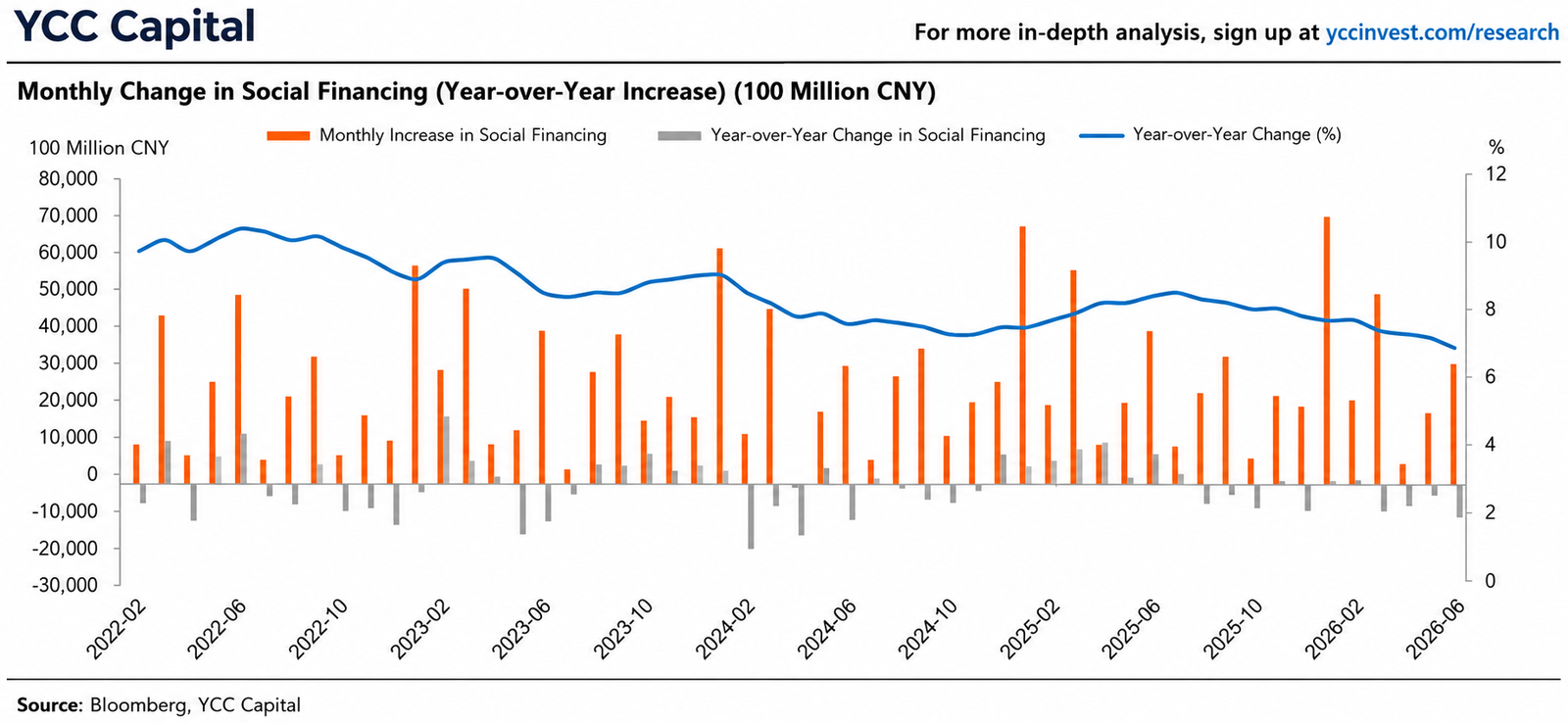
China’s Credit Engine Is Still Misfiring: Weak Financing Growth Signals a More Challenging Second Half
YCC CAPITAL Emerging Markets & China Strategy July 19, 2026 Executive Perspective Credit is often described as the lifeblood of an economy. When businesses are confident, households optimistic, and governments investing aggressively, financing flows naturally through the financial system. When confidence fades, however, even abundant liquidity struggles to find productive borrowers. China’s June financial data illustrates precisely this dilemma. Headline liquidity remains plentiful, yet the transmission mechanism from policy easing to real economic activity continues to weaken. Aggregate Social Financing (ASF) growth slowed again, corporate borrowing remained subdued, household leverage failed to recover meaningfully, and monetary aggregates softened after temporary strength earlier this year. The numbers do not point toward an imminent financial crisis. Rather, they reinforce a longer-running structural transition in which China is gradually moving away from the debt-intensive growth model that powered its economy for nearly two decades. The challenge is that no equally powerful replacement engine has fully emerged. For global investors, this distinction matters enormously. Slower credit expansion does not necessarily imply an abrupt collapse, but it does suggest that expectations for a broad-based Chinese economic reacceleration should remain restrained. While fiscal policy may cushion downside risks during the second half of the year, the underlying issues—property weakness, cautious private investment, and local government deleveraging—remain far from resolved. Just as an experienced sailor recognizes that calm seas can conceal strong undercurrents, investors should look beyond China’s headline liquidity figures to examine the quality and direction of credit creation itself. The June data suggest those undercurrents remain considerably weaker than headline policy rhetoric would imply. Aggregate Financing Continues to Lose Momentum China’s Aggregate Social Financing (ASF)—the broadest measure of credit supplied to the real economy—expanded by RMB 3.4 trillion in June, representing a decline of approximately RMB 861 billion compared with the same month last year. Outstanding ASF growth slowed further to 7.4% year-over-year, extending the gradual deceleration seen throughout recent quarters. The deterioration was not driven by a single category but reflected weakness across several major financing channels. Lower bank lending, slower government bond issuance and weaker trust lending collectively weighed on overall financing growth. Offsetting these declines only partially were stronger corporate bond issuance and increased use of bankers’ acceptances. The composition of financing is becoming increasingly important. Historically, China’s credit expansion depended overwhelmingly upon commercial bank lending. Today, direct financing through bond issuance is gradually assuming a larger role. Policymakers have repeatedly emphasized improving financing efficiency rather than simply expanding credit volumes, suggesting that slower loan growth is becoming an accepted feature of China’s evolving financial architecture. Nevertheless, structural improvement should not be confused with cyclical strength. The underlying demand for credit remains soft, indicating that both businesses and households continue to approach new borrowing with considerable caution. Corporate Credit Demand Remains Constrained Perhaps the clearest message from June’s data is that corporate confidence has yet to recover convincingly. Short-term corporate loans increased by RMB 820 billion, representing a year-over-year decline of roughly RMB 340 billion. At first glance, this may appear alarming. However, part of the decline reflects changing financing preferences rather than outright deterioration. Banks have continued aggressively purchasing commercial bills amid persistently low bill discount rates, encouraging companies to substitute traditional short-term loans with bill financing. Still, substitution explains only part of the picture. Medium- and long-term corporate loans increased just RMB 560 billion, falling approximately RMB 450 billion from the previous year. These longer-duration loans typically finance factory construction, infrastructure, equipment investment and capacity expansion. Their continued weakness therefore signals restrained corporate investment rather than temporary financing adjustments. Several structural forces continue suppressing borrowing appetite. First, local governments have adopted more conservative project approval standards under stricter accountability requirements. Infrastructure investment has consequently proceeded at a measured pace rather than serving as the aggressive growth engine seen during previous economic slowdowns. Second, China’s ongoing local government debt restructuring continues to absorb financial resources. Existing debt replacement programs have reduced immediate financial stress but simultaneously limit fresh credit creation. Third, corporate bond financing has become increasingly attractive amid relatively favorable funding costs. Many higher-quality borrowers now prefer issuing bonds directly instead of relying exclusively on bank loans. Taken together, these developments suggest that credit weakness increasingly reflects muted investment intentions rather than supply constraints. Banks remain willing to lend. Borrowers simply remain hesitant to borrow. Households Continue to Prioritize Balance Sheet Repair If corporate credit reflects business confidence, household borrowing provides perhaps an even clearer window into consumer sentiment. Here too, June’s data offered little encouragement. Household short-term loans increased by only RMB 106 billion, declining approximately RMB 156 billion year-over-year. Consumer credit demand has weakened despite multiple rounds of government stimulus. Trade-in subsidy programs for automobiles, home appliances and consumer electronics generated an initial burst of spending after their introduction. Much of that pent-up demand, however, now appears to have been exhausted. Employment conditions continue improving only gradually, while income expectations remain subdued. Under such circumstances, households naturally become more cautious about discretionary borrowing. This behavior mirrors what many families experience after purchasing a home or navigating a period of financial uncertainty. Rather than immediately taking on additional debt, households typically rebuild savings before expanding consumption once again. China appears to be experiencing this balance-sheet adjustment on a national scale. Property Market Stabilization Remains Fragile Longer-term household borrowing—which is dominated by residential mortgage lending—continued weakening as well. New medium- and long-term household loans reached RMB 158 billion, approximately RMB 177 billion lower than one year earlier. The weakness remains closely linked to China’s still-fragile housing market. Transaction volumes across thirty major Chinese cities declined 6.7% year-over-year during June. Breaking the figures down further reveals declines across virtually every tier of city: Tier-one cities: -2.2% Tier-two cities: -8.7% Tier-three cities: -8.2% While policymakers have introduced numerous measures to stabilize real estate markets, much of the initial recovery appears to have represented the release of previously delayed demand rather than the beginning of a sustained expansion. Earlier policy easing successfully encouraged first-time buyers and purchasers seeking relatively affordable homes to