Why the KWEB Round Trip Is a Governance Warning, Not Just a Valuation Opportunity
Report Date: June 14, 2026 | Source: Bloomberg, YCC Capital
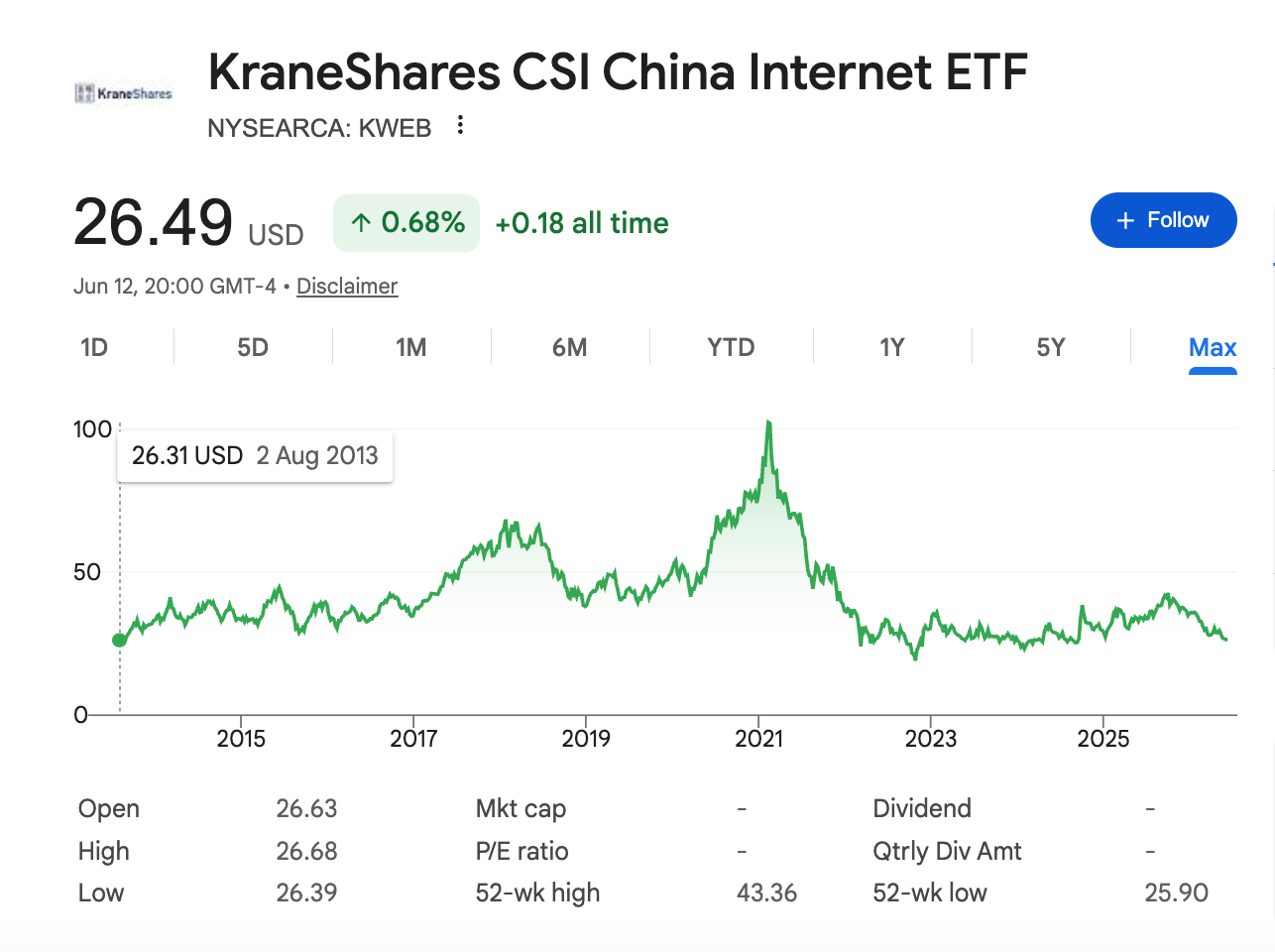
YCC Capital Perspective: The most important chart in China today is not GDP, retail sales, or export volume. It is the long-term price chart of China internet equities. The KraneShares CSI China Internet ETF (KWEB) listed in 2013 around $26 and, according to the referenced screen capture, recently traded at $26.49. That is a decade-plus round trip in the price of an asset class that once represented the cleanest investable expression of Chinese innovation, consumption, and digital productivity. The lesson is not that Chinese entrepreneurs failed. The lesson is that private shareholder value was repeatedly subordinated to political objectives, social control, capital-account management, and policy discretion.
Executive Summary
- KWEB is the cleanest public-market case study of the China private-sector risk premium: a growth ETF that moved from euphoria to policy discount, round-tripping from its 2013 listing price after peaking above $100 in 2021.
- The last five years rewired the investment case: Ant Group was halted, Alibaba was fined, for-profit tutoring was dismantled, DiDi was punished after listing, golden shares expanded, property wealth collapsed, and population decline became official reality.
- China internet companies remain operationally impressive, but equity owners no longer control the residual claim in the way investors assume in liberal-market systems. The state has become both regulator and shadow strategic shareholder.
- For global allocators, the strategic issue is not whether Chinese stocks can rally. They can. The issue is whether rallies compensate investors for a structurally higher governance, capital-flow, and geopolitical discount.
- YCC Capital views China-linked risk assets as trading instruments, not default strategic allocations. Exposure should be sized around policy tail risk, not index weight.
Figure 1: KWEB Price Round Trip Since Listing
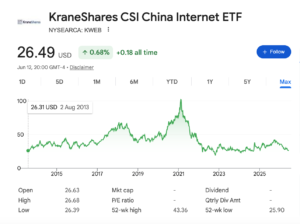
KraneShares CSI China Internet ETF, price level, approximate points from public market data and screenshot.
KWEB At-a-Glance | Data Point |
ETF inception | July 31, 2013 |
Early listed price reference | $26.31 on Aug. 2, 2013 |
Recent price reference | $26.49 |
Price change since early reference | +$0.18 / +0.68% |
2021 cycle peak | Above $100 |
52-week range shown in screenshot | $25.90 to $43.36 |
Source: Bloomberg, YCC Capital. Price-only reference; does not include distributions or taxes.
I. The KWEB Chart: The Perfect Autopsy of a Broken Growth Narrative
KWEB was launched on July 31, 2013 and seeks to track the CSI Overseas China Internet Index, providing concentrated exposure to China-based internet and platform companies listed offshore and in Hong Kong. In the 2010s, this was marketed as one of the purest ways to own China’s rising consumer class: e-commerce, digital payments, food delivery, online entertainment, gaming, search, online travel, and social media.
For several years, the logic worked. Chinese internet platforms compounded users, gross merchandise volume, advertising revenue, cloud adoption, and payments penetration. The sector combined the growth profile of Silicon Valley with the demographic scale of a continental economy. By early 2021, KWEB traded above $100. In hindsight, that peak was not merely a valuation top; it was the last market price of the old social contract between Beijing and private capital.
The current price near the original listing price is therefore more than a disappointing return. It is a market verdict. Investors who bought a decade of Chinese internet growth effectively received a decade of political repricing. The businesses grew, the user bases grew, the technology improved, and the market capitalization still vaporized. That is the defining feature of regime risk: fundamentals can move one way while ownership value moves the other.
The KWEB round trip also destroys a common allocator defense: “China always comes back.” China often does stimulate, stabilize, and engineer powerful bear-market rallies. But the chart shows that tactical recoveries do not necessarily repair structural impairment. A stock can rally 50% and still remain trapped in a lower valuation regime if the discount rate has permanently changed.
II. The Five-Year Timeline: From Platform Capitalism to Platform Supervision
Period | Policy / Market Event | Investment Meaning |
Late 2020 | Ant Group’s planned IPO was halted after Jack Ma’s public criticism of financial regulators. | The state signaled that systemically important private platforms would not be permitted to set the terms of financial innovation. |
2021 | Alibaba received a record antitrust fine; DiDi faced cybersecurity scrutiny shortly after its U.S. listing; the Double Reduction policy dismantled much of the for-profit K-12 tutoring industry. | The market learned that profitable, VC-backed sectors could become policy liabilities overnight. |
2021-2022 | Evergrande defaulted and the property downturn widened; zero-Covid disruptions damaged consumption and small-business confidence. | The macro backdrop shifted from property-led wealth creation to balance-sheet repair and household caution. |
2022-2023 | PCAOB access lowered immediate ADR delisting risk, while Beijing also moved toward golden-share influence in key internet subsidiaries. | A U.S. listing became less binary, but political control became more institutionalized. |
2023-2024 | Reopening produced a weaker-than-expected recovery; Alibaba announced restructuring; regulators later declared parts of the Alibaba rectification process complete. | The state shifted from punishment to stabilization, but not back to the pre-2020 model of platform autonomy. |
2024-2026 | Evergrande liquidation/delisting, continuing property weakness, population decline, deflationary pressure, content-control campaigns, and renewed cross-border investment scrutiny. | China internet moved from a growth-beta asset to a policy-cycle asset with embedded capital-control and geopolitical risk. |
Source: Bloomberg, YCC Capital.
III. Xi’s Collision With Economic Reality
The original bull case for China internet assumed that the state would tolerate private platforms because they delivered growth, employment, convenience, consumption, tax revenue, and global prestige. That assumption underestimated the degree to which the Chinese Communist Party treats large private networks as political infrastructure. Once platforms became gateways to credit, data, speech, youth culture, education, employment, and household balance sheets, they stopped being ordinary listed companies. They became instruments of national governance.
The crackdown on private enterprise has therefore been more than a sector rotation. It reflected a reordering of priorities: common prosperity over platform margins, data security over shareholder transparency, ideological supervision over algorithmic freedom, financial stability over fintech disruption, and social control over consumer internet monetization. In Western markets, the state typically regulates companies from outside the shareholder contract. In China, the party can effectively sit above the contract.
This is why the phrase “cheap China tech” can be misleading. A low multiple is not always a bargain. Sometimes it is a receipt for a risk that cannot be modeled in conventional discounted cash flow. If a company can be told to restructure, donate, delist, stop enrolling users, convert a business line into a nonprofit, limit content, alter algorithms, or accept state-linked strategic influence, then the equity deserves a different discount rate.
IV. Property, Demographics, and the Vanishing Consumer Tailwind
China’s property sector was the household balance-sheet engine behind much of the consumption story. Rising home prices made families feel wealthier, developers and local governments recycled land finance into activity, and the urban middle class treated property as both shelter and savings. That engine has stalled. Evergrande’s default in 2021, liquidation order in 2024, and subsequent delisting process became symbols of a deeper balance-sheet recession: homebuyers do not simply buy fewer apartments; they become less willing to spend, borrow, invest, or have children.
Demographics intensify the problem. China’s officially reported population has been declining for multiple consecutive years, births remain historically depressed, and the age structure is turning from a demographic dividend into a claims problem. Education costs, housing costs, employment uncertainty, and low confidence help explain why families are reluctant to raise birth rates. Ironically, the tutoring crackdown targeted one symptom of that pressure, but it also destroyed a listed-sector investment thesis and reinforced the broader perception that Beijing can eliminate an industry to solve a social problem.
The result is a negative feedback loop for platform companies. Weak property prices hit confidence. Weak confidence hits consumption. Weak consumption hits merchant advertising, discretionary spending, gaming, online travel, delivery volumes, and fintech credit quality. Weak private-sector valuations then reduce hiring and household wealth effects. The old model treated China internet as a leveraged play on upward mobility. The new model must price it as a leveraged play on a stressed social contract.
V. Governance Is the Core Risk, Not the Side Note
Traditional emerging-market analysis often treats governance as a qualitative footnote beneath growth, valuation, and liquidity. China forces the order to be reversed. Governance is the asset. If the governance claim is unstable, growth becomes insufficient compensation.
Foreign investors do not own Chinese operating companies in the same way they own a U.S. industrial company or a Japanese exporter. Many offshore Chinese internet exposures rely on variable interest entity structures, offshore holding companies, regulatory tolerance, and exchange-listing access. These structures worked while incentives were aligned. The last five years showed that alignment can change abruptly.
Golden-share arrangements and state-linked minority stakes further complicate the picture. A 1% stake with board representation, veto rights, or privileged access to data can matter far more than its economic size. It changes the nature of corporate governance from shareholder primacy to party-state embeddedness. That may reduce some regulatory uncertainty by formalizing channels of control, but it also confirms the strategic subordination of shareholders.
Figure 2: China Internet Risk Premium Stack
Risk Factor | Illustrative Score (0-100) |
Policy Optionality | 90 |
VIE/ADR Structure | 75 |
Property/Wealth Effect | 80 |
Demographics | 70 |
Capital Controls | 65 |
Geopolitical Discount | 85 |
Source: Bloomberg, YCC Capital. Illustrative scoring framework, 0-100; not a security rating.
VI. The Benchmark Trap: Passive Allocators Import Political Risk
The rise of passive investing transformed index membership into a capital-allocation machine. Pension funds, retirement plans, ESG products, and global equity mandates often own China not because the ultimate saver made a China call, but because a benchmark embedded that exposure. This creates a governance mismatch. The end investor may believe they own diversified global capitalism; in practice, part of the portfolio may be exposed to companies whose governance rights are constrained by an authoritarian political system.
This does not mean every Chinese company is uninvestable. It does mean the default allocation deserves scrutiny. Index inclusion is not the same as investor protection. Liquidity is not the same as governance. A large market capitalization is not the same as a durable residual claim. The KWEB experience demonstrates how a benchmark-friendly growth sector can become a decade-long capital sink once the political discount changes.
The ESG dimension is particularly uncomfortable. Many global investors claim to prioritize transparency, accountability, minority-shareholder rights, stakeholder alignment, and governance quality. Yet index-based products can still direct capital into structures where true control is opaque, state influence is growing, and shareholder remedies are limited. That is not a minor inconsistency. It is a structural contradiction inside the global asset-management industry.
VII. Why Rallies Still Happen – and Why They Can Mislead
China risk assets will continue to stage violent rallies. Valuations become washed out. Short interest builds. Policy headlines improve. Buyback programs are announced. Regulators signal support. Domestic investors look for alternatives to property. Global investors fear missing a stimulus cycle. In this environment, a 30% to 60% rebound can happen quickly.
But a rally is not the same as a regime repair. The market must distinguish between cyclical oxygen and structural healing. Cyclical oxygen includes rate cuts, fiscal support, buybacks, relaxation of enforcement pressure, and verbal reassurance. Structural healing would require credible limits on arbitrary policy intervention, stronger protection for minority shareholders, genuine household income support, durable property stabilization, transparent treatment of VIE structures, and reduced geopolitical pressure. China has delivered the former more often than the latter.
The practical implication is simple: China internet exposure should be traded around policy cycles, not treated as a permanent compounder by default. Investors can own a rally, but they should not confuse it with restored rule-of-law economics.
VIII. Strategic Framework for Investors
Question | YCC Capital View | Portfolio Implication |
Is China internet cheap? | Yes on headline multiples, but cheapness is partly compensation for permanent political optionality. | Use valuation as an entry discipline, not as a stand-alone thesis. |
Can Beijing support the market? | Yes. China has powerful administrative tools and can generate sharp rallies. | Policy support can justify tactical exposure, but not unlimited strategic allocation. |
Has the crackdown ended? | The punitive phase may ease, but supervision has been institutionalized. | Assume intervention risk remains embedded in the asset class. |
Is KWEB a clean China consumption proxy? | Less than before. It is now a combined bet on consumption, regulation, ADR/HK liquidity, platform supervision, and geopolitics. | Size the position as a macro-political instrument. |
What would change the view? | Credible property stabilization, household-income reform, consistent private-sector protection, and reduced capital-control/geopolitical risk. | Upgrade exposure only when policy credibility improves, not merely when prices fall. |
Source: Bloomberg, YCC Capital.
IX. YCC Capital Closing View: Do Not Buy the Old China in the New China
Investors are often tempted to buy the memory of an asset rather than the asset itself. China internet is a textbook example. The memory is powerful: Alibaba as China’s Amazon, Tencent as China’s social operating system, Meituan as urban services infrastructure, JD.com as logistics efficiency, Pinduoduo as consumer disruption, and the entire sector as the digital nervous system of 1.4 billion people.
But the investable asset has changed. The old China offered growth with regulatory opacity. The new China offers policy direction with growth uncertainty. The old China rewarded scale. The new China can punish scale. The old China allowed entrepreneurs to build quasi-infrastructure. The new China wants the party-state to supervise that infrastructure.
KWEB’s lost decade is therefore not an accident. It is the market learning, slowly and expensively, that shareholder value in China is conditional. The companies may still innovate. The stocks may still rally. But the strategic discount is real. For global investors, the discipline is to separate businesses from securities, growth from ownership rights, and price declines from true bargains.
Our bottom line: China internet is no longer a simple growth allocation. It is a governance-risk instrument sitting at the intersection of property deflation, demographic decline, capital controls, U.S.-China rivalry, and party-state supervision. That does not make it untradable. It makes it unforgiving.
Editorial Board
Name | Title |
Ken Cao | Chief Strategist, Global Investment Strategy |
Akiko Ikezawa | Managing Analyst |
Yui Nabeshima | Strategist |
Mai Ikeda | Research Analyst |
IMPORTANT DISCLAIMER
This research report is provided for informational and educational purposes only and does not constitute an offer to sell or a solicitation of an offer to buy any securities, financial instruments, or investment products. It is not intended as investment, legal, accounting, or tax advice and should not be relied upon as such. The views, opinions, and projections expressed herein are those of YCC Capital Management and its research personnel as of the date of publication and are subject to change without notice. Past performance is not indicative of future results.
YCC Capital Management, its affiliates, principals, and employees may hold long or short positions in securities or instruments discussed in this report and may trade for their own accounts or for client accounts in a manner inconsistent with the recommendations herein. This report is based on publicly available information and data believed to be reliable, but YCC Capital makes no representation or warranty, express or implied, as to the accuracy, completeness, or timeliness of such information. Forward-looking statements involve risks and uncertainties that could cause actual results to differ materially from those projected.
Recipients of this report should conduct their own independent due diligence and consult with their own financial, legal, and tax advisors before making any investment decisions. This report is intended solely for qualified investors and institutional clients who possess the knowledge and experience to evaluate the risks involved. YCC Capital accepts no liability for any loss or damage arising from the use of or reliance on this report or its contents.
This report is intended solely for the use of the intended recipient(s) and may not be reproduced or redistributed for commercial purposes without the prior written consent of YCC Capital. © 2026 YCC Capital. All rights reserved. YCC Capital’s flagship vehicle, the YCC International Value Fund, LP, maintains a concentrated global macro value strategy with a focus on capital-flow-driven mispricings and asymmetric hedging opportunities. The Fund is registered in the State of Delaware, U.S and structured as a 506(c) fund. Performance data, where referenced, has been verified by independent third parties including NAV Consulting; however, individual investor results may vary.
Contact Us
For questions, contact ir@yccinvest.com. Sign up for free daily market insight at yccinvest.com.