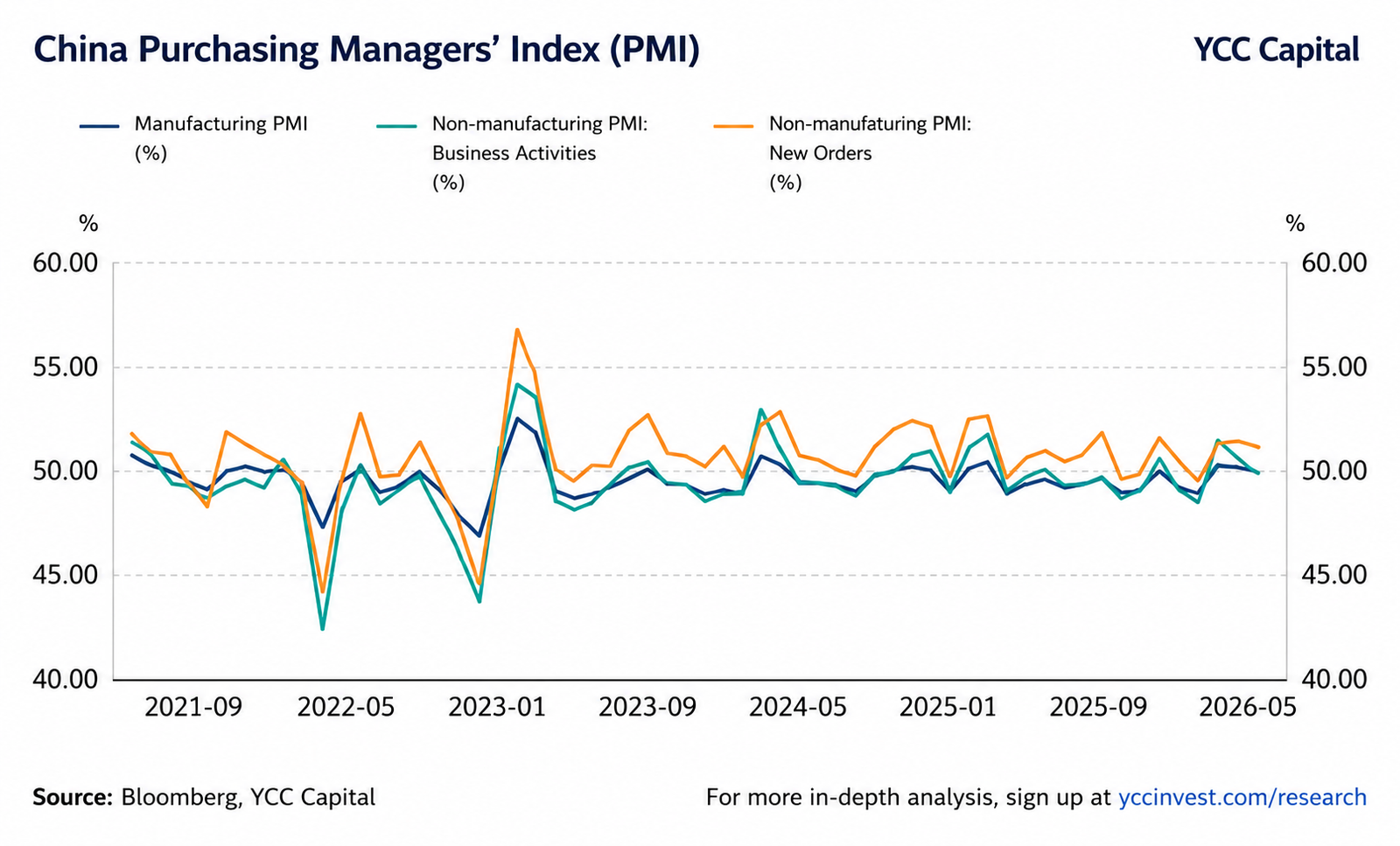
YCC CAPITAL Emerging Markets & China Strategy Date: June 21, 2026 Executive Summary There are moments in economic cycles when the headline numbers tell only half the story. Walking through a shopping district today in many Chinese cities offers a useful illustration. Factories continue shipping products around the world, ports remain busy, and exporters report solid order books. Yet many households remain cautious, postponing major purchases, reducing leverage, and waiting for greater confidence about the future. That divergence defines China’s current macro landscape. May 2026 data showed: Manufacturing PMI remained at the expansion-contraction threshold. Export growth stayed exceptionally strong. Producer prices continued recovering. Consumer inflation remained positive but subdued. Retail sales disappointed. Credit demand from households and businesses remained weak. Fixed asset investment continued contracting. The property sector remained under pressure despite gradual inventory improvement. At YCC Capital, we believe the most important takeaway is not that China is falling back into recession. Rather, the economy is navigating a prolonged transition away from a property-led growth model toward a more balanced framework. That adjustment is inherently uneven and takes time. While 2026 is shaping up to be a better macro year than 2025, the conditions for a powerful V-shaped recovery remain absent. Manufacturing Activity: Stabilization Rather Than Acceleration PMI Sits Exactly on the Neutral Line China’s official manufacturing PMI registered 50.0 in May, down slightly from April and exactly at the dividing line between expansion and contraction. Large enterprises remained relatively healthy, while small and medium-sized firms experienced renewed pressure. Key observations include: Production remained in expansion territory. New orders softened. Raw material inventories declined. Employment indicators weakened. Supplier delivery times lengthened further. The message is straightforward: factories continue producing, but demand growth is not keeping pace. Meanwhile, the non-manufacturing PMI improved modestly to 50.1, led primarily by services, while construction activity remained weak. YCC View China’s industrial sector remains supported by export competitiveness and ongoing supply-chain advantages. However, domestic demand has not yet become a sufficiently powerful second engine. The economy is moving forward, but not accelerating. Inflation: Producer Prices Recover Faster Than Consumer Prices CPI Remains Benign Consumer inflation rose 1.2% year-over-year in May. Food prices continued to exert downward pressure, particularly pork prices, while service-related categories showed moderate gains. Consumer price dynamics remain remarkably restrained despite policy easing. This reflects: Cautious household spending behavior. Weak housing-related demand. Limited pricing power among retailers. High savings preferences among consumers. PPI Continues Recovering Producer prices increased 3.9% year-over-year, extending the recovery trend observed throughout 2026. Rising energy prices, particularly in coal, petrochemicals, and non-ferrous metals, contributed significantly to the improvement. Notably, producer inflation is rising faster than consumer inflation. Historically, this pattern often appears in the early stages of cyclical recoveries when industrial activity improves before household demand fully rebounds. YCC View Inflation conditions remain constructive rather than problematic. We expect: CPI to continue gradually rising. PPI momentum to moderate somewhat if global energy prices ease. Deflation concerns to continue fading throughout 2026. Trade: Exports Continue to Surprise on the Upside External Demand Remains the Bright Spot China’s total trade volume reached $648.1 billion in May, representing 22.6% year-over-year growth. Key figures: Indicator May 2026 Exports $376.8 billion Export Growth +19.4% YoY Imports $271.4 billion Import Growth +27.4% YoY Trade Surplus $105.4 billion Export growth remained strong across major trading partners. Highlights include: Exports to the United States rose 35.4%. Exports to ASEAN increased 24.3%. Exports to the European Union rose 7.6%. Exports to Japan increased 10.9%. A particularly notable trend is the continued expansion of ASEAN’s role within China’s export ecosystem. Why Exports Are Holding Up Chinese manufacturers continue benefiting from: Scale advantages. Cost competitiveness. Technological upgrading. Strong demand for industrial products and intermediate goods globally. YCC View The biggest threat to China’s exports is not tariffs. The larger risk is a broader slowdown in global growth. If the U.S. economy enters recession or global demand weakens materially, export momentum could fade quickly. Until then, exports remain China’s strongest macro pillar. Credit Conditions: Weak Demand for Borrowing Persists Perhaps the most revealing part of the May data came from financial indicators. Social Financing Growth Slows Outstanding Total Social Financing (TSF) expanded 7.7% year-over-year, while RMB loans to the real economy increased only 5.5%. More importantly, underlying demand remains soft. Household Borrowing Weakens In May: Household loans declined. Short-term consumer loans fell. Medium and long-term housing-related loans also contracted. This signals continued caution among consumers. People are choosing to save rather than spend or leverage. Corporate Borrowing Also Remains Muted Corporate lending showed little evidence of a major investment cycle. Short-term and long-term corporate loans remained weak, while much of the increase came through bill financing rather than productive investment borrowing. That is often a sign that: Business confidence remains fragile. Firms are prioritizing liquidity management. Capital expenditure plans remain conservative. YCC View Credit data suggest that monetary easing alone cannot solve the problem. The challenge today is not credit supply. The challenge is credit demand. Until households regain confidence and businesses see stronger future opportunities, borrowing activity will likely remain subdued. Consumption and Investment: The Missing Piece of the Recovery Retail Sales Disappoint May retail sales fell 0.6% year-over-year, reflecting both base effects and underlying demand weakness. Several key categories remained particularly weak: Automobiles Building materials Furniture Household appliances These sectors share an important characteristic: They are closely linked to housing activity. When property transactions slow, the ripple effects extend across the broader consumption ecosystem. A Real-World Example Buying a home is rarely a single purchase. A new apartment often leads to: Furniture purchases. Appliance upgrades. Renovation spending. Vehicle purchases. Increased discretionary consumption. When housing activity weakens, many of those secondary spending channels weaken as well. This helps explain why consumption remains sluggish despite improving industrial conditions. Fixed Asset Investment Continues Contracting During January-May: Fixed asset investment fell 4.1%. Private sector investment fell 7.1%. Manufacturing investment rose modestly. Infrastructure investment remained positive but moderate. The divergence between public and private investment remains striking. Private sector confidence has yet
Investors in Xi’s China Faced a Lost Decade
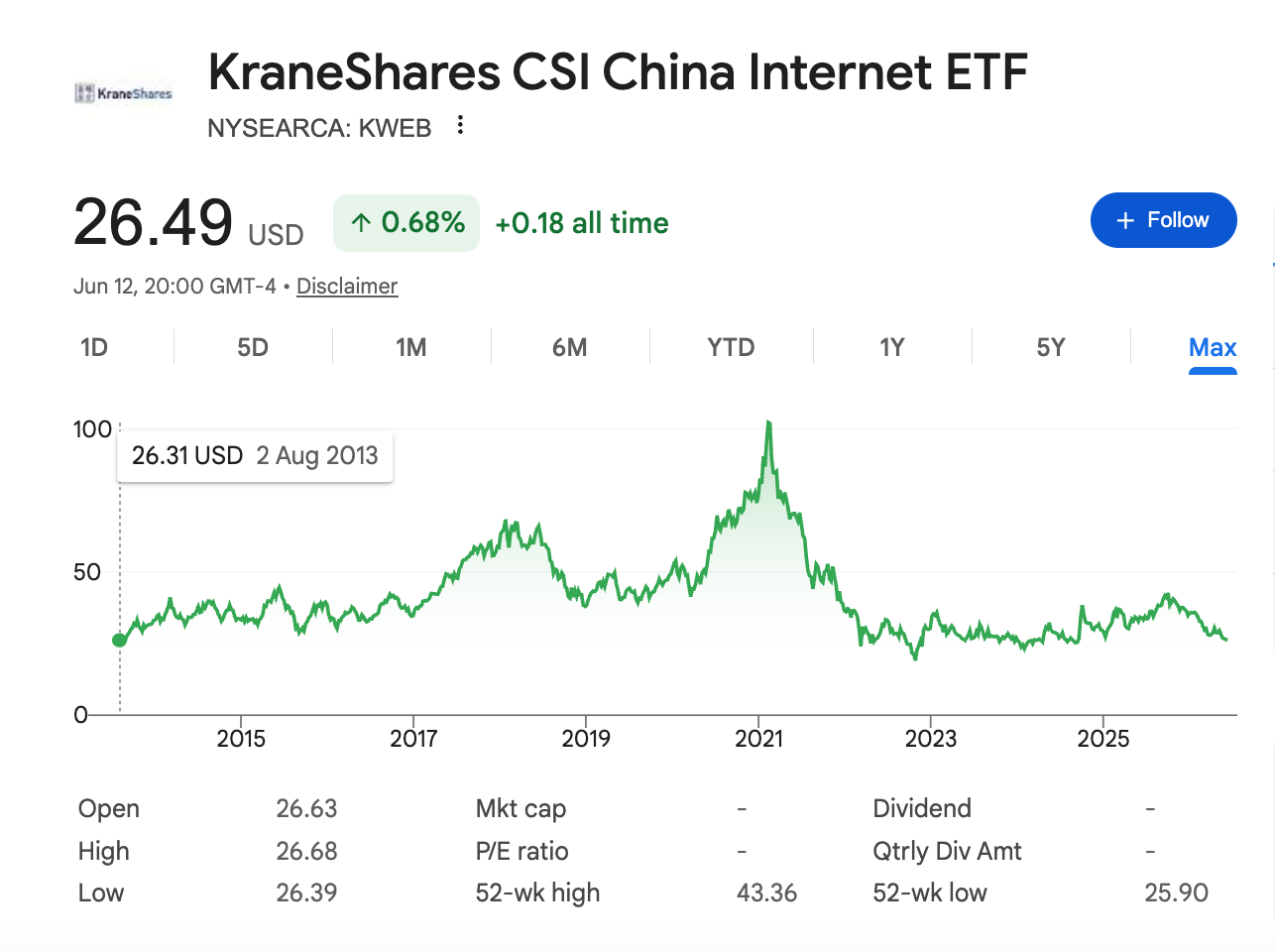
Why the KWEB Round Trip Is a Governance Warning, Not Just a Valuation Opportunity Report Date: June 14, 2026 | Source: Bloomberg, YCC Capital YCC Capital Perspective: The most important chart in China today is not GDP, retail sales, or export volume. It is the long-term price chart of China internet equities. The KraneShares CSI China Internet ETF (KWEB) listed in 2013 around $26 and, according to the referenced screen capture, recently traded at $26.49. That is a decade-plus round trip in the price of an asset class that once represented the cleanest investable expression of Chinese innovation, consumption, and digital productivity. The lesson is not that Chinese entrepreneurs failed. The lesson is that private shareholder value was repeatedly subordinated to political objectives, social control, capital-account management, and policy discretion. Executive Summary KWEB is the cleanest public-market case study of the China private-sector risk premium: a growth ETF that moved from euphoria to policy discount, round-tripping from its 2013 listing price after peaking above $100 in 2021. The last five years rewired the investment case: Ant Group was halted, Alibaba was fined, for-profit tutoring was dismantled, DiDi was punished after listing, golden shares expanded, property wealth collapsed, and population decline became official reality. China internet companies remain operationally impressive, but equity owners no longer control the residual claim in the way investors assume in liberal-market systems. The state has become both regulator and shadow strategic shareholder. For global allocators, the strategic issue is not whether Chinese stocks can rally. They can. The issue is whether rallies compensate investors for a structurally higher governance, capital-flow, and geopolitical discount. YCC Capital views China-linked risk assets as trading instruments, not default strategic allocations. Exposure should be sized around policy tail risk, not index weight. Figure 1: KWEB Price Round Trip Since Listing KraneShares CSI China Internet ETF, price level, approximate points from public market data and screenshot. KWEB At-a-Glance Data Point ETF inception July 31, 2013 Early listed price reference $26.31 on Aug. 2, 2013 Recent price reference $26.49 Price change since early reference +$0.18 / +0.68% 2021 cycle peak Above $100 52-week range shown in screenshot $25.90 to $43.36 Source: Bloomberg, YCC Capital. Price-only reference; does not include distributions or taxes. I. The KWEB Chart: The Perfect Autopsy of a Broken Growth Narrative KWEB was launched on July 31, 2013 and seeks to track the CSI Overseas China Internet Index, providing concentrated exposure to China-based internet and platform companies listed offshore and in Hong Kong. In the 2010s, this was marketed as one of the purest ways to own China’s rising consumer class: e-commerce, digital payments, food delivery, online entertainment, gaming, search, online travel, and social media. For several years, the logic worked. Chinese internet platforms compounded users, gross merchandise volume, advertising revenue, cloud adoption, and payments penetration. The sector combined the growth profile of Silicon Valley with the demographic scale of a continental economy. By early 2021, KWEB traded above $100. In hindsight, that peak was not merely a valuation top; it was the last market price of the old social contract between Beijing and private capital. The current price near the original listing price is therefore more than a disappointing return. It is a market verdict. Investors who bought a decade of Chinese internet growth effectively received a decade of political repricing. The businesses grew, the user bases grew, the technology improved, and the market capitalization still vaporized. That is the defining feature of regime risk: fundamentals can move one way while ownership value moves the other. The KWEB round trip also destroys a common allocator defense: “China always comes back.” China often does stimulate, stabilize, and engineer powerful bear-market rallies. But the chart shows that tactical recoveries do not necessarily repair structural impairment. A stock can rally 50% and still remain trapped in a lower valuation regime if the discount rate has permanently changed. II. The Five-Year Timeline: From Platform Capitalism to Platform Supervision Period Policy / Market Event Investment Meaning Late 2020 Ant Group’s planned IPO was halted after Jack Ma’s public criticism of financial regulators. The state signaled that systemically important private platforms would not be permitted to set the terms of financial innovation. 2021 Alibaba received a record antitrust fine; DiDi faced cybersecurity scrutiny shortly after its U.S. listing; the Double Reduction policy dismantled much of the for-profit K-12 tutoring industry. The market learned that profitable, VC-backed sectors could become policy liabilities overnight. 2021-2022 Evergrande defaulted and the property downturn widened; zero-Covid disruptions damaged consumption and small-business confidence. The macro backdrop shifted from property-led wealth creation to balance-sheet repair and household caution. 2022-2023 PCAOB access lowered immediate ADR delisting risk, while Beijing also moved toward golden-share influence in key internet subsidiaries. A U.S. listing became less binary, but political control became more institutionalized. 2023-2024 Reopening produced a weaker-than-expected recovery; Alibaba announced restructuring; regulators later declared parts of the Alibaba rectification process complete. The state shifted from punishment to stabilization, but not back to the pre-2020 model of platform autonomy. 2024-2026 Evergrande liquidation/delisting, continuing property weakness, population decline, deflationary pressure, content-control campaigns, and renewed cross-border investment scrutiny. China internet moved from a growth-beta asset to a policy-cycle asset with embedded capital-control and geopolitical risk. Source: Bloomberg, YCC Capital. III. Xi’s Collision With Economic Reality The original bull case for China internet assumed that the state would tolerate private platforms because they delivered growth, employment, convenience, consumption, tax revenue, and global prestige. That assumption underestimated the degree to which the Chinese Communist Party treats large private networks as political infrastructure. Once platforms became gateways to credit, data, speech, youth culture, education, employment, and household balance sheets, they stopped being ordinary listed companies. They became instruments of national governance. The crackdown on private enterprise has therefore been more than a sector rotation. It reflected a reordering of priorities: common prosperity over platform margins, data security over shareholder transparency, ideological supervision over algorithmic freedom, financial stability over fintech disruption, and social control over consumer internet monetization. In