
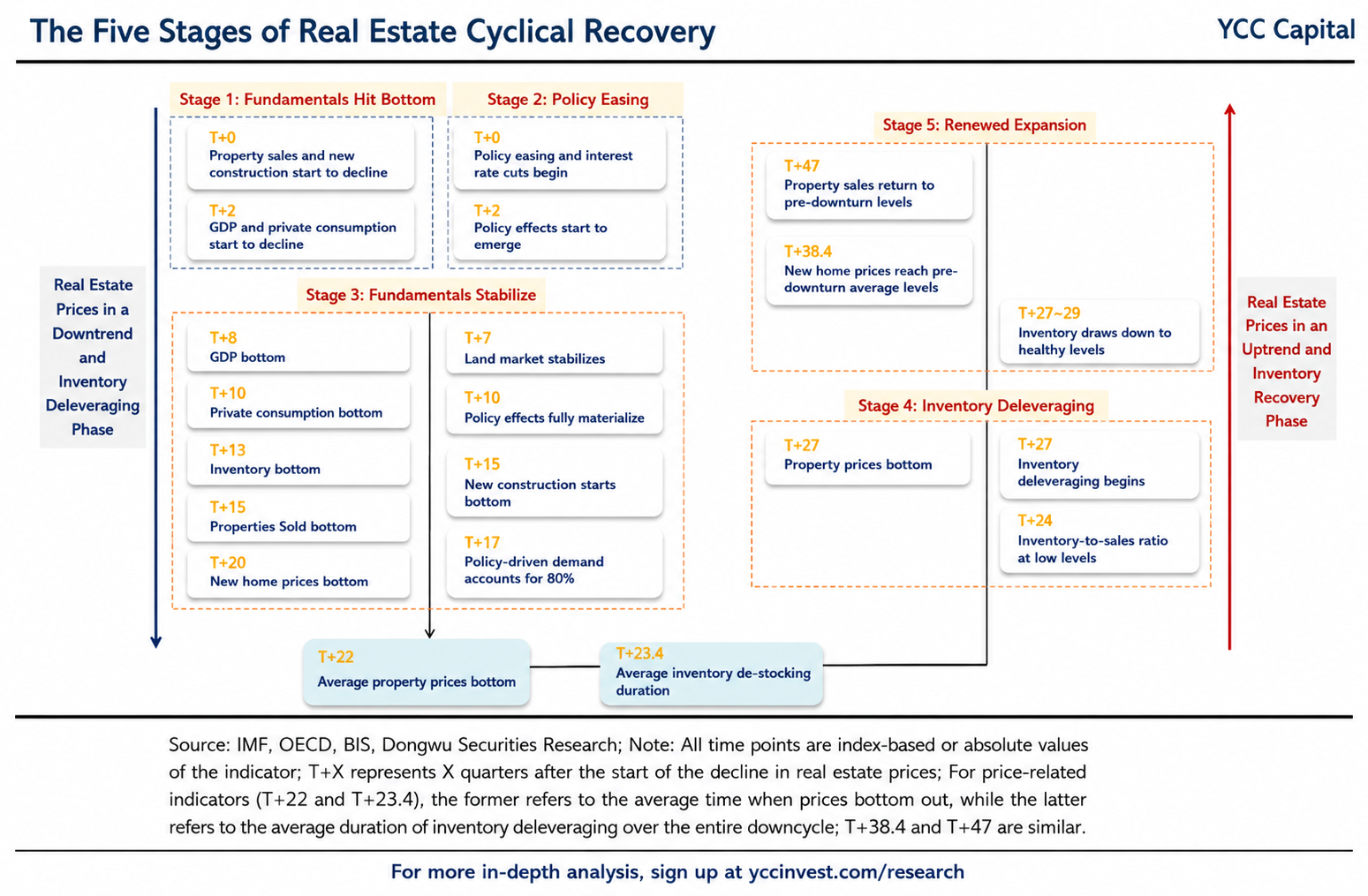
YCC CAPITAL Global Strategy June 24, 2026 Executive Summary Housing downturns often feel like watching a tide retreat. The first instinct is to stare at the shoreline and wait for the water to return. Yet history suggests that by the time the tide visibly comes back in, many of the most important signals have already appeared elsewhere. Investors frequently focus on house prices themselves when attempting to identify a market bottom. Policymakers watch mortgage lending. Developers watch construction activity. Yet a review of 190 housing downturns across 57 economies over the past 55 years suggests that these indicators often arrive too late. The global evidence points to a remarkably consistent sequence: Consumption recovers first. House prices recover second. Credit growth and residential investment recover later. This finding challenges several widely held assumptions about real estate cycles. More importantly, it provides a practical framework for evaluating where an economy sits within a housing correction. The lessons extend beyond property markets. Housing is not merely an asset class. For many households, it represents the largest balance-sheet item, the largest source of leverage, and the single most important determinant of perceived wealth. Housing cycles therefore become macroeconomic cycles. A family that bought a home near the peak often postpones furniture purchases, automobile upgrades, vacations, and discretionary spending. A developer delays projects. Banks tighten lending standards. Policymakers respond. Entire economic systems adjust around the housing market’s trajectory. Yet history shows that recoveries rarely begin where investors expect them to. The central conclusion from international experience is straightforward: The speed of leverage accumulation determines how deep prices fall. Residential investment dynamics determine how long prices fall. Consumption recovery helps determine when prices stop falling. Together, these three variables form a practical roadmap for identifying housing-market turning points. Sources: Bloomberg, YCC Capital. YCC Perspective One of the most persistent mistakes investors make is assuming that housing recoveries begin in housing. In reality, housing is often one of the last major sectors to heal. Consider a household after a property downturn. The family may remain reluctant to buy another home. They may still be worried about prices. Yet if employment stabilizes, wages improve, and confidence gradually returns, they may resume dining out, traveling, replacing appliances, or purchasing consumer electronics. The recovery begins not with property transactions but with everyday life. The global evidence repeatedly demonstrates that economic normalization usually starts before housing-market normalization becomes obvious. For investors attempting to identify inflection points, this distinction matters enormously. Three Common Misconceptions About Housing Recoveries Across market cycles, three beliefs repeatedly emerge. The first is that house prices must recover before consumption can recover. The second is that households must resume borrowing before housing can stabilize. The third is that residential construction must recover before house prices can bottom. All three assumptions appear intuitive. All three are largely contradicted by historical evidence. Analysis of 190 housing downturns reveals a consistent sequencing pattern: Consumption → House Prices → Credit ≈ Residential Investment Consumption typically bottoms first. House prices follow. Credit expansion and residential investment generally recover afterward. This pattern appears repeatedly across developed and emerging economies, across inflationary and deflationary environments, and across multiple institutional frameworks. The implication is profound: A housing market does not need to stop falling before consumption improves. A household sector does not need to resume leveraging before housing stabilizes. Residential investment does not need to recover before property prices reach a bottom. Understanding these lead-lag relationships is essential for identifying turning points. Part I: Consumption Is the Earliest Signal The Global Evidence The historical sample divides housing downturns into two categories: Ordinary Housing Recessions These represent the majority of cases. Average house-price declines are relatively modest. Consumption generally continues growing, albeit at a slower pace. In these episodes, consumption rarely experiences outright contraction. Deep Housing Recessions These represent the most severe quarter of observations. House prices decline by more than 28.6%. Consumption falls meaningfully. These cases provide the clearest insights into turning-point behavior. Among severe housing downturns: Consumption bottoms around T+10 quarters. House prices bottom around T+22 quarters. Consumption therefore leads housing by approximately three years. Even more striking: Among cases where a consumption downturn can be clearly identified, consumption bottoms before house prices in nearly 87% of episodes. This consistency makes consumption one of the most reliable leading indicators available. Why Consumption Recovers First Growth Becomes Less Dependent on Housing During severe housing downturns, economies often enter a phase that can be described as de-real-estatized growth. Economic activity gradually begins recovering outside the property sector. Manufacturing stabilizes. Employment improves. Service-sector activity expands. Income expectations recover. GDP growth often turns before housing. Across the international sample: GDP bottoms around T+8. Consumption bottoms around T+10. House prices bottom around T+22. This creates a multi-year period during which economic growth resumes while housing remains weak. The economy moves forward before property markets do. Policy Support Reaches Consumers Faster Fiscal and monetary easing also help explain consumption’s earlier recovery. Governments frequently expand deficits during housing downturns. Central banks cut rates aggressively. Employment and corporate activity stabilize. Income expectations improve. Consumption responds relatively quickly because it is fundamentally an income-driven flow variable. House prices, by contrast, remain constrained by: Excess inventory Weak credit creation Negative expectations Balance-sheet repair Supply overhangs Housing therefore recovers much more slowly. The Saturation and Replacement Cycle A second explanation involves replacement cycles. During housing booms, households rarely purchase only a home. They often buy: Furniture Appliances Electronics Renovation services Home improvements Vehicles Housing booms therefore pull future consumption forward. Demand becomes front-loaded. After the boom ends, both housing demand and related consumption experience a temporary vacuum. The difference lies in replacement timing. A refrigerator eventually needs replacement. A washing machine eventually wears out. A sofa becomes outdated. These replacement cycles are relatively short. Housing replacement cycles are far longer. Homes depreciate slowly. Transactions are expensive. Financing matters. Expectations matter. Inventory matters. As a result, consumption adjusts and recovers sooner. Housing remains trapped in a longer cycle. The Changing Structure of Consumption Not all consumption
The Fog of Peace, The Fog of Policy: A Fragile Middle East Truce Meets a More Ambiguous Federal Reserve
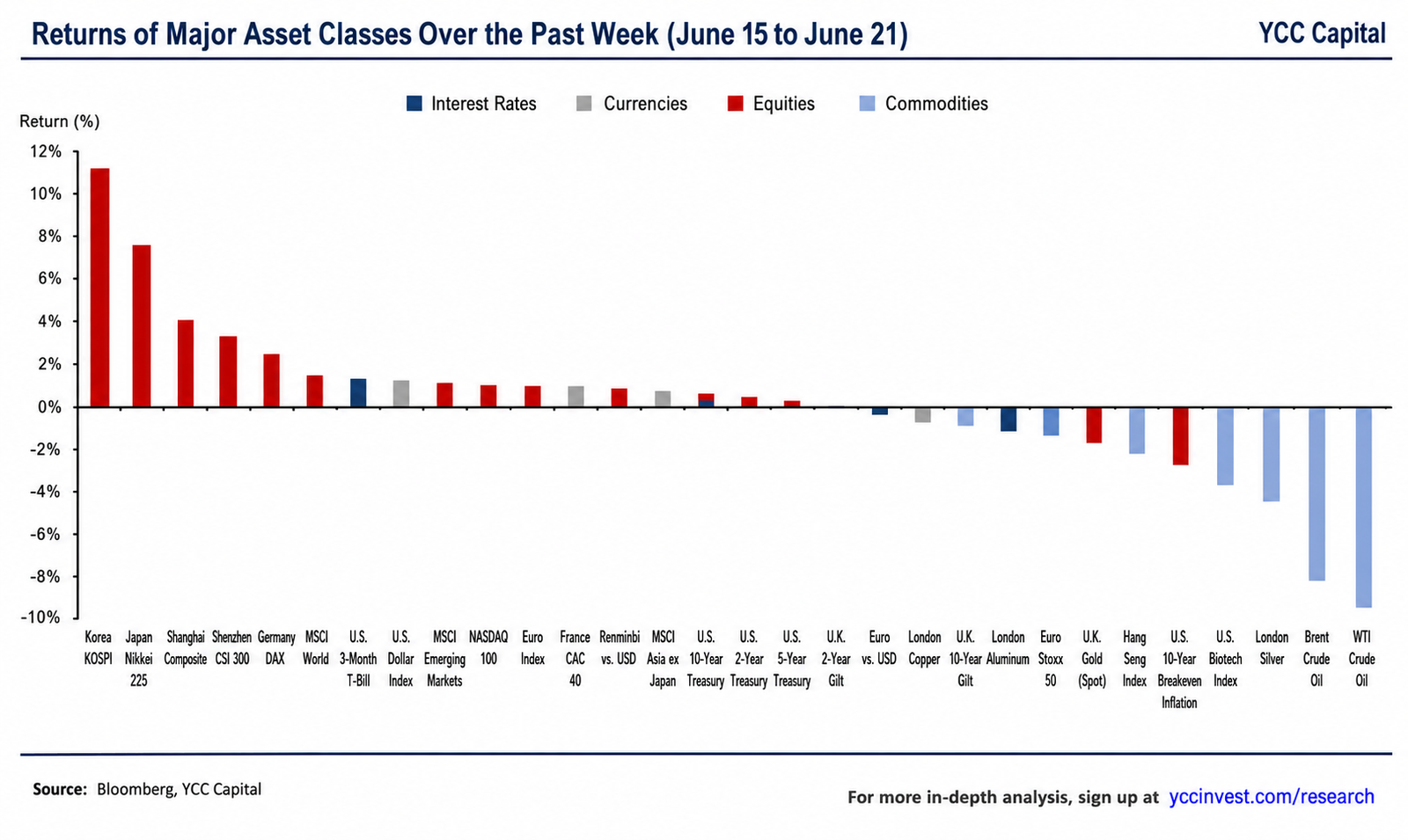
YCC CAPITAL Global Strategy June 22, 2026 YCC Perspective Financial markets often move not on certainty, but on the belief that uncertainty is fading. Last week offered a powerful example. As investors began to price a reduced probability of a prolonged Middle East conflict and a reopening of critical shipping routes through the Strait of Hormuz, oil prices fell sharply and global risk appetite improved. Yet beneath the market relief lies a more complicated reality: neither the geopolitical situation nor monetary policy has become substantially clearer. Instead, investors are now confronting two new forms of ambiguity. The first is geopolitical: a U.S.–Iran memorandum that pauses conflict but leaves the hardest disputes unresolved. The second is monetary: a Federal Reserve increasingly shaped by Chairman Kevin Warsh’s preference for less forward guidance and greater policy discretion. Markets celebrated peace and stability. The underlying documents suggest investors should remain more cautious. Executive Summary Key Conclusions Oil prices experienced one of their sharpest weekly declines of the year as markets priced in a lower probability of prolonged disruption in the Middle East. Global equities broadly advanced, led by technology-heavy markets including South Korea and Japan. The June FOMC meeting delivered a more hawkish message than markets anticipated. Chairman Warsh’s first major press conference signaled potentially significant changes to the Fed’s operating framework. The U.S.–Iran Memorandum of Understanding (MoU) represents a temporary 60-day framework rather than a permanent peace settlement. Major disputes surrounding Iran’s nuclear program, uranium stockpiles, missile development, and governance of the Strait of Hormuz remain unresolved. While immediate geopolitical risks have moderated, structural risks remain elevated. Global Asset Allocation Review Risk Assets Recover as Oil Collapses Markets entered last week positioned for escalation. They exited the week positioning for negotiation. As military confrontation between the United States and Iran shifted toward a diplomatic process, investors rapidly unwound energy risk premiums. The expectation of resumed maritime traffic through the Strait of Hormuz became a dominant market theme. The result was a dramatic repricing: WTI crude declined approximately 9.8% during the week. Brent crude fell roughly 7.7%. Precious metals weakened. The U.S. dollar strengthened. Global equity markets advanced despite a hawkish Federal Reserve meeting. Among major equity markets: South Korea’s KOSPI led gains. Japan’s Nikkei 225 continued its strong advance. Emerging-market equities outperformed. Technology-related sectors remained the primary leadership group. The resilience of semiconductor stocks and the Magnificent Seven was particularly notable given the simultaneous rise in interest-rate expectations. This is an important signal. Markets increasingly view artificial intelligence investment, semiconductor demand, and digital infrastructure spending as structural growth stories capable of overcoming moderate increases in financing costs. U.S. Economy: Resilient Consumer, Weak Housing Mixed Economic Signals Continue Recent U.S. economic releases painted a picture of an economy that remains resilient but uneven. Retail sales in May exceeded consensus expectations, suggesting consumers continue spending despite elevated interest rates and higher energy costs. However, housing data told a different story. Housing starts fell significantly below expectations and dropped to levels not seen since the aftermath of the Global Financial Crisis, underscoring the sensitivity of the housing sector to elevated borrowing costs. This divergence captures the central challenge facing policymakers: Consumers remain active. Interest-rate-sensitive sectors remain weak. One useful real-world analogy is a family budget during a period of higher gasoline prices. The family may continue traveling and spending overall, but discretionary purchases become increasingly selective. That appears to be occurring within the U.S. economy. Although aggregate consumption remains healthy, higher fuel expenditures are crowding out portions of other spending categories. Credit-card data suggest overall consumer activity remains strong, but spending composition has become less favorable. Federal Reserve: Hawkish Dots, Ambiguous Leadership Understanding the Warsh Framework The June FOMC meeting surprised markets with a more hawkish policy outlook than expected. While rates remained unchanged, the updated projections reinforced expectations that monetary policy could remain restrictive for longer. More important than the rate decision itself was Chairman Kevin Warsh’s broader philosophical approach. Our interpretation is that Warsh may pursue reform across three dimensions. 1. Less Communication, More Market Volatility Since the Bernanke era, the Federal Reserve has increasingly relied on forward guidance. Press conferences, Summary of Economic Projections (SEP), and the dot plot have become essential tools for shaping market expectations. Warsh appears skeptical of this framework. During his remarks, he emphasized that markets should derive policy expectations from economic fundamentals rather than from extensive Fed signaling. If implemented fully, this approach would represent one of the largest communication shifts in modern Federal Reserve history. The likely consequence: Higher volatility. Investors would receive fewer policy clues before meetings and would need to infer policy decisions directly from incoming economic data. The era of the “Fed Put” could become significantly weaker. 2. Trend Dependence Rather Than Data Dependence Warsh repeatedly emphasized that policymakers should focus on trends rather than isolated economic releases. Three-month and six-month averages appear likely to receive greater weight than single-month surprises. This may sound subtle. In practice, it could materially alter market behavior. Investors have become conditioned to react aggressively to each inflation print, payroll release, or CPI surprise. A trend-focused Fed would be less responsive to individual data points and more concerned with persistent directional movements. Warsh also signaled interest in utilizing broader and more real-time private-sector datasets rather than relying exclusively on traditional government surveys. 3. Balance-Sheet Reduction Combined with Regulatory Easing Perhaps the most overlooked aspect of the June meeting was discussion surrounding quantitative tightening. The Fed reaffirmed its commitment to an “ample reserves” framework. This matters because maintaining ample reserves limits how aggressively the central bank can shrink its balance sheet without causing funding-market disruptions. Warsh’s apparent objective is not simply to reduce the Fed’s Treasury holdings. Instead, he appears interested in shifting Treasury ownership from the Federal Reserve back toward commercial banks. Achieving that outcome would likely require: Reduced regulatory burdens. Lower liquidity constraints. Adjustments to banking supervision. Coordination across multiple regulatory agencies. This implies a slower and more gradual balance-sheet reduction process than some investors fear. The
After the Dollar: The Next Monetary Order and the Strategic Choices Facing China
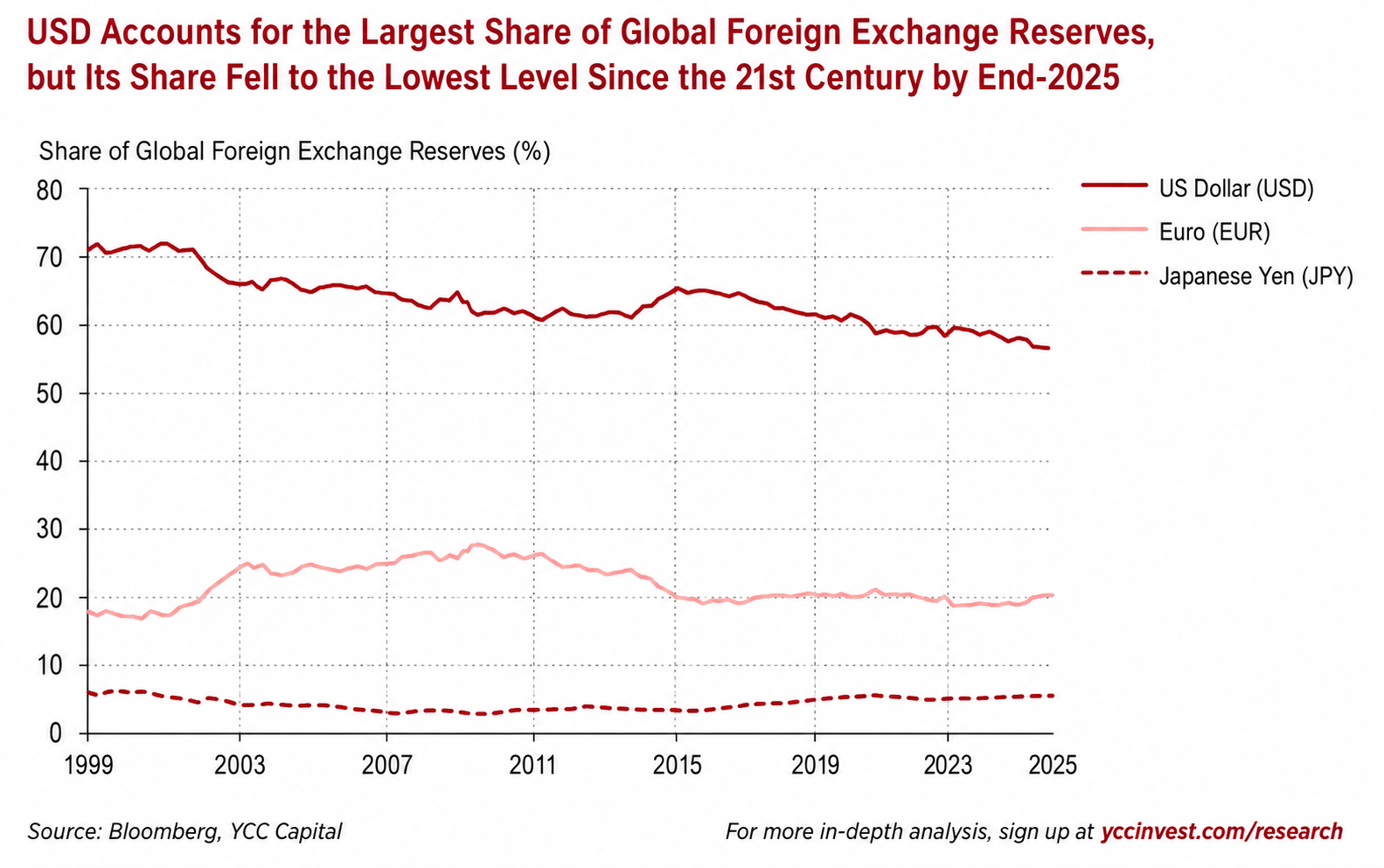
YCC CAPITAL Global Strategy June 21, 2026 Executive Perspective International monetary systems rarely change overnight. They evolve gradually, often appearing stable until a series of political, economic, and geopolitical pressures suddenly expose deeper structural weaknesses. The post-1971 international monetary order—commonly known as the Jamaica System—has survived for more than half a century. It has enabled globalization, supported unprecedented growth in international trade, and provided the world with a common reserve and settlement currency centered around the U.S. dollar. Yet the same system has also generated persistent global imbalances, concentrated extraordinary privileges in the United States, and increasingly raised questions about long-term sustainability. Recent developments have accelerated this debate. Rising geopolitical fragmentation, sanctions, trade conflicts, reserve diversification, and unusually strong demand for gold all suggest that global confidence in the existing system is no longer as unquestioned as it once was. At YCC Capital, we believe the critical question is not whether the dollar disappears. It will not. The more important question is whether the international monetary architecture gradually evolves toward a more diversified framework in which the dollar remains important but no longer occupies the singular position it has held since the collapse of Bretton Woods. The answer carries profound implications for investors, policymakers, and corporations worldwide. The Existing System: Powerful but Increasingly Strained The international monetary system governs how countries settle trade, move capital, manage reserves, and coordinate financial relations. Since the collapse of Bretton Woods in 1971 and the formal establishment of the Jamaica System in 1976, the world has operated under a fiat currency framework. Unlike previous eras, currencies are no longer backed by gold or any physical commodity. Their value rests primarily on confidence, institutional credibility, and macroeconomic management. This framework has several defining characteristics: 1. Fiat Money Dominates Modern currencies derive value not from gold convertibility but from public confidence and sovereign authority. The United States, Europe, Japan, China, and virtually every major economy now operate under fiat systems. Monetary authorities possess significant flexibility in managing liquidity, interest rates, and economic cycles. 2. Unlimited Nominal Currency Creation Once currencies were detached from gold, governments gained the ability to create money unconstrained by physical reserves. This flexibility has allowed policymakers to respond aggressively to crises ranging from the 2008 Global Financial Crisis to the pandemic-era economic shock. 3. Dollar Centrality Despite decades of predictions regarding its decline, the dollar remains the dominant reserve asset, settlement currency, and global funding vehicle. The depth of U.S. financial markets, the liquidity of Treasury securities, and the network effects embedded in global commerce continue to reinforce dollar dominance. 4. Flexible Exchange Rates Most major economies now allow exchange rates to fluctuate, providing an important shock absorber that was unavailable under fixed exchange-rate regimes. The Structural Problems of Dollar Dominance The current system has delivered enormous benefits. Yet its weaknesses have become increasingly visible. Persistent Global Imbalances One of the most significant flaws is the persistence of large and durable trade imbalances. For decades, the United States has functioned as the world’s primary deficit country while export-oriented economies—including parts of East Asia and major commodity exporters—have generated sustained surpluses. This arrangement has enabled globalization but has also created structural distortions that never fully self-correct. The Dollar’s “Exorbitant Privilege” Former French officials famously described America’s position as an “exorbitant privilege.” Because the world demands dollars, the United States can finance deficits at exceptionally favorable terms. It can effectively exchange financial claims denominated in its own currency for real goods, services, and assets produced elsewhere. This privilege has underpinned decades of American consumption and financial expansion. The Sustainability Problem Every reserve currency system contains an inherent tension. The world requires increasing quantities of reserve assets. Yet supplying those assets typically requires the issuing country to run deficits. Over time, persistent deficits may weaken confidence in the very assets that the world depends upon. This contradiction remains one of the most important long-term vulnerabilities of the current order. Why Gold Is Unlikely to Return Periods of uncertainty often revive calls for a return to gold-backed money. History suggests otherwise. The gold standard provided a clear anchor for confidence. Citizens trusted money because it could be exchanged for gold at fixed rates. However, that stability came at a significant cost. Governments surrendered monetary flexibility. Economic shocks had to be absorbed by real economies rather than central banks. Deflationary pressures became common. Financial crises often proved deeper and more prolonged because policymakers lacked the tools needed to stabilize demand. The Great Depression remains one of the strongest historical examples of these limitations. Returning to gold would require societies to abandon many of the stabilization mechanisms they now consider essential. That outcome appears highly unlikely. The Great Monetary Transformation The most important monetary development of the past two centuries was not the rise of the dollar. It was the transition from “anchored money” to “confidence-based money.” This shift delivered several major benefits: Greater Economic Stability Flexible monetary policy has reduced the volatility of both inflation and economic growth. Enhanced Crisis Management Modern central banks can inject liquidity during financial panics, helping prevent systemic collapse. Flexible Exchange Rates Countries can use currency adjustments to absorb external shocks instead of relying entirely on painful domestic deflation. Support for Globalization The modern system enabled large-scale international trade imbalances that facilitated export-led growth models across much of Asia. This last point is particularly important. Countries such as China benefited enormously from access to external demand generated by deficit economies, particularly the United States. Scenarios We Can Largely Rule Out As investors consider the future of the international monetary system, several commonly discussed outcomes appear improbable. A Single Global Currency The euro experience demonstrates the difficulty of maintaining a monetary union without political and fiscal integration. If relatively similar European economies struggle with monetary union, a global version appears even less realistic. A Return to Commodity-Backed Money Gold, commodity baskets, and similar proposals would sacrifice monetary flexibility while introducing substantial price volatility. The economic costs would likely outweigh the benefits. Sovereignless
Peace Priced In, Pain Still Ahead: Why the U.S.–Iran Accord Does Not End the Economic Aftershocks
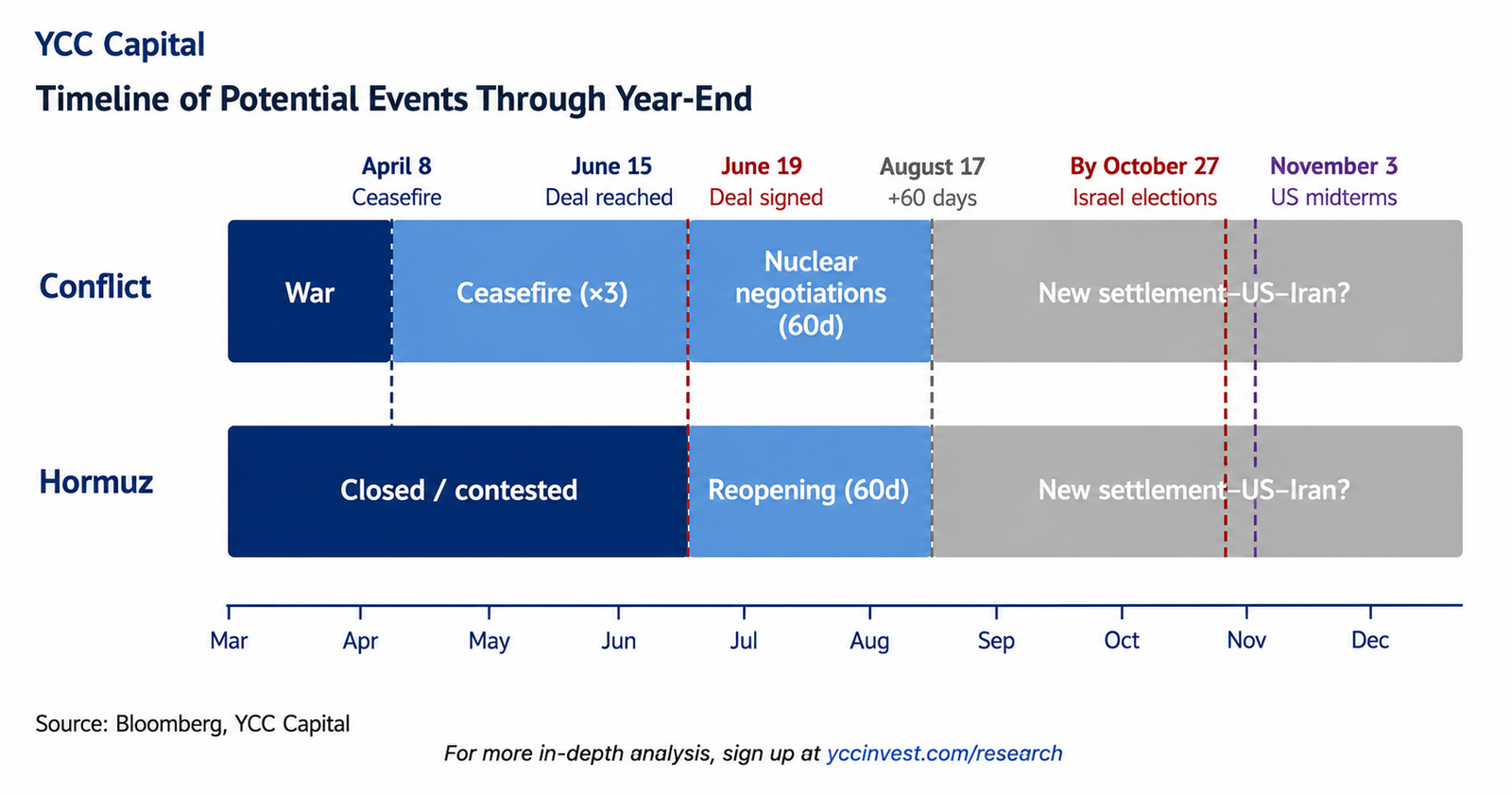
YCC CAPITAL Global Strategy June 21, 2026 Executive Summary Financial markets have largely celebrated the announcement of a temporary U.S.–Iran agreement, a 60-day ceasefire framework, and the gradual reopening of the Strait of Hormuz. Asset prices have responded as if a major geopolitical risk has been removed. Yet the real economy operates on a different timetable. The central message from our analysis is straightforward: markets are pricing peace, while households, corporations, and governments are still paying the bill for war. The economic transmission of the energy shock has not yet fully passed through inflation, wages, consumption, and corporate earnings. The relief is real, but it is neither immediate nor guaranteed. Much like a household whose utility bill arrives weeks after a heatwave has ended, economies often experience the most painful consequences of an energy shock after the headlines disappear. That lag now matters enormously for investors. YCC Perspective The ceasefire represents a meaningful de-escalation rather than a durable geopolitical settlement. Investors should resist the temptation to treat the reopening of Hormuz as an “all clear” signal. The next phase of the cycle is likely to be defined less by military developments and more by three questions: How quickly can global energy flows normalize? How persistent will inflation prove to be? Will central banks tighten policy into weakening economies? Those questions—not the ceasefire announcement itself—will determine asset returns over the next 12–18 months. The Deal: A Framework for De-escalation, Not a Final Settlement The U.S.–Iran understanding establishes a 60-day ceasefire period, opens a pathway toward renewed nuclear negotiations, and creates conditions for the gradual reopening of the Strait of Hormuz. The agreement also provides Iran temporary flexibility to increase oil exports while broader sanctions discussions continue. However, permanent sanctions relief remains conditional upon progress in nuclear negotiations and compliance with broader geopolitical commitments. This distinction is critical. The market has interpreted the agreement as a solution. In reality, it is closer to a probation period. The durability of the arrangement depends on: Successful mine-clearing operations in the Strait of Hormuz. Restoration of commercial shipping confidence. Stability in war-risk insurance pricing. Continued progress in nuclear negotiations. Maintenance of ceasefires across other regional fronts, particularly Lebanon. History suggests that confidence recovers more slowly than physical infrastructure. Even after the Iran-Iraq War ceasefire in 1988, commercial shipping required months—not weeks—to normalize despite naval protection. Energy Markets: Relief Arrives Slowly The market’s first reaction has focused on oil. That reaction is understandable but incomplete. Our base case assumes: Approximately 65% of disrupted oil supply returns within three months. Around 80% returns within four months. Full normalization occurs near year-end. Under this scenario: Period Brent Oil Forecast Q3 2026 ~$80/bbl Q4 2026 ~$75/bbl 2027 Average ~$70/bbl The decline in prices reflects normalization rather than oversupply. Additional barrels are expected from: Iran OPEC production normalization U.S. output Venezuela Other non-OPEC producers At the same time, global demand is expected to recover as Asian industrial activity improves and strategic inventories are replenished. The result is not a collapse in oil prices but rather a transition toward a more balanced market. Inflation: The Peak Is Still Ahead One of the most important market misconceptions today is that lower oil prices immediately mean lower inflation. That is not how inflation transmission works. Energy shocks move through the economy in stages: Energy and transport costs rise. Producer prices increase. Businesses pass costs to consumers. Wage negotiations adjust. Core inflation rises with a lag. As a result, inflation may actually worsen before it improves. Our expectations: United States 2026 CPI: approximately 3.3% Core CPI exceeds 3% during Q4 2026 Eurozone Inflation peaks near 3.4% Average 2026 inflation around 3.1% Real wage growth is unlikely to turn meaningfully positive until early 2027. Markets are therefore discounting inflation improvement several quarters before official data will confirm it. Central Banks Face Their Biggest Policy Risk Since 2022 The Federal Reserve and the ECB now face an uncomfortable dilemma. By the time inflation data peaks, underlying economic momentum may already be weakening. Yet policymakers remain heavily dependent on backward-looking indicators. Our base case expects: One additional Federal Reserve rate hike. One additional ECB rate hike. The risk is clear: Central banks may tighten policy precisely as inflation pressures begin fading and growth slows. This risk is particularly acute in Europe, where growth is already fragile. The United States enjoys stronger structural growth drivers and therefore has greater capacity to absorb further tightening. Europe does not. Why Europe Remains the Most Vulnerable Region The U.S.–Iran agreement does not affect all economies equally. America enters this period with several advantages: Net energy exporter status. Strong AI-driven capital expenditure cycle. Supportive fiscal policy. Wealth effects from elevated equity valuations. Europe enjoys none of these offsets. The Eurozone remains vulnerable because: Energy intensity is higher. Trade dependence is greater. Consumer confidence remains weak. Fiscal flexibility has been largely exhausted. Germany benefits from defense and infrastructure spending. Elsewhere conditions remain far more challenging. France, for example, continues to show deteriorating business sentiment and weak growth momentum. For European households, the squeeze is likely to persist through most of 2026. Energy bills absorb a larger share of disposable income than in the United States, while mortgage repricing remains especially painful in markets such as the United Kingdom and the Netherlands. China: Stable Growth, Persistent Export Strength China remains one of the more resilient major economies. Growth continues to be driven by: High-tech manufacturing. Export competitiveness. AI-related hardware demand. Clean-energy supply chains. Our expectations: Year GDP Growth 2026 4.7% 2027 4.4% Inflation remains subdued: Year CPI 2026 1.0% 2027 1.2% The People’s Bank of China therefore retains flexibility to maintain accommodative policy. The primary risk remains trade policy, particularly potential U.S. tariff escalation. Corporate Impact: Pricing Power Becomes Everything Lower energy prices help businesses, but not equally. The key dividing line is pricing power. Likely Beneficiaries Airlines Branded pharmaceuticals Specialty chemicals Fertilizer producers Semiconductor companies benefiting from AI demand More Vulnerable Industries Automotive OEMs Generic pharmaceuticals Consumer hardware manufacturers Commodity producers without