
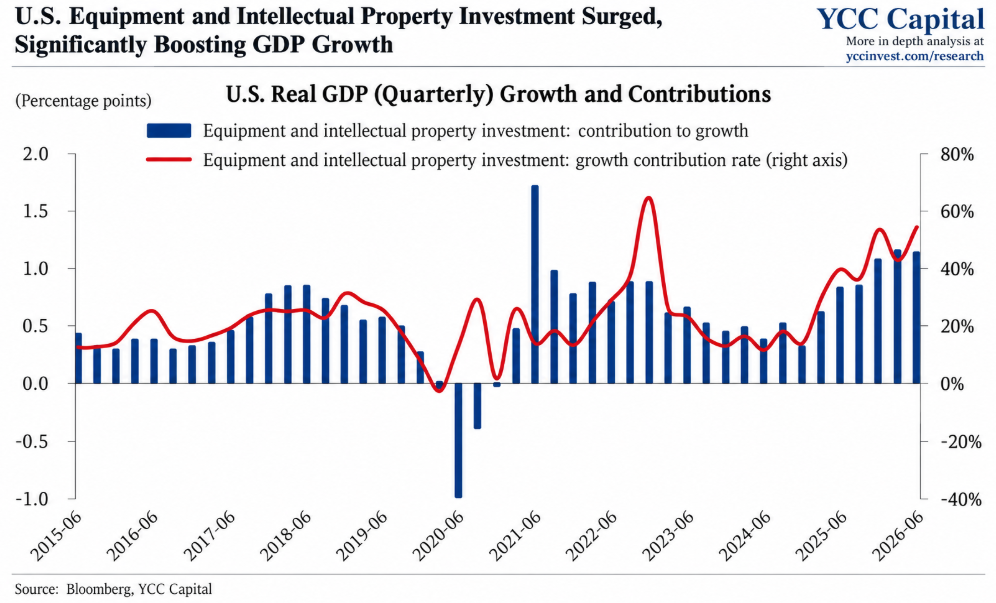
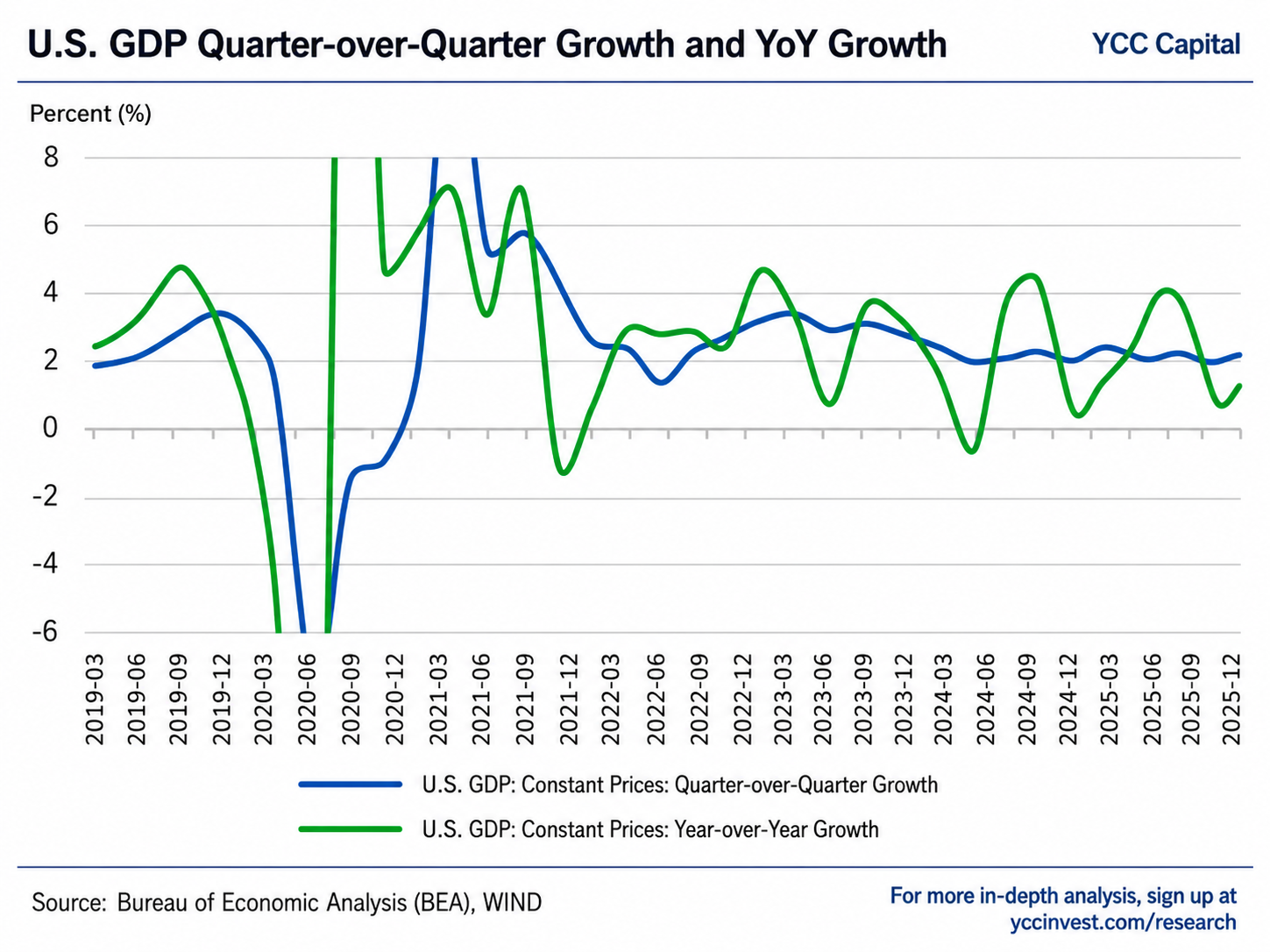
YCC CAPITAL Global Strategy September 8, 2026 YCC Capital Research The global AI investment boom is creating prosperity, but it is not distributing that prosperity evenly. Both the United States and China increasingly resemble K-shaped economies: technology-intensive industries are moving upward while traditional sectors, smaller businesses, and selected household groups remain under pressure. Yet the similarity ends there. In China, the divide is principally between industries. New engines such as advanced manufacturing, digital infrastructure, and AI-related production are expanding, but they have not replaced the employment, income, property-wealth, and fiscal contribution once generated by real estate and infrastructure. The result is an economy where productive capacity remains relatively strong while domestic demand remains weak. In the United States, the divide is increasingly between households and firms. AI capital expenditure and rising financial assets are generating powerful gains for technology companies and wealthier households, while high interest rates and elevated living costs disproportionately burden smaller firms and lower-income consumers. The distinction matters for investors. America’s K-shaped expansion is uncomfortable but still growth-supportive. China’s version is more problematic because the declining side of the K remains large enough to overwhelm much of the incremental contribution from the rising side. China: New Engines Are Growing, but the Old Economy Is Shrinking Faster China’s macroeconomic backdrop remains defined by weak demand, low inflation, and low interest rates. During the first half of 2026, real GDP expanded 4.7% year over year, yet fixed-asset investment fell 5.7%, while retail sales grew only 1.3%. That combination tells an important story. Production continues to outrun demand, and external activity remains healthier than the domestic economy. In July, headline CPI inflation was only 0.5%, with core CPI at 0.9%. The seven-day reverse-repurchase policy rate remained at 1.4%. Cheap money has therefore not translated into a meaningful acceleration in household spending or private investment. Low rates are sometimes interpreted as supportive. But rates are also a thermometer. When borrowing costs remain extremely low while credit demand stays weak, the message is often not “abundant opportunity,” but insufficient appetite to borrow. China’s problem is therefore larger than a simple difference in growth rates between new and old industries. The contraction of property and other traditional engines has already spread through investment, employment, household income, wealth, local-government finance, and business confidence. Meanwhile, the gains from advanced industries have not yet reached the household sector at sufficient scale. The employment mathematics illustrate the challenge. In 2023, every RMB100 million of domestic final demand generated approximately 238.1 jobs in new-economy industries, compared with 307.9 jobs in old-economy industries and 281.3 jobs in baseline industries. New-economy industries accounted for 18.1% of national value added, but only 16.6% of employee compensation. Baseline industries represented 52.0% of value added yet 60.5% of employee compensation. That gap is crucial. China can manufacture more semiconductors, automation equipment, batteries, and digital services without reproducing the employment multiplier once associated with property, construction, and traditional services. For a household, GDP is an abstraction; the paycheck is not. This is why we remain cautious on China’s domestic macro outlook. The new economy is real and technologically important, but it is still too capital-intensive, too concentrated, and too weakly transmitted into household income to fully compensate for the retreat of the old growth model. America: AI Capex Is Powerful Enough to Move the Cycle The U.S. presents a very different K-shaped structure. Real GDP expanded 2.1% year over year in the second quarter of 2026. Equipment investment increased 9.6%, while intellectual-property investment rose 8.3%. Together, these categories contributed approximately 1.1 percentage points to economic growth. This is not a marginal phenomenon. AI investment is becoming a macroeconomic variable. Major U.S. technology companies continue to spend aggressively on chips, servers, data centers, cloud infrastructure, software, and electricity capacity. Unlike conventional corporate investment, much of this spending is relatively insensitive to interest rates. Competitive pressure, rapid technological change, and the fear of surrendering strategic position can matter more than near-term financing costs. A company racing to secure leadership in AI infrastructure does not necessarily behave like a property developer calculating whether a project still works after a 100-basis-point move in borrowing costs. The wealth effect compounds the impact. From 2023 through the first quarter of 2026, U.S. household equity holdings increased approximately 70%, accounting for around 60% of the rise in total household assets. Consumption has consequently remained resilient. Real consumer spending grew 2.3% year over year in the second quarter of 2026, while the household saving rate declined from 5.1% in January 2025 to 2.7% in June 2026, the lowest reading since June 2022. The U.S. economy therefore has something China currently lacks: a powerful feedback loop connecting technological investment, financial markets, household wealth, and consumption. We remain cautiously optimistic on the U.S. economy for precisely this reason. But America’s Strength Is Unevenly Distributed The American expansion is resilient, not broad-based. Traditional construction is weak. Residential and non-residential construction investment declined a combined 4.2% year over year in the second quarter, subtracting roughly 0.3 percentage points from GDP growth. Nominal construction spending fell 2.6% during the first half of 2026. Manufacturing plants, commercial facilities, hospitals, hotels, and other conventional projects have softened, even as AI-related communications infrastructure continues to expand. Small businesses are also feeling the pressure. The NFIB small-business optimism index stood at 95.3 in May 2026, down 4.2 points from December 2025. Expectations for hiring, capital expenditure, and sales growth weakened. Companies with fewer than 250 employees account for roughly 73% of U.S. employment, yet their payroll growth has been only marginal since 2025. Businesses with fewer than ten employees lost approximately 292,000 workers in 2025, almost 4.5 times the employment decline experienced during the 2020 pandemic shock. High rates are asymmetric. Cash-rich technology companies can finance investment internally and may even earn substantial interest income. Small businesses frequently rely on bank credit, revolving facilities, and shorter-duration borrowing. The same interest rate can therefore be almost irrelevant to one company and existential to another. The Household Divide Is Even More
Two Economies, One K: Why America’s AI Boom Is Holding Up Growth While China’s Old Engines Keep Fading
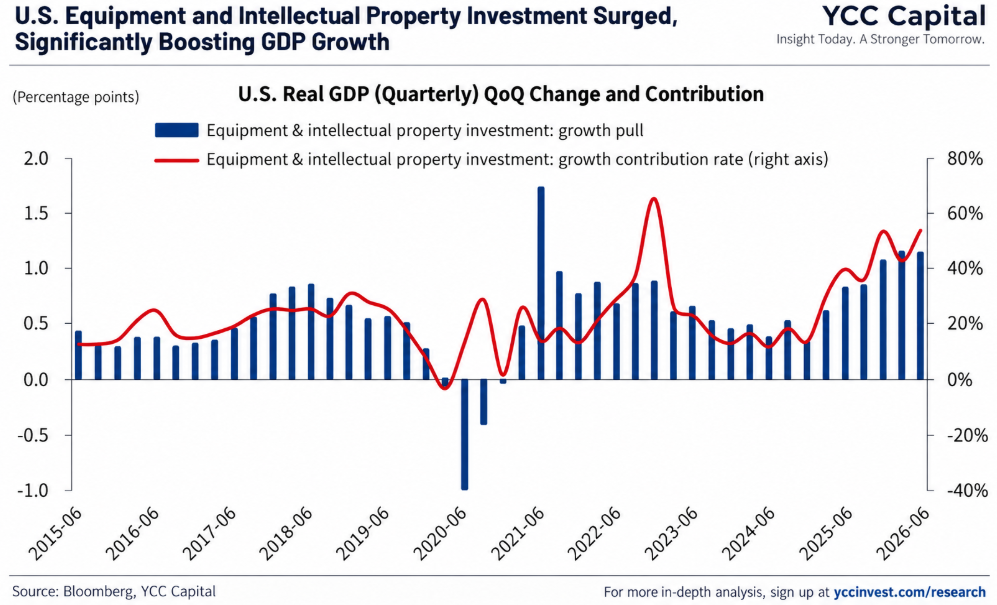
YCC CAPITAL Global Strategy September 8, 2026 YCC Capital Perspective The global economy increasingly resembles a city where the newest towers are filling with light while entire older neighborhoods remain dim. Artificial intelligence, advanced computing and capital-intensive technology are creating powerful new pockets of growth, but those gains are not spreading evenly across industries, workers or households. The United States and China both exhibit this “K-shaped” pattern, yet the economic consequences are fundamentally different. In the U.S., AI investment, rising financial wealth and high-income consumption are strong enough to keep aggregate growth resilient despite pressure on small businesses and rate-sensitive sectors. In China, new-economy industries are expanding, but their contribution remains insufficient to offset the contraction in property, construction and other traditional engines. Our central conclusion is straightforward: America’s K-shaped economy is unequal but still growing; China’s is increasingly constrained by an incomplete handoff between old and new growth models. China: New Engines Are Growing, but the Hole Left by the Old Economy Is Larger China’s macro backdrop remains characterized by weak domestic demand, subdued inflation and unusually low interest rates. In the first half of 2026, real GDP expanded 4.7% year over year, yet fixed-asset investment fell 5.7% and retail sales rose only 1.3%. By July, headline CPI inflation was just 0.5%, core CPI was 0.9%, and the seven-day reverse-repurchase rate remained at 1.4%. Those numbers describe an economy in which supply remains considerably stronger than demand. Lower financing costs have not generated a meaningful revival in household consumption or private investment. The difficulty is not simply that traditional industries are growing more slowly than high-tech sectors. Property and other old-economy industries historically supported employment, household wealth, local-government revenue and broad domestic supply chains. Their contraction therefore travels through the economy quickly. New industries, by contrast, are more capital- and technology-intensive and create fewer jobs per unit of output. The employment arithmetic illustrates the problem. In 2023, every RMB100 million of final domestic demand generated approximately 238 jobs in new-economy industries, compared with 308 in old-economy industries and 281 in core mainstream industries. New-economy sectors represented 18.1% of national value added but only 16.6% of employee compensation. Mainstream industries produced 52.0% of value added while accounting for 60.5% of compensation. China can produce more advanced machinery, digital services and technology exports without automatically creating an equivalent improvement in household income. That disconnect is central to our cautious view. The new economy is real, but it has not yet developed enough economic mass—or sufficiently broad transmission into household balance sheets—to replace property-led demand. America: AI Capital Spending Has Become a Macro Force The U.S. version of the K is different because the upper arm is unusually powerful. Real U.S. GDP grew 2.1% year over year in the second quarter of 2026. Equipment investment increased 9.6% and intellectual-property investment rose 8.3%; together, the two categories contributed roughly 1.1 percentage points to growth. AI investment is no longer a narrow technology story. Spending stretches across semiconductors, servers, data centers, cloud infrastructure, software and electricity generation. Large technology companies also possess substantial internal cash flows, making investment less sensitive to interest rates than conventional capital spending. This matters enormously for the cycle. A small manufacturer deciding whether to purchase machinery at elevated borrowing costs may postpone the decision. A technology platform fighting for leadership in a once-in-a-generation computing transition has a very different incentive. Waiting can be more expensive than capital. The capital-market channel reinforces the effect. Between 2023 and the first quarter of 2026, U.S. household equity holdings increased approximately 70% and accounted for roughly 60% of the increase in total household assets. Real consumption rose 2.3% year over year in the second quarter, while the household saving rate declined from 5.1% in January 2025 to 2.7% by June 2026. For investors, this creates an important feedback loop: AI investment supports profits and asset prices; rising financial wealth supports higher-income consumption; that consumption supports aggregate growth. The Other America Still Feels the Weight of High Rates Resilience does not mean uniform prosperity. Residential and nonresidential construction investment fell a combined 4.2% year over year in the second quarter, subtracting roughly 0.3 percentage points from GDP growth. Nominal construction spending declined 2.6% during the first half of 2026, with weakness across factories, commercial buildings, hospitals and hotels outside AI-related communications infrastructure. Small businesses face an even sharper financing disadvantage. Large technology companies can fund investment internally and may even earn substantial interest income on cash holdings. Smaller businesses rely more heavily on bank loans and short-term credit. The small-business optimism index stood at 95.3 in May 2026, down 4.2 points from December 2025. Businesses with fewer than 250 employees account for roughly 73% of U.S. employment, yet their payroll expansion has been significantly weaker than that of larger companies. Businesses with fewer than ten employees lost about 292,000 workers in 2025. The K also runs directly through household balance sheets. High-income households benefit disproportionately from equity-market appreciation, while lower-income households experience higher borrowing costs and greater pressure from essential expenses. Consumer sentiment fell from 60.7 in June 2025 to 51.7 in August 2026 and reached 44.8 in May. Lower-income wage growth has slowed materially: from August 2025 through July 2026, wage growth for the bottom income quartile ran around 3.5%–3.7%, close to its weakest pace since 2016. Yet we remain cautiously constructive on the U.S. macro outlook. The distributional strains are meaningful, but the upper branch of the K remains strong enough to preserve aggregate momentum. High Inflation Is Both Symptom and Constraint U.S. headline CPI inflation stood at 3.4% in July, with core inflation at 2.5%. The federal-funds target range remained 3.50%–3.75%. This creates a self-reinforcing cycle. AI investment and high-income consumption keep growth firmer than traditional rate-sensitive sectors alone would imply. Stronger demand keeps inflation sticky. Sticky inflation limits the Federal Reserve’s ability to ease aggressively. Higher-for-longer rates then impose additional pressure on small businesses, housing and leveraged households. It is uncomfortable, but not necessarily recessionary. China faces almost
Two Economies, Two K’s: China’s Weak Domestic Loop Meets America’s AI-Led Expansion
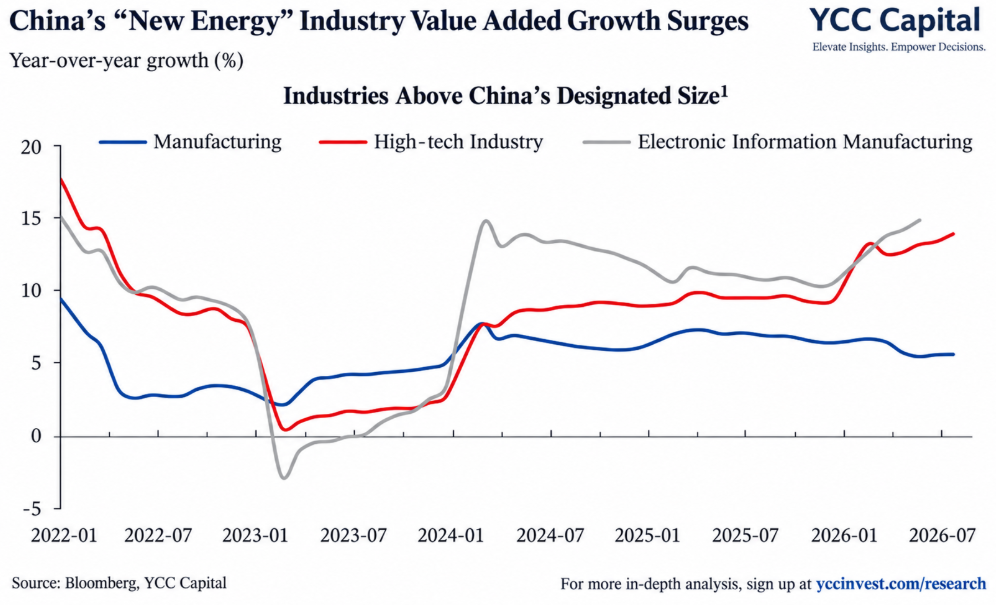
YCC CAPITAL Global Strategy September 4, 2026 The YCC View The global economy is increasingly being described by averages that conceal more than they reveal. China offers perhaps the clearest example. At the headline level, growth remains positive and advanced manufacturing is expanding rapidly. Beneath that surface, however, the economy is splitting into two very different tracks: AI, electronics and high-end manufacturing are accelerating, while property, traditional consumption and household balance sheets remain under pressure. That divergence matters because the sectors moving upward are not yet large enough—or labor-intensive enough—to compensate fully for the sectors moving downward. A semiconductor fab can generate extraordinary output with relatively few workers; a housing boom once supported construction crews, furniture stores, appliance manufacturers, local governments and household confidence simultaneously. One engine is technologically powerful. The other was economically broad. The result is a K-shaped Chinese economy in which industrial sophistication is rising faster than household prosperity. By contrast, the United States is experiencing its own K-shaped expansion, but with a crucial difference: the upward branch, led by AI investment and capital-market wealth creation, has so far been strong enough to keep aggregate growth comparatively resilient. China: New Engines Are Accelerating China’s strongest economic momentum is concentrated in advanced manufacturing. During January–July 2026, value added in high-technology manufacturing increased 13.8% year over year, far above the 5.3% growth of industrial enterprises above designated size. High-technology industry investment rose 5.0%, even as total fixed-asset investment fell 6.7%. July sharpened the contrast. Value added in equipment manufacturing increased 12.3%, high-technology manufacturing rose 16.9%, and digital-product manufacturing expanded 17.3%. Electronics alone contributed 43.7% of the growth in industrial value added. Production of sensors increased 35.3%, memory chips 30.2%, and industrial robots 30.2%. AI, electronic information and advanced equipment are no longer peripheral stories. They have become central pillars supporting Chinese industrial production. Corporate profitability shows the same divide. During January–July, total profits of large industrial enterprises increased 17.6%, while profits in high-technology manufacturing surged 50.1%. By comparison, profits in non-metallic mineral products fell 48.2%. The equity market has been equally unforgiving in separating winners from losers. During the first eight months of 2026, the CSI 300 slipped 0.1%, while the technology-heavy STAR 50 gained 25.3%. Of 31 major Shenwan industries, only ten posted gains. Electronics advanced 36.7% and communications 31.0%, while several traditional consumer sectors—including retail, beauty and automobiles—fell close to or beyond 20%. In other words, China does have a bull market. It is simply an unusually narrow one. Exports: AI Is Doing Heavy Lifting The AI supply chain has also become an important engine of external demand. During January–July 2026, China’s U.S.-dollar exports increased 18.5% year over year. AI-related supply-chain exports reached approximately $582.8 billion, equivalent to 23.1% of total exports, up from 18.6% in 2025. These exports increased 50.1%, contributing roughly 9.1 percentage points to overall export growth and accounting for approximately 49.4% of the increase in exports. This is strategically important, but it also exposes the central weakness of the current growth model: some of the strongest demand for China’s new industrial capacity is coming from overseas rather than Chinese households. The factory floor is modernizing faster than the domestic demand engine is healing. Source: Bloomberg, YCC Capital The Old Economy Is Still Shrinking The problem sits most visibly in property. During the first half of 2026, real-estate industry value added declined 0.2%, while construction value added fell 4.0%. During January–July, real-estate development investment contracted 19.2% year over year. In July, second-hand residential prices across 70 major cities were down 5.4% from a year earlier. Property’s economic footprint extends far beyond developers. Housing connects steel, cement, chemicals, building materials, appliances, furniture, construction activity, local-government finance and household wealth. Input-output analysis illustrates why the decline remains so difficult to replace. In 2023, every RMB1 of domestic final demand in old-economy industries generated approximately RMB2.524 of total domestic output, compared with RMB2.282 for new-economy industries. New manufacturing is increasingly productive, but the old growth complex still possesses deeper economic linkages. It is a little like replacing a department store with a high-end technology laboratory. The laboratory may be more innovative and profitable per employee, but fewer surrounding restaurants, delivery workers and neighborhood businesses necessarily benefit from each dollar spent inside it. The Household Balance Sheet Remains the Weak Link Weak property prices are feeding directly into household behavior. During January–July, retail sales increased only 1.2%. Services performed better, with service retail sales rising 5.0%, while goods retail sales increased just 1.1%. Durable categories such as automobiles, appliances and household furnishings remained particularly soft. Chinese households are also saving more. The estimated urban household saving rate increased from 33.7% in December 2025 to 36.5% in June 2026. That behavior is rational. Housing represents roughly half of Chinese household assets. When property prices fall, asset values decline while mortgage obligations do not fall in parallel. Families respond by protecting cash flow and rebuilding balance sheets rather than increasing discretionary spending. Household leverage consequently declined from 61.5% in Q1 2025 to 57.7% in Q2 2026. Deleveraging may improve financial resilience over time, but during the adjustment it acts as a brake on consumption. Jobs Reveal the Missing Transmission Mechanism Headline unemployment does not fully capture the strain. China’s surveyed urban unemployment rate stood at 5.2% in July, but unemployment among workers aged 16–24 excluding students rose sharply from 14.9% to 17.9%, its highest level since August 2025. Per-capita wage income increased 5.3% in the second quarter, below the 5.8% pace recorded in the fourth quarter of 2024. This exposes the central problem with the transition toward new growth drivers. Advanced technology sectors are capital- and knowledge-intensive. They can produce impressive revenue, exports and market capitalization without creating employment on the scale once generated by construction, property services and traditional manufacturing. The missing loop is therefore straightforward: industrial expansion should raise domestic value added, which should raise employment and compensation, which should lift household consumption. China has achieved the first stage more convincingly than the remaining three. Strong Supply,
Korea’s Great Deleveraging: Why One of the World’s Most Leveraged Equity Markets Has Become the New Fault Line for Global Technology Stocks
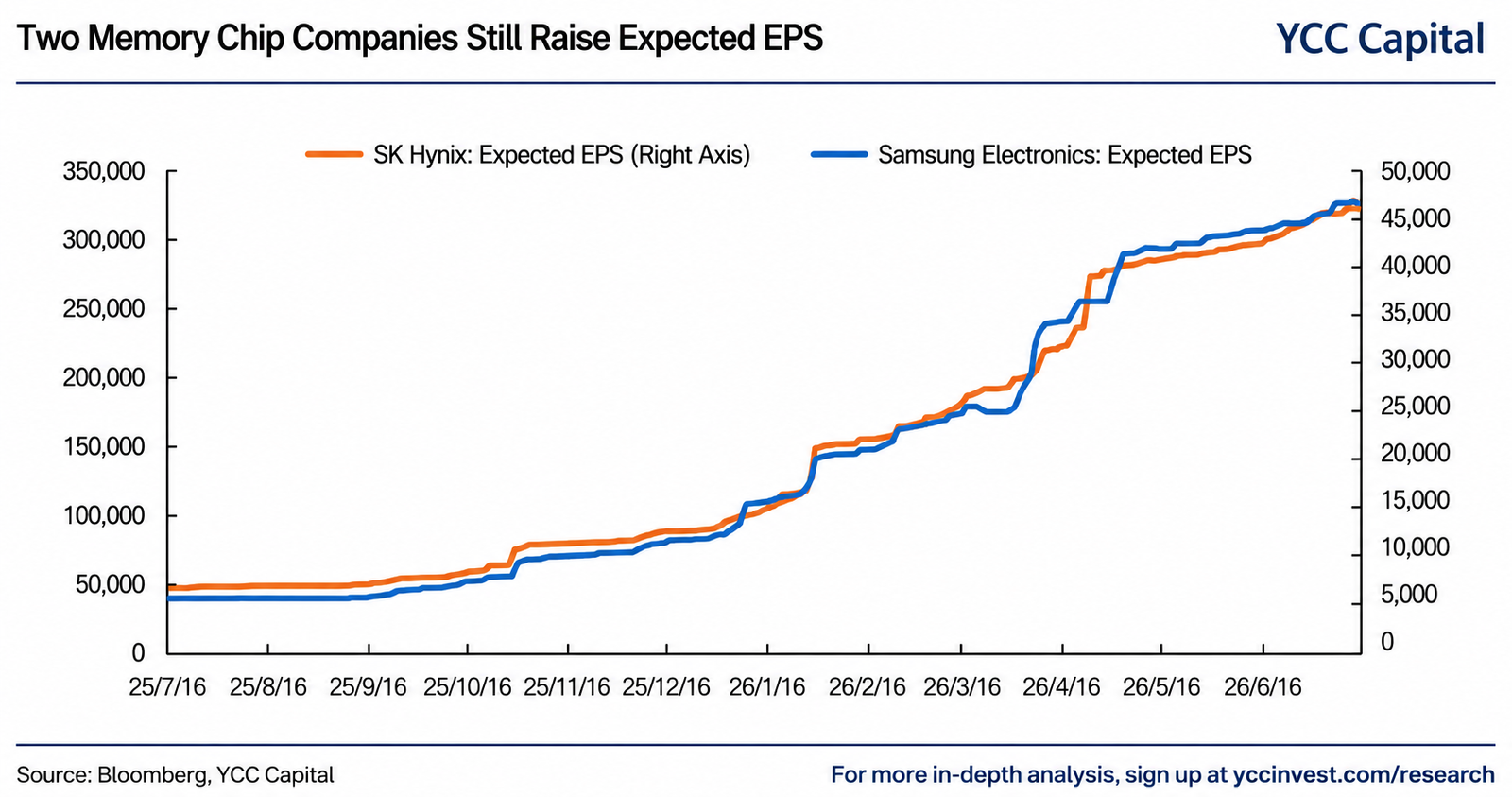
YCC CAPITAL Global Strategy July 18, 2026 Executive Summary Markets rarely collapse because a long-term investment story suddenly disappears. More often, they unravel because too many investors crowd into the same trade using borrowed money. The recent correction in South Korean equities fits this pattern almost perfectly. At first glance, the nearly 25% drawdown in the KOSPI appeared alarming enough to raise questions about whether the global AI investment cycle had finally reached its limits. Yet a closer examination suggests something different. The semiconductor industry’s structural outlook has not fundamentally deteriorated. Instead, Korea has become the first major market to experience a large-scale liquidity shock created by excessive leverage concentrated in a narrow group of technology stocks. The implications extend well beyond Seoul. South Korea has evolved into one of the most important transmission mechanisms for global technology sentiment. Samsung Electronics and SK Hynix now dominate index composition, ETF flows, retail participation and leveraged trading activity to such an extent that volatility in Korean markets increasingly spills over into U.S., Hong Kong and broader Asian technology equities. From a macro perspective, Korea today resembles a speedboat moving through rough seas while larger markets resemble ocean liners. The speedboat may be smaller, but the waves it generates can still rock much larger vessels. When leverage becomes excessive, price declines are no longer driven primarily by deteriorating fundamentals but by investors selling because they have no alternative. YCC Capital believes the current episode should primarily be understood as a liquidity-driven deleveraging event rather than the beginning of a structural bear market for artificial intelligence or memory semiconductors. Nevertheless, liquidity shocks often last longer than investors initially expect, especially when forced selling mechanisms continue feeding upon themselves. The key question is therefore no longer whether valuations have become attractive. The more important question is whether the deleveraging process has actually finished. Korea Has Become the Global Amplifier of Technology Risk Appetite Over the past several years, South Korea has quietly transformed into one of the world’s most leveraged technology equity markets. This concentration stems from three characteristics. First, Samsung Electronics and SK Hynix together represent an extraordinary share of market capitalization and trading activity. The two memory-chip manufacturers account for roughly half of KOSPI’s effective technology exposure, making the entire market unusually dependent upon the fortunes of the semiconductor cycle. Second, leverage has become layered rather than isolated. Retail investors increasingly employ multiple financing channels simultaneously. Traditional margin financing has expanded rapidly. Securities-backed loans allow investors to borrow against existing holdings. Single-stock leveraged ETFs offer two-times daily exposure to individual companies. Options and derivatives add yet another layer of embedded leverage. Finally, these products interact with one another. Unlike a traditional investment portfolio, where one investor’s losses need not immediately affect another participant, Korea’s leveraged ecosystem creates automatic selling pressure whenever prices decline. That makes liquidity—not earnings—the dominant short-term driver. This distinction is critical. Consensus earnings forecasts for both Samsung Electronics and SK Hynix continue to improve as AI infrastructure investment remains robust. Demand for high-bandwidth memory (HBM), advanced DRAM and AI servers has softened only marginally relative to the extraordinary optimism priced into markets earlier this year. The structural investment case has therefore weakened far less than share prices would suggest. Instead, investors have been forced to reduce exposure because financing conditions tightened. History provides several useful parallels. China’s 2015 equity collapse was not initially caused by collapsing corporate earnings. Rather, excessive margin financing eventually overwhelmed the market. Likewise, the precious metals correction earlier this year reflected an unwinding of leveraged positioning more than any dramatic change in long-term supply-demand fundamentals. Korea now appears to be following a remarkably similar path. The Market Correction Has Been Violent, but the Volatility Structure Suggests Deleveraging Remains Incomplete The KOSPI has fallen nearly one-quarter from its June peak, officially entering bear-market territory. At the same time, implied volatility remains exceptionally elevated. VKOSPI, although below its most extreme readings, continues to trade near the upper end of its historical range, indicating that investors remain engaged in aggressive portfolio repositioning rather than orderly accumulation. Leverage products have experienced even more dramatic declines. Many of the recently launched single-stock leveraged ETFs focused on Samsung Electronics and SK Hynix have lost more than 10% in a single trading session, with several falling below their original issue prices. Assets under management have contracted sharply. This decline reflects two reinforcing dynamics. Some investors have redeemed their ETF holdings. Others have remained invested but experienced substantial mark-to-market losses. Either outcome produces the same macro consequence: the amount of pro-cyclical capital supporting the market shrinks rapidly. The contraction has been particularly visible in leveraged products linked to SK Hynix, whose assets have fallen dramatically from recent highs. For market stability, this matters because leveraged ETFs must rebalance daily. During rising markets, these products buy additional exposure to maintain target leverage. During falling markets, they must sell. This creates negative gamma dynamics, reinforcing existing market moves instead of dampening them. In extreme trading sessions, the products themselves become sources of additional volatility. Korea’s Regulatory Framework Reduces Excesses—but Cannot Eliminate Pro-Cyclical Selling South Korean regulators have not ignored these risks. Authorities have gradually tightened investor access to leveraged products by raising minimum deposit requirements, expanding mandatory investor education, suspending approvals for additional single-stock leveraged ETFs and restricting promotional activity. Beginning in August 2026, minimum deposits required for participation in certain leveraged ETF products will rise substantially, while educational requirements become more stringent. These measures should reduce future speculative participation. However, they do little to address existing positions. The more important vulnerability lies within margin financing itself. Although maintenance ratios differ among brokerage firms, many retail margin accounts operate around maintenance collateral requirements of roughly 140%. Once collateral values fall below required thresholds, investors receive margin calls. Failure to provide additional capital within the required period allows brokerages to liquidate positions automatically. Importantly, this process is highly pro-cyclical. When many investors breach collateral thresholds simultaneously, forced liquidation accelerates market declines, triggering additional margin calls elsewhere.
The Market’s Long Game: What Is a Fair Long-Term Return for Equities?
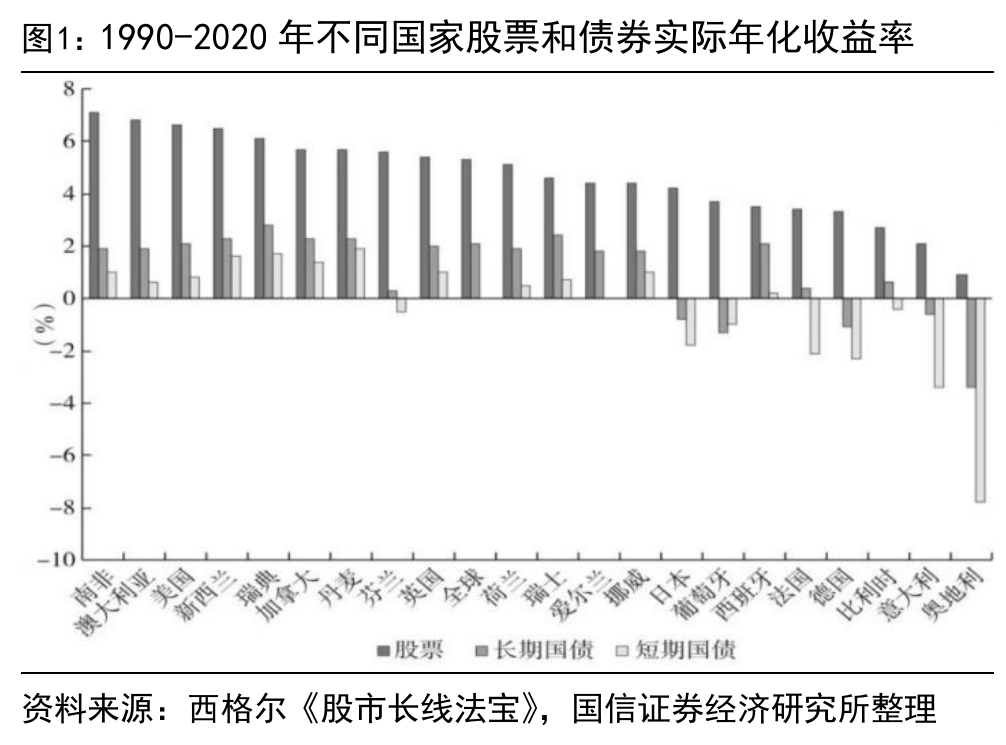
YCC CAPITAL Global Strategy Date: July 14, 2026 Executive Summary Every market cycle eventually tempts investors into believing that “this time is different.” During technology booms, it becomes easy to assume extraordinary returns are permanent. During prolonged downturns, investors often conclude that equities have permanently lost their appeal. History suggests both conclusions are usually wrong. One of the most useful questions an investor can ask is not whether markets will rise next month or next quarter, but rather what constitutes a reasonable long-term return from owning productive businesses. That question lies at the heart of portfolio construction, pension management, wealth preservation, and capital allocation. Looking across more than a century of global market history, one conclusion emerges with remarkable consistency: equities remain the highest-returning major asset class over long investment horizons. Despite wars, depressions, inflationary shocks, financial crises and political upheaval, diversified stock ownership has historically delivered nominal annualized returns of roughly 8%–10%, comfortably exceeding bonds, real estate, commodities, precious metals and cash. This observation is not simply a statistical curiosity. It reflects a fundamental truth about capitalism itself. Businesses innovate, productivity improves, earnings compound and dividends accumulate. Investors who remain patient participate directly in that process. For long-term investors, patience is not merely a virtue—it is an economic asset. At YCC Capital, we believe today’s market environment makes revisiting these long-run relationships particularly valuable. The dramatic divergence between technology leadership and traditional sectors has reignited debates about fair valuation, sustainable returns and future market leadership. Understanding where current returns stand relative to historical norms provides an essential framework for evaluating opportunities across global markets. Several broad conclusions emerge from our analysis. First, global equity markets have historically generated nominal annualized returns close to 8–10%, with U.S. equities delivering approximately 9–10% over the past century. Second, long-term stock returns ultimately reflect economic fundamentals rather than investor enthusiasm. At the macro level, countries experiencing faster nominal GDP growth generally produce stronger long-run equity returns. At the company level, corporate earnings growth and dividend distributions explain the overwhelming majority of long-term shareholder wealth creation. Third, valuation expansion—or what investors often describe as multiple expansion—has historically contributed surprisingly little over very long horizons. Market optimism fluctuates dramatically from cycle to cycle, but corporate cash generation ultimately determines investment outcomes. Fourth, while U.S. equities have recently generated returns substantially above their historical averages, broad Chinese equity benchmarks have produced returns closer to—or even below—their long-term norms. Within China, however, significant dispersion has emerged across sectors, with technology outperforming while traditional industries including property, financials and consumer staples continue to lag historical performance. Rather than signaling the end of equity investing, these divergences illustrate the normal evolution of market cycles. The Century-Long Evidence: Why Equities Continue to Outperform Imagine two families beginning their investment journeys generations ago. One purchases government bonds and safely rolls them over every decade. The other acquires ownership stakes in businesses—factories at first, later industrial firms, consumer brands, software companies and artificial intelligence leaders—allowing profits to compound through reinvestment and dividends. Both experience recessions, inflation and geopolitical shocks. Yet after several decades, the second family’s wealth becomes exponentially larger. That simple illustration captures one of the most consistent findings in financial history. Equities Have Been the World’s Best Long-Term Investment Historical evidence spanning more than one hundred years demonstrates remarkable consistency across developed markets. Research summarized by Jeremy Siegel and corroborated by subsequent academic literature shows that between 1900 and 2020 global equities generated approximately 5.3% real annual returns after inflation. Once inflation is incorporated, nominal returns approach 9% annually, while U.S. equities have historically exceeded 9.5% nominal annual returns. Although annual market performance fluctuates dramatically, extending the investment horizon progressively reduces the influence of temporary market dislocations. Looking at more recent decades tells a similar story. Between 1988 and 2021: Global equities produced approximately 8.7% annualized U.S. dollar returns. Emerging markets generated roughly 10.5%. U.S. equities delivered approximately 11.6%. Different regions experience different cycles, yet the long-run equilibrium remains remarkably stable. For investors with horizons extending twenty years or longer, annualized equity returns have historically converged toward approximately 8–10%. This consistency reflects a fundamental economic reality. Unlike bonds, whose future cash flows are largely fixed, businesses possess the ability to expand production, improve productivity, develop new technologies, enter new markets and raise prices alongside inflation. Equity ownership therefore represents participation in an expanding economic system rather than ownership of a fixed contractual claim. Stocks Consistently Outperform Other Major Asset Classes Historical asset allocation data reinforces the same conclusion. Across more than two centuries of U.S. financial history, equities have significantly outperformed nearly every major alternative investment. Average nominal annual returns approximately equal: U.S. equities: 8.4% Long-term government bonds: 5.0% Treasury bills: 4.0% Gold: 2.1% U.S. dollar cash purchasing power: 1.4% While the numerical differences appear modest on an annual basis, compounding transforms these gaps into extraordinary wealth differentials. A single dollar invested in U.S. equities at the beginning of the nineteenth century would ultimately have appreciated into tens of millions of dollars when dividends are continually reinvested. The same dollar invested in gold or cash would have produced only a tiny fraction of that wealth. Compounding is often called the eighth wonder of the world because it rewards consistency rather than brilliance. Investors rarely appreciate its full power because it unfolds gradually before becoming exponential. China Shows Similar Asset Allocation Patterns—With Important Caveats China’s modern financial history is considerably shorter, yet broad asset allocation trends display similar characteristics. Between 2005 and 2025: Wind All A shares delivered approximately 10.6% annualized total returns. CSI 300 Total Return Index generated roughly 10.0%. Residential real estate, including rental income, returned approximately 8.3%. Broad commodities produced roughly 4.8%. Government bonds generated approximately 4.3%. Equities therefore remained the strongest-performing major domestic asset class over the period. However, YCC Capital believes investors should interpret these figures cautiously. Unlike the United States, China’s future economic trajectory faces substantially greater structural uncertainty. Demographic deterioration, declining productivity growth, elevated local government debt, prolonged weakness in property markets and
The Second Half Begins: Can America’s AI Boom Defy Monetary Gravity?
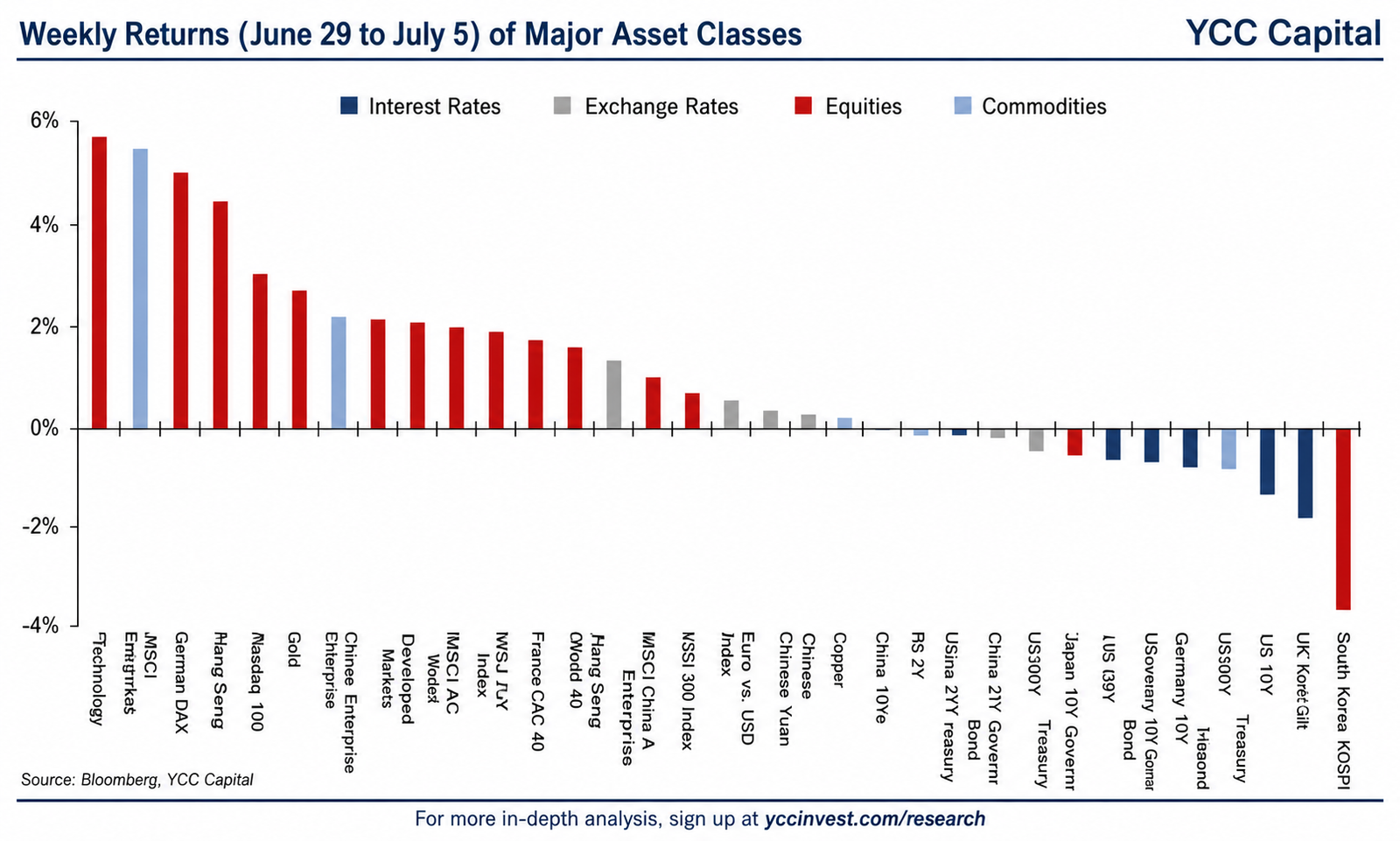
YCC CAPITAL Global Strategy July 7, 2026 Executive Summary The first half of 2026 reminded investors that financial markets rarely move in straight lines. They move through narratives. Just as a marathon runner constantly adjusts pace according to terrain rather than following a rigid timetable, global markets spent the past six months continuously rewriting their expectations for U.S. growth and Federal Reserve policy. Three distinct narratives dominated the first half of the year. Markets initially embraced the idea of a soft landing accompanied by further policy easing. That confidence then gave way to concerns over stagflation as geopolitical tensions in the Middle East pushed energy prices sharply higher. Finally, a powerful combination of resilient U.S. economic activity and another wave of AI-driven capital expenditure convinced investors that America might be entering another expansionary cycle, prompting expectations that the Federal Reserve could eventually return to rate hikes. At YCC Capital, we believe the market has become overly confident in the last of these narratives. While the U.S. economy continues to outperform most developed markets, the current expansion remains unusually uneven. Much of the recent strength reflects temporary fiscal impulses, exceptional AI investment and one-off demand drivers rather than a broad-based acceleration in household consumption and private investment. As these temporary supports fade during the second half of the year, markets are likely to reassess the probability of renewed monetary tightening. Instead of a sustained hiking cycle, we expect macro liquidity conditions to gradually improve during the third quarter, creating a more constructive backdrop for risk assets while simultaneously capping further increases in Treasury yields. The investment landscape therefore becomes increasingly selective. Technology earnings, rather than macroeconomic headlines alone, are likely to determine leadership within equities, while fixed income markets should continue oscillating within broad trading ranges instead of developing sustained directional trends. YCC Perspective One of the greatest investing mistakes is confusing momentum with permanence. History repeatedly shows that markets tend to extrapolate today’s strongest trend indefinitely into the future. During the housing boom, investors believed property prices could only rise. During the internet revolution, profitability became almost irrelevant. Today, many investors increasingly assume that AI investment alone can permanently elevate U.S. economic growth and justify another Federal Reserve tightening cycle. Reality is rarely that simple. Artificial intelligence unquestionably represents one of the most important technological revolutions in decades. However, technological revolutions do not eliminate business cycles. They reshape them. At YCC Capital, our base case remains cautiously constructive on the U.S. economy while remaining skeptical that current growth is sufficiently broad-based to justify another sustained period of monetary tightening. Global Markets in the First Half of 2026 Global asset performance during the first six months of 2026 reflected an unusually concentrated leadership structure. Equities dramatically outperformed most traditional asset classes, supported by accelerating investment into artificial intelligence infrastructure, resilient corporate earnings and continued optimism surrounding productivity gains from next-generation computing technologies. Asian equity markets emerged as some of the strongest performers globally. Japan continued benefiting from structural corporate reforms, improving shareholder returns and persistent foreign capital inflows. South Korea also experienced strong gains as semiconductor demand recovered alongside global AI infrastructure spending. Meanwhile, emerging markets generally outperformed developed markets, although performance remained highly uneven across regions. Countries benefiting from technology exports, commodity production or resilient domestic demand substantially outpaced economies facing persistent structural challenges. China, despite periodic policy support, continued to struggle with weak private-sector confidence, ongoing property market adjustments and declining demographic momentum, limiting broader investor enthusiasm. Commodity markets told a more complicated story. Oil prices remained elevated for much of the first half as geopolitical tensions involving Iran supported risk premiums across energy markets. Gold experienced a powerful rally early in the year before retreating as real interest rates increased and markets aggressively priced higher future policy rates. Fixed income investors faced another challenging environment. Long-duration government bonds continued to underperform amid persistent inflation concerns and repeated upward revisions to interest rate expectations. Rather than providing diversification benefits, sovereign bonds frequently moved in tandem with changing inflation expectations, reinforcing the increasingly complex relationship between equity and fixed income markets. Three Distinct Market Narratives Phase One: The Soft Landing Consensus The year began with broad confidence that inflation was gradually coming under control while economic growth remained resilient enough to avoid recession. Labor markets continued cooling without collapsing. Consumer spending moderated but remained healthy. Inflation gradually trended lower. Markets therefore priced multiple Federal Reserve rate cuts throughout 2026. Treasury yields drifted lower while growth stocks regained leadership. For many investors, it appeared that the Federal Reserve had engineered one of the most successful soft landings in modern history. That narrative would not survive long. Phase Two: The Return of Stagflation Fears The geopolitical landscape changed dramatically following renewed tensions involving Iran. Oil prices rose rapidly, pushing inflation expectations sharply higher. Markets quickly shifted away from pricing monetary easing toward anticipating defensive policy tightening aimed at preventing another inflation cycle. This represented an important distinction. Markets were no longer expecting rate hikes because growth was accelerating. They were expecting rate hikes because inflation risk had returned. Real yields actually remained relatively stable during much of this period while inflation expectations accounted for the majority of Treasury yield increases. Commodity markets significantly outperformed while longer-duration bonds weakened. Investors increasingly questioned whether the inflation battle had truly been won. Phase Three: The AI Expansion Narrative The final months of the first half produced another major shift. Strong GDP components, continued labor market resilience and extraordinary levels of AI-related capital expenditure encouraged markets to embrace an entirely different explanation for higher interest rates. Instead of temporary inflation pressures, investors increasingly believed the U.S. economy had entered a new expansion cycle. Large-scale AI infrastructure investment strengthened productivity expectations while corporate earnings remained robust. Federal funds futures gradually shifted from expecting additional easing toward pricing the possibility that the Federal Reserve could eventually resume policy tightening during 2027. This marked one of the most dramatic expectation reversals witnessed in recent years. The market was
Trump’s Election Playbook: Inflation, Tariffs and Geopolitics Enter a New Phase
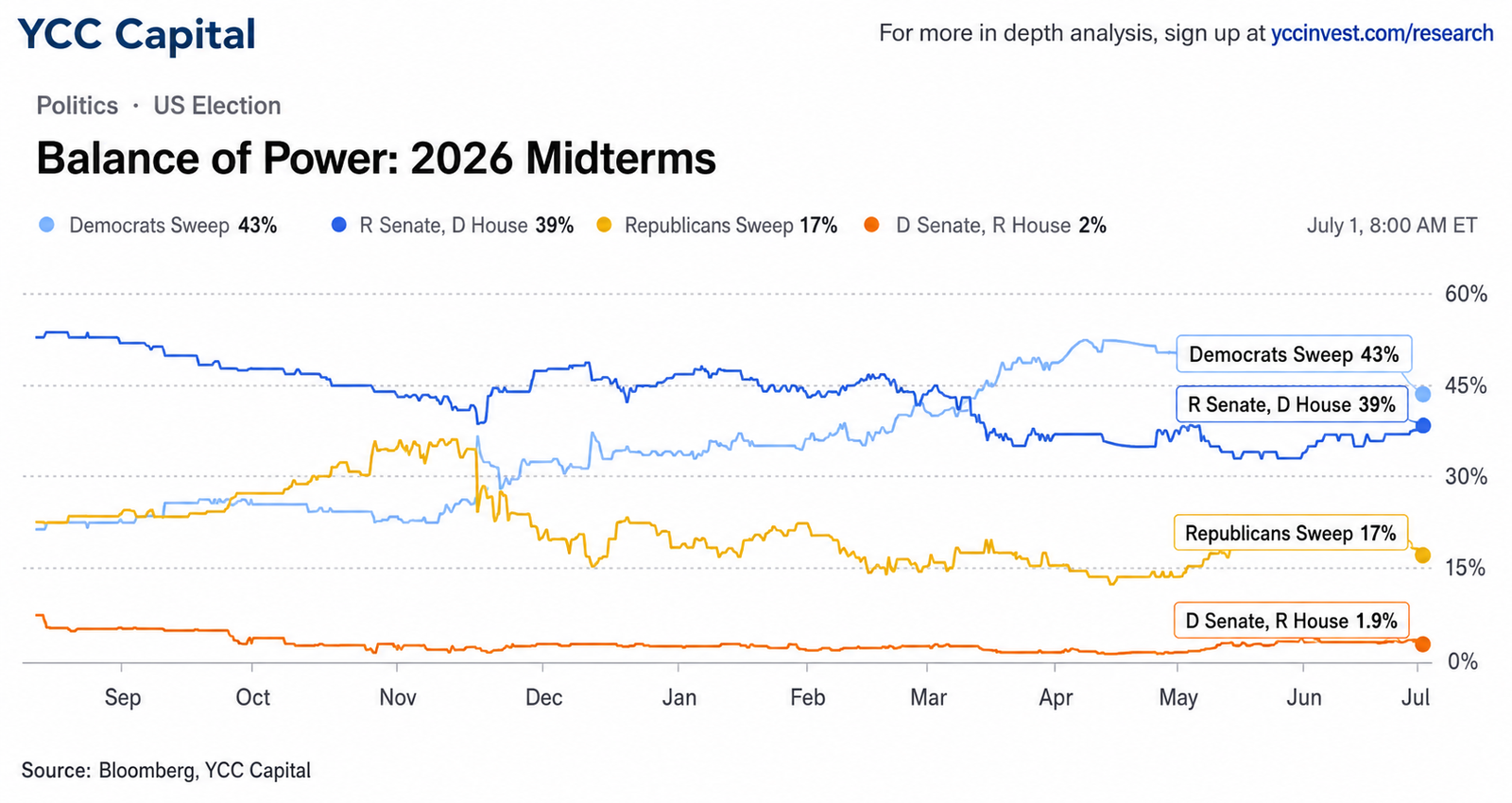
YCC CAPITAL Global Strategy July 6, 2026 Executive Summary Markets often focus on the next inflation print or the next Federal Reserve meeting. Yet the deeper driver of asset prices is frequently political incentives. As the United States approaches the 2026 midterm elections, macro policy is increasingly being shaped not simply by economic objectives but by electoral strategy. Understanding this interaction between politics and markets is becoming essential for investors. At YCC Capital, our base case remains that U.S. inflation is approaching a cyclical peak despite continued producer price pressures. Meanwhile, the Trump administration is likely to intensify the use of executive authorities—including tariffs, foreign policy initiatives, and border security measures—to offset domestic political constraints. Rather than pursuing difficult legislative battles, Washington is increasingly relying on areas where presidential discretion remains strongest. This combination should produce a market environment characterized by moderating inflation, elevated geopolitical headlines, persistent trade frictions, and relatively resilient U.S. economic performance compared with most developed peers. Investors should expect more political volatility than macroeconomic deterioration. Producer Prices Remain Elevated, but Underlying Inflation Momentum Is Beginning to Cool The latest Producer Price Index (PPI) data illustrates an important distinction between headline inflation and underlying pricing pressure. While headline producer inflation continues to appear elevated, much of the increase reflects energy-related effects rather than broad-based inflationary acceleration. According to recent U.S. Labor Department data, headline PPI rose 6.5% year-over-year in May, the strongest reading since late 2022 and slightly above consensus expectations. Energy prices surged more than 10% on a monthly basis, accounting for a substantial share of the increase. However, the underlying picture appears considerably more constructive. Core PPI, excluding food and energy, increased 4.9% year-over-year, below market expectations of 5.4%. Monthly core producer inflation similarly rose only 0.4%, modestly below consensus estimates. This divergence matters. Commodity-driven inflation tends to reverse more quickly than wage-driven or services inflation. While headline numbers understandably capture investor attention, monetary policymakers generally focus on the persistence of inflation rather than temporary energy shocks. The current environment increasingly resembles the latter stages of previous inflation cycles, when headline inflation temporarily overshoots before gradually easing as commodity pressures stabilize. Source: Bloomberg, YCC Capital. Middle East Stabilization Could Mark the Turning Point for Inflation One of the largest macro variables over the coming quarters remains the evolution of Middle East geopolitics. Our baseline assumption is that negotiations between Washington and Tehran continue progressing despite periodic setbacks. Although regional flashpoints—including Israel and Lebanon—are likely to generate recurring episodes of volatility, the broader diplomatic framework appears sufficiently established to reduce the probability of a sustained energy shock. Political negotiations rarely proceed in straight lines. Like commercial mergers, agreements frequently experience public disagreements before ultimately reaching implementation. Should current negotiations continue broadly along their present trajectory, Brent crude is likely to remain within approximately a US$70–90 per barrel range. Such pricing would allow U.S. inflation to gradually moderate through the second half of the year. Under our central scenario: Headline CPI finishes the year around 3.6%–3.8%. Core CPI moderates toward approximately 2.7%–2.8%. Headline PCE declines to roughly 3.3%–3.5%. Core PCE falls toward 3.0%–3.2%. These outcomes would compare favorably with the Federal Reserve’s own projections and reinforce expectations that inflation has entered a slower but sustainable disinflationary path. Politics Is Becoming the Dominant Macro Variable As the 2026 midterm elections approach, the Trump administration’s policy priorities increasingly reflect electoral rather than purely economic considerations. Domestic legislation remains constrained by congressional arithmetic, procedural delays, and persistent inflation concerns. Consequently, the White House is likely to rely increasingly on policy areas where executive authority is strongest. Foreign affairs, tariffs, border enforcement, sanctions, and national security all fall into this category. This represents what can best be described as an “external solutions to internal challenges” strategy. Rather than attempting to solve every domestic issue before voters head to the polls, the administration is likely to emphasize visible demonstrations of executive action abroad while limiting exposure to politically difficult domestic negotiations. For markets, this implies a higher frequency of geopolitical announcements without necessarily implying a proportional deterioration in underlying macroeconomic fundamentals. The Midterm Elections: Republicans Face a Difficult House Map Prediction markets and polling currently point toward an increasingly challenging environment for Republicans in the House of Representatives. Recent market pricing suggests Democrats possess a high probability of reclaiming the House, reflecting both historical midterm dynamics and continued voter dissatisfaction regarding living costs. This would not represent an unusual political development. American voters have historically used midterm elections to rebalance power away from the governing party. Republicans currently maintain only a narrow House majority, leaving little room for electoral underperformance. Even modest shifts among competitive districts could prove sufficient to transfer control. Although Republican-led states have pursued redistricting efforts designed to improve electoral positioning, Democrats require relatively limited gains among competitive districts to regain a governing majority. Current projections therefore continue to favor Democratic control of the House following the election. Source: Bloomberg, YCC Capital. The Senate Remains a Different Story While the House appears increasingly competitive, the Senate presents Republicans with a substantially stronger defensive position. Republicans currently maintain a 53–47 Senate majority. Although Democrats need only four net gains to reclaim control, the electoral geography presents considerable obstacles. Several Democratic-held seats—including Michigan and Georgia—remain highly competitive. Meanwhile, opportunities for Democrats to capture Republican-held seats remain limited primarily to a handful of competitive states such as Maine and North Carolina. Based on current polling trends, Republicans appear more likely than not to retain Senate control, albeit with a narrower majority. Maintaining Senate control would preserve the administration’s ability to confirm judicial appointments, executive nominees, and many elements of the broader policy agenda, even under a divided Congress. Why Tariffs Remain Central to Trump’s Strategy Among all policy tools available to the administration, tariffs remain perhaps the most politically valuable. They offer several simultaneous advantages: First, tariff revenue provides measurable fiscal support. Since implementation, tariff collections have materially strengthened federal revenues while modestly reducing fiscal deficits. Second, tariffs reinforce the administration’s
Trump’s Political Playbook: Winning Abroad to Stabilize at Home
As the 2026 U.S. midterm elections draw closer, the Trump administration’s policy priorities are increasingly being shaped by electoral arithmetic rather than legislative ambition. The political landscape suggests Republicans face a meaningful risk of losing control of the House of Representatives, while retaining the Senate—particularly by defending key swing states—has become the administration’s overriding objective. From YCC Capital’s perspective, this political reality will define Washington’s macro policy agenda over the coming quarters. Measures capable of producing visible domestic economic benefits before November remain limited. Inflation remains above target, fiscal legislation faces procedural hurdles, and structural reforms require more time than the electoral calendar allows. Consequently, the administration is likely to emphasize policies that can be implemented rapidly through executive authority, while shifting public attention toward international issues where political victories are easier to communicate. In practice, this implies a governing philosophy best summarized as “address domestic challenges through external action.” Rather than allowing voters to focus on persistent inflation or legislative gridlock, the administration is expected to place greater emphasis on trade disputes, national security, immigration enforcement, and geopolitical competition—issues that resonate strongly with its political base. History offers many examples of governments seeking external achievements during periods of domestic constraint. When household budgets remain under pressure, political narratives often become just as important as economic statistics. For many voters, perceptions of national strength can temporarily outweigh frustration over grocery bills or mortgage costs. The administration therefore appears likely to revive a more assertive version of the “America First” agenda, coupling economic nationalism with an increasingly selective approach to international engagement. Tariffs Likely to Return to the Center of Economic Policy Trade policy is expected to become one of the administration’s primary policy tools. YCC Capital expects renewed Section 301 tariffs to be introduced relatively quickly, both as a negotiating instrument and as a visible demonstration of support for domestic manufacturing. Although tariffs carry inflationary risks over the medium term, their political appeal remains considerable. They provide a tangible policy action that can be implemented without requiring congressional approval while reinforcing the administration’s narrative of protecting American workers. For financial markets, however, tariffs represent a double-edged sword. While selected domestic industries may benefit from increased protection, higher import costs would place additional upward pressure on producer prices and potentially complicate the Federal Reserve’s inflation battle. Supply chains have become more diversified than during the first Trump administration, but they remain globally interconnected, meaning renewed trade barriers would still ripple across manufacturing, logistics, and corporate earnings. Geopolitics: Selective Confrontation Rather Than Global Intervention The administration is also expected to adopt a more selective geopolitical strategy. Rather than pursuing broad international commitments, Washington is likely to prioritize situations where political victories can be demonstrated clearly while avoiding prolonged military entanglements. This approach resembles an updated version of the Monroe Doctrine—placing greater emphasis on America’s immediate strategic interests while limiting commitments elsewhere unless direct national interests are involved. Such an approach seeks highly visible diplomatic successes without assuming open-ended geopolitical liabilities. Markets generally favor predictability over activism. A foreign policy centered on measurable objectives rather than expansive nation-building could reduce certain geopolitical risk premiums, although trade frictions and strategic competition are likely to remain persistent features of the global investment landscape. Federal Reserve: A More Hawkish Institutional Direction Another important theme emerging from the report is the anticipated shift in Federal Reserve leadership. Under the baseline scenario presented, Kevin Warsh would steer the Federal Reserve toward a more explicitly hawkish policy framework while simultaneously initiating institutional reforms aimed at increasing accountability and modernizing the central bank’s decision-making process. Warsh’s initial public messaging has emphasized one overriding objective: restoring price stability before pursuing easier monetary policy. According to the report, reform efforts would include establishing multiple expert working groups and drawing upon outside academic expertise to reassess the Federal Reserve’s operating framework. Such reforms would represent one of the most significant institutional overhauls in decades. For markets, the symbolism may matter almost as much as the policy itself. Central-bank credibility is built not merely through interest-rate decisions but through confidence that policymakers remain committed to their inflation mandate. Interest Rates: Higher for Longer Despite signs that inflation could gradually moderate later in the year, the report argues that the United States is unlikely to re-enter an easing cycle anytime soon. The baseline expectation remains that one additional rate increase could occur during the second half of the year if inflation proves more persistent than anticipated. Even if further tightening ultimately proves unnecessary, policymakers are expected to maintain a restrictive stance until inflation moves convincingly back toward target. From YCC Capital’s perspective, the underlying logic remains straightforward. The U.S. economy has demonstrated remarkable resilience despite elevated borrowing costs. Consumer spending has stabilized, business investment—particularly in artificial intelligence infrastructure—remains exceptionally strong, and labor-market conditions continue to support income growth. Under such circumstances, prematurely easing policy would risk reigniting inflation before it has been fully contained. Only under a scenario in which inflation declines materially faster than expected would policymakers likely abandon additional tightening. Looking further ahead, the report suggests that any meaningful return to rate cuts is more likely to emerge during 2027 rather than in the immediate future. Strategic Investment View The interaction between politics, monetary policy, and structural investment continues to define the investment landscape. Political headlines will undoubtedly generate short-term volatility. Tariff announcements, election polling, and geopolitical developments are all capable of producing sharp market reactions over days or weeks. Yet beneath that noise, the more durable investment story remains centered on productivity growth driven by technological investment. America’s AI capital expenditure boom continues to represent one of the strongest structural growth engines globally. While concerns surrounding commercialization and return on investment deserve close monitoring, current spending commitments remain largely locked in through multi-year infrastructure programs. Meanwhile, inflation appears likely to moderate gradually rather than collapse, implying that interest rates should remain structurally higher than investors became accustomed to during the previous decade. For long-term investors, the environment increasingly resembles a marathon
Europe’s Energy Shock Is Not Over: A Fragile Recovery Faces Inflation, Trade Frictions, and Monetary Tightening
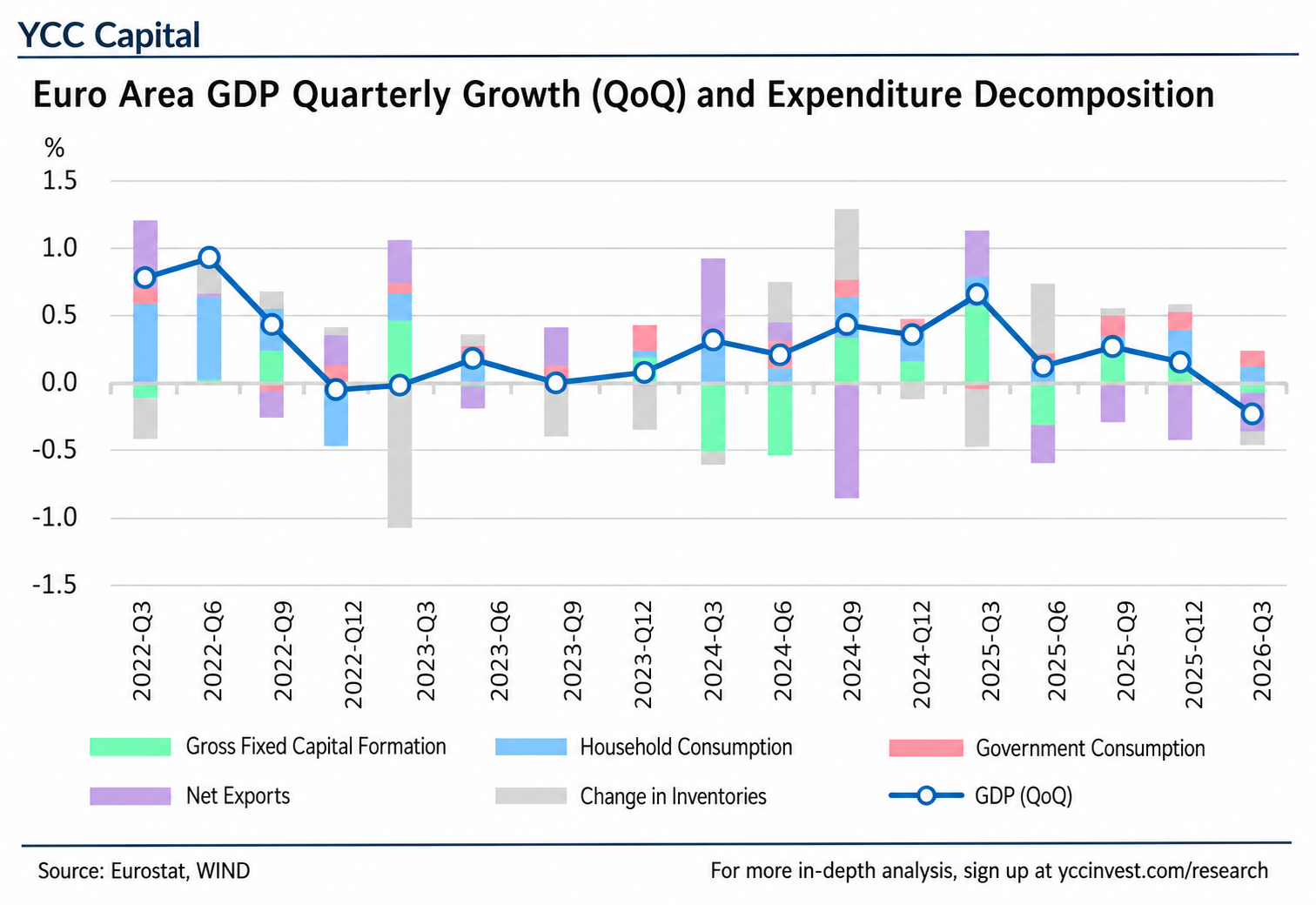
YCC CAPITAL Global Strategy July 4, 2026 Executive Perspective Financial markets often resemble long-distance endurance races rather than sprints. During periods of calm, investors tend to focus on incremental improvements in growth and earnings. Yet when a geopolitical shock suddenly disrupts critical supply chains, the resilience of an economy is determined less by headline GDP figures than by its ability to absorb higher costs without triggering financial instability. Europe now finds itself precisely in such an environment. Although the worst fears surrounding Middle East energy disruptions have eased, the aftershocks continue to ripple through inflation, industrial production, exports, and consumer confidence. Lower oil prices may gradually relieve pressure during the second half of the year, but the structural damage inflicted by elevated energy costs, weak investment, and persistent trade uncertainty cannot be reversed overnight. At YCC Capital, our assessment remains that Europe is entering a prolonged phase of low-growth normalization rather than a powerful cyclical rebound. Growth is likely to stabilize, but expectations for a vigorous recovery remain premature. Europe: Recovery Under Pressure from Energy Costs Energy Shock Pushes the Eurozone Back Toward Stagnation The Eurozone economy weakened considerably during the first quarter of 2026, highlighting the vulnerability of an import-dependent economic bloc to external energy disruptions. Real GDP expanded only 0.3% year-over-year, while quarterly GDP contracted 0.2%, marking the region’s first sequential decline since 2020. Several factors converged simultaneously. The temporary disruption of shipping through the Strait of Hormuz sharply increased LNG and crude oil prices, raising production costs across Europe’s industrial base. Higher input costs compressed corporate profit margins, discouraged fixed investment, and weakened the international competitiveness of European exports. At the same time, the unwinding of precautionary export activity ahead of anticipated U.S. tariff measures created significant distortions. Irish multinational pharmaceutical companies had accelerated exports during late 2025, leaving an unusually weak export base during the first quarter of 2026. While government spending and household consumption continued providing modest support, business investment and net exports became significant drags on overall growth. Fixed investment declined by 0.3% quarter-over-quarter, while net exports made the largest negative contribution to GDP as exports slipped and imports increased alongside higher energy bills. Government expenditure remained the principal stabilizing force for domestic demand. Diverging National Performances Economic performance varied substantially across major European economies. Germany demonstrated modest resilience with quarterly GDP growth of 0.3%, its strongest quarterly expansion in a year, although underlying industrial conditions remained fragile. France experienced its first quarterly contraction since 2020, reflecting weaker domestic demand and deteriorating business confidence. Spain once again emerged as Europe’s strongest performer. Tourism, renewable energy investment, food production, and agricultural exports allowed Spanish GDP to expand by 0.6%, extending an impressive streak of sustained quarterly growth. Italy maintained relatively stable momentum through moderate domestic demand and continued industrial resilience. Ireland represented the largest outlier, with GDP collapsing over 12% quarter-on-quarter, largely reflecting extraordinary swings in multinational pharmaceutical exports rather than broad domestic weakness. Consumer Spending Loses Momentum High Energy Bills Are Reshaping Household Behavior For most households, inflation is experienced less through economic statistics than through everyday purchases. A family may postpone replacing a vehicle, dine out less frequently, or delay home renovations—not because employment has deteriorated, but because higher utility bills steadily erode disposable income. That pattern increasingly characterizes consumer behavior across Europe. Retail sales slowed noticeably during the first four months of 2026 as rising energy prices reduced purchasing power and encouraged precautionary savings. Germany and France both experienced weaker retail activity compared with 2025 averages. Although UK retail sales appeared comparatively robust, much of the apparent strength reflected temporary factors including favorable base effects, higher nominal prices, and unusually warm weather that accelerated seasonal purchases rather than signaling a durable improvement in household demand. Consumer Confidence Remains Fragile Labor markets have remained relatively stable, with Eurozone unemployment fluctuating around 6.3–6.4%. However, wage growth has slowed significantly from the elevated pace recorded during 2024. Real purchasing power has therefore weakened as inflation accelerated once again. Consumer confidence deteriorated sharply during the height of Middle East tensions before recovering modestly as geopolitical risks eased. Nevertheless, confidence indicators remain well below 2025 averages. Service-sector activity has also weakened, suggesting that households continue exercising caution regarding discretionary spending. Taken together, subdued wage growth, cautious consumers, and slowing services activity imply that consumption will remain a relatively weak pillar of European growth throughout much of 2026. Industrial Recovery Faces Structural Obstacles Europe’s industrial sector remains exceptionally sensitive to energy costs. Unlike commodity-exporting economies, Europe imports much of its energy needs, making industrial production particularly vulnerable to disruptions in global oil and natural gas markets. Energy-intensive industries—including chemicals, steel, and heavy manufacturing—have experienced significant cost pressures throughout 2026. Adding further complexity, trade protectionism and supply-chain disruptions continue weighing on manufacturing. European automobile producers face mounting competitive pressure from Chinese electric vehicle manufacturers, while semiconductor supply chains remain exposed to geopolitical uncertainty. Industrial production across the Eurozone declined on average during the first four months of 2026. Germany experienced the weakest performance among major economies owing to its heavy dependence on manufacturing exports and energy-intensive production. France proved comparatively more resilient because of its higher degree of energy independence and stronger aerospace, defense, and pharmaceutical sectors. The United Kingdom also experienced weaker industrial output as higher energy costs filtered through domestic production. External Trade Remains Under Pressure Tariffs Continue to Cast a Shadow Although headline tariff disputes have become less prominent than during earlier periods of trade tensions, their effects remain visible in trade flows. Eurozone exports declined during early 2026, while imports increased primarily because higher energy prices inflated import values. Trade surpluses narrowed substantially. The principal drag did not originate from Germany or France alone but also reflected sharp swings among smaller economies, particularly Ireland following its earlier surge in pharmaceutical exports. Meanwhile, U.S. imports from the Eurozone remained materially below year-earlier levels despite gradual improvement in monthly growth rates. Tariff-related uncertainty has therefore diminished but has not disappeared. Businesses remain reluctant to commit long-term
The AI Supercycle Meets Geopolitical Fracture: Why the New RCEP Landscape Will Produce Winners, Laggards, and a New Investment Cycle
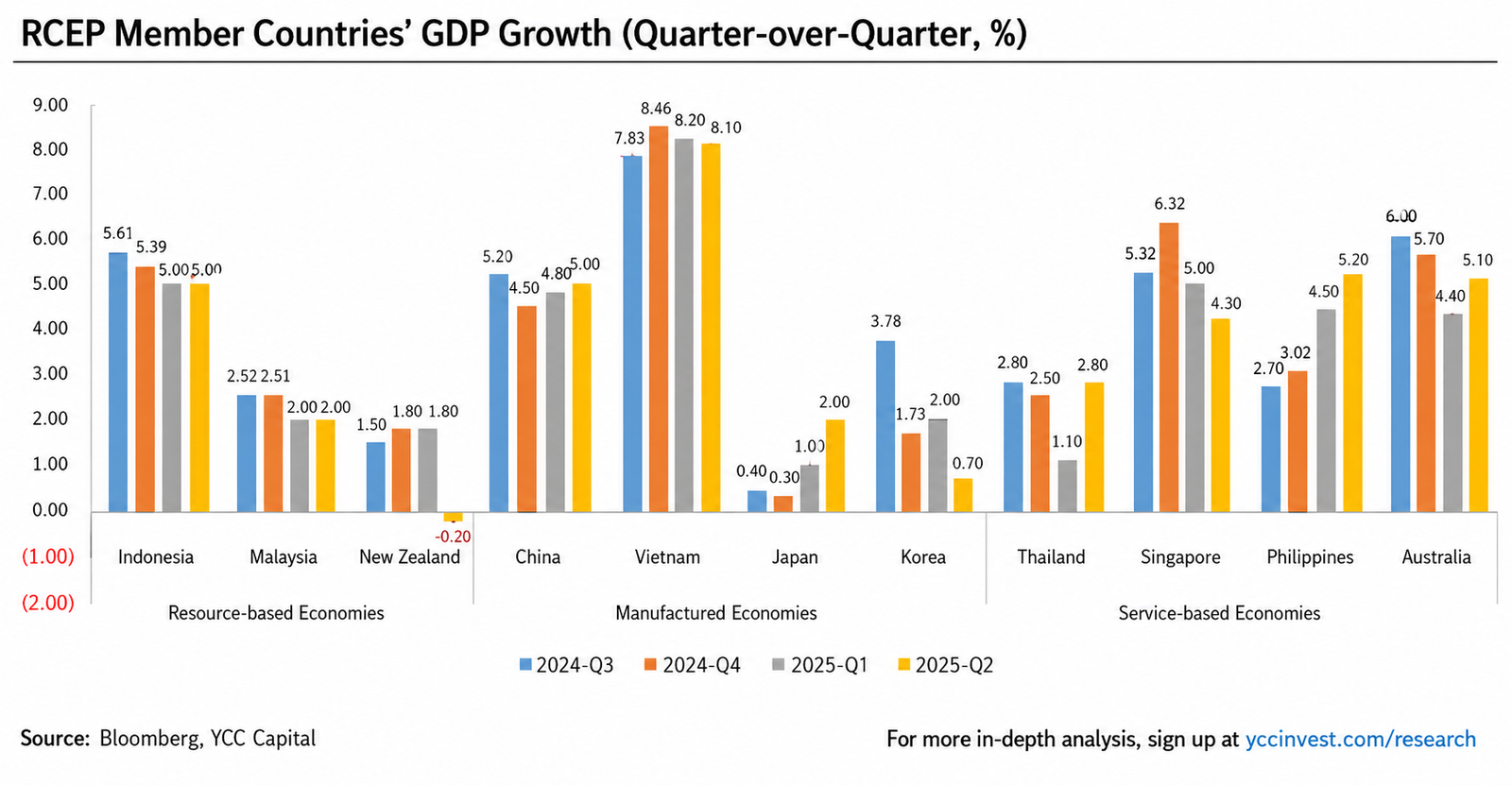
YCC CAPITAL Global Strategy July 3, 2026 Executive Perspective There are moments in global markets when the dominant narrative changes almost overnight. Investors entered 2026 expecting trade disputes and tariff negotiations to dictate Asia’s economic outlook. Instead, a different set of forces rapidly took center stage. Artificial intelligence has evolved from a technological theme into one of the world’s largest capital expenditure cycles. At the same time, geopolitical tensions across the Middle East have reshaped energy markets, inflation expectations, and monetary policy across Asia-Pacific. Together, these developments have fundamentally altered the economic trajectory of the Regional Comprehensive Economic Partnership (RCEP). The result is a region increasingly divided not by geography, but by industrial positioning. Economies deeply embedded within the AI supply chain continue to outperform. Resource exporters benefit from higher commodity prices but face tighter monetary conditions. Tourism-dependent economies remain vulnerable to softer global travel demand, elevated inflation, and weaker household spending. At YCC Capital, we believe investors should increasingly view the RCEP bloc through this structural lens rather than treating the region as a homogeneous growth story. The AI investment cycle remains in its early stages, suggesting that the divergence between manufacturing leaders and consumption-led economies is likely to persist well into 2027. Like the early years of electrification or the internet revolution, today’s AI boom is not lifting every boat equally. It is rewarding those building the infrastructure of tomorrow while exposing the structural weaknesses of economies still reliant on yesterday’s engines of growth. Sources: Bloomberg, YCC Capital. A Fundamental Shift in the Drivers of Regional Growth During the first half of 2026, three themes replaced tariff concerns as the dominant drivers of regional performance: The global AI investment boom Escalating geopolitical tensions in the Middle East Renewed monetary tightening across many central banks This combination produced one of the widest performance gaps among RCEP economies in recent years. Rather than moving together, regional economies increasingly separated into three distinct groups: Manufacturing economies, including South Korea, Japan, Vietnam and China, delivered the strongest overall growth thanks to booming semiconductor and AI hardware demand. Resource exporters, including Australia, Indonesia and New Zealand, benefited from higher commodity prices but faced rising inflation and tighter financial conditions. Service-oriented economies, including Thailand and the Philippines, experienced noticeably weaker momentum as tourism slowed while domestic consumption remained under pressure. This evolving hierarchy is unlikely to reverse quickly. Instead, it reflects structural changes in the global economy rather than a temporary cyclical fluctuation. Manufacturing Economies Become the Primary Winners of the AI Investment Cycle The defining economic story of 2026 is not simply higher semiconductor demand. It is the emergence of an entirely new investment supercycle. Unlike previous technology booms that depended largely on smartphone upgrades or PC replacement cycles, today’s AI expansion requires enormous investments across multiple layers of hardware simultaneously: GPU clusters High-bandwidth memory (HBM) Advanced DRAM NAND flash Optical networking Data center infrastructure Semiconductor manufacturing equipment Advanced packaging Precision industrial components This breadth has fundamentally changed semiconductor demand dynamics. Historically, semiconductor markets experienced relatively predictable three-to-four-year cycles. However, the current AI infrastructure buildout has disrupted that pattern. Global semiconductor shipments have continued accelerating rather than peaking, supporting manufacturing activity across Asia for nearly a year. South Korea has emerged as perhaps the clearest beneficiary. Its global leadership in high-bandwidth memory allows firms such as Samsung Electronics and SK Hynix to capture extraordinary pricing power as AI accelerators increasingly require faster memory solutions. The transition from model training toward AI agents and physical AI applications further expands long-term demand. Japan occupies a different—but equally important—position. Rather than dominating chip production itself, Japanese firms continue to supply critical semiconductor equipment, specialty chemicals, and advanced manufacturing technologies. As AI investment broadens, Japan’s competitive advantages in robotics, industrial automation and precision engineering become increasingly valuable. Vietnam continues climbing the manufacturing value chain. Having already become an important production base for Apple, Samsung and other multinational manufacturers, Vietnam is now gradually expanding beyond assembly toward semiconductor packaging, testing and precision components. China remains an indispensable manufacturing platform within global supply chains despite persistent geopolitical headwinds. Industrial upgrading continues across advanced manufacturing, although structural challenges surrounding demographics, property markets and capital allocation continue to weigh on the country’s broader long-term outlook. From an investment perspective, AI remains the single most important structural growth driver across the manufacturing economies. Commodity Exporters Enjoy Stronger Prices—but Face New Constraints Resource-exporting economies experienced a more complicated first half. The Middle East conflict sharply increased prices for oil, coal, palm oil and other commodities beginning in March, improving export revenues for Australia and Indonesia. However, this commodity rally differs fundamentally from previous cycles. Prices have risen primarily because of supply disruptions rather than booming global demand. That distinction matters. When commodity prices rise because supplies become constrained, exporters receive higher prices without necessarily experiencing significant increases in export volumes. Economic growth therefore improves, but less dramatically than during traditional commodity supercycles. Australia illustrates this dynamic particularly well. Higher energy prices support national income while AI-related data center investment continues driving business capital expenditure. Yet elevated inflation has forced the Reserve Bank of Australia into additional policy tightening, weighing on household consumption. Indonesia presents a similarly mixed picture. Domestic demand remains relatively resilient, supported by government spending initiatives and infrastructure investment. However, rupiah depreciation, capital outflows and policy uncertainty continue limiting private investment confidence. New Zealand has benefited less directly from commodity markets because dairy prices remain influenced by agricultural supply conditions rather than energy markets. Looking ahead, resource exporters should continue outperforming many service-oriented economies, although tighter monetary policy will increasingly offset some of the benefits from stronger commodity prices. Tourism-Dependent Economies Continue Facing Headwinds Not every economy benefits equally from AI. Thailand and the Philippines demonstrate this divergence clearly. International tourism softened noticeably during the first half of 2026 as geopolitical uncertainty increased transportation costs and weakened travel demand. For Thailand, tourism remains a critical pillar of economic activity. Household debt also remains elevated, limiting consumer spending even as inflation
The Energy Shock Is Fading—Now Markets Must Price the Next Liquidity Cycle
Global Strategy June 27, 2026 Executive Perspective Financial markets rarely wait for certainty—they price the direction of change. Over the past six months, investors have been consumed by one question: would geopolitical tensions in the Middle East trigger a second inflation wave severe enough to derail the global easing cycle? Our assessment is increasingly that the answer is no. The energy shock that temporarily disrupted inflation expectations now appears to be evolving into a geopolitical risk premium rather than a persistent macroeconomic regime shift. Oil prices remain sensitive to headlines, yet the transmission into core inflation has been remarkably limited across most developed economies. As negotiations surrounding Iran gradually reduce the probability of a prolonged supply disruption through the Strait of Hormuz, the world economy is beginning to transition from an environment dominated by inflation fears toward one increasingly shaped by liquidity conditions. History reminds us that markets often become obsessed with yesterday’s crisis precisely when tomorrow’s opportunity is quietly taking shape. Like a homeowner who continues reinforcing the roof after the storm has already passed, policymakers and investors risk focusing too heavily on fading inflation while underestimating the significance of improving financial conditions. For investors, this transition matters enormously. Rather than asking whether inflation has disappeared completely, the more important question is whether central banks can once again shift their attention toward growth, liquidity, and financial stability. We believe that pivot has already begun. Investment Thesis YCC Capital believes the second half of 2026 will be characterized by four major macro transitions. First, the inflation shock is becoming increasingly concentrated in energy rather than broad-based consumer prices. Core inflation across most developed markets continues to moderate despite elevated oil prices, suggesting that wage-price spirals remain largely absent. Second, global economic growth is slowing without collapsing. Manufacturing activity linked to artificial intelligence infrastructure continues to outperform traditional sectors, while services activity has softened under the weight of higher interest rates and weaker consumer confidence. Third, central banks are entering a prolonged policy pause rather than embarking on another aggressive tightening campaign. Although several policymakers have temporarily delayed additional rate cuts because of geopolitical uncertainty, the overall direction of monetary policy remains substantially easier than during the inflation peak. Finally, liquidity—not inflation—will increasingly become the dominant driver of asset prices. As balance-sheet policy gradually becomes more important than policy rates, investors should begin paying closer attention to the evolution of quantitative tightening and financial conditions rather than focusing exclusively on headline inflation data. The Real Economy: Growth Continues, But Momentum Is Uneven Across the G7 economies, first-quarter growth remained positive but subdued. Germany finally surpassed its previous post-pandemic output peak, driven primarily by stronger exports rather than domestic demand. France experienced similarly modest expansion, although consumer spending remained restrained. Britain benefited from a mild improvement in household demand, while Japan continued to outperform expectations thanks to robust AI-related exports and resilient domestic consumption. Canada presents a more concerning picture. Economic output has effectively stagnated over the past year as restrictive monetary policy continues weighing on investment and housing activity. Australia likewise experienced slowing growth following multiple policy rate increases, illustrating how monetary tightening continues to filter through developed economies with considerable lags. One important takeaway emerges from this divergence. The global economy is no longer moving in synchrony. Export-oriented economies integrated into the AI supply chain are outperforming economies driven primarily by domestic consumption. That distinction is likely to become even more important over the coming year. Inflation Is Cooling Where It Matters The most important development in global inflation is not that headline prices have become stable—it is that inflation is increasingly failing to spread beyond energy. During the first half of 2026, renewed geopolitical tensions surrounding the Middle East pushed crude oil prices materially higher, prompting fears that the global economy was entering another inflationary cycle reminiscent of 2022. Yet the data tell a different story. Across the United States, Europe, Canada, Australia, and Japan, core inflation has remained comparatively resilient to the energy shock. This distinction is critical. Headline inflation often dominates financial headlines because consumers experience higher fuel prices immediately. Central banks, however, are far more concerned with whether temporary price increases become embedded in wages, rents, and services. Thus far, that transmission mechanism has remained surprisingly weak. Several factors explain this outcome. Household demand has moderated under the weight of higher interest rates, supply chains have largely normalized, and businesses have become considerably more cautious about passing temporary input-cost increases onto consumers. The inflation psychology that characterized the immediate post-pandemic period has faded. Regional differences nevertheless remain significant. Japan and the United Kingdom have experienced relatively softer inflation outcomes thanks partly to domestic energy policies and government support measures. Germany’s inflation has stabilized despite lingering industrial cost pressures, while France has experienced somewhat greater sensitivity to higher energy prices because of differences in consumer energy exposure. Canada presents perhaps the clearest example of policy restraint working through the economy. Slowing growth, weaker housing activity, and cooling labor-market conditions have collectively reduced underlying inflation pressure compared with last year. Taken together, the evidence suggests that developed economies are confronting an energy price shock rather than a generalized inflation regime. That distinction substantially reduces the probability that central banks will be forced into another aggressive tightening cycle. Markets should therefore become increasingly selective when interpreting inflation surprises. Not every increase in headline CPI represents a fundamental shift in monetary policy. Central Banks Have Pressed Pause—Not Reverse Financial markets frequently confuse temporary policy hesitation with structural policy reversal. The recent actions of major central banks illustrate precisely this distinction. Several monetary authorities have chosen to delay additional easing while evaluating the implications of geopolitical risks. Australia paused after a sequence of tightening measures. The European Central Bank and the Bank of Japan adopted more cautious policy settings amid renewed uncertainty surrounding energy markets. Meanwhile, the Federal Reserve, Bank of England, and Bank of Canada have maintained a patient stance while emphasizing their willingness to respond should inflation expectations
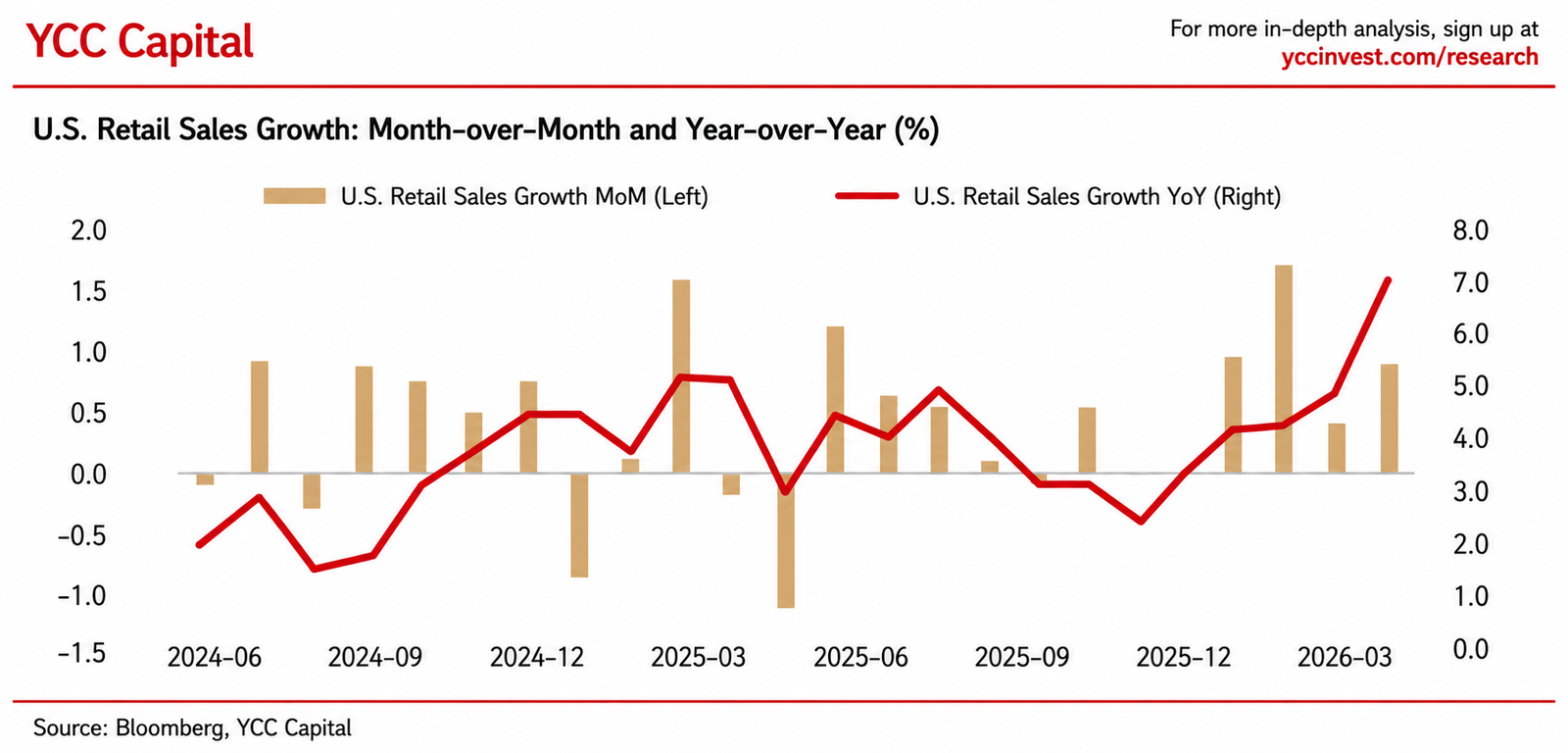
Has Peak Hawkishness Arrived? Why the Fed’s Toughest Message May Also Mark the Turning Point
YCC CAPITAL Global Strategy June 26, 2026 Executive Summary Financial markets often mistake a hawkish central bank meeting for the beginning of an even more aggressive tightening cycle. History, however, suggests that the loudest warnings from policymakers frequently arrive just as the underlying inflation backdrop begins to improve. The Federal Reserve’s June FOMC meeting may prove to be another example. The Federal Reserve left the federal funds target range unchanged at 3.50%–3.75%, while delivering a notably more hawkish communication than markets had anticipated. The Committee upgraded its inflation projections, revised policy rate expectations higher, and emphasized that restoring price stability remains its overriding priority. Short-term Treasury yields moved higher in response, while longer-dated yields remained comparatively stable, reflecting a market that believes tighter policy today may ultimately restrain future growth. From our perspective, however, the more important story lies beneath the headlines. Inflationary pressures appear increasingly concentrated in a handful of temporary drivers—notably energy prices and housing costs—both of which show signs of moderating over the medium term. At the same time, structural improvements in productivity, particularly those driven by artificial intelligence, could allow economic output to remain resilient even as labor demand gradually softens. Much like a storm that appears most intense immediately before the clouds begin to clear, the Fed’s latest hawkish rhetoric may ultimately represent the high-water mark of this tightening narrative rather than the beginning of another prolonged inflation cycle. Accordingly, YCC Capital believes market expectations for additional monetary tightening may now be approaching their cyclical peak. While inflation risks cannot yet be dismissed—particularly given ongoing geopolitical uncertainty in the Middle East—the balance of evidence increasingly points toward gradually easing price pressures over the next 12 to 18 months. Overseas Macro Developments A World Still Navigating Geopolitical Crosscurrents Global financial markets spent the past week oscillating between optimism and renewed caution as developments in the Middle East continued to shift rapidly. Early in the week, reports that the United States and Iran had reached a temporary ceasefire understanding, accompanied by an agreement to reopen commercial navigation through the Strait of Hormuz, helped ease investor anxiety. Oil prices retreated meaningfully, risk appetite improved, and global equity markets responded positively. The improvement proved fragile. By the weekend, Iranian officials again suggested the possibility of closing the Strait of Hormuz, while U.S. officials maintained that commercial shipping remained operational. These conflicting statements underscored an important reality: geopolitical risks have moderated, but they have not disappeared. The current ceasefire remains vulnerable to sudden reversals, leaving energy markets highly sensitive to further developments. Despite these uncertainties, falling crude oil prices provided sufficient support for risk assets. All three major U.S. equity indices advanced over the week, with the S&P 500 gaining 0.93%, marking its second consecutive weekly increase. Technology stocks once again served as the primary engine of market performance, reinforcing investors’ preference for companies with durable earnings growth and structural exposure to artificial intelligence. From an investment perspective, this pattern is becoming increasingly familiar. Markets are no longer reacting simply to geopolitical headlines; rather, investors are constantly weighing geopolitical risks against technological innovation and resilient corporate profitability. For now, the latter continues to dominate. U.S. Labor Market Continues Its Gradual Cooling Recent economic data suggest that the U.S. labor market is continuing its orderly moderation rather than experiencing a sharp deterioration. Initial unemployment claims edged modestly higher during the week, while continuing claims also remained elevated relative to earlier in the year. These developments point toward gradually easing labor market tightness, although conditions remain far from recessionary. This distinction matters. Labor markets rarely transition directly from strength to weakness overnight. Instead, they typically resemble a slowly turning ship—momentum persists long after the initial change in direction. Current employment indicators continue to suggest that businesses are becoming somewhat more cautious in hiring, but widespread layoffs have yet to emerge. At YCC Capital, we believe investors should resist interpreting every softer labor market reading as a recession signal. Instead, these data are more consistent with an economy moving toward a healthier balance between labor demand and supply after several years of exceptional tightness. Consumer Spending Remains Remarkably Resilient While employment has cooled modestly, U.S. households continue to demonstrate surprising resilience. Retail sales expanded 6.88% year-over-year while increasing 0.88% month-over-month, indicating that consumer demand remains well supported despite elevated borrowing costs. This resilience reflects several factors. Household balance sheets remain healthier than during previous tightening cycles, wage growth continues to support disposable income, and many consumers continue to benefit from accumulated savings and rising productivity across key sectors of the economy. For policymakers, resilient consumption presents both reassurance and frustration. Strong consumer demand helps sustain economic growth, but it also complicates the Federal Reserve’s efforts to return inflation fully toward its 2% target. As long as spending remains robust, policymakers are unlikely to declare victory over inflation prematurely. Housing Remains the Economy’s Weakest Link If one sector clearly illustrates the cumulative effects of higher interest rates, it is housing. The NAHB/Wells Fargo Housing Market Index declined further to 35 in June 2026, remaining well below the neutral threshold of 50 and signaling continued pessimism among homebuilders. Unlike consumer spending, residential real estate responds directly to financing costs. Mortgage rates remain elevated by historical standards, limiting affordability and discouraging both buyers and developers from expanding activity. Yet today’s housing weakness may become tomorrow’s inflation relief. Housing inflation behaves much like the wake behind a large cargo ship—it continues moving long after the vessel itself has changed direction. Home prices have already softened significantly over the past year, and because rental inflation historically follows changes in house prices with roughly a one-year lag, shelter inflation is likely to continue easing throughout 2027. This represents one of the strongest structural arguments supporting a gradual decline in underlying U.S. inflation over the medium term. Japan: Inflation Is Cooling, Reducing Pressure on the Bank of Japan Japan’s latest inflation data reinforce the view that the country’s price pressures remain relatively well contained despite the gradual normalization of