
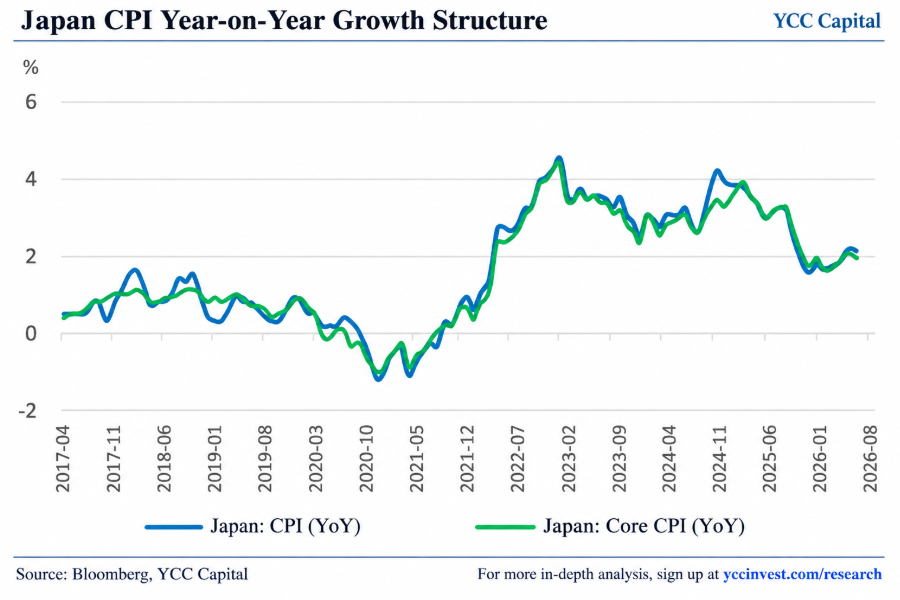
YCC CAPITAL Japan Investment Strategy September 22, 2026 Investment Perspective Japan’s monetary normalization has moved into a more consequential phase. At its September 18 policy meeting, the Bank of Japan raised its policy rate by 25 basis points to 1.25%, matching market expectations. More important than the size of the move was its timing: only one meeting separated this increase from the previous hike, making this the shortest interval between rate increases since the current normalization cycle began in 2024. For YCC Capital, the message is increasingly clear. Japan is no longer debating whether inflation can survive outside the extraordinary monetary architecture of the post-deflation era. The policy question is becoming how quickly the BOJ should remove accommodation without destabilizing an economy that is recovering, but hardly overheating. That distinction matters. Japan still faces expensive energy, uneven domestic demand and substantial external uncertainty. Yet these are better understood as cyclical constraints on normalization rather than evidence of permanent economic decline. Labor scarcity, wage-price dynamics, AI-related external demand and currency depreciation are creating an inflation environment fundamentally different from the one Japan confronted for much of the previous three decades. A 7–2 Vote Reveals an Emerging Policy Divide The BOJ approved the 25bp increase by seven votes to two. The dissenters argued that neither economic activity nor inflation had accelerated sufficiently to justify another increase. The composition of that dissent deserves attention. Both opposing members were appointed in 2026 by Prime Minister Sanae Takaichi. One, Toichiro Asada, had also been the only dissenter against the June rate increase, while Ayano Sato joined the board following that meeting. This does not overturn the BOJ’s current normalization trajectory, but it introduces an increasingly visible political-economy tension. The administration favors an accommodative economic-policy posture, while the central bank is confronting inflation risks that may require additional tightening. The calendar could make that tension more important. Hawkish board members Hajime Takata and Naoki Tamura are scheduled to complete their terms after the July 2027 meeting. If their successors favor a more dovish approach, the internal hurdle for subsequent tightening could rise. The BOJ therefore has an incentive to use the present window to normalize rates gradually rather than risk having to move more aggressively later. Anyone who has lived through a period of rapidly changing household prices understands the problem intuitively. A central bank would rather turn the thermostat down a little at a time than wait until the room is uncomfortably hot and then throw open every window. Governor Kazuo Ueda’s latest communication increasingly resembles that first approach. AI Is Becoming Part of Japan’s Macro Story The BOJ’s broad economic assessment remains relatively stable: Japan is experiencing a moderate recovery, with weakness in some areas. Yet beneath that unchanged headline, the composition of growth is improving in several important respects. Exports and industrial production were upgraded from broadly flat to beginning to increase, with robust global demand related to artificial intelligence playing a significant role. The BOJ still expects moderate economic growth accompanied by some deceleration. High oil prices remain a drag, while government measures and accommodative financial conditions provide support. AI demand has now joined that list of positive forces. This is important for Japan’s longer-term investment narrative. The country sits inside critical portions of the global semiconductor, semiconductor-equipment, materials and precision-manufacturing ecosystem. An AI capital-expenditure cycle originating elsewhere can therefore transmit directly into Japanese factories, exporters and industrial investment. That does not make Japan immune to the global cycle. It does, however, provide another source of resilience at precisely the moment monetary policy is becoming less accommodative. Inflation Risks Are Shifting Upward The inflation discussion was notably more consequential. Core CPI inflation has moved higher at the margin. Energy prices continue to contribute to price pressures, while two additional channels have become more prominent: semiconductor price increases associated with AI demand and the inflationary consequences of a weaker yen. Persistent labor shortages remain especially important. The BOJ expects underlying inflation to reach its 2% target during the second half of fiscal 2026 or during fiscal 2027. The inflation chart accompanying our assessment shows why the debate has changed: after decades in which Japan struggled to generate sustained inflation, headline and underlying measures are now operating much closer to the BOJ’s objective. Governor Ueda highlighted three major upside inflation risks: developments in the Middle East, stronger AI-related demand and further yen weakness. The currency channel may prove particularly important. Wider interest-rate differentials between Japan and other economies can maintain depreciation pressure on the yen, which in turn raises the domestic cost of imported goods and energy. Currency weakness therefore does more than alter exporter earnings. It can become a transmission belt carrying global inflation directly into Japanese household budgets. Ueda said underlying inflation is approaching 2%, while warning that there is a risk of overshooting the target. That language suggests the BOJ is becoming more concerned about doing too little than it was earlier in the normalization cycle. The Destination Is Uncertain, but the Direction Is Not Ueda characterized monetary policy as having entered a “new stage.” Despite successive increases, he continues to regard current policy settings as accommodative and sees room for additional hikes. The logic is straightforward. If inflation is converging toward 2%, the BOJ wants to guide policy toward a more neutral setting gradually. Waiting too long could force faster tightening later—the very outcome policymakers would prefer to avoid. The BOJ estimates Japan’s neutral nominal interest rate within an unusually broad range of roughly 1.1% to 2.5%. Ueda emphasized that the neutral rate cannot be identified precisely and that the eventual terminal policy rate cannot be predetermined. Economic activity, inflation and financial conditions will determine how far normalization ultimately proceeds. That uncertainty should not be mistaken for indecision. Central banking rarely provides a clean destination marker. The BOJ knows the road it is traveling even if the precise exit remains obscured by fog. YCC Strategic View We expect the BOJ to continue pursuing gradual and orderly normalization, provided wage-price
The Yen’s Real Battle: Why BOJ Tightening Alone Will Not Be Enough
YCC CAPITAL Japan Investment Strategy August 20, 2026 YCC Capital Research The market is increasingly treating a September Bank of Japan rate hike as the next major turning point for the yen. We think that framing is too narrow. Monetary tightening matters, but Japan’s currency problem has evolved beyond a simple interest-rate-differential story. Fiscal credibility, the quality of Japan’s external surplus, and—most importantly—the country’s productivity trajectory increasingly determine whether yen strength can become durable rather than merely episodic. Our central conclusion is straightforward: the BOJ can buy the yen time, but it cannot manufacture a lasting bull market in the currency by itself. For that, Japan needs productivity growth strong enough to turn today’s fiscal expansion from a perceived liability into an investment in tomorrow’s productive capacity. September Is Becoming a Live Meeting Expectations for faster BOJ tightening have risen sharply. Markets recently priced the probability of a September rate increase at roughly 80%, as policymakers became increasingly concerned that yen weakness could amplify imported inflation. The BOJ’s policy rate currently stands at 1.0%, following the June increase, and the next Monetary Policy Meeting is scheduled for September 17–18. The July meeting placed unusual emphasis on upside inflation risks. Policymakers highlighted the combination of yen depreciation, elevated energy costs, overseas demand and AI-related investment as factors capable of keeping price pressures stronger than previously anticipated. The weak yen is particularly important. Currency depreciation raises the domestic price of imported fuel, food, raw materials and durable goods. Once households and businesses begin expecting those increases to persist, the exchange rate can influence not only observed inflation but inflation expectations themselves. This is why the BOJ increasingly appears willing to move more quickly. Yet the currency market is sending an uncomfortable message: expectations of tighter monetary policy have not produced proportionate yen appreciation. Following intervention around late July and early August, USD/JPY fell from above 163 toward 157, while speculative net short-yen positions contracted rapidly. But the move did not hold. USD/JPY subsequently returned toward 159, surrendering nearly half of the yen’s initial roughly 5% appreciation. Even as September hike expectations climbed toward their highest level of the year, the yen struggled to strengthen further. That divergence is the heart of the story. Sources: Bloomberg, YCC Capital The Yen Is No Longer Trading Only on Rate Differentials For decades, explaining USD/JPY often began with the U.S.-Japan interest-rate spread. Higher U.S. yields encouraged investors to borrow cheaply in yen and purchase higher-yielding dollar assets. Narrower spreads should therefore have supported the yen. That relationship has weakened materially. As the scale of the yen carry trade contracted after August 2024, USD/JPY increasingly decoupled from the U.S.-Japan yield differential. Japan exited negative interest rates in March 2024, and subsequent changes in global monetary conditions progressively narrowed the relevant rate gap. Nevertheless, the yen remained under pressure. We believe the market has increasingly substituted fiscal risk for interest-rate differentials as a key marginal pricing factor. This matters because raising the overnight rate does not automatically repair concerns at the long end of the government bond curve. Think of it as a household whose salary has improved but whose spending commitments are expanding even faster. A higher savings rate helps, but creditors will still focus on the trajectory of the balance sheet. Currency investors are behaving similarly toward Japan: the BOJ’s rate normalization is constructive, but markets are simultaneously asking what fiscal expansion means for future debt issuance and sovereign financing costs. The Long End Is Sending a Fiscal Message The spread between 30-year and 2-year Japanese government bond yields provides a useful window into this repricing. Fiscal concerns intensified from late 2025 as expectations of aggressive government support increased. A planned ¥21.3 trillion stimulus package coincided with weakness in both the yen and ultra-long JGBs. Fiscal sensitivity became still clearer in January 2026. Proposals to suspend the consumption tax on food for two years raised concerns over the resulting revenue gap and additional bond issuance. Thirty- and forty-year JGB yields rose by roughly 40 basis points. The issue resurfaced in June. A proposal to reduce the consumption tax on food from 8% to 1% implied an estimated revenue shortfall of approximately ¥4.4 trillion, without a clearly identified funding source. Subsequent efforts to advance a temporary food-tax reduction were accompanied by repeated jumps in long-end yields. The message is not that Japan faces an inevitable fiscal crisis. We do not view today’s challenges as evidence of permanent Japanese decline. Japan retains substantial domestic savings, institutional depth, sophisticated corporations and considerable overseas assets. Rather, markets are demanding a clearer distinction between productive fiscal expansion and consumption-oriented deficit expansion. If additional borrowing finances technologies, infrastructure, automation and industries that lift future output, the long-run consequences can be constructive. If it primarily widens recurring fiscal deficits without increasing productive capacity, monetary tightening will have difficulty generating lasting currency appreciation. Sources: Bloomberg, YCC Capital Japan’s External Surplus Is Not the Yen Support It Once Was There is a second structural change: Japan’s balance of payments remains strong in headline terms, but its composition has become less supportive of the currency. Before 2010, Japan regularly generated merchandise trade surpluses. Exporters earned foreign currency and converted a meaningful share of those proceeds back into yen, creating a persistent underlying source of yen demand. That mechanism has weakened. Import growth has increasingly outpaced exports, and the goods balance moved from persistent surplus toward narrower surpluses and, following the pandemic-era shock, recurring deficits. Higher energy prices have made the problem more visible because Japan remains heavily dependent on imported energy. At the same time, Japan continues to generate a substantial current-account surplus. The important question is where that surplus comes from. Since 2022, the goods-and-services account has generally been in deficit. The current-account surplus has instead depended overwhelmingly on primary income: profits, dividends and interest generated by Japan’s enormous stock of overseas direct and portfolio investments. Economically, that is a sign of accumulated national wealth. From a currency-flow perspective, however, it is less powerful than
Japan’s Uneven Renaissance: Why the AI Boom Is Powering Exports While Domestic Demand Still Searches for Momentum
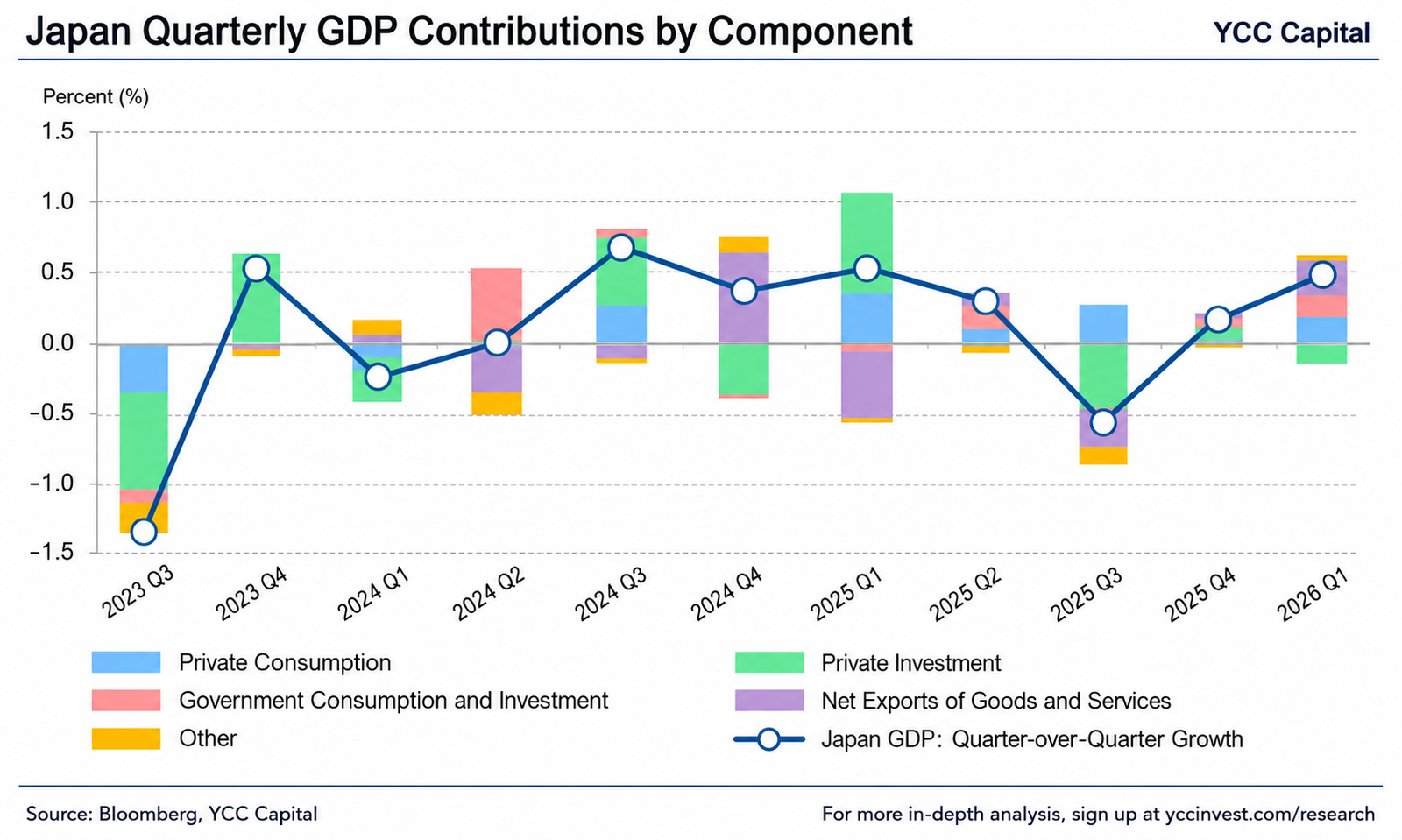
YCC CAPITAL Japan Investment Strategy Date: July 4, 2026 Executive Summary Japan enters the second half of 2026 in a position that would have seemed improbable only a few years ago. After decades defined by deflation, subdued wage growth, and recurring policy experiments, the country has finally begun to normalize monetary policy. Yet this normalization is taking place against an economy that remains profoundly uneven. Manufacturing is benefiting from one of the strongest global semiconductor investment cycles in history, while household consumption continues to recover only gradually. Inflation has moderated, but underlying price pressures have not disappeared. The Bank of Japan is raising interest rates, but only cautiously, mindful that today’s fragile expansion cannot withstand excessive tightening. At YCC Capital, we believe investors should avoid viewing Japan through a single narrative. The country is neither experiencing a broad-based economic boom nor slipping back into stagnation. Instead, Japan is evolving into an economy increasingly divided between globally competitive technology exporters and domestically oriented sectors that remain constrained by demographics, fiscal limitations, and cautious consumer behavior. The result is an economy where external demand continues to outperform domestic demand, corporate earnings remain resilient despite global uncertainties, and monetary normalization proceeds gradually rather than aggressively. While headline growth is likely to remain modest, structural improvements in corporate governance, semiconductor leadership, and wage formation continue to strengthen Japan’s long-term investment case. Domestic Economy: A Recovery That Remains Uneven Japan’s economy expanded modestly during the first half of 2026, extending its recovery for a second consecutive quarter. Real GDP grew at an annualized pace of approximately 1.8% in the first quarter, equivalent to quarterly growth of 0.5%, while year-over-year growth slowed to roughly 0.4% as the economy faced increasingly difficult comparisons with the stronger performance recorded in 2025. The composition of growth reveals a familiar pattern. Household consumption remained positive, government spending continued to provide meaningful support, but business investment weakened considerably. Net exports emerged as the largest contributor to overall growth, highlighting Japan’s continued dependence on external demand. This divergence increasingly defines today’s Japanese economy. Imagine a train whose front car is accelerating while the middle cars are still gathering speed. Export-oriented manufacturers linked to artificial intelligence, semiconductors, robotics, and advanced machinery continue to move ahead rapidly, while domestic sectors dependent on household spending remain considerably slower. Government investment also played a stabilizing role during the first half, cushioning weaker private-sector capital expenditure. Although housing investment showed signs of improvement, overall corporate investment remained subdued as firms balanced stronger earnings against higher financing costs and continued geopolitical uncertainty. Manufacturing Continues to Lead the Expansion Industrial production has strengthened noticeably since the beginning of the year. Average industrial output growth returned to positive territory, reversing last year’s contraction, while manufacturing PMI readings consistently remained above the expansion threshold. In April, Japan’s manufacturing PMI reached its highest level in more than a decade. Several forces explain this improvement. First, geopolitical uncertainty encouraged many manufacturers to build precautionary inventories, temporarily boosting new orders. Second, the global artificial intelligence investment cycle continues to drive extraordinary demand for semiconductor equipment, specialty materials, precision machinery, and factory automation—all industries where Japanese companies maintain global technological leadership. Automotive manufacturing and industrial robotics also continued to perform well despite broader uncertainties surrounding international trade. Unlike previous Japanese recoveries, this industrial rebound is being driven less by cyclical inventory rebuilding and more by structural technological investment. AI infrastructure requires enormous quantities of semiconductor manufacturing equipment, specialty chemicals, advanced materials, precision optics, and automation systems—segments where Japanese firms remain indispensable participants in global supply chains. Consumers Are Recovering, But Confidence Remains Fragile Household spending has been considerably less impressive. Real household consumption remained largely flat during the opening months of 2026, representing a meaningful slowdown compared with last year’s stronger gains. Inflation-adjusted spending declined modestly despite improvements in nominal retail sales. Consumer confidence weakened sharply during the escalation of Middle East tensions before recovering gradually as geopolitical risks moderated. Yet beneath these relatively soft spending figures lies a more encouraging development. Nominal wage growth accelerated meaningfully during the first four months of the year. More importantly, declining inflation allowed real wage growth to turn positive after remaining negative for much of the previous year. This marks one of the most significant structural improvements within Japan’s economy. For decades, Japanese households became accustomed to stagnant incomes and limited purchasing power. A sustained period of positive real wage growth changes consumer psychology gradually rather than overnight. Families typically increase discretionary spending only after becoming confident that higher incomes will persist rather than prove temporary. At YCC Capital, we believe improving real wages should provide increasing support for domestic consumption during the second half of the year, particularly if lower energy prices continue to ease household financial pressures. Inflation Has Slowed, But Underlying Pressures Remain Headline inflation moderated significantly during the first half of 2026. Consumer prices rose approximately 1.5% year-over-year in May, comfortably below the levels recorded late last year. Core inflation also declined meaningfully as government subsidies and favorable base effects temporarily reduced measured price pressures. Government intervention played an important role in this moderation. Electricity subsidies, natural gas assistance, fuel price support, education-related subsidies, and targeted household transfers collectively offset much of the increase in global energy costs. At the same time, unusually high inflation readings recorded during early 2025 created statistical base effects that mechanically lowered annual inflation rates this year. However, investors should avoid concluding that Japan’s inflation challenge has disappeared. Producer prices continue rising rapidly, indicating that upstream cost pressures remain substantial. Wage growth continues to strengthen following another successful annual spring wage negotiation cycle. Meanwhile, the weaker yen continues to increase import costs across a broad range of goods and services. As various government subsidy programs gradually expire later this year, headline inflation is likely to move modestly higher again. Although international oil prices have begun retreating from recent peaks, underlying domestic inflation appears increasingly self-sustaining. We expect inflation to approach—and potentially temporarily exceed—the Bank of Japan’s 2% target
The Yen’s Fiscal Reckoning Why Japan’s Next Currency Crisis May Be Driven Less by Monetary Policy—and More by Sovereign Balance Sheet Risk
YCC CAPITAL Japan Investment Strategy June 26, 2026 Executive Summary For much of the past three decades, investors have viewed every sharp depreciation of the Japanese yen through a familiar lens. Monetary policy divergence widened, carry trades accelerated, speculative positioning increased, and eventually policymakers intervened before the currency stabilized. That framework has repeatedly explained major episodes of yen weakness since the Plaza Accord. Today, however, the underlying story has evolved. While the interest-rate differential between the United States and Japan remains the immediate driver of USD/JPY, it no longer tells the complete story. A deeper structural transition is taking place beneath the surface. Japan’s fiscal position, long considered manageable because of exceptionally low borrowing costs and deep domestic savings, is gradually becoming a source of macroeconomic vulnerability. Rising government financing costs, slowing domestic growth, demographic headwinds, and the diminishing effectiveness of foreign-exchange intervention are converging into a combination that markets have rarely needed to confront. The consequence is that the yen is beginning to trade less like the world’s traditional safe-haven currency and more like the funding currency of an economy facing mounting fiscal constraints. This distinction matters enormously. Currency markets rarely move because of a single event. Instead, they reprice when investors collectively recognize that an old equilibrium is no longer sustainable. In our assessment, Japan is approaching precisely such an inflection point. The catalyst for the latest depreciation has been renewed divergence between Federal Reserve and Bank of Japan policy expectations following stronger-than-expected U.S. economic data and persistent inflation pressures. Yet beneath that cyclical backdrop lies a more consequential structural reality: Japan’s ability to finance one of the largest sovereign debt burdens in the developed world increasingly depends on an environment of exceptionally low interest rates. As that environment gradually disappears, fiscal arithmetic—not merely monetary policy—will become progressively more important in determining the long-term direction of the yen. At YCC Capital, we believe investors should begin thinking about the Japanese currency through a broader macro framework that incorporates sovereign balance-sheet sustainability, geopolitical constraints on reserve management, and the changing role of Japan within global capital flows. The next major move in the yen may ultimately be driven less by what the Bank of Japan chooses to do and more by what the Japanese government’s balance sheet allows it to do. The End of a Familiar Playbook Imagine balancing a household budget with a mortgage fixed at almost zero interest for decades. The monthly payments feel manageable, allowing spending decisions that would otherwise appear aggressive. Then imagine interest rates gradually rising. The outstanding debt has not changed overnight, but the cost of servicing that debt steadily consumes a larger share of income. Eventually, even without increasing borrowing, financial flexibility begins to disappear. Japan now faces a similar macroeconomic challenge. For decades, the country’s extraordinary public debt burden attracted remarkably little concern because financing costs remained close to zero. Investors trusted the Bank of Japan’s commitment to accommodative monetary policy, domestic institutions absorbed the overwhelming majority of government bond issuance, and persistent deflation kept nominal yields exceptionally low. That environment is changing. Although Japanese interest rates remain modest by international standards, they have risen meaningfully from the ultra-low levels that prevailed throughout the era of quantitative and qualitative easing. Government bond yields have reached their highest levels in years, increasing the future refinancing costs associated with an enormous stock of outstanding debt. Unlike previous episodes of yen weakness, therefore, today’s depreciation cannot be understood solely through the lens of interest-rate differentials. Instead, it reflects the interaction of four powerful forces: Persistent monetary policy divergence between the Federal Reserve and the Bank of Japan. The continued attractiveness of global carry trades financed in yen. Increasing political and geopolitical constraints on Japan’s foreign-exchange intervention toolkit. A gradual reassessment of Japan’s long-term fiscal sustainability. Each of these factors reinforces the others. Higher U.S. yields encourage capital to flow toward dollar-denominated assets. Those flows weaken the yen. A weaker yen raises import prices and inflation in Japan, complicating monetary policy decisions. Meanwhile, higher Japanese yields increase government financing costs, limiting fiscal flexibility and making investors increasingly sensitive to sovereign risk. What initially appears to be a currency story gradually evolves into a sovereign balance-sheet story. History suggests that these transitions often occur slowly before accelerating rapidly. A New Era for the Yen Since the Plaza Accord in 1985, the yen has experienced several pronounced periods of depreciation. Although each episode unfolded under different economic circumstances, three recurring forces consistently emerged: First, Japan’s domestic economy weakened relative to the United States. Second, U.S. interest rates rose relative to Japanese rates, widening the incentive for capital to move abroad. Third, Japan struggled to maintain technological leadership during periods of global industrial transformation, allowing the United States to attract a disproportionate share of international investment. Those historical episodes provide useful perspective, but they do not fully explain today’s environment. The current depreciation follows years of unprecedented monetary accommodation, extraordinary fiscal expansion, pandemic-era policy intervention, shifting global supply chains, and rising geopolitical fragmentation. These forces have fundamentally altered how international investors assess sovereign risk, reserve currencies, and global capital allocation. Most importantly, the market is beginning to recognize that Japan’s debt dynamics matter not only for bond investors but also for currency markets. As long as financing costs remained near zero, debt accumulation appeared sustainable. Once yields begin trending higher—even gradually—that assumption deserves renewed scrutiny. The result is that the yen may increasingly respond to fiscal developments in addition to traditional monetary policy expectations. For decades, Japan benefited from extraordinary policy credibility. Whether that credibility can be maintained in an environment of structurally higher global interest rates will become one of the defining macroeconomic questions of the coming decade. Why This Yen Selloff Is Fundamentally Different Every major currency cycle has a story that investors initially dismiss as temporary. In the early stages, markets often attribute exchange-rate moves to routine interest-rate fluctuations or positioning dynamics. Only later does it become apparent that a deeper structural transition
The Bank of Japan Just Sent a Warning to the Entire Financial World
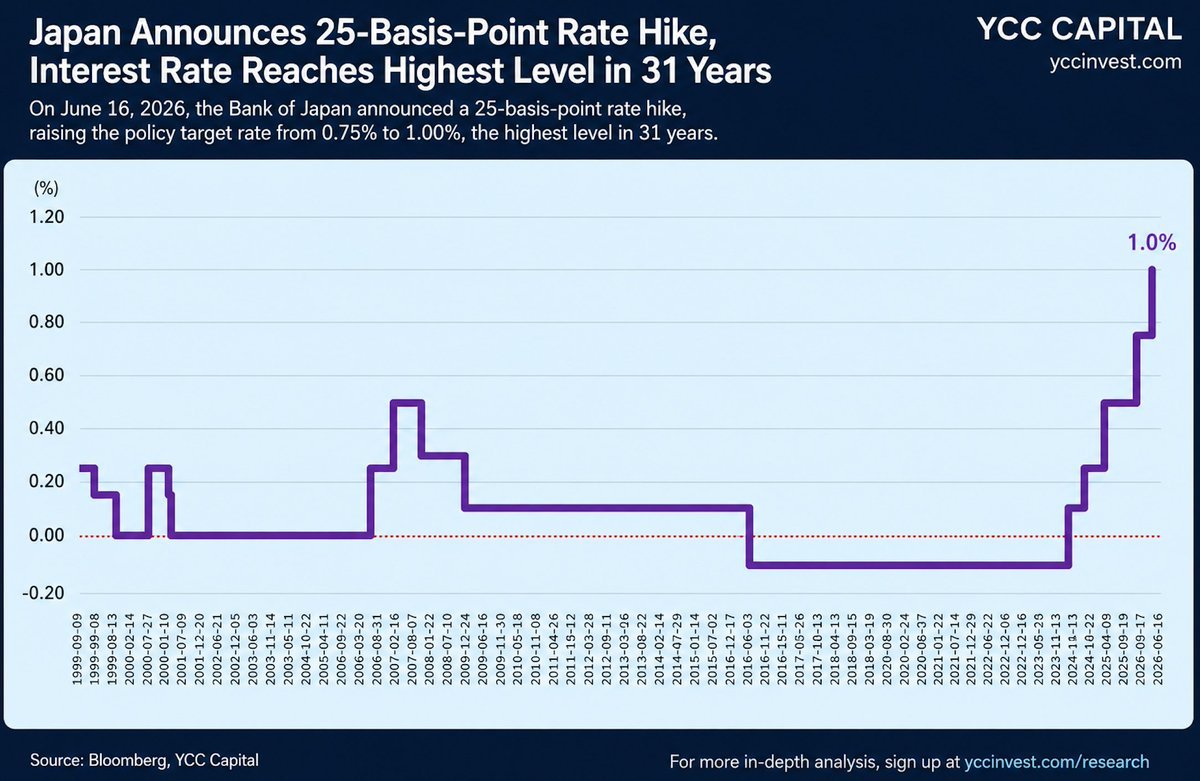
Why the Bank of Japan’s “hike plus pause on QT” is less a hawkish thunderbolt than a careful step on a very narrow bridge Report Date: June 16, 2026 | Source: Bloomberg, YCC Capital YCC Capital Perspective: Japan has crossed a psychological line. A 1.0% policy rate still looks modest by U.S. or European standards, but for Japan it is the end of an era. For a generation, households, banks, insurers, exporters, and global macro investors learned to treat yen funding as financial oxygen: almost free, always available, and rarely questioned. The Bank of Japan is now trying to normalize that oxygen supply without suffocating the patient. That is the central tension of this cycle. EXECUTIVE SUMMARY The Bank of Japan raised its policy target rate by 25 basis points to 1.0%, the highest level in roughly 31 years. Yet the simultaneous decision to slow, and eventually pause, the reduction of JGB purchases softened the tightening message. This was a “rate hike with shock absorbers.” The BOJ tightened the price of money but reassured the bond market that it would not abruptly remove the liquidity backstop. The immediate drivers were imported inflation, energy vulnerability, and yen weakness. Japan remains heavily exposed to Middle East crude flows, while a weak yen magnifies the domestic cost of imported fuel, food, and raw materials. The market reaction shows the ambiguity. The yen remained under pressure while equities rallied, suggesting investors read the BOJ’s move as normalization without a full liquidity withdrawal. The strategic risk lies in the policy contradiction: fiscal expansion meets monetary tightening. Higher rates increase debt-service pressure just as the government leans on stimulus and defense spending. The Policy Decision: A Hike That Came Wrapped in Cushioning After a two-day policy meeting on June 15-16, 2026, the Bank of Japan announced that it would raise its policy target rate from 0.75% to 1.0%. At the same time, it signaled that the reduction in Japanese government bond purchases would not continue indefinitely at the same pace. From June 2026 through the January-March 2027 quarter, monthly JGB purchases are scheduled to decline by roughly JPY 200 billion per calendar quarter. From April 2027, the BOJ plans to pause further reductions and stabilize monthly JGB purchases at around JPY 2 trillion. That combination matters. A pure rate hike says: “conditions are too hot.” A rate hike paired with a pledge to preserve bond-market flexibility says: “conditions are too hot, but the plumbing is fragile.” In practical market language, this was not a Volcker-style hammer. It was a surgeon’s scalpel used while the patient is still moving. The BOJ also retained the option to respond flexibly if long-term yields rise too quickly. That includes increasing JGB purchases beyond the scheduled plan, conducting fixed-rate purchase operations, and providing funds against pooled collateral. The message to the market was therefore deliberately mixed: policy normalization is proceeding, but the central bank will not allow the bond market to seize up if term yields jump too far, too fast. Figure 1. Japan policy target rate reaches 1.0%. Source: Bloomberg, YCC Capital. The Normalization Path Since 2024 Japan’s monetary normalization has unfolded gradually. In 2024, the BOJ raised rates twice, lifting the policy target from the zero-rate zone to 0.25%. In January 2025, it raised rates by another 25 basis points to 0.50%, the largest single increase since 2007. In December 2025, it raised rates again to 0.75%, the highest level since 1995. The June 2026 hike to 1.0% brings the policy rate back to a level not seen for roughly three decades. This is why the headline looks small but the regime change is large. A one-percentage-point policy rate is ordinary in many countries. In Japan, it is like hearing a quiet house suddenly creak at night: the sound itself is modest, but it tells you the structure is moving. Why the BOJ Moved: Imported Inflation Meets a Weak Currency The direct catalyst for the rate hike was the combination of rising imported inflation and renewed energy-price pressure linked to Middle East geopolitical tension. Japan is one of the world’s most energy-import-dependent major economies. As of February 2026, Japan’s dependence on Middle East crude imports exceeded 94%, and imports from Saudi Arabia, the United Arab Emirates, Kuwait, and Qatar alone accounted for more than 90% of total crude oil imports. More than 90% of Japan’s Middle East crude shipments pass through the Strait of Hormuz, leaving the energy supply chain exposed to regional conflict and maritime disruption. The report’s underlying logic is simple: Japan imports energy, Japan imports inflation, and a weaker yen multiplies both. When oil prices rise in dollars and the yen weakens at the same time, Japanese consumers experience a double hit. It is the macro version of buying the same daily convenience-store coffee and suddenly noticing that the price tag has quietly jumped. The CPI debate becomes real when it shows up in routine purchases. Following the outbreak of U.S.-Israel conflict with Iran, shipping through the Strait of Hormuz was effectively disrupted, with many Japan-related vessels stuck inside the Persian Gulf. Although the Japanese government announced an emergency energy diversification strategy and stated that July crude imports would fully avoid the Strait of Hormuz, near-term supply gaps and higher transport costs had already delivered a sharp shock to prices. Producer-price pressure confirms the transmission. Japan’s PPI rose 5.3% year over year in April 2026 and 6.3% in May 2026, the largest increase since March 2023. The rise in raw-material and energy costs has begun to move from corporate transaction prices into broader consumer-price categories. The recent pullback in oil prices after tentative ceasefire arrangements does not remove the macro risk. The agreement is still politically fragile, navigation through the Strait of Hormuz may require a 30- to 45-day observation period before normal operations are fully restored, and core issues such as sanctions, maritime management, and regional military posture remain unresolved. In YCC’s view, oil’s short-term decline is relief, not resolution. The Yen Is the
The Hidden Force Crushing the Japanese Yen is About to Reverse
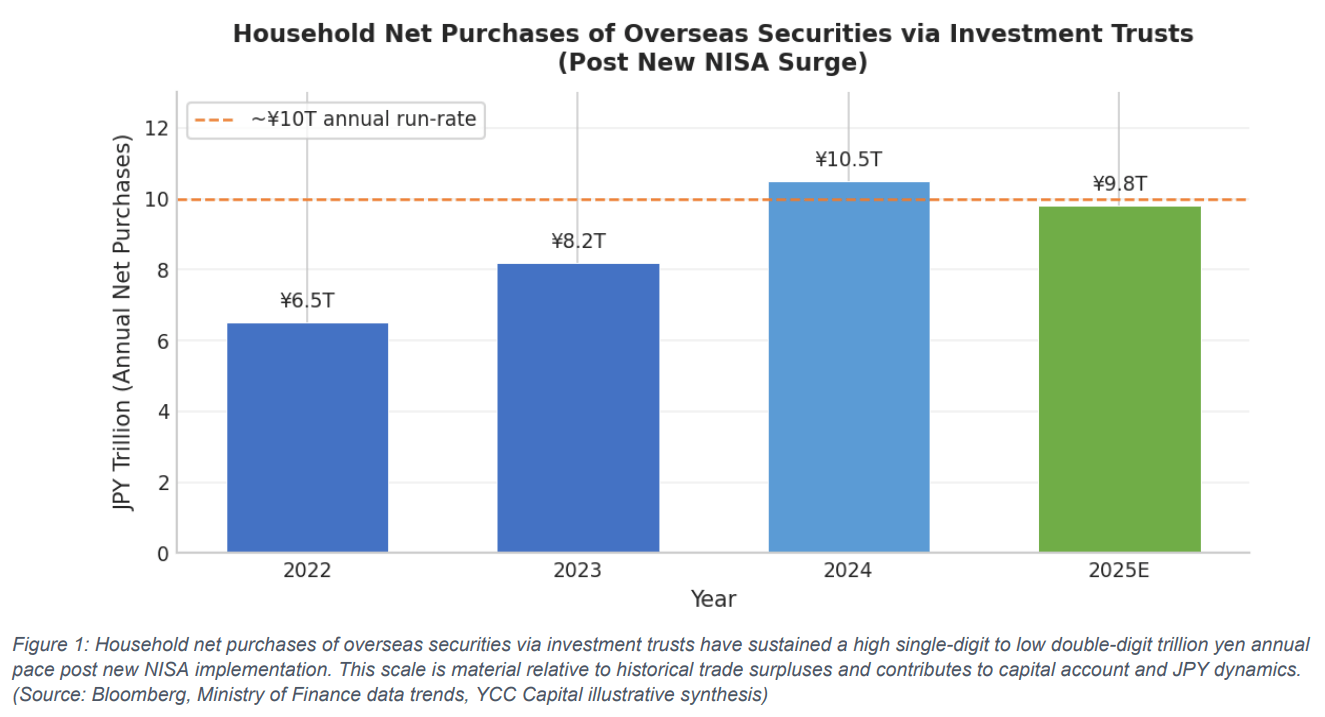
Implications for Household Portfolio Rebalancing, JGB Market Stability, and Yen Dynamics in Japan’s Asset Management Nation Initiative. YCC Perspective At YCC Capital, our global macro value lens prioritizes capital-flow dynamics and gaps between prevailing policy narratives and underlying household realities. Japan’s ‘Asset Management Nation’ push and the expanded NISA framework have catalyzed a notable shift from savings to investment. Yet this transition has manifested asymmetrically: record flows into overseas equity funds and global ‘all-country’ products have amplified capital outflows and contributed to JPY pressure, even as domestic rates begin a long-awaited normalization. In this context, renewed attention on personal JGBs—retail-targeted, principal-protected Japanese government bonds—represents a pragmatic policy response aimed at diversifying household choices, anchoring a more resilient domestic investor base for JGBs amid elevated foreign participation metrics, and offering a low-volatility JPY ballast within increasingly globally exposed portfolios. This analysis examines the drivers behind the current discussion, the structural features of personal JGBs, potential design enhancements, and the broader implications for Japan’s macro-financial stability from our cross-border capital allocation perspective. Key Takeways Elevated foreign ownership of JGBs (certain measures now exceeding prior domestic-centric thresholds) and sustained household purchases of overseas securities via investment trusts—running at approximately ¥10 trillion annually since the new NISA launch—have intensified policy focus on expanding stable domestic holding layers, especially among households, to reduce concentration and outflow risks. Personal JGBs feature built-in principal guarantees and yields that have turned competitive following the exit from zero/negative rates, providing households with a simple, government-backed domestic fixed-income option that was structurally unappealing during the deflationary decades but now offers meaningful ballast versus bank deposits or concentrated global equity bets. The post-NISA surge in global equity and ‘all-country’ fund allocations has added a material layer to Japan’s capital account outflows and JPY softness; thoughtfully designed domestic alternatives can partially rebalance these flows without restricting investor freedom, supporting more stable two-way capital dynamics. Ongoing deliberations—including potential yield adjustments to better compete with tax-advantaged equity upside, careful consideration of NISA eligibility (complicated by the product’s principal-protection nature), and ancillary features such as inheritance planning—signal constructive product evolution while preserving the core attributes of safety, simplicity, and broad accessibility. From YCC’s vantage point, revitalized personal JGBs can function as an effective portfolio diversifier and ‘balancer’ alongside global growth assets. This supports household financial resilience, dampens tail risks from over-concentration in equities or foreign currency exposure, and aligns with long-term compounding in a normalizing Japanese interest rate regime—without displacing higher-conviction international opportunities where narrative-reality gaps remain wide. The Evolving JGB Holder Base and the Policy Push for Domestic Stability Japan’s JGB market has long benefited from a deep domestic investor base, historically dominated by banks, the Bank of Japan, and households. However, foreign participation has risen meaningfully over the past decade-plus, with certain visibility-adjusted or net metrics now reflecting elevated offshore holdings. While this globalization of the investor base brings liquidity benefits, it also introduces greater potential for volatility in response to global risk sentiment, interest rate differentials, and currency moves. Against this backdrop, recent policy discussions—spanning the Asset Management Nation Parliamentary League and public comments from figures such as Finance Minister Katayama—have emphasized the desirability of a broader, more stable domestic holding layer. Households represent one of the more promising areas for incremental absorption. Unlike institutional players with strict mandates or mark-to-market sensitivities, retail investors can provide sticky, long-term demand when products are appropriately designed and communicated. The policy intuition is straightforward: if a larger share of Japan’s substantial household financial assets can be channeled into domestically issued, yen-denominated instruments with attractive risk-return profiles, the JGB market gains a more resilient core, reducing reliance on potentially flighty foreign flows during stress episodes. This is not framed as a rejection of international capital or a ‘closed market’ impulse. Rather, it reflects a recognition that diversified holder composition—domestic retail alongside foreign institutions and domestic banks—enhances overall market stability. The discussion is therefore constructive and market-oriented: how to make personal JGBs a more compelling choice within a competitive menu of options available to Japanese savers and investors. Household Overseas Investment Surge and Macro Implications Parallel to the JGB holder discussion has been the well-documented acceleration of household capital outflows via investment trusts. Following the 2024 expansion of NISA (Nippon Individual Savings Account) tax-advantaged frameworks, annual net purchases of overseas securities through such vehicles have settled into a roughly ¥9.5–11 trillion run-rate. Products such as global all-country equity funds and S&P; 500 trackers have captured the lion’s share of these flows. While multiple factors influence the JPY—including corporate hedging behavior, trade balances, and global USD strength—the household channel is no longer negligible. In years when the current account surplus was itself only in the low-20 trillion yen range, sustained double-digit trillion yen outflows via retail investment vehicles represent a meaningful swing factor. This does not imply that overseas investment should be curtailed; on the contrary, greater international diversification is healthy for Japanese households long starved of yield. However, the asymmetry—strong one-way flows into global equities with limited counterbalancing domestic fixed-income uptake—creates excess pressure on the currency and complicates the BOJ’s normalization path. A natural policy and market response is therefore to ensure that the domestic menu includes compelling, easy-to-understand options that can attract a portion of these flows on their own merits. Personal JGBs, if properly positioned and modestly enhanced, can play exactly this ‘balancer’ role without requiring any investor to forgo global opportunities. Design Features of Personal JGBs: Why They Merit Fresh Consideration Personal JGBs have existed for years but suffered from chronically low uptake during the zero- and negative-rate era. Their core architecture, however, is well-suited to the current environment: Principal Protection: After a minimum holding period (typically one year for certain series), the government stands ready to repurchase at par, providing a hard floor that bank deposits and equity funds lack. Modest penalties or opportunity costs may apply for early exit, but the downside is capped in nominal terms. Yield Mechanics: Fixed-rate variants offer predictable coupons. Floating-rate versions are periodically reset (often semi-annually)