YCC CAPITAL
Japan Investment Strategy
September 22, 2026
Investment Perspective
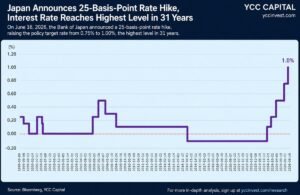
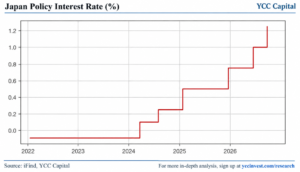
Japan’s monetary normalization has moved into a more consequential phase. At its September 18 policy meeting, the Bank of Japan raised its policy rate by 25 basis points to 1.25%, matching market expectations. More important than the size of the move was its timing: only one meeting separated this increase from the previous hike, making this the shortest interval between rate increases since the current normalization cycle began in 2024.
For YCC Capital, the message is increasingly clear. Japan is no longer debating whether inflation can survive outside the extraordinary monetary architecture of the post-deflation era. The policy question is becoming how quickly the BOJ should remove accommodation without destabilizing an economy that is recovering, but hardly overheating.
That distinction matters. Japan still faces expensive energy, uneven domestic demand and substantial external uncertainty. Yet these are better understood as cyclical constraints on normalization rather than evidence of permanent economic decline. Labor scarcity, wage-price dynamics, AI-related external demand and currency depreciation are creating an inflation environment fundamentally different from the one Japan confronted for much of the previous three decades.
A 7–2 Vote Reveals an Emerging Policy Divide
The BOJ approved the 25bp increase by seven votes to two. The dissenters argued that neither economic activity nor inflation had accelerated sufficiently to justify another increase.
The composition of that dissent deserves attention. Both opposing members were appointed in 2026 by Prime Minister Sanae Takaichi. One, Toichiro Asada, had also been the only dissenter against the June rate increase, while Ayano Sato joined the board following that meeting.
This does not overturn the BOJ’s current normalization trajectory, but it introduces an increasingly visible political-economy tension. The administration favors an accommodative economic-policy posture, while the central bank is confronting inflation risks that may require additional tightening.
The calendar could make that tension more important. Hawkish board members Hajime Takata and Naoki Tamura are scheduled to complete their terms after the July 2027 meeting. If their successors favor a more dovish approach, the internal hurdle for subsequent tightening could rise. The BOJ therefore has an incentive to use the present window to normalize rates gradually rather than risk having to move more aggressively later.
Anyone who has lived through a period of rapidly changing household prices understands the problem intuitively. A central bank would rather turn the thermostat down a little at a time than wait until the room is uncomfortably hot and then throw open every window. Governor Kazuo Ueda’s latest communication increasingly resembles that first approach.
AI Is Becoming Part of Japan’s Macro Story
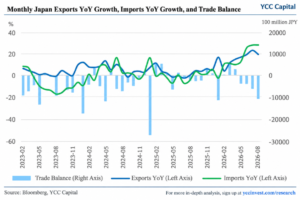
The BOJ’s broad economic assessment remains relatively stable: Japan is experiencing a moderate recovery, with weakness in some areas. Yet beneath that unchanged headline, the composition of growth is improving in several important respects.
Exports and industrial production were upgraded from broadly flat to beginning to increase, with robust global demand related to artificial intelligence playing a significant role. The BOJ still expects moderate economic growth accompanied by some deceleration. High oil prices remain a drag, while government measures and accommodative financial conditions provide support. AI demand has now joined that list of positive forces.
This is important for Japan’s longer-term investment narrative. The country sits inside critical portions of the global semiconductor, semiconductor-equipment, materials and precision-manufacturing ecosystem. An AI capital-expenditure cycle originating elsewhere can therefore transmit directly into Japanese factories, exporters and industrial investment.
That does not make Japan immune to the global cycle. It does, however, provide another source of resilience at precisely the moment monetary policy is becoming less accommodative.
Inflation Risks Are Shifting Upward
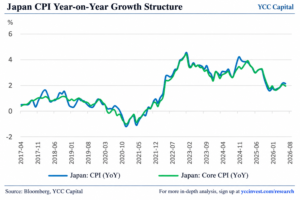
The inflation discussion was notably more consequential.
Core CPI inflation has moved higher at the margin. Energy prices continue to contribute to price pressures, while two additional channels have become more prominent: semiconductor price increases associated with AI demand and the inflationary consequences of a weaker yen.
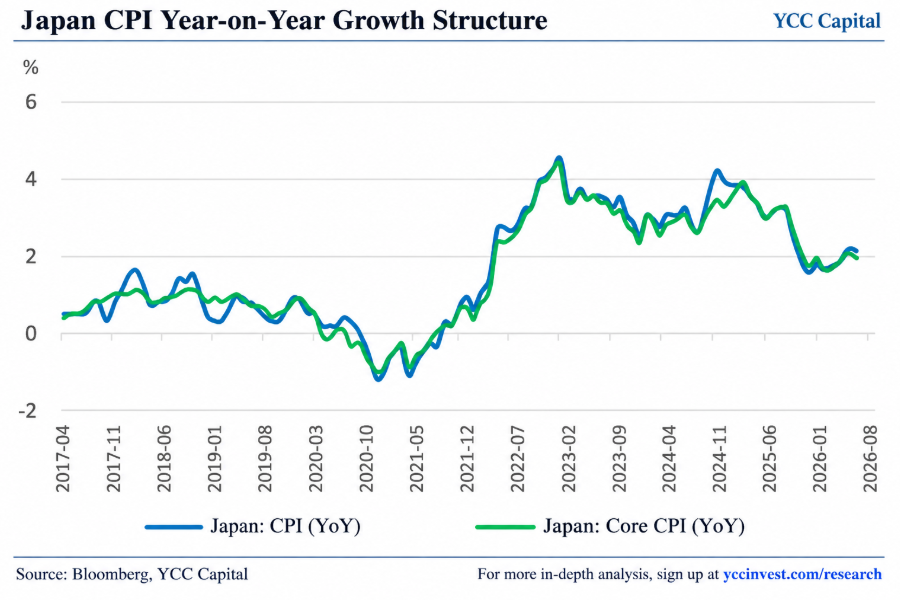
Persistent labor shortages remain especially important. The BOJ expects underlying inflation to reach its 2% target during the second half of fiscal 2026 or during fiscal 2027. The inflation chart accompanying our assessment shows why the debate has changed: after decades in which Japan struggled to generate sustained inflation, headline and underlying measures are now operating much closer to the BOJ’s objective.
Governor Ueda highlighted three major upside inflation risks: developments in the Middle East, stronger AI-related demand and further yen weakness.
The currency channel may prove particularly important. Wider interest-rate differentials between Japan and other economies can maintain depreciation pressure on the yen, which in turn raises the domestic cost of imported goods and energy. Currency weakness therefore does more than alter exporter earnings. It can become a transmission belt carrying global inflation directly into Japanese household budgets.
Ueda said underlying inflation is approaching 2%, while warning that there is a risk of overshooting the target. That language suggests the BOJ is becoming more concerned about doing too little than it was earlier in the normalization cycle.
The Destination Is Uncertain, but the Direction Is Not
Ueda characterized monetary policy as having entered a “new stage.” Despite successive increases, he continues to regard current policy settings as accommodative and sees room for additional hikes.
The logic is straightforward. If inflation is converging toward 2%, the BOJ wants to guide policy toward a more neutral setting gradually. Waiting too long could force faster tightening later—the very outcome policymakers would prefer to avoid.
The BOJ estimates Japan’s neutral nominal interest rate within an unusually broad range of roughly 1.1% to 2.5%. Ueda emphasized that the neutral rate cannot be identified precisely and that the eventual terminal policy rate cannot be predetermined. Economic activity, inflation and financial conditions will determine how far normalization ultimately proceeds.
That uncertainty should not be mistaken for indecision. Central banking rarely provides a clean destination marker. The BOJ knows the road it is traveling even if the precise exit remains obscured by fog.
YCC Strategic View
We expect the BOJ to continue pursuing gradual and orderly normalization, provided wage-price dynamics remain intact and the economy retains sufficient resilience. Energy-price pass-through, persistent labor scarcity and yen depreciation all argue against prematurely declaring the inflation challenge resolved. AI-related demand provides an additional cushion for industrial activity.
For Japanese assets, the implications are more nuanced than the simple proposition that “higher rates are bad.” A sustained exit from emergency-era monetary settings can reinforce the credibility of Japan’s economic normalization, improve price discovery and reshape capital allocation. The transition can create volatility—particularly for highly rate-sensitive assets—but it also reflects an economy moving farther away from the deflationary conditions that defined an earlier era.
Globally, the picture deserves attention as well. With major developed economies simultaneously confronting inflation and less-abundant liquidity, another increment of BOJ tightening can matter beyond Japan through currencies, sovereign yields and cross-border capital flows. Japan has long been an important source of inexpensive funding. As that funding becomes incrementally less cheap, global investors should expect occasional tremors across leveraged and duration-sensitive positions.
The principal risks to this view are an unexpectedly severe escalation in geopolitical tensions and substantially greater-than-anticipated depreciation pressure on the yen. Either could complicate the BOJ’s attempt to normalize gradually.
Japan’s central bank is walking a narrower path, but the broader transition remains constructive: inflation is functioning again, corporate and industrial activity is finding new sources of demand, and monetary policy is regaining conventional room to operate. The challenge now is not escaping structural decline; it is managing the short-term costs of normalization without extinguishing the longer-term improvement underneath it.
Source: Bloomberg, YCC Capital
Editorial Board
Ken Cao, Chief Strategist, Global Investment Strategy; Le Gao, Managing Analyst; Yui Nabeshima, Strategist; Mai Ikeda, Research Analyst.
IMPORTANT DISCLAIMER
This research report is provided for informational and educational purposes only and does not constitute an offer to sell or a solicitation of an offer to buy any securities, financial instruments, or investment products. It is not intended as investment, legal, accounting, or tax advice and should not be relied upon as such. The views, opinions, and projections expressed herein are those of YCC Capital Management and its research personnel as of the date of publication and are subject to change without notice. Past performance is not indicative of future results.
YCC Capital Management, its affiliates, principals, and employees may hold long or short positions in securities or instruments discussed in this report and may trade for their own accounts or for client accounts in a manner inconsistent with the recommendations herein. This report is based on publicly available information and data believed to be reliable, but YCC Capital makes no representation or warranty, express or implied, as to the accuracy, completeness, or timeliness of such information. Forward-looking statements involve risks and uncertainties that could cause actual results to differ materially from those projected.
Recipients of this report should conduct their own independent due diligence and consult with their own financial, legal, and tax advisors before making any investment decisions. YCC Capital accepts no liability for any loss or damage arising from the use of or reliance on this report or its contents.
This report is intended solely for the use of the intended recipient(s) and may not be reproduced or redistributed for commercial purposes without the prior written consent of YCC Capital. © 2026 YCC Capital. All rights reserved. YCC Capital’s flagship vehicle, the YCC International Value Fund, LP, maintains a concentrated global macro value strategy with a focus on capital-flow-driven mispricings and asymmetric hedging opportunities. The Fund is registered in the State of Delaware, U.S and structured as a 506(c) fund. Performance data, where referenced, has been verified by independent third parties including NAV Consulting; however, individual investor results may vary.
Contact Us
For research inquiries, contact ir@yccinvest.com.
Sign up for free daily market insight at yccinvest.com.
Footer on every page:
YCC Capital Research | Sign up for free daily market insight at www.yccinvest.com
The Bank of Japan Just Sent a Warning to the Entire Financial World
The Yen’s Real Battle: Why BOJ Tightening Alone Will Not Be Enough
The Yen’s False Bottom: Intervention Can Break Momentum, Not Rewrite Fundamentals