YCC CAPITAL
Japan Investment Strategy
Date: July 4, 2026
Executive Summary
Japan enters the second half of 2026 in a position that would have seemed improbable only a few years ago. After decades defined by deflation, subdued wage growth, and recurring policy experiments, the country has finally begun to normalize monetary policy. Yet this normalization is taking place against an economy that remains profoundly uneven. Manufacturing is benefiting from one of the strongest global semiconductor investment cycles in history, while household consumption continues to recover only gradually. Inflation has moderated, but underlying price pressures have not disappeared. The Bank of Japan is raising interest rates, but only cautiously, mindful that today’s fragile expansion cannot withstand excessive tightening.
At YCC Capital, we believe investors should avoid viewing Japan through a single narrative. The country is neither experiencing a broad-based economic boom nor slipping back into stagnation. Instead, Japan is evolving into an economy increasingly divided between globally competitive technology exporters and domestically oriented sectors that remain constrained by demographics, fiscal limitations, and cautious consumer behavior.
The result is an economy where external demand continues to outperform domestic demand, corporate earnings remain resilient despite global uncertainties, and monetary normalization proceeds gradually rather than aggressively. While headline growth is likely to remain modest, structural improvements in corporate governance, semiconductor leadership, and wage formation continue to strengthen Japan’s long-term investment case.
Domestic Economy: A Recovery That Remains Uneven
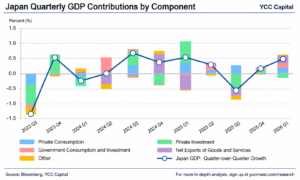
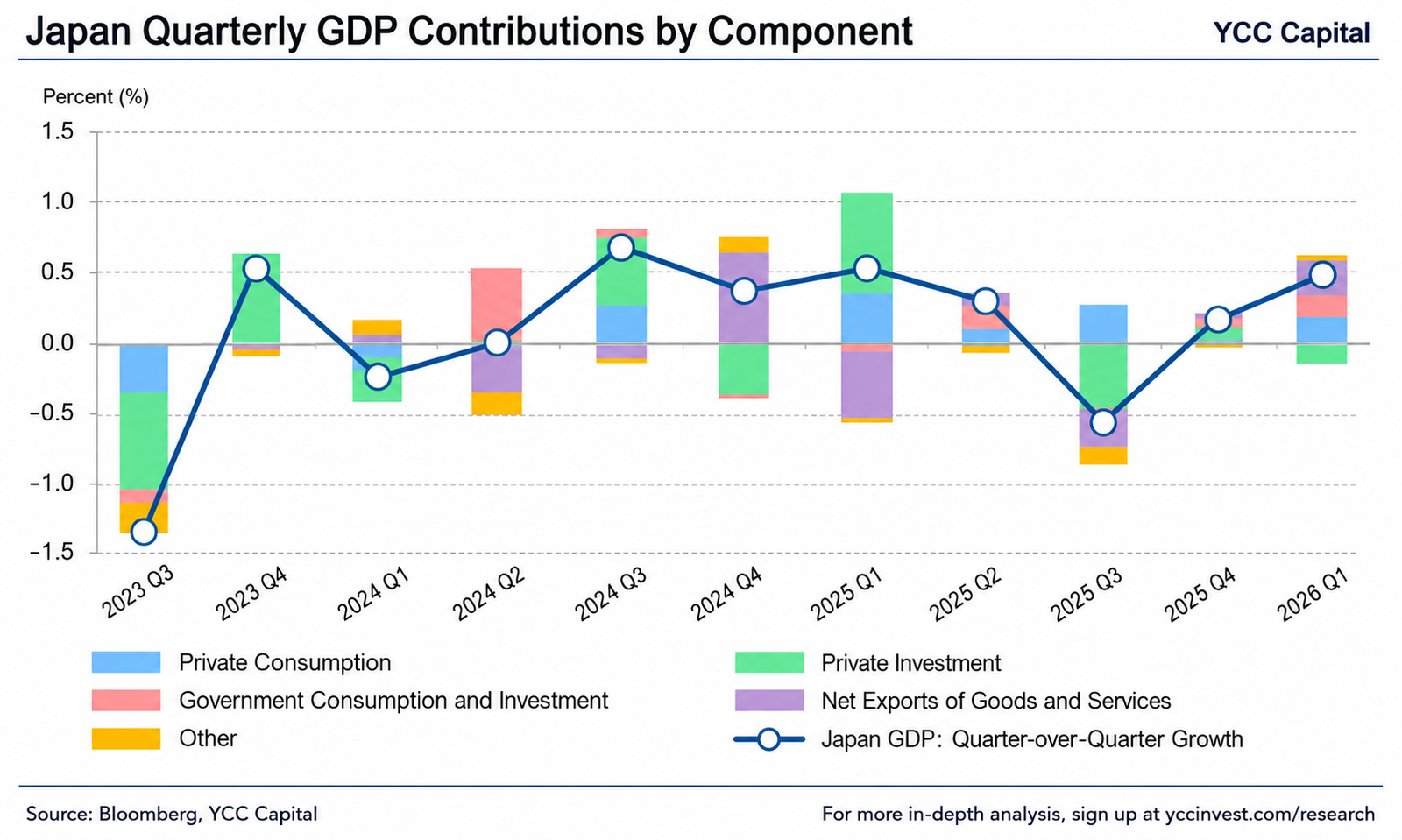
Japan’s economy expanded modestly during the first half of 2026, extending its recovery for a second consecutive quarter. Real GDP grew at an annualized pace of approximately 1.8% in the first quarter, equivalent to quarterly growth of 0.5%, while year-over-year growth slowed to roughly 0.4% as the economy faced increasingly difficult comparisons with the stronger performance recorded in 2025.
The composition of growth reveals a familiar pattern. Household consumption remained positive, government spending continued to provide meaningful support, but business investment weakened considerably. Net exports emerged as the largest contributor to overall growth, highlighting Japan’s continued dependence on external demand.
This divergence increasingly defines today’s Japanese economy. Imagine a train whose front car is accelerating while the middle cars are still gathering speed. Export-oriented manufacturers linked to artificial intelligence, semiconductors, robotics, and advanced machinery continue to move ahead rapidly, while domestic sectors dependent on household spending remain considerably slower.
Government investment also played a stabilizing role during the first half, cushioning weaker private-sector capital expenditure. Although housing investment showed signs of improvement, overall corporate investment remained subdued as firms balanced stronger earnings against higher financing costs and continued geopolitical uncertainty.
Manufacturing Continues to Lead the Expansion
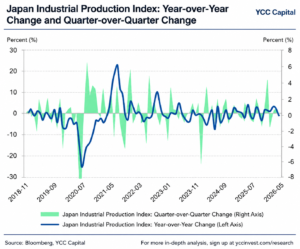 Industrial production has strengthened noticeably since the beginning of the year. Average industrial output growth returned to positive territory, reversing last year’s contraction, while manufacturing PMI readings consistently remained above the expansion threshold. In April, Japan’s manufacturing PMI reached its highest level in more than a decade.
Several forces explain this improvement.
First, geopolitical uncertainty encouraged many manufacturers to build precautionary inventories, temporarily boosting new orders.
Second, the global artificial intelligence investment cycle continues to drive extraordinary demand for semiconductor equipment, specialty materials, precision machinery, and factory automation—all industries where Japanese companies maintain global technological leadership.
Automotive manufacturing and industrial robotics also continued to perform well despite broader uncertainties surrounding international trade.
Unlike previous Japanese recoveries, this industrial rebound is being driven less by cyclical inventory rebuilding and more by structural technological investment. AI infrastructure requires enormous quantities of semiconductor manufacturing equipment, specialty chemicals, advanced materials, precision optics, and automation systems—segments where Japanese firms remain indispensable participants in global supply chains.
Consumers Are Recovering, But Confidence Remains Fragile
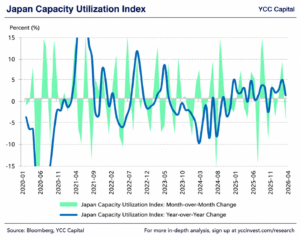
Household spending has been considerably less impressive.
Real household consumption remained largely flat during the opening months of 2026, representing a meaningful slowdown compared with last year’s stronger gains. Inflation-adjusted spending declined modestly despite improvements in nominal retail sales. Consumer confidence weakened sharply during the escalation of Middle East tensions before recovering gradually as geopolitical risks moderated.
Yet beneath these relatively soft spending figures lies a more encouraging development.
Nominal wage growth accelerated meaningfully during the first four months of the year. More importantly, declining inflation allowed real wage growth to turn positive after remaining negative for much of the previous year. This marks one of the most significant structural improvements within Japan’s economy.
For decades, Japanese households became accustomed to stagnant incomes and limited purchasing power. A sustained period of positive real wage growth changes consumer psychology gradually rather than overnight. Families typically increase discretionary spending only after becoming confident that higher incomes will persist rather than prove temporary.
At YCC Capital, we believe improving real wages should provide increasing support for domestic consumption during the second half of the year, particularly if lower energy prices continue to ease household financial pressures.
Inflation Has Slowed, But Underlying Pressures Remain
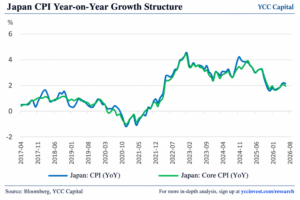
Headline inflation moderated significantly during the first half of 2026. Consumer prices rose approximately 1.5% year-over-year in May, comfortably below the levels recorded late last year. Core inflation also declined meaningfully as government subsidies and favorable base effects temporarily reduced measured price pressures.
Government intervention played an important role in this moderation.
Electricity subsidies, natural gas assistance, fuel price support, education-related subsidies, and targeted household transfers collectively offset much of the increase in global energy costs. At the same time, unusually high inflation readings recorded during early 2025 created statistical base effects that mechanically lowered annual inflation rates this year.
However, investors should avoid concluding that Japan’s inflation challenge has disappeared.
Producer prices continue rising rapidly, indicating that upstream cost pressures remain substantial. Wage growth continues to strengthen following another successful annual spring wage negotiation cycle. Meanwhile, the weaker yen continues to increase import costs across a broad range of goods and services.
As various government subsidy programs gradually expire later this year, headline inflation is likely to move modestly higher again. Although international oil prices have begun retreating from recent peaks, underlying domestic inflation appears increasingly self-sustaining.
We expect inflation to approach—and potentially temporarily exceed—the Bank of Japan’s 2% target during the fourth quarter before stabilizing.
Semiconductor Leadership Continues to Transform Japan’s External Sector
Japan’s external sector has become one of the strongest pillars supporting overall economic growth.
Exports expanded at double-digit rates during the first five months of the year, significantly outperforming imports and sharply reducing the country’s trade deficit. A weaker yen, exceptionally strong semiconductor demand, and favorable comparison effects all contributed to the improvement.
The regional composition of exports highlights an important structural shift.
Trade with China, Taiwan, Hong Kong, and South Korea strengthened substantially as semiconductor supply chains expanded throughout East Asia. Exports to Europe and Southeast Asia also increased strongly, more than offsetting softer shipments to the United States amid evolving trade policies.
Looking at product categories, semiconductor equipment, electrical machinery, batteries, industrial equipment, and ships all delivered robust export performance. Traditional sectors including automobiles and steel experienced comparatively weaker demand.
The broader message is clear. Japan is increasingly exporting technology rather than simply manufactured goods. This distinction matters because technology-oriented exports generally generate higher profit margins, stronger pricing power, and more resilient long-term earnings.
Weak Yen, Strong Equity Markets
One of the defining features of 2026 has been the extraordinary divergence between the Japanese currency and domestic equity markets.
The yen weakened to its lowest level against the U.S. dollar in approximately four decades despite repeated government intervention. Interest rate differentials explain only part of this depreciation. Investors also remain concerned about Japan’s exceptionally high public debt burden, persistent capital outflows, and the Bank of Japan’s relatively gradual approach toward policy normalization.
Yet the same weak currency has become a powerful tailwind for Japanese equities.
The Nikkei 225 continued reaching successive record highs during the first half of the year. Export-oriented companies benefited from improved overseas earnings translated into weaker yen, while global enthusiasm surrounding artificial intelligence drove substantial gains across semiconductor equipment manufacturers, robotics companies, and advanced industrial technology firms.
Foreign investors also continued increasing allocations to Japanese equities, encouraged by ongoing corporate governance reforms, improved shareholder returns, and government initiatives supporting strategic industries including semiconductors, artificial intelligence, and advanced manufacturing.
Japan’s equity story increasingly resembles that of a globally competitive industrial technology platform rather than a purely domestic economy.
Outlook for the Second Half of 2026
Looking ahead, Japan should continue expanding, although growth will remain highly uneven.
External demand is likely to remain the principal engine of expansion. Continued investment in artificial intelligence infrastructure worldwide should sustain exceptionally strong demand for Japanese semiconductor materials, precision equipment, and advanced manufacturing technologies.
Meanwhile, easing geopolitical tensions and softer energy prices should improve corporate profitability while supporting household purchasing power.
Nevertheless, meaningful challenges remain.
Japan’s fiscal flexibility has narrowed considerably following years of large-scale government support programs. As temporary energy subsidies expire, fiscal policy will become less supportive. At the same time, higher interest rates will gradually weigh on corporate investment, housing activity, and interest-sensitive consumer spending.
Overall, we expect Japan’s economy to expand by approximately 0.6%–0.8% during 2026, reflecting continued recovery but below the pace seen in stronger post-pandemic rebounds.
Bank of Japan: Gradual Normalization Continues
The Bank of Japan has now firmly entered a new monetary policy era.
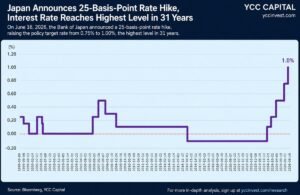
Following its June decision to raise the policy rate to 1.0%, the highest level since the mid-1990s, policymakers have clearly signaled that further normalization remains appropriate. Officials increasingly emphasize that inflation is becoming more durable, supported by stronger wage growth, higher service prices, and persistent import-cost pressures.
At the same time, the central bank remains acutely aware of Japan’s vulnerabilities.
Aggressive tightening would risk undermining an expansion that remains heavily dependent on exports. Higher interest rates also significantly increase debt-servicing costs for a government whose public debt exceeds 260% of GDP.
These competing objectives suggest a highly cautious path forward.
Our base case anticipates one additional 25-basis-point rate increase during the second half of 2026, most likely occurring only after policymakers gain greater confidence that inflation remains sustainably near target while domestic demand continues improving.
The pace of tightening is likely to remain measured rather than aggressive, preserving financial stability while gradually restoring policy normalization after decades of extraordinary accommodation.
YCC Capital Investment View
Japan’s investment story continues to improve, but not because the entire economy is booming.
Rather, the country’s comparative advantage is becoming increasingly concentrated in industries positioned at the center of the next global investment cycle. Artificial intelligence, semiconductor manufacturing, factory automation, precision equipment, and advanced industrial technologies continue attracting both domestic investment and international capital.
Domestic demand remains the weakest link in the recovery, while fiscal constraints limit the government’s ability to provide additional large-scale stimulus. Nevertheless, stronger wage growth, improving corporate governance, and disciplined monetary normalization represent meaningful structural improvements compared with previous decades.
For global investors, Japan increasingly offers exposure to world-class industrial technology leadership rather than merely a cyclical recovery story. While short-term volatility surrounding interest rates, currency movements, and geopolitics should be expected, the country’s long-term trajectory continues to improve.
At YCC Capital, we remain constructive on Japan’s medium-term outlook, particularly in globally competitive sectors linked to artificial intelligence, advanced manufacturing, automation, and semiconductor capital expenditure. Although cyclical headwinds remain, Japan’s structural transformation appears increasingly durable.
Sources: Bloomberg, YCC Capital
Editorial Board
Ken Cao — Chief Strategist, Global Investment Strategy
Le Gao — Managing Analyst
Yui Nabeshima — Strategist
Mai Ikeda — Research Analyst
IMPORTANT DISCLAIMER
“This research report is provided for informational and educational purposes only and does not constitute an offer to sell or a solicitation of an offer to buy any securities, financial instruments, or investment products. It is not intended as investment, legal, accounting, or tax advice and should not be relied upon as such. The views, opinions, and projections expressed herein are those of YCC Capital Management and its research personnel as of the date of publication and are subject to change without notice. Past performance is not indicative of future results.
YCC Capital Management, its affiliates, principals, and employees may hold long or short positions in securities or instruments discussed in this report and may trade for their own accounts or for client accounts in a manner inconsistent with the recommendations herein. This report is based on publicly available information and data believed to be reliable, but YCC Capital makes no representation or warranty, express or implied, as to the accuracy, completeness, or timeliness of such information. Forward-looking statements involve risks and uncertainties that could cause actual results to differ materially from those projected.
Recipients of this report should conduct their own independent due diligence and consult with their own financial, legal, and tax advisors before making any investment decisions. YCC Capital accepts no liability for any loss or damage arising from the use of or reliance on this report or its contents.
This report is intended solely for the use of the intended recipient(s) and may not be reproduced or redistributed for commercial purposes without the prior written consent of YCC Capital. © 2026 YCC Capital. All rights reserved. YCC Capital’s flagship vehicle, the YCC International Value Fund, LP, maintains a concentrated global macro value strategy with a focus on capital-flow-driven mispricings and asymmetric hedging opportunities. The Fund is registered in the State of Delaware, U.S. and structured as a 506(c) fund. Performance data, where referenced, has been verified by independent third parties including NAV Consulting; however, individual investor results may vary.
Contact Us
YCC Capital Research
Email: ir@yccinvest.com
Sign up for our free daily market insights and macro research at www.yccinvest.com.
For more related research:
The Energy Shock Is Fading—Now Markets Must Price the Next Liquidity Cycle