YCC CAPITAL
Japan Investment Strategy
August 20, 2026
YCC Capital Research
The market is increasingly treating a September Bank of Japan rate hike as the next major turning point for the yen. We think that framing is too narrow. Monetary tightening matters, but Japan’s currency problem has evolved beyond a simple interest-rate-differential story. Fiscal credibility, the quality of Japan’s external surplus, and—most importantly—the country’s productivity trajectory increasingly determine whether yen strength can become durable rather than merely episodic.
Our central conclusion is straightforward: the BOJ can buy the yen time, but it cannot manufacture a lasting bull market in the currency by itself. For that, Japan needs productivity growth strong enough to turn today’s fiscal expansion from a perceived liability into an investment in tomorrow’s productive capacity.
September Is Becoming a Live Meeting
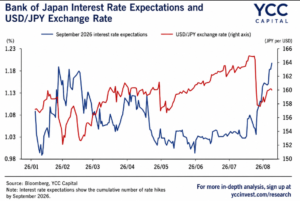
Expectations for faster BOJ tightening have risen sharply. Markets recently priced the probability of a September rate increase at roughly 80%, as policymakers became increasingly concerned that yen weakness could amplify imported inflation.
The BOJ’s policy rate currently stands at 1.0%, following the June increase, and the next Monetary Policy Meeting is scheduled for September 17–18. The July meeting placed unusual emphasis on upside inflation risks. Policymakers highlighted the combination of yen depreciation, elevated energy costs, overseas demand and AI-related investment as factors capable of keeping price pressures stronger than previously anticipated.
The weak yen is particularly important. Currency depreciation raises the domestic price of imported fuel, food, raw materials and durable goods. Once households and businesses begin expecting those increases to persist, the exchange rate can influence not only observed inflation but inflation expectations themselves.
This is why the BOJ increasingly appears willing to move more quickly.
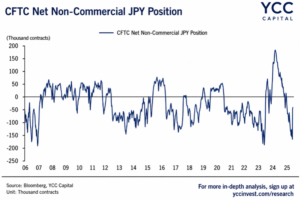
Yet the currency market is sending an uncomfortable message: expectations of tighter monetary policy have not produced proportionate yen appreciation.
Following intervention around late July and early August, USD/JPY fell from above 163 toward 157, while speculative net short-yen positions contracted rapidly. But the move did not hold. USD/JPY subsequently returned toward 159, surrendering nearly half of the yen’s initial roughly 5% appreciation.
Even as September hike expectations climbed toward their highest level of the year, the yen struggled to strengthen further.
That divergence is the heart of the story.
Sources: Bloomberg, YCC Capital
The Yen Is No Longer Trading Only on Rate Differentials
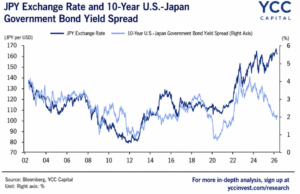
For decades, explaining USD/JPY often began with the U.S.-Japan interest-rate spread. Higher U.S. yields encouraged investors to borrow cheaply in yen and purchase higher-yielding dollar assets. Narrower spreads should therefore have supported the yen.
That relationship has weakened materially.
As the scale of the yen carry trade contracted after August 2024, USD/JPY increasingly decoupled from the U.S.-Japan yield differential. Japan exited negative interest rates in March 2024, and subsequent changes in global monetary conditions progressively narrowed the relevant rate gap. Nevertheless, the yen remained under pressure.
We believe the market has increasingly substituted fiscal risk for interest-rate differentials as a key marginal pricing factor.
This matters because raising the overnight rate does not automatically repair concerns at the long end of the government bond curve.
Think of it as a household whose salary has improved but whose spending commitments are expanding even faster. A higher savings rate helps, but creditors will still focus on the trajectory of the balance sheet. Currency investors are behaving similarly toward Japan: the BOJ’s rate normalization is constructive, but markets are simultaneously asking what fiscal expansion means for future debt issuance and sovereign financing costs.
The Long End Is Sending a Fiscal Message
The spread between 30-year and 2-year Japanese government bond yields provides a useful window into this repricing.
Fiscal concerns intensified from late 2025 as expectations of aggressive government support increased. A planned ¥21.3 trillion stimulus package coincided with weakness in both the yen and ultra-long JGBs.
Fiscal sensitivity became still clearer in January 2026. Proposals to suspend the consumption tax on food for two years raised concerns over the resulting revenue gap and additional bond issuance. Thirty- and forty-year JGB yields rose by roughly 40 basis points.
The issue resurfaced in June. A proposal to reduce the consumption tax on food from 8% to 1% implied an estimated revenue shortfall of approximately ¥4.4 trillion, without a clearly identified funding source. Subsequent efforts to advance a temporary food-tax reduction were accompanied by repeated jumps in long-end yields.
The message is not that Japan faces an inevitable fiscal crisis. We do not view today’s challenges as evidence of permanent Japanese decline. Japan retains substantial domestic savings, institutional depth, sophisticated corporations and considerable overseas assets.
Rather, markets are demanding a clearer distinction between productive fiscal expansion and consumption-oriented deficit expansion.
If additional borrowing finances technologies, infrastructure, automation and industries that lift future output, the long-run consequences can be constructive. If it primarily widens recurring fiscal deficits without increasing productive capacity, monetary tightening will have difficulty generating lasting currency appreciation.
Sources: Bloomberg, YCC Capital
Japan’s External Surplus Is Not the Yen Support It Once Was
There is a second structural change: Japan’s balance of payments remains strong in headline terms, but its composition has become less supportive of the currency.
Before 2010, Japan regularly generated merchandise trade surpluses. Exporters earned foreign currency and converted a meaningful share of those proceeds back into yen, creating a persistent underlying source of yen demand.
That mechanism has weakened.
Import growth has increasingly outpaced exports, and the goods balance moved from persistent surplus toward narrower surpluses and, following the pandemic-era shock, recurring deficits. Higher energy prices have made the problem more visible because Japan remains heavily dependent on imported energy.
At the same time, Japan continues to generate a substantial current-account surplus. The important question is where that surplus comes from.
Since 2022, the goods-and-services account has generally been in deficit. The current-account surplus has instead depended overwhelmingly on primary income: profits, dividends and interest generated by Japan’s enormous stock of overseas direct and portfolio investments.
Economically, that is a sign of accumulated national wealth. From a currency-flow perspective, however, it is less powerful than the old export-surplus model.
A significant share of overseas earnings is reinvested through foreign subsidiaries or deployed into additional overseas assets rather than repatriated and converted into yen. A ¥1 increase in primary income therefore does not necessarily create ¥1 of incremental spot-market yen demand.
Japan can consequently run a healthy current-account surplus while the yen remains weak.
Sources: Bloomberg, YCC Capital
Productivity Is the Variable That Matters Most
This brings us to the most important long-term driver: total factor productivity, or TFP.
Historical data show a striking relationship between Japanese productivity and the yen when TFP is advanced by approximately two years. The statistical relationship in the historical sample is unusually strong, with the regression exhibiting an R² of approximately 0.78.
During the 1980s and 1990s, dramatic yen appreciation was not simply the mechanical consequence of the Plaza Accord. It occurred against a backdrop in which Japan had achieved substantial productivity gains and formidable industrial competitiveness.
By contrast, as TFP growth stagnated or declined during portions of the 2000s, the yen settled into a structurally weaker range.
This is where our longer-term view on Japan becomes considerably more constructive.
Japan does not need to recreate the industrial model of the 1980s. It needs to increase output per unit of scarce labor and capital. With an aging population and persistent labor constraints, automation, robotics, artificial intelligence and digitalization are not fashionable optional extras—they are increasingly economic necessities.
Anyone who has walked into a small Japanese restaurant where one person manages orders, payment and service has seen the demographic challenge in miniature. Scale that experience across logistics, healthcare, manufacturing and professional services, and the investment case for automation becomes tangible.
If fiscal spending helps accelerate AI adoption, improve capital allocation, automate labor-intensive industries and strengthen globally competitive businesses, Japan can convert a near-term fiscal concern into a longer-term productivity dividend.
That would change the yen story fundamentally.
YCC Strategic View: A Hierarchy for Yen Appreciation
We rank the mechanisms capable of generating sustainable yen appreciation in three tiers.
The strongest mechanism is persistent TFP growth. Productivity improves Japan’s relative economic fundamentals, raises expected returns on domestic investment and makes fiscal expansion easier to justify through higher future output.
The second tier is credible fiscal discipline combined with monetary normalization. A tighter policy mix can improve confidence, compress risk premia and reduce incentives to fund overseas positions in yen. A September BOJ hike would therefore be meaningful—but not sufficient on its own.
The weakest mechanism is foreign-exchange intervention. Intervention can punish excessive positioning, interrupt momentum and create powerful short-term rallies. The move from above 163 toward 157 demonstrated exactly that. But without a change in the underlying economic incentives, intervention resembles pushing a beach ball underwater: the market can be forced away from equilibrium temporarily, but the pressure eventually reappears.
For investors, the distinction between cyclical and structural forces is critical. We would not interpret current yen weakness as evidence that Japan’s long-term economic normalization has failed. Wage behavior, corporate governance, domestic investment, inflation psychology and monetary policy have already changed materially from the deflationary era.
The next chapter depends on whether those changes translate into productivity.
A BOJ hike can slow the yen’s decline. Fiscal credibility can remove a major headwind. But productivity is what can turn defense into offense.
If Japan succeeds in using AI, automation and capital-market reform to raise TFP, today’s fiscal concerns may ultimately prove cyclical rather than structural. That is the scenario in which a genuinely durable yen appreciation cycle becomes credible—and, in our view, it is the variable investors should watch long after the September BOJ meeting has passed.
Sources: Bloomberg, YCC Capital
Editorial Board
Ken Cao, Chief Strategist, Global Investment Strategy
Le Gao, Managing Analyst
Yui Nabeshima, Strategist
Mai Ikeda, Research Analyst
IMPORTANT DISCLAIMER
This research report is provided for informational and educational purposes only and does not constitute an offer to sell or a solicitation of an offer to buy any securities, financial instruments, or investment products. It is not intended as investment, legal, accounting, or tax advice and should not be relied upon as such. The views, opinions, and projections expressed herein are those of YCC Capital Management and its research personnel as of the date of publication and are subject to change without notice. Past performance is not indicative of future results.
YCC Capital Management, its affiliates, principals, and employees may hold long or short positions in securities or instruments discussed in this report and may trade for their own accounts or for client accounts in a manner inconsistent with the recommendations herein. This report is based on publicly available information and data believed to be reliable, but YCC Capital makes no representation or warranty, express or implied, as to the accuracy, completeness, or timeliness of such information. Forward-looking statements involve risks and uncertainties that could cause actual results to differ materially from those projected.
Recipients of this report should conduct their own independent due diligence and consult with their own financial, legal, and tax advisors before making any investment decisions. YCC Capital accepts no liability for any loss or damage arising from the use of or reliance on this report or its contents.
This report is intended solely for the use of the intended recipient(s) and may not be reproduced or redistributed for commercial purposes without the prior written consent of YCC Capital. © 2026 YCC Capital. All rights reserved. YCC Capital’s flagship vehicle, the YCC International Value Fund, LP, maintains a concentrated global macro value strategy with a focus on capital-flow-driven mispricings and asymmetric hedging opportunities. The Fund is registered in the State of Delaware, U.S and structured as a 506(c) fund. Performance data, where referenced, has been verified by independent third parties including NAV Consulting; however, individual investor results may vary.
Contact Us
For research inquiries, please contact ir@yccinvest.com.
For free daily market insight from YCC Capital, sign up for our newsletter at yccinvest.com.
YCC CAPITAL | Japan Investment Strategy
YCC Capital Research | Sign up for free daily market insight at www.yccinvest.com
For more related research:
The Bank of Japan Just Sent a Warning to the Entire Financial World
The Yen’s False Bottom: Intervention Can Break Momentum, Not Rewrite Fundamentals
The Warsh Shock: The Fed’s Hawkish Reset Forces a Full Market Repricing