YCC CAPITAL
Global Asset Allocation
August Global Asset Allocation Outlook
August 13, 2026
YCC Capital Perspective
July reminded investors of an old market truth: when everyone is standing on the same side of the boat, it does not take a storm to make the deck tilt. The month combined renewed Middle East geopolitical stress with a sharp reassessment of crowded AI trades. Former leadership areas corrected violently, deeply oversold assets rebounded, and global markets moved through a broad mean-reversion phase.
The more important change, however, was not simply price action. The AI investment narrative itself is maturing. Investors are shifting from asking how much capital companies can spend to asking what that spending actually earns. The market is moving from a capacity story to an efficiency story—from racks, chips and data centers to revenue conversion, margins, cash flow and return on invested capital.
That distinction will matter across equities, bonds and commodities through the remainder of 2026.
Global Assets: Mean Reversion Takes Control
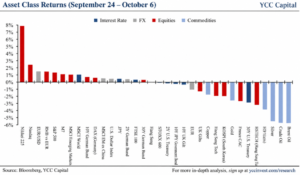
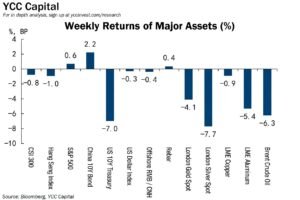
July produced one of the clearest rotations of the year. Brent crude gained 23.6% during the month as renewed U.S.-Iran tensions and restrictions around strategically important shipping routes revived supply concerns. Gold rose 0.8%, ending four consecutive months of declines, while silver stabilized more cautiously. Copper and aluminum remained relatively resilient as AI infrastructure and power-grid investment continued to support demand.
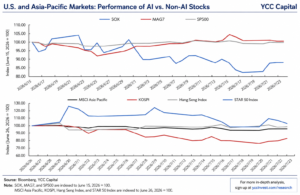
Equity performance was more uneven. The Philadelphia Semiconductor Index fell by more than 20% as investors reduced exposure to crowded AI hardware positions. Korea was hit by simultaneous deleveraging in chip shares and regulatory uncertainty. In China, the ChiNext Index fell 23.0% in July, while the Shanghai Composite declined 6.4%. The damage was amplified by leveraged positioning rather than by a comparable deterioration in underlying earnings expectations.
Hong Kong moved in the opposite direction, gaining 13.1%, supported by low valuations, dividend exposure and renewed foreign inflows. We would resist extrapolating that relative strength into a broader bullish China thesis. China’s underlying macro picture remains weak: property is still contracting, private-sector confidence is fragile, investment appetite is poor, and policy remains focused on preventing disorder rather than engineering a durable reacceleration.
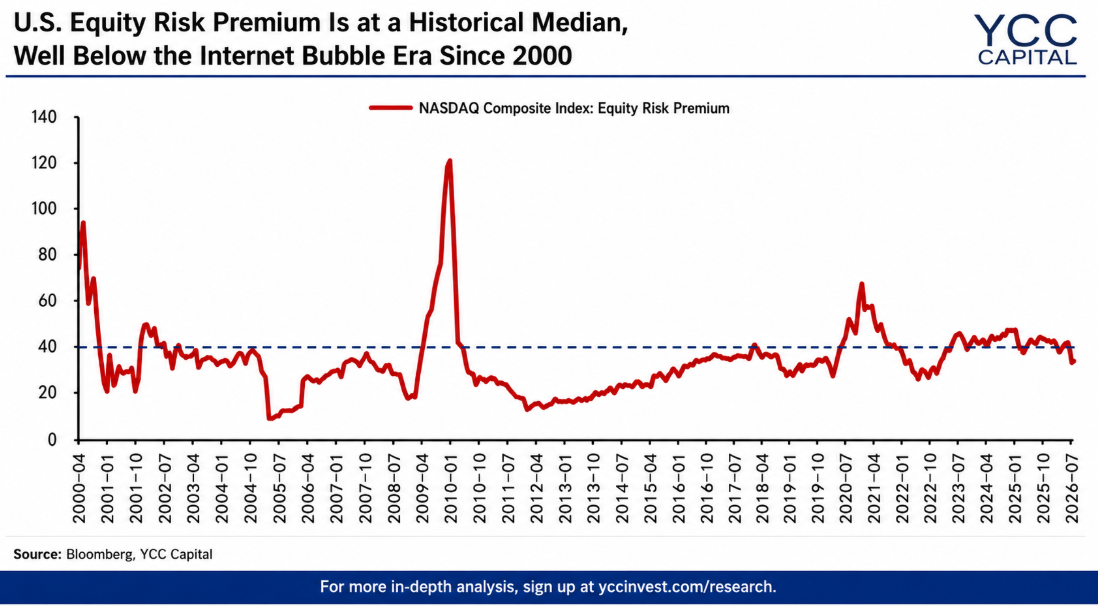
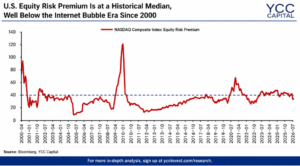
In the United States, the S&P 500 was broadly flat in July while the Nasdaq declined 3.2%. We view the U.S. correction as healthier than alarming. Valuations remain elevated in selective growth segments, but they are nowhere close to the extremes seen during the 2000 technology bubble. The U.S. also retains a stronger combination of household demand, innovation, fiscal support and corporate profitability than most major economies.
AI: The Market Now Wants Receipts
The first stage of the AI trade rewarded spending. When computing supply was scarce, capital expenditure itself became evidence of future growth. That phase is ending.
Cloud companies are now spending at extraordinary levels, and free cash flow is becoming tighter. Investors are therefore demanding proof that each dollar of capital expenditure can be transformed into revenue, earnings and durable cash generation. Companies with strong ROIC are increasingly being rewarded, while firms whose economics depend primarily on perpetual increases in hardware spending face a higher burden of proof.
This is a familiar pattern. During the internet buildout, early profits accrued to fiber, networking and infrastructure providers. Over time, economic value migrated toward companies capable of controlling network access, monetizing traffic and building applications on top of that infrastructure. AI may follow a similar path.
Falling token costs and improving inference efficiency should gradually shift profit pools toward hyperscale cloud platforms and eventually toward software and application businesses. Hardware remains strategically important, but its beta increasingly depends on the rate of acceleration in AI capital spending. If capex growth merely stays high rather than accelerating, the market can still compress hardware multiples.
For investors, this is the difference between buying the shovel manufacturer and buying the business that eventually learns how to turn the mine into cash.
China: A Slower Economy With Fewer Easy Policy Answers
China’s economy remains in a long-cycle slowdown, even though the pace of deterioration has moderated. New-economy sectors are providing some support, but traditional growth engines continue to weaken.
Infrastructure investment fell 2.4% year to date, manufacturing investment declined 1.2%, and real-estate development investment dropped 18.0%. Housing starts, completions and developer funding each recorded declines exceeding 20%. Property is therefore not simply one weak sector; it continues to transmit weakness into construction materials, household appliances, furnishings, local-government finance and consumer confidence.
Consumption also remains soft. Trade-in subsidies are producing diminishing returns, while households remain cautious because of uncertainty around employment, property wealth and long-term income. Services are comparatively stronger, but discretionary goods, autos, appliances and dining remain weak.
Exports have been a major offset, helped by global demand, AI-related capital expenditure and manufacturing supply-chain strength. Yet reliance on exports creates its own vulnerability because external demand cannot indefinitely compensate for weak domestic balance sheets.
Policy remains defensive rather than reflationary. Authorities are emphasizing industrial upgrading, domestic demand stabilization, social support and risk containment. Incremental stimulus is more likely if growth falls materially below targets for multiple quarters or if unemployment, debt stress or an external shock worsens. Until then, policy appears designed to keep the floor from collapsing rather than to lift the ceiling.
Bonds: China’s Ultra-Long Duration Still Has Relative Value
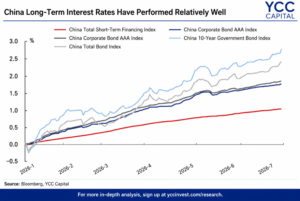
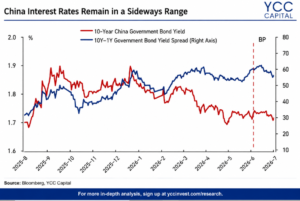
China’s government-bond market remains supported by weak domestic demand, slowing credit creation and expectations of further monetary accommodation. In July, the curve bull-flattened as long-end yields declined while the short end adjusted more modestly.
The 30-year government bond yield fell below 2.2%. Credit spreads generally widened, and three-year AA+ yields in property, steel, coal, power and construction moved to approximately 1.85%, 1.81%, 1.74%, 1.74% and 1.79%, respectively.
For the third quarter, we expect yields to remain more likely to fall than rise, but the room for a dramatic rally is limited by countercyclical policy support. A reasonable range is approximately 1.65%-1.70% for the 10-year government bond and 2.15%-2.20% for the 30-year.
The most interesting relative-value signal is at the ultra-long end. The 30-year/10-year yield ratio is near 1.28 versus a long-run center around 1.20, while the 30s/10s spread is close to 47 basis points. That leaves scope for further compression and makes 30-year duration comparatively attractive.
Equities: Rotation Before Resolution
China’s July technology collapse was driven heavily by positioning. Daily A-share turnover averaged RMB 2.68 trillion, down 13.8% from June, while margin-financing balances fell by RMB 409.1 billion to RMB 2.61 trillion. Crowded trades unwound quickly, forcing investors into banks, energy, food and other lower-volatility areas.
That does not mean Chinese technology has become structurally attractive. The near-term problem is that trapped positioning remains substantial, and a sustained recovery would require new fundamental catalysts rather than merely cheaper prices.
Within global equities, we prefer a more balanced framework. U.S. technology remains supported by stronger commercialization and deeper capital markets, although select AI hardware names may require time for valuations to reconnect with cash-flow economics. Cloud platforms and application-layer companies should increasingly capture value as model costs decline.
Gold: Supported, but the Upside Is No Longer One-Way
Gold became less sensitive to U.S. real yields in July. Real rates rose sharply, yet gold still managed a modest gain. That resilience reflects continuing geopolitical uncertainty and concern around the long-term credibility of fiat monetary systems.
Three expectation gaps matter now. First, the U.S. economy may remain stronger than markets expect, supported by AI investment, fiscal policy and resilient consumption. That is a headwind for gold.
Second, markets may be overpricing Federal Reserve tightening. Current inflation is far below the levels associated with historical stagflationary tightening cycles. Additional rate increases would also risk destabilizing highly valued technology assets and tightening financial conditions sharply. We therefore believe unchanged policy is more likely than an aggressive renewed hiking cycle absent a major inflation shock.
Third, Middle East tensions may prove more persistent than markets assume. The U.S.-Iran confrontation involves energy security, regional alliances and long-running strategic objectives that are unlikely to disappear through a single diplomatic episode.
These forces create a floor under gold, but not necessarily another explosive leg higher. We expect improved sentiment and continued strategic demand, while stronger U.S. growth and tighter global monetary expectations constrain upside.
Oil: Geopolitics Meets Thin Inventories
Oil has returned to a geopolitical pricing regime. Renewed U.S.-Iran tensions disrupted confidence around the Strait of Hormuz, while risks around the Bab el-Mandeb added concern over shipping security. Together, these routes influence an exceptionally large share of international energy and merchandise trade.
At the same time, summer travel demand is improving refinery utilization in both the United States and China, while global inventories remain lean. OECD and non-OECD crude stocks have declined, and the U.S. Strategic Petroleum Reserve remains historically depleted.
That combination gives oil a stronger downside buffer than many other commodities. We expect Brent to remain volatile at relatively elevated levels through the third quarter. The path will depend on geopolitical developments and producer policy, but low inventories make the market unusually sensitive to even temporary supply disruptions.
YCC Strategic View
The defining transition in markets is not the death of the AI theme. It is the end of the period when investors could treat spending itself as proof of value.
The next phase will reward businesses that can convert infrastructure into productivity, revenue and cash flow. That shift supports selective U.S. cloud and application businesses over indiscriminate hardware exposure. It also argues for a more balanced equity allocation as crowded positioning continues to normalize.
In China, weak domestic demand, property stress and cautious policy continue to justify a defensive stance. Ultra-long government bonds remain one of the cleaner expressions of that macro environment. Gold retains strategic value as a hedge, but near-term upside is constrained. Oil remains the asset most directly exposed to geopolitical asymmetry.
Markets often behave like household budgets after an enthusiastic renovation: the first question is how ambitious the project can become; eventually, someone looks at the bank account and asks whether the new kitchen actually improved the value of the house. AI has reached that second conversation.
Source: Bloomberg, YCC Capital
Editorial Board
Ken Cao, Chief Strategist, Global Investment Strategy
Le Gao, Managing Analyst
Yui Nabeshima, Strategist
Mai Ikeda, Research Analyst
IMPORTANT DISCLAIMER
“This research report is provided for informational and educational purposes only and does not constitute an offer to sell or a solicitation of an offer to buy any securities, financial instruments, or investment products. It is not intended as investment, legal, accounting, or tax advice and should not be relied upon as such. The views, opinions, and projections expressed herein are those of YCC Capital Management and its research personnel as of the date of publication and are subject to change without notice. Past performance is not indicative of future results.
YCC Capital Management, its affiliates, principals, and employees may hold long or short positions in securities or instruments discussed in this report and may trade for their own accounts or for client accounts in a manner inconsistent with the recommendations herein. This report is based on publicly available information and data believed to be reliable, but YCC Capital makes no representation or warranty, express or implied, as to the accuracy, completeness, or timeliness of such information. Forward-looking statements involve risks and uncertainties that could cause actual results to differ materially from those projected.
Recipients of this report should conduct their own independent due diligence and consult with their own financial, legal, and tax advisors before making any investment decisions. YCC Capital accepts no liability for any loss or damage arising from the use of or reliance on this report or its contents.
This report is intended solely for the use of the intended recipient(s) and may not be reproduced or redistributed for commercial purposes without the prior written consent of YCC Capital. © 2026 YCC Capital. All rights reserved. YCC Capital’s flagship vehicle, the YCC International Value Fund, LP, maintains a concentrated global macro value strategy with a focus on capital-flow-driven mispricings and asymmetric hedging opportunities. The Fund is registered in the State of Delaware, U.S and structured as a 506(c) fund. Performance data, where referenced, has been verified by independent third parties including NAV Consulting; however, individual investor results may vary.”
Contact Us
For research inquiries, contact ir@yccinvest.com.
Sign up for free daily market insight at yccinvest.com.
YCC Capital Research | Sign up for free daily market insight at www.yccinvest.com
For related research:
Gold After the Shock: Why Safe-Haven Investing Has Entered a Functional Era
The AI Infrastructure Boom: Can Trillions in Investment Become Sustainable Economic Value?
China’s Growth Engine Loses Momentum: Why the Q2 GDP Miss Signals a Longer Road to Recovery