July 25, 2026
YCC Perspective
Markets rarely move in straight lines. Like traffic during rush hour, capital often slows in one lane before accelerating into another. Over recent weeks, investors have watched precisely this phenomenon unfold. Money has rotated away from some of the market’s biggest AI hardware winners and into areas that had lagged for months—including precious metals.
The temptation is to interpret gold’s rebound as the beginning of another powerful bull market. We believe that conclusion is premature.
Instead, current price action appears to reflect tactical portfolio rebalancing rather than a decisive change in the macro regime. Gold has undoubtedly regained investor attention, but the structural catalysts that historically sustain major advances remain only partially in place.
The distinction matters. Tactical rallies can be profitable, but strategic bull markets require fundamentally different drivers.
A Market Defined by Rotation Rather Than Panic
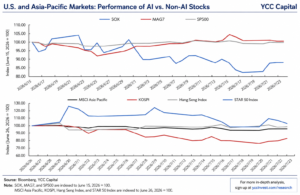
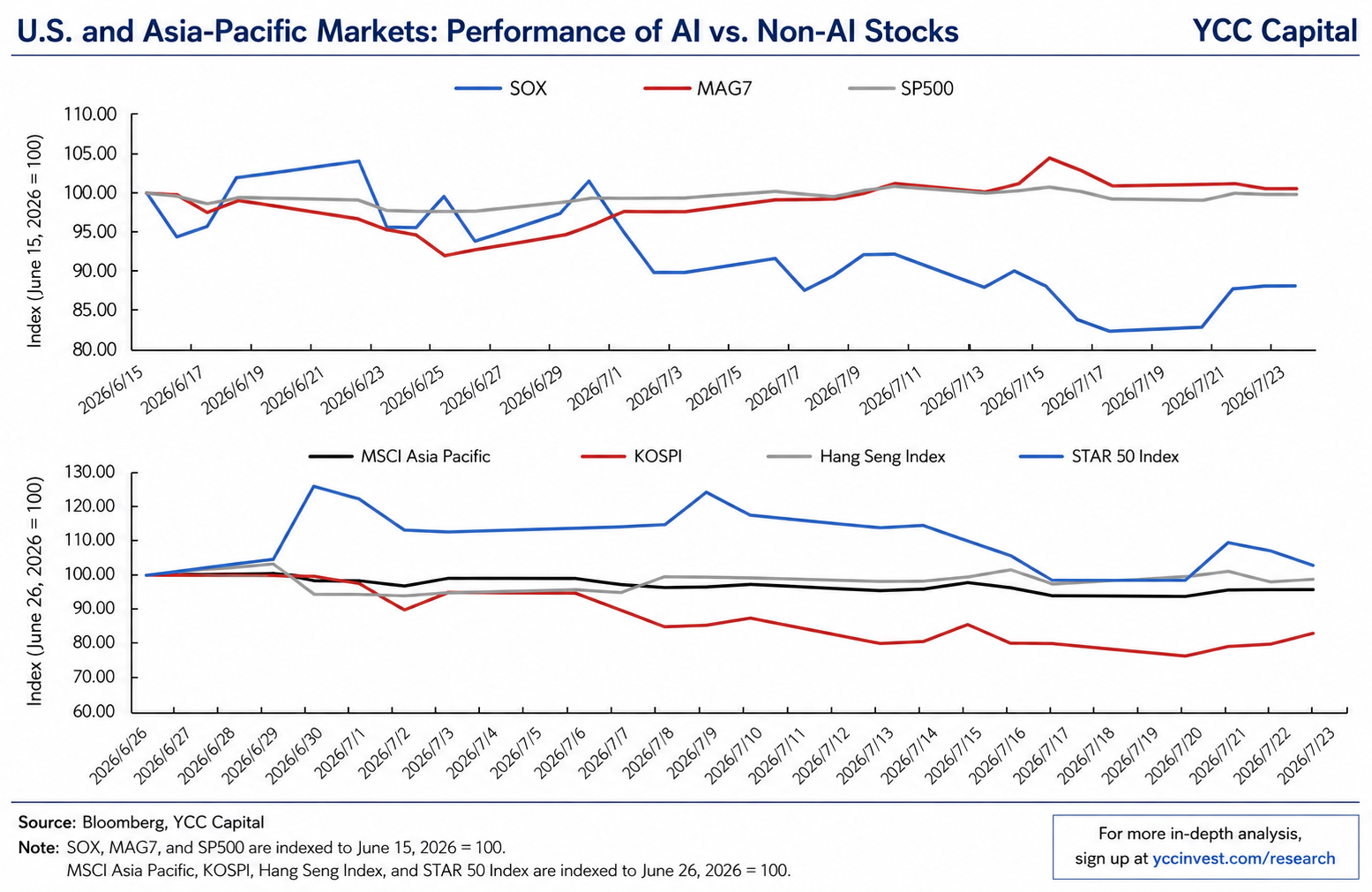
Since late June, global equity markets have undergone one of their sharpest style rotations this year.
The immediate catalyst was an aggressive correction across AI hardware stocks. Deleveraging in Korean equities combined with widespread profit-taking across semiconductor leaders triggered a broader reassessment of technology positioning.
Capital subsequently migrated into several different destinations.
In the United States, investors reduced exposure to semiconductor manufacturers while maintaining or increasing allocations to the largest platform companies within the Magnificent Seven. Across Asia, selling pressure spread through Korea, Japan, and technology-heavy Chinese growth indices, while capital simultaneously found its way into Hong Kong technology, defensive sectors, and precious metals.
This distinction is important.
Markets have not broadly abandoned risk.
Instead, investors have become significantly more selective.
That difference suggests a rotation rather than a collapse.
Precious Metals Suddenly Reappear
Against this backdrop, both gold and silver staged an impressive recovery.
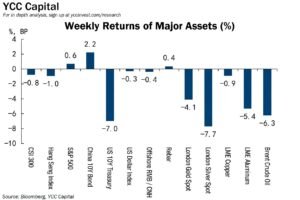
Beginning around July 20, spot gold advanced roughly 2.6%, while silver—traditionally exhibiting greater volatility—rose approximately 4.5%.
Mining equities outperformed even the underlying metals.
Major producers experienced double-digit gains within only a few trading sessions, demonstrating how quickly leverage can amplify improving sentiment toward the sector.
At first glance, this appears to resemble the early stages of another precious metals bull market.
However, market history teaches that sharp rebounds often occur inside longer consolidation phases.
The current move still lacks many of the characteristics associated with durable trend reversals.
Why Rising Oil Has Not Prevented Gold from Recovering
Earlier this year, stronger oil prices became one of the principal headwinds for gold.
Higher energy prices reinforced inflation concerns, pushed Treasury yields higher, and encouraged investors to delay expectations for Federal Reserve easing.
Those dynamics weighed heavily on precious metals.
Recently, however, something changed.
Oil prices and U.S. Treasury yields continued rising, yet gold also began appreciating.
Rather than signalling an entirely new macro regime, this divergence suggests markets have become less sensitive to incremental inflation fears.
Investors increasingly appear to believe that the Federal Reserve has already approached the most hawkish stage of the current policy cycle.
When expectations stop becoming more restrictive—even if policy itself remains tight—the headwind facing non-yielding assets like gold becomes considerably less severe.
This subtle shift helps explain why precious metals have been able to stabilize despite conditions that previously would have generated significant selling pressure.
Technical Signals Remain Inconclusive
Despite recent strength, technical confirmation remains limited.
Gold has not yet decisively broken the downward trading channel established since late April.
Momentum indicators have improved modestly, but they remain insufficient to confirm that institutional investors have broadly repositioned toward the sector.
Short-term rallies frequently occur during corrective phases.
Only sustained buying accompanied by stronger macro catalysts would transform today’s recovery into a genuine structural uptrend.
For now, caution remains warranted.
Capital Flows Are Improving—but Only Gradually
Flow data paints a similar picture.
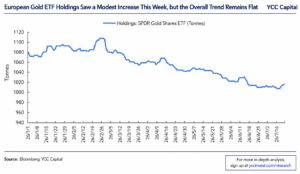
The world’s largest gold-backed exchange-traded fund, SPDR Gold Shares, experienced a modest increase in holdings during the week covered by the report, rising from approximately 999 tonnes to just over 1,000 tonnes.
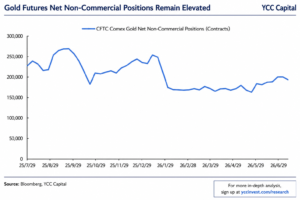
Likewise, speculative positioning in COMEX gold futures recovered modestly after months of weakness.
These developments deserve attention because institutional positioning often leads price trends.
Yet the magnitude of these inflows remains relatively small when compared with previous periods that launched sustained bull markets.
In other words, investors are beginning to rebuild exposure—but not aggressively.
The market is testing conviction rather than displaying it.
Central Banks Have Not Yet Accelerated Purchases
Another critical pillar supporting gold over recent years has been central-bank demand.
Reserve diversification has steadily increased across many emerging economies as monetary authorities sought to reduce long-term dependence on U.S. dollar assets.
Recent purchasing data, however, does not indicate a significant acceleration.
Official-sector buying remains supportive but broadly consistent with previous trends rather than signalling a renewed wave of accumulation.
Without stronger central-bank demand, it becomes more difficult for gold to sustain major upside momentum solely through speculative positioning.
Three Catalysts Still Need to Fall Into Place
At YCC Capital, we believe three major macro conditions remain essential before gold can enter another lasting secular advance.
First, investors must begin questioning AI returns rather than merely AI valuations.
Markets have started debating whether spending levels across AI infrastructure are economically justified.
This debate has intensified as hardware stocks corrected sharply.
Yet capital expenditure announcements continue to suggest that hyperscale technology companies remain committed to expanding AI investment.
Google’s decision to modestly increase its 2026 capital expenditure guidance reinforced confidence that the industry’s investment cycle has not yet ended.
Meanwhile, Micron shares recovered following the announcement, indicating that fundamental investors continue viewing AI infrastructure as a long-duration growth opportunity rather than a speculative bubble.
The next major test will come from earnings and investment plans released by Microsoft, Meta, and Amazon.
Should these companies maintain or increase capital expenditure guidance, confidence in the AI investment cycle would likely strengthen once again.
That outcome would reduce demand for defensive allocations such as gold.
Second, expectations for Federal Reserve easing must strengthen.
Although markets have become less concerned about additional tightening, they have not yet embraced an aggressive easing cycle.
Current pricing suggests only modest changes in monetary policy expectations despite recent movements in oil prices and inflation expectations.
Gold historically performs best when investors anticipate falling real interest rates rather than simply stable ones.
That transition has yet to occur.
Third, confidence in the U.S. dollar must weaken.
Perhaps the most powerful catalyst for gold would be renewed concerns surrounding America’s fiscal trajectory.
Large deficits, expanding debt issuance, or political uncertainty could eventually encourage investors to diversify further away from dollar-denominated assets.
This remains a lower-probability scenario over the near term.
Nevertheless, if concerns surrounding fiscal sustainability intensify—particularly approaching future political milestones—the resulting demand for reserve diversification could significantly strengthen gold’s long-term outlook.
This would likely represent the highest-conviction bullish scenario for precious metals.
Investment Strategy: Position for Balance Rather Than Extremes
Our base case remains constructive but measured.
Gold continues to possess meaningful strategic allocation value.
However, we believe investors should distinguish between portfolio insurance and momentum investing.
The metal is increasingly attractive as a diversifier within balanced portfolios, particularly alongside technology holdings whose valuations remain elevated after several years of exceptional performance.
Rather than replacing technology, gold should increasingly complement it.
We therefore expect portfolio construction during the second half of the year to become more balanced between growth assets and defensive real assets.
Under our central scenario, gold is more likely to experience a gradual repair of investor sentiment than an immediate breakout into another powerful bull market.
A year-end trading range of approximately US$4,300–4,500 per ounce remains achievable if macro conditions evolve broadly as expected.
Substantially higher prices would likely require either a meaningful deterioration in confidence surrounding AI investment returns, a decisive shift toward Federal Reserve easing, or renewed concerns regarding the long-term credibility of U.S. fiscal policy.
Until one or more of these catalysts emerges, investors should approach gold with patience rather than urgency.
YCC Strategic View
The strongest investment opportunities rarely arise from chasing yesterday’s winners or today’s headlines. Instead, they emerge when markets quietly begin redistributing capital before consensus fully recognizes the change. We believe that is precisely where precious metals stand today. Gold is becoming increasingly valuable as strategic portfolio insurance, but not yet as a clear momentum trade. For long-term investors, disciplined accumulation during periods of weakness remains preferable to aggressive buying after sharp rallies. The current environment argues for diversification, selective positioning, and a balanced allocation between enduring technology leadership and high-quality defensive assets rather than an all-or-nothing shift toward either theme.
Risk Factors
Every macro thesis is only as robust as the assumptions underpinning it. While our base case envisions a gradual recovery in gold prices alongside continued resilience in U.S. technology, investors should remain alert to several risks that could materially alter this outlook.
The first risk is that AI-related capital expenditure disappoints. The current market narrative still assumes that hyperscale cloud providers—including Microsoft, Meta, Amazon, and Google—will maintain extraordinarily high investment levels in AI infrastructure over the coming years. Should these companies significantly reduce spending plans or indicate that returns on incremental investment are deteriorating faster than anticipated, earnings expectations for the semiconductor and AI hardware ecosystem could face another round of downward revisions. Such an outcome would likely trigger renewed volatility across technology markets and accelerate capital rotation toward defensive assets, including gold.
A second risk stems from inflation. Although markets have become less sensitive to higher oil prices than they were earlier this year, a sustained surge in energy prices could once again alter monetary policy expectations. If inflation proves more persistent than currently anticipated, investors may begin pricing in additional Federal Reserve tightening or a prolonged period of elevated interest rates. Higher real yields have historically acted as a significant headwind for precious metals, potentially offsetting support from safe-haven demand.
Finally, financial market leverage remains an important source of uncertainty. Over recent years, abundant liquidity encouraged investors to increase exposure to higher-volatility assets, particularly within technology and AI-related sectors. Should deleveraging intensify globally—whether because of tighter financial conditions, regulatory developments, or unexpected macroeconomic shocks—risk assets could experience another sharp correction. While gold often performs well during periods of financial stress, broad-based liquidation events can temporarily pressure even traditional safe-haven assets as investors seek liquidity across portfolios.
Taken together, these risks reinforce our preference for balanced portfolio construction rather than concentrated positioning.
Editorial Board
Ken Cao
Chief Strategist, Global Investment Strategy
Le Gao
Managing Analyst
Yui Nabeshima
Strategist
Mai Ikeda
Research Analyst
IMPORTANT DISCLAIMER
This research report is provided for informational and educational purposes only and does not constitute an offer to sell or a solicitation of an offer to buy any securities, financial instruments, or investment products. It is not intended as investment, legal, accounting, or tax advice and should not be relied upon as such. The views, opinions, and projections expressed herein are those of YCC Capital Management and its research personnel as of the date of publication and are subject to change without notice. Past performance is not indicative of future results.
YCC Capital Management, its affiliates, principals, and employees may hold long or short positions in securities or instruments discussed in this report and may trade for their own accounts or for client accounts in a manner inconsistent with the recommendations herein. This report is based on publicly available information and data believed to be reliable, but YCC Capital makes no representation or warranty, express or implied, as to the accuracy, completeness, or timeliness of such information. Forward-looking statements involve risks and uncertainties that could cause actual results to differ materially from those projected.
Recipients of this report should conduct their own independent due diligence and consult with their own financial, legal, and tax advisors before making any investment decisions. YCC Capital accepts no liability for any loss or damage arising from the use of or reliance on this report or its contents.
This report is intended solely for the use of the intended recipient(s) and may not be reproduced or redistributed for commercial purposes without the prior written consent of YCC Capital. © 2026 YCC Capital. All rights reserved. YCC Capital’s flagship vehicle, the YCC International Value Fund, LP, maintains a concentrated global macro value strategy with a focus on capital-flow-driven mispricings and asymmetric hedging opportunities. The Fund is registered in the State of Delaware, U.S., and structured as a Rule 506(c) fund. Performance data, where referenced, has been verified by independent third parties including NAV Consulting; however, individual investor results may vary.
Contact Us
For research inquiries or institutional partnerships, please contact:
YCC Capital Research
📧 ir@yccinvest.com
To receive our free daily macro and market intelligence, sign up at:
YCC Capital Research | Sign up for free daily market insight at www.yccinvest.com
For more related research:
Gold’s Shakeout Is Not the End of the Bull Market
After the Dollar: The Next Monetary Order and the Strategic Choices Facing China
The Fed’s Hawkish Reset: From “When to Cut” to “Whether to Hike Again”
Oil, Rates, and Risk: Why the Middle East Shock Is Repricing Global Fixed Income