YCC CAPITAL
Global Asset Allocation
October 8, 2026
Global markets have just delivered an unusually revealing combination: long-term interest rates rose sharply, yet U.S. equities recovered strongly. Oil and precious metals fell, the dollar strengthened, European equities weakened, and Japanese and Korean stocks rallied alongside U.S. technology. Rather than treating these moves as contradictions, YCC Capital sees them as different expressions of the same macro transition. Markets are becoming less worried about an imminent Federal Reserve hike while simultaneously assigning greater value—and a higher term premium—to durable U.S. growth.
That distinction matters. A rising 10-year Treasury yield caused by stronger growth expectations is very different from one driven purely by tighter monetary policy. For investors, it is the difference between a higher mortgage payment because the economy is overheating and a higher mortgage payment because household income prospects have improved. The cost of capital rises in both cases, but the implications for earnings and risk assets are not remotely identical.
Cross-Asset Markets: Four Forces Behind the Divergence
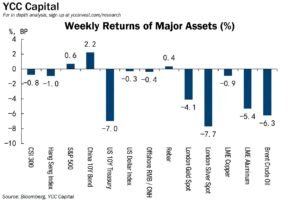
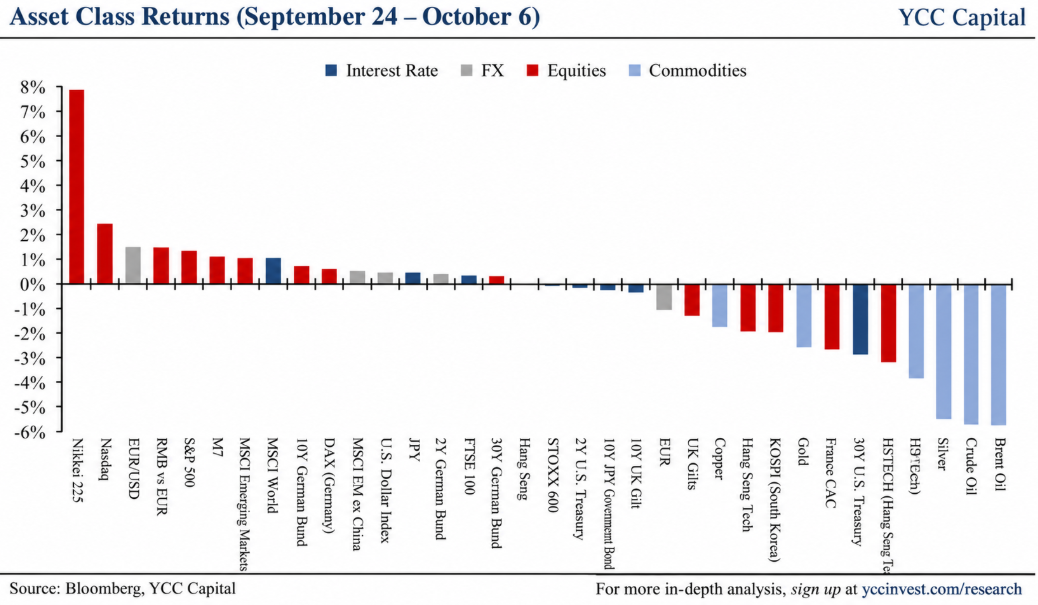
Between September 25 and October 6, global asset performance diverged sharply. Japan’s Nikkei 225 surged 7.89%, leading major equity indices, while U.S. and Korean technology shares also strengthened. European equities moved in the opposite direction. In fixed income, the U.S. 10-year Treasury yield briefly exceeded 5.3%, with the curve steepening materially. The dollar strengthened to its highest level since May 2025, while the euro weakened. Brent crude fell 5.65%, and gold and silver came under significant pressure as global long-duration yields climbed. Source: Bloomberg, YCC Capital.
We see four forces driving this landscape.
First, oil’s geopolitical premium eased as expectations improved around Middle Eastern supply. Progress remained uneven in U.S.-Iran diplomacy and arrangements surrounding shipping routes, but reports of increased Saudi Red Sea loadings, partial Strait of Hormuz transportation and greater Oman Gulf transshipment reduced fears of severe export disruption. In early October, G7 measures involving strategic oil reserves and OPEC+’s decision to maintain production further moderated supply anxiety. Brent consequently moved back below $100 per barrel at one stage.
Second, expectations for another near-term Federal Reserve hike declined. Revised PCE inflation was softer, September payroll growth disappointed, and senior Fed officials adopted a less aggressive tone. August headline PCE inflation was reported at 3.4% year over year, below the 3.7% consensus expectation, while September nonfarm payrolls increased by only 29,000, versus 90,000 expected. Unemployment unexpectedly rose to 4.2%, and wage growth softened. At one point, market-implied odds of an October hike dropped below 20%. Source: Bloomberg, YCC Capital.
Third, falling expectations for the next Fed hike did not translate into falling long-term yields. Stronger U.S. growth expectations, persistent inflation uncertainty and spillovers from rising overseas yields pushed term premiums higher. Europe faced a less constructive version of the same rate shock: French fiscal concerns intensified following the October 1 presentation of the 2027 budget, raising doubts about the political feasibility of deficit reduction.
Fourth, AI fundamentals remained powerful enough to offset part of the valuation pressure from higher rates. Microsoft’s Copilot upgrade reinforced expectations for AI commercialization, Micron’s stronger-than-expected guidance supported the memory-demand story, and Nvidia announced an additional $150 billion share-repurchase authorization. Technology therefore remained the engine of U.S., Japanese and Korean equity performance.
The U.S. Economy Looks Stronger Than the Old Data Suggested
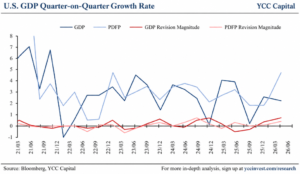
The most consequential development may be the revision of the U.S. national accounts. The updated figures simultaneously strengthened the recent growth picture and softened measured inflation—an unusually favorable combination.
Annualized real GDP growth for 2026 Q1 and Q2 was revised upward by 0.4 and 0.7 percentage points, respectively. More importantly, private domestic final purchases—the component we regard as a cleaner measure of underlying private-sector demand—were revised upward by 0.1 and 0.4 percentage points to 3.3% and 4.2%. Source: Bloomberg, YCC Capital.
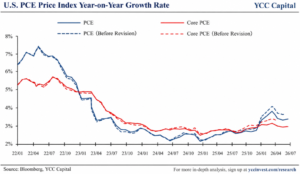
Inflation revisions moved in the opposite direction. Changes to PCE measurement, including portfolio-management services, legal services and computer software, materially lowered the 2026 inflation trajectory. July headline PCE was revised from 3.7% to 3.34%, while core PCE was revised from 3.36% to 2.98%. August readings stood at approximately 3.42% headline and 3.01% core.
Household fundamentals also look healthier. Real disposable personal income was revised higher across the past five years, while the household saving rate was increased materially. Since April, the estimated saving rate was lifted from below 3% to above 4%, reaching 4.09% in August. Source: Bloomberg, YCC Capital.
This helps explain a puzzle that has frustrated bearish U.S. forecasts: consumers have continued spending despite restrictive interest rates. The household balance sheet had more breathing room than previously measured. Anyone who has managed a family budget understands the difference between spending from a nearly empty checking account and spending while quietly rebuilding savings. The headline purchase looks identical; the resilience behind it does not.
We therefore remain cautiously optimistic on the United States. September’s weak payroll number deserves attention, but a single volatile employment print is insufficient to overturn broader evidence of resilient domestic demand.
The Yield Curve Is Sending a Different Message
After the stronger-than-expected September 23 U.S. PMI release, the Treasury term spread bottomed and subsequently widened. Earlier, hawkish guidance from Jackson Hole and the September FOMC had pushed two-year yields higher as investors priced tighter policy. Since September 24, however, softer payrolls, consumer confidence and ISM readings—combined with dovish Fed communication—have driven October hike expectations from roughly 70% to about 19%.
Yet long yields continued rising.
That is the critical signal. The market increasingly appears to be pricing a lower probability of immediate Fed tightening but a higher equilibrium for nominal growth and term premium. We expect the Fed may skip an October hike, while retaining flexibility thereafter. This is not the same thing as declaring victory over inflation.
Europe faces a more difficult configuration. French fiscal risk and sticky inflation have increased long-duration risk premiums without a comparable improvement in growth expectations. The euro consequently weakened, the dollar index moved above 102, and European equities lagged U.S. markets. Source: Bloomberg, YCC Capital.
Equities: Technology Wins, but Concentration Is the Price
The U.S. equity rebound remains fundamentally supported by AI-related earnings, orders and commercialization. But the breadth of the rally is becoming increasingly narrow. The ratio of the capitalization-weighted S&P 500 to its equal-weight counterpart has reached another high, illustrating how heavily index performance depends on the largest technology companies.
We would therefore distinguish between being constructive on U.S. equities and being indiscriminately bullish. Higher long-term yields remain a genuine headwind for rate-sensitive sectors and long-duration valuations. Earnings delivery matters more as discount rates rise.
Japan offers a particularly interesting counterpoint. The Nikkei’s 7.89% advance demonstrates how technology exposure and semiconductor demand can dominate short-term rate concerns. Japan still faces cyclical challenges, but we do not interpret them as evidence of permanent structural decline. Improving corporate behavior, technology exposure and continued reform leave us optimistic about Japan’s longer-term trajectory.
YCC Strategic View
The portfolio message is straightforward: the world is not experiencing one synchronized rate shock. In the United States, higher long yields increasingly reflect resilient growth and term premium even as immediate Fed-hike expectations recede. In Europe, fiscal credibility and inflation risks are doing more of the damage. Technology continues to provide earnings support to U.S. and Asian markets, while falling oil prices offer a modest disinflationary cushion.
We favor selective U.S. risk exposure, particularly where earnings can justify elevated valuations, while remaining alert to index concentration. We retain a constructive long-term view on Japan. We are more cautious toward Europe where fiscal risk is rising without equivalent growth compensation. Key risks remain renewed U.S.-Iran tensions and another oil-price spike, unexpectedly disruptive U.S. policy changes, and a more aggressive Federal Reserve path than markets currently discount.
Source: Bloomberg, YCC Capital.
Editorial Board
Ken Cao, Chief Strategist, Global Investment Strategy; Le Gao, Managing Analyst; Yui Nabeshima, Strategist; Mai Ikeda, Research Analyst.
IMPORTANT DISCLAIMER
This research report is provided for informational and educational purposes only and does not constitute an offer to sell or a solicitation of an offer to buy any securities, financial instruments, or investment products. It is not intended as investment, legal, accounting, or tax advice and should not be relied upon as such. The views, opinions, and projections expressed herein are those of YCC Capital Management and its research personnel as of the date of publication and are subject to change without notice. Past performance is not indicative of future results.
YCC Capital Management, its affiliates, principals, and employees may hold long or short positions in securities or instruments discussed in this report and may trade for their own accounts or for client accounts in a manner inconsistent with the recommendations herein. This report is based on publicly available information and data believed to be reliable, but YCC Capital makes no representation or warranty, express or implied, as to the accuracy, completeness, or timeliness of such information. Forward-looking statements involve risks and uncertainties that could cause actual results to differ materially from those projected.
Recipients of this report should conduct their own independent due diligence and consult with their own financial, legal, and tax advisors before making any investment decisions. YCC Capital accepts no liability for any loss or damage arising from the use of or reliance on this report or its contents.
This report is intended solely for the use of the intended recipient(s) and may not be reproduced or redistributed for commercial purposes without the prior written consent of YCC Capital. © 2026 YCC Capital. All rights reserved. YCC Capital’s flagship vehicle, the YCC International Value Fund, LP, maintains a concentrated global macro value strategy with a focus on capital-flow-driven mispricings and asymmetric hedging opportunities. The Fund is registered in the State of Delaware, U.S and structured as a 506(c) fund. Performance data, where referenced, has been verified by independent third parties including NAV Consulting; however, individual investor results may vary.
Contact Us
For research inquiries, contact ir@yccinvest.com. Sign up for YCC Capital’s free daily market insight at yccinvest.com.
YCC Capital Research | Sign up for free daily market insight at www.yccinvest.com
For more related reaserch:
The Long End Is Sending a Message: What Can Cool U.S. Treasury Yields?
The Dual Nature of Interest Rates: Why U.S. Treasury Yields Are Entering a Higher-for-Longer Regime
Warsh Draws the Line: The Fed’s Rate Hike Is a Warning, Not an Ending
The Fed’s Hawkish Turn: One More Hike, Not a New Hiking Cycle