YCC CAPITAL
Commodity & Energy Strategy
August 12, 2026
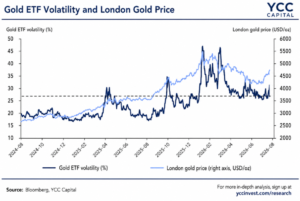
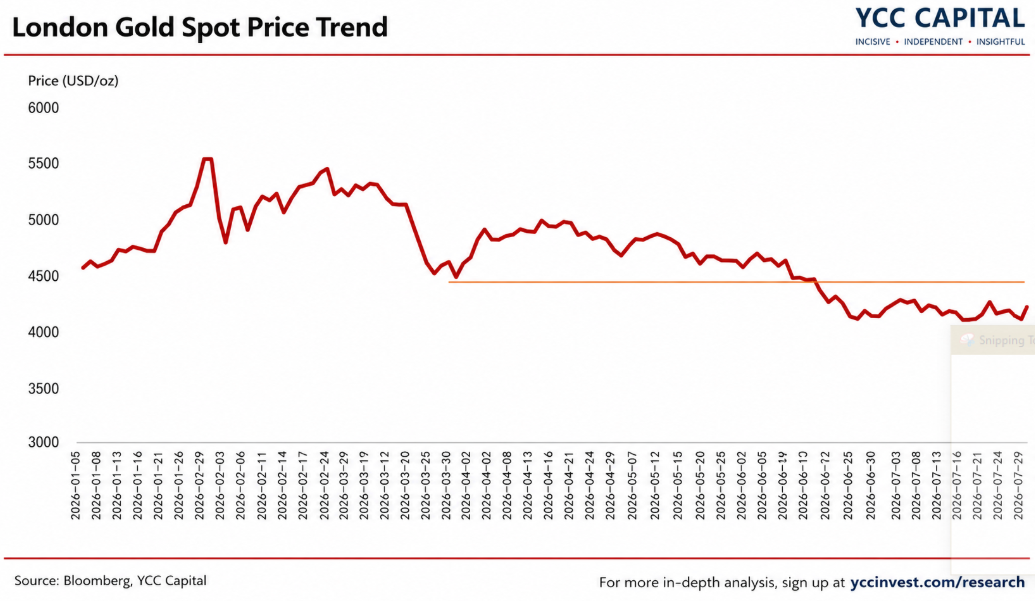
Gold’s first-half collapse was not simply a failed inflation hedge or a temporary bout of speculative excess. It was a stress test for the entire architecture of safe assets. After touching a record $5,405/oz on January 29, international gold prices reversed violently, falling to roughly $4,002/oz by the end of June, a drawdown of more than 30%. Volatility rose sharply as markets moved from pricing geopolitical escalation and rapid Federal Reserve easing to confronting stubborn inflation, resilient U.S. growth and a higher-for-longer cost of capital.
At YCC Capital, we think the lesson extends far beyond gold. Investors have spent decades using “safe haven” as though it were a single category. It is not. Cash that meets tomorrow morning’s margin call, Treasury bills that can be pledged as collateral, and gold held outside the credit system solve fundamentally different problems. In a genuine crisis, the distinction is similar to the difference between carrying cash, owning insurance and having a spare key: all provide security, but not for the same emergency.
The First-Half Gold Shock Was a Repricing of Opportunity Cost
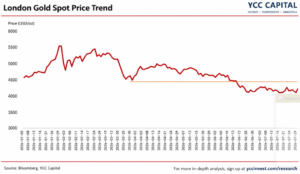
The first phase of 2026 was driven by an unusually powerful feedback loop. Geopolitical anxiety, enthusiasm around “de-dollarization” and speculative positioning reinforced one another, producing repeated record highs. Gold set new peaks 12 times before January 29. The market was effectively paying in advance for several highly bullish outcomes at once: escalating conflict, weakening confidence in the dollar and aggressive Fed easing.
That combination did not materialize. Instead, U.S. economic activity remained solid and inflation stayed above target. On July 29, the Federal Reserve maintained the federal-funds target range at 3.50%-3.75% by a 9-3 vote, with the three dissenters preferring a 25-basis-point increase. The Fed explicitly described economic activity as expanding at a solid pace while inflation remained elevated. (Federal Reserve)
This matters enormously for gold because gold has no yield. Its biggest competitor is not another metal; it is the return available on highly liquid interest-bearing dollar assets. When real yields are attractive, the insurance premium embedded in gold becomes expensive to carry. Investors living through ordinary household finance intuitively understand this trade-off. A safe full of cash may feel comforting, but if a deposit account suddenly pays a meaningful real return, the cost of leaving money idle becomes impossible to ignore.
We therefore interpret the first-half selloff as a violent clearing of excessive safe-haven premium accumulated during the previous two years rather than evidence that gold has lost its strategic role.
Source: Bloomberg, YCC Capital
The Dollar Remains the Liquidity King
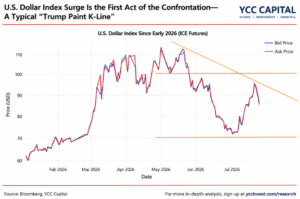
The fashionable conclusion that rising geopolitical fragmentation must produce a rapidly declining dollar is too simplistic. The dollar remains embedded in the plumbing of global finance. According to the BIS, the dollar was on one side of 89.2% of global foreign-exchange transactions in April 2025, up from 88.4% in 2022. Every one of the ten most heavily traded currency pairs still involved the dollar. (Bank for International Settlements)
Reserve data tell a similarly nuanced story. IMF figures show the dollar’s share of allocated official foreign-exchange reserves rose to 57.13% in the first quarter of 2026. The dollar is therefore not experiencing anything resembling an imminent monetary collapse. (IMF Data)
The more useful framework is functional segmentation. Dollar cash and Treasury bills remain extraordinarily difficult to replace for immediate payments, collateral and global debt service. Longer-dated Treasuries are different: they introduce significant duration, inflation and term-premium risk. Gold is different again. It cannot compete with dollars for immediate settlement, but it does not depend on an issuer’s promise to repay.
China illustrates the limitations of the alternative-currency narrative. Renminbi settlement can create useful redundancy in selected bilateral trade corridors, but China’s capital controls, uneven legal transparency, restricted convertibility and relatively shallow hedging markets constrain the currency’s ability to become a genuine global financing substitute. A payment channel is not the same thing as a reserve ecosystem. We expect Beijing to continue promoting monetary alternatives, but we remain skeptical that these initiatives can materially displace the dollar’s global balance-sheet role over any reasonable investment horizon.
Gold Is Institutional Insurance, Not Cash
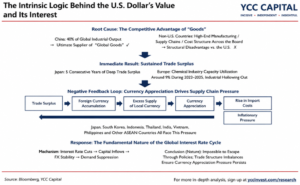
The strongest long-term case for gold is therefore not “the dollar is dying.” It is that increasingly fragmented political and financial systems raise the value of owning an asset with no issuer, no maturity date and no conventional counterparty liability.
The distinction became much clearer after the March 2020 Treasury-market liquidity dislocation and the freezing of Russian official reserves in 2022. Both episodes demonstrated that an asset’s quoted value is not identical to its usability during stress. Security now has at least three dimensions.
The first is liquidity security: can the asset meet payments, margin calls and debt service immediately? Dollar cash and T-bills dominate here. The second is duration security: can an institution match long-dated liabilities without accepting excessive interest-rate risk? High-quality bonds serve this purpose, but their defensive qualities weaken when inflation and term premiums rise. The third is institutional security: can wealth remain accessible if sovereign, sanctions or legal-jurisdiction risk becomes extreme? Gold has an unusually important role in this layer.
That explains persistent official-sector demand. Yet central-bank buying should never be mistaken for an unconditional price floor. When emerging markets face severe currency pressure or dollar shortages, gold itself can be sold to generate liquidity. The reserve asset proves its usefulness precisely because it can be mobilized.
Source: Bloomberg, YCC Capital
Our Second-Half View: Bottoming First, Repair Later
We expect the second half of 2026 to remain volatile rather than develop into a clean bull market. Our base case is a bottoming process during the third quarter followed by a more constructive recovery in the fourth quarter.
Near term, the principal obstacle remains U.S. monetary policy. The July FOMC outcome confirmed that policymakers are not in a rush to ease, while three members already favored another hike. That backdrop should keep real rates relatively restrictive and preserve the appeal of cash and short-duration Treasuries. We remain cautiously optimistic on the U.S. economy: solid productivity, investment and labor-market resilience make a soft landing more plausible than the dramatic recession scenario that gold bulls priced earlier in the year. (Federal Reserve)
The original correction also removed much of the speculative froth. Around $3,700/oz, we see an important zone where weaker positioning, improved valuation and strategic official-sector demand could begin to establish a more durable floor. This should not be interpreted as a precise trading target; after a 30% drawdown, markets rarely turn with the neatness of a textbook chart.
By the fourth quarter, the asymmetry should improve. If energy inflation cools and U.S. price pressures moderate, expectations for additional tightening should fade. The Fed’s scheduled September 15-16 and October 27-28 meetings will therefore matter more than any single geopolitical headline. (Federal Reserve) Political uncertainty around the November U.S. midterm elections could also modestly revive demand for institutional hedges.
Our central recovery zone remains approximately $4,300-$4,500/oz during a successful fourth-quarter normalization. A renewed geopolitical shock or clear U.S. hard landing could push gold substantially higher. Conversely, renewed inflation combined with stronger-than-expected U.S. growth could prolong the correction and expose the $3,500/oz area.
The key portfolio conclusion is more important than any single price target. Investors should stop asking, “What is the safest asset?” and begin asking, “Safe against what?” We prefer dollar liquidity for immediate balance-sheet resilience, short-duration government paper where capital preservation and yield are priorities, and gold as long-horizon institutional insurance. The new safe-haven portfolio is not a single bunker. It is a system of defenses.
Source: Bloomberg, YCC Capital
Editorial Board
Ken Cao, Chief Strategist, Global Investment Strategy; Le Gao, Managing Analyst; Yui Nabeshima, Strategist; Mai Ikeda, Research Analyst.
IMPORTANT DISCLAIMER
This research report is provided for informational and educational purposes only and does not constitute an offer to sell or a solicitation of an offer to buy any securities, financial instruments, or investment products. It is not intended as investment, legal, accounting, or tax advice and should not be relied upon as such. The views, opinions, and projections expressed herein are those of YCC Capital Management and its research personnel as of the date of publication and are subject to change without notice. Past performance is not indicative of future results.
YCC Capital Management, its affiliates, principals, and employees may hold long or short positions in securities or instruments discussed in this report and may trade for their own accounts or for client accounts in a manner inconsistent with the recommendations herein. This report is based on publicly available information and data believed to be reliable, but YCC Capital makes no representation or warranty, express or implied, as to the accuracy, completeness, or timeliness of such information. Forward-looking statements involve risks and uncertainties that could cause actual results to differ materially from those projected.
Recipients of this report should conduct their own independent due diligence and consult with their own financial, legal, and tax advisors before making any investment decisions. YCC Capital accepts no liability for any loss or damage arising from the use of or reliance on this report or its contents.
This report is intended solely for the use of the intended recipient(s) and may not be reproduced or redistributed for commercial purposes without the prior written consent of YCC Capital. © 2026 YCC Capital. All rights reserved. YCC Capital’s flagship vehicle, the YCC International Value Fund, LP, maintains a concentrated global macro value strategy with a focus on capital-flow-driven mispricings and asymmetric hedging opportunities. The Fund is registered in the State of Delaware, U.S and structured as a 506(c) fund. Performance data, where referenced, has been verified by independent third parties including NAV Consulting; however, individual investor results may vary.
Contact Us
For research inquiries, contact ir@yccinvest.com. Sign up for free daily market insight at yccinvest.com.
Running footer on every page:
YCC Capital Research | Sign up for free daily market insight at www.yccinvest.com
For more related research:
The Fed’s Hawkish Reset: From “When to Cut” to “Whether to Hike Again”
When the Tide Recedes: Why the U.S. Dollar Is Entering a New Era of Two-Way Risk
The Dollar’s Second Wind: Why Confidence—Not Just Interest Rates—Is Driving the Greenback Higher