
YCC CAPITAL
Emerging Markets & China Strategy
August 17, 2026
China’s housing market is beginning to show a familiar late-cycle pattern: transaction activity is trying to stabilize before confidence has truly recovered. Beijing’s latest round of property easing is therefore important, but investors should distinguish between a stabilization of turnover and a genuine repair of the housing system. The former is increasingly plausible. The latter remains a much higher bar.
For households, this distinction is intuitive. A family may decide to attend more apartment viewings because mortgage terms improve, but that does not automatically mean it has regained confidence in future income, home prices, or the broader economy. Housing markets usually turn first in activity, then in pricing, and only much later in sentiment. Beijing appears to be entering that first stage.
New-Home Weakness Is Moderating, While Resale Activity Finds a Floor
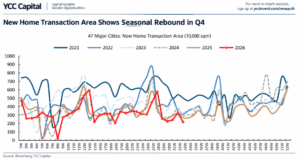
During August 1–7, new-home transaction area across 47 tracked cities totaled 2.181 million square meters, down 34.6% from the previous week and 18.4% from a year earlier. The headline remains weak, although the pace of deterioration appears to be slowing.
The divergence between city tiers remains significant. First-tier cities recorded a 31.8% year-over-year increase in transaction area, while second-tier and third-tier cities declined 32.5% and 23.2%, respectively. That contrast reinforces a broader theme we have emphasized for China: national averages increasingly conceal a highly uneven housing economy in which stronger cities can stabilize while lower-tier markets remain burdened by excess supply, weaker demographics, and poorer household confidence.
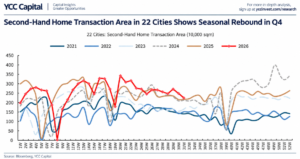
The resale market is somewhat more constructive. Across 22 cities, secondary-home transaction area fell 10.5% week over week during August 1–7 but still increased 5.1% from a year earlier. Transaction volumes remained near the strongest seasonal levels seen over the past five years.
Supply pressure is also easing marginally. Since the beginning of August, resale listings have declined 0.04% from end-July levels and are 0.5% lower than a year earlier. The move is small, but direction matters. A market cannot stabilize sustainably when new listings continually overwhelm transaction demand. The recent moderation suggests that the pace of forced or precautionary selling may be losing momentum.
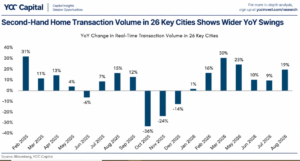
Higher-frequency activity looks stronger still. From August 1 through August 9, real-time secondary-home transactions across 26 major cities increased 19% year over year, an improvement from July’s overall performance.
Source: Bloomberg, YCC Capital
Beijing’s Policy Package Lowers the Friction of Buying
On August 7, Beijing introduced seven measures covering purchase restrictions, housing transfers, and the housing provident fund system. The measures are designed to reduce the practical cost of entering the market rather than attempting another broad credit-driven property boom.
One of the most consequential changes concerns non-Beijing households. The required period of social-security or individual-income-tax contributions for purchasing a home in the capital has been standardized at one year, eliminating the previous distinction between properties inside and outside the Fifth Ring Road.
Beijing also substantially increased maximum provident-fund mortgage limits. For households in which both spouses contribute to the housing provident fund, the maximum first-home loan has doubled from RMB1.2 million to RMB2.4 million. The maximum second-home loan has risen from RMB1.0 million to RMB2.0 million.
The city also adjusted the relationship between contribution history and borrowing capacity. For dual-contributor households, a contribution period of five years and one month can now qualify the borrower for the full RMB2.4 million ceiling.
This matters because mortgage affordability is not an abstract variable. Imagine a young Beijing couple considering a RMB3 million resale apartment. Under the previous framework, the gap between the maximum subsidized provident-fund loan and the purchase price could feel prohibitively large. Raising the subsidized borrowing ceiling does not make the apartment cheap, but it can materially change the monthly-payment calculation. Housing decisions are often made at the kitchen table, not on a macroeconomic spreadsheet, and reducing that monthly burden can convert hesitation into a transaction.
Why Beijing May See a Meaningful Near-Term Response
The policy architecture resembles the seven-measure easing package introduced by Shanghai earlier this year: relax restrictions for non-local residents while reducing financing costs through more generous provident-fund lending.
The timing also matters. Beijing’s package follows the Politburo’s call for stronger countercyclical policy support and arrives before the traditional September–October sales season. That sequencing gives policymakers an opportunity to amplify the impact of seasonal demand.
There are five reasons Beijing may respond relatively well.
First, aggregate demand has already stopped deteriorating at the pace seen last year. During the first seven months of 2026, combined new- and secondary-home transaction area in Beijing was essentially flat from a year earlier, rising approximately 0.002%. That compares with a 6.1% decline in total demand last year. Flat growth is hardly a boom, but in a prolonged property adjustment, the transition from contraction to stability is meaningful.
Second, resale supply has contracted. Listings at major brokerage platforms have fallen to roughly 118,000 units, down 17% year over year and 0.1% from the previous month. Reduced inventory pressure creates a better foundation for price stabilization.
Third, Beijing’s provident-fund system has unusually broad coverage. Approximately 42.7% of the city’s permanent population is eligible for provident-fund lending, the highest coverage rate among major Chinese cities. The latest increase in household borrowing capacity—up by as much as RMB1.2 million—is also larger than the RMB800,000 increase previously introduced in Shanghai.
Fourth, Beijing’s resale market is dominated by practical, lower-priced purchases rather than speculative luxury demand. In July, homes priced below RMB3 million represented 49% of secondary transactions, while homes between RMB3 million and RMB5 million accounted for another 28%. Nearly four-fifths of transactions therefore occurred below RMB5 million, with the median transaction price around RMB3 million. A RMB2.4 million provident-fund mortgage can cover a substantial portion of the financing requirement for the median buyer.
Fifth, transaction prices have started to rebound. Although asking prices remain under pressure, actual resale transaction prices have recovered approximately 1.9% from their recent low. This divergence suggests that Beijing’s immediate problem may increasingly be one of confidence and liquidity rather than a complete absence of underlying demand.
Source: Bloomberg, YCC Capital
Stabilization Is Not the Same as Recovery
We would still resist interpreting Beijing’s easing as evidence that China’s property downturn is ending.
The strongest housing markets can stabilize because they benefit from concentrated employment, better public services, population inflows, and deeper buyer pools. Beijing and Shanghai are not representative of the national market. In many lower-tier cities, the more difficult problems remain unresolved: excess housing stock, weak household formation, poor developer balance sheets, declining land-sale economics, and persistent expectations of falling prices.
Policy can reduce transaction friction, but it cannot instantly restore the belief that residential property is a reliable store of wealth. That belief was built over decades and has been damaged over several years.
This is the central reason we remain cautious on China overall. Beijing’s policy package may produce stronger turnover and a modest price response in the capital, but the national property sector still faces a balance-sheet adjustment rather than a conventional cyclical slowdown. The distinction is critical. Cyclical downturns respond quickly to cheaper credit. Balance-sheet recessions respond more slowly because households and businesses prioritize repairing finances over taking additional leverage.
For markets, the result may be a series of localized rebounds rather than a synchronized national recovery.
Policy Signal: More Incremental Easing Is Likely
Beijing’s decision carries significance beyond the capital itself. Until now, the city had remained relatively restrained even as other major markets relaxed housing restrictions and increased provident-fund support.
That restraint made the August policy shift more notable. It suggests that property stabilization is becoming a more visible part of the broader countercyclical policy toolkit for the second half of the year.
Additional measures in major cities are therefore likely. Policymakers can further relax purchase restrictions, reduce financing costs, increase provident-fund limits, support housing inventory absorption, and improve liquidity for qualified developers.
Yet investors should be careful about confusing policy intensity with policy effectiveness. China has repeatedly demonstrated that administrative easing can generate short-lived bursts of activity without solving the deeper confidence problem. The housing market is like a heavy door whose hinges have rusted: policymakers can push harder, and the door may move, but restoring smooth movement takes more than one shove.
YCC Strategic View
Our base case is that Beijing’s housing market improves modestly over the coming months, with secondary-home transactions benefiting more visibly than new-home sales. Reduced listings, better subsidized mortgage availability, and a high share of affordable resale transactions provide a credible foundation for near-term stabilization.
At the national level, however, we remain defensive. China’s property adjustment continues to weigh on household wealth perceptions, local-government finances, credit creation, and private-sector confidence. Improvement in Beijing should therefore be treated as evidence that targeted policy can stabilize high-quality urban markets—not as proof that China has escaped its broader property deleveraging cycle.
The most useful signal to monitor is not simply transaction volume. We would focus on whether resale listings continue to fall, whether actual transaction prices sustain their recent rebound, and whether stabilization spreads beyond Beijing and Shanghai into stronger second-tier cities.
If activity improves while prices and listings remain weak, the market will still be clearing rather than recovering. If activity, prices, and inventory begin improving together, the case for a more durable turn becomes stronger.
For now, Beijing looks closer to a floor. China’s national property market does not.
Key Risks
The principal downside risk is a renewed increase in secondary-home listings across major cities. A sharp rise in supply could overwhelm incremental demand and accelerate price declines. A substantial fall in rents would also weaken the investment economics of residential property and could place additional pressure on valuations.
A second risk is a sharper-than-expected slowdown in the broader Chinese economy. Weakening employment, income expectations, or private-sector confidence could offset the benefit of lower mortgage costs and delay housing stabilization.
The upside risk to our cautious view would be a sustained improvement in transaction prices alongside declining inventories and broader stabilization across multiple city tiers. At present, we do not see sufficient evidence to make that our base case.
Source: Bloomberg, YCC Capital
Editorial Board
Ken Cao, Chief Strategist, Global Investment Strategy
Le Gao, Managing Analyst
Yui Nabeshima, Strategist
Mai Ikeda, Research Analyst
IMPORTANT DISCLAIMER
This research report is provided for informational and educational purposes only and does not constitute an offer to sell or a solicitation of an offer to buy any securities, financial instruments, or investment products. It is not intended as investment, legal, accounting, or tax advice and should not be relied upon as such. The views, opinions, and projections expressed herein are those of YCC Capital Management and its research personnel as of the date of publication and are subject to change without notice. Past performance is not indicative of future results.
YCC Capital Management, its affiliates, principals, and employees may hold long or short positions in securities or instruments discussed in this report and may trade for their own accounts or for client accounts in a manner inconsistent with the recommendations herein. This report is based on publicly available information and data believed to be reliable, but YCC Capital makes no representation or warranty, express or implied, as to the accuracy, completeness, or timeliness of such information. Forward-looking statements involve risks and uncertainties that could cause actual results to differ materially from those projected.
Recipients of this report should conduct their own independent due diligence and consult with their own financial, legal, and tax advisors before making any investment decisions. YCC Capital accepts no liability for any loss or damage arising from the use of or reliance on this report or its contents.
This report is intended solely for the use of the intended recipient(s) and may not be reproduced or redistributed for commercial purposes without the prior written consent of YCC Capital. © 2026 YCC Capital. All rights reserved. YCC Capital’s flagship vehicle, the YCC International Value Fund, LP, maintains a concentrated global macro value strategy with a focus on capital-flow-driven mispricings and asymmetric hedging opportunities. The Fund is registered in the State of Delaware, U.S and structured as a 506(c) fund. Performance data, where referenced, has been verified by independent third parties including NAV Consulting; however, individual investor results may vary.
Contact Us
For research inquiries, institutional discussions, or additional information, contact ir@yccinvest.com.
Sign up for free daily market insight at yccinvest.com.
YCC CAPITAL | Emerging Markets & China Strategy
YCC Capital Research | Sign up for free daily market insight at www.yccinvest.com
For more related research:
Investors in Xi’s China Faced a Lost Decade
China’s Growth Engine Is Losing Altitude: Exports Still Fly, But Domestic Demand Is Running on Empty