YCC CAPITAL
Innovation Themes & Strategy
Date: August 7, 2026
Executive Summary
Every technological revolution begins with optimism. Railroads transformed commerce before many lines went bankrupt. Fiber-optic networks were massively overbuilt during the dot-com era before eventually becoming the backbone of the internet economy. Artificial intelligence infrastructure appears to be entering a similar phase today. Governments, hyperscalers, and private capital are racing to build computing capacity, yet the commercial ecosystem capable of fully utilizing that capacity is still developing.
From YCC Capital’s perspective, this distinction between infrastructure demand and economic return will become one of the defining macro investment themes of the second half of this decade. Investors should resist the temptation to treat all AI capital expenditure as immediately productive. Instead, the investment cycle is likely to unfold in several stages: first, infrastructure construction; second, enterprise adoption; third, sustainable monetization; and finally, productivity gains that justify the enormous upfront investment.
This sequencing matters enormously for asset allocation.
Global AI Infrastructure Spending Has Entered a New Phase
Around the world, AI investment has rapidly evolved from private-sector experimentation into a matter of national industrial strategy.
Major economies increasingly regard AI as foundational infrastructure comparable to electricity grids, transportation systems, or telecommunications networks. Consequently, public policy has shifted from encouraging innovation toward actively financing large-scale deployment.
Several recent initiatives illustrate the extraordinary scale of this commitment:
- The four largest U.S. hyperscale cloud providers announced combined 2026 capital expenditure plans exceeding US$700 billion.
- South Korea unveiled its national “Three Mega Projects” focused on semiconductors, Physical AI, and AI data centers, representing planned investment of approximately RMB 6.4 trillion.
- Japan intends to mobilize roughly ¥101.6 trillion of combined public and private investment in AI and semiconductors by fiscal 2040.
- The European Union continues expanding semiconductor investment through the proposed European Chips Act 2.0.
This increasingly resembles an international infrastructure race rather than a conventional technology investment cycle. Much like the construction of national railway systems or 5G networks, governments increasingly view AI capacity as a strategic asset rather than simply a commercial opportunity.
Governments Are Becoming Financing Partners
One particularly notable development is the increasing willingness of governments to facilitate AI infrastructure financing.
Rather than relying solely on private investment, public authorities are experimenting with innovative financing structures.
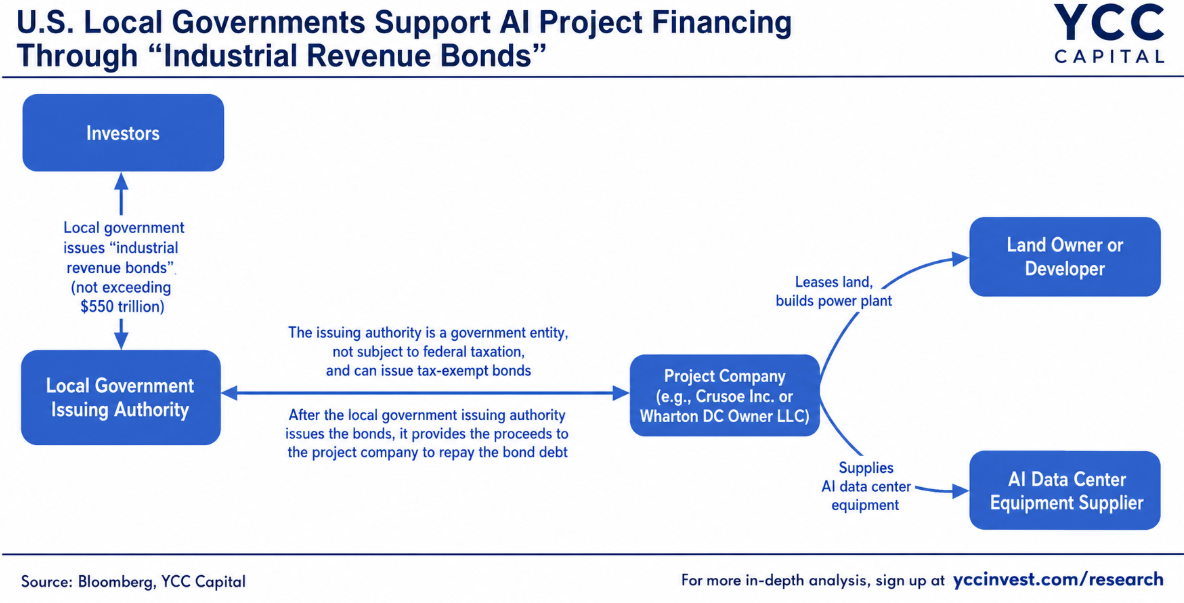
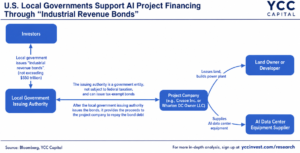
One example highlighted in our analysis involves Missouri, where local authorities proposed issuing up to US$85 billion in industrial revenue bonds to support construction of a Crusoe-affiliated AI data center. Under this structure, the government temporarily owns infrastructure assets before leasing them back to operators, allowing project revenues to service the debt.
This approach demonstrates an important evolution.
Governments are no longer merely regulating AI—they are becoming balance-sheet participants.
Such financing mechanisms reduce funding costs while accelerating deployment, a trend that may spread globally as AI becomes increasingly intertwined with national competitiveness.
China’s Ambitious AI Infrastructure Vision
China has likewise elevated computing infrastructure into one of its highest strategic priorities.
Authorities have identified six major infrastructure networks for accelerated development:
- Water infrastructure
- Modern electricity grids
- National computing networks
- Next-generation communications networks
- Underground municipal infrastructure
- Modern logistics networks
Among these, the national computing network stands out as the centerpiece of AI development.
According to official guidance, direct investment in computing-network construction during the Fifteenth Five-Year Plan could reach approximately RMB 4 trillion, largely through expansion of the “East Data, West Computing” initiative.
Telecommunications investment adds another substantial layer, with Chinese carriers expected to invest over RMB 1.3 trillion between 2025 and 2030 in communications infrastructure supporting AI deployment.
Estimating China’s Future AI Data Center Buildout
One of the report’s central analytical exercises involves translating investment targets into physical computing capacity.
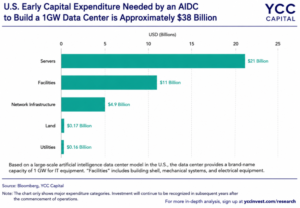
International comparisons suggest that constructing a 1 GW AI data center requires roughly US$38–44 billion of upfront capital.
China benefits from significantly lower non-hardware construction costs.
Based on several announced domestic projects, excluding AI servers and chips, physical construction costs average only RMB 20–25 billion per GW.
When AI hardware procurement is included, total investment rises to approximately RMB 160–172 billion per GW, roughly 65% of comparable U.S. construction costs.
Applying these assumptions to the government’s projected RMB 4 trillion investment implies potential deployment of at least 24.1 GW of new AI data-center capacity.
This estimate should be viewed as a lower bound. Should domestic AI hardware become materially cheaper than imported alternatives, total deployable capacity could exceed this figure.
Token Demand Suggests Capacity Could Eventually Be Utilized
Infrastructure investment only makes sense if future demand ultimately absorbs new capacity.
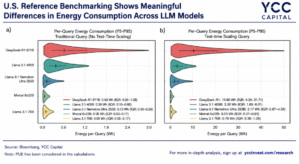
Using Microsoft’s published estimates of energy consumption per AI request together with assumptions regarding data-center utilization, the report estimates that 24.1 GW of new capacity could support incremental daily AI inference demand of approximately 529 trillion tokens.
That would raise China’s estimated daily token usage from roughly 100 trillion tokens at the end of 2025 to approximately 629 trillion tokens over the Fifteenth Five-Year Plan period.
Supporting this projection is the remarkable acceleration already observed in AI usage.
Official statistics cited in the report indicate that China’s average daily token consumption increased from roughly 100 billion in early 2024 to 100 trillion by the end of 2025, before reaching approximately 140 trillion by March 2026.
Such explosive growth suggests that, purely from a demand perspective, substantial additional computing capacity could eventually find users.
Nevertheless, translating usage growth into sustainable economic returns remains a far more difficult challenge.
Reality Has Yet to Match the Vision
Despite ambitious plans, implementation remains considerably slower.
One revealing indicator is China’s issuance of local government special bonds that finance physical investment projects.
During the first seven months of 2026, issuance reached only 58.5% of the expected annual quota, representing a noticeably slower pace than previous years.
More strikingly, only around 1.6% of these investment funds were directed toward new infrastructure categories such as AI data centers.
This disconnect highlights a recurring challenge in China’s investment model.
While central planning can announce extraordinarily large targets, local governments ultimately require projects capable of generating acceptable economic returns and passing increasingly rigorous feasibility assessments.
Many AI infrastructure projects continue to struggle with uncertain commercial viability, delaying implementation despite strong policy support.
Monetization Remains the Industry’s Largest Unanswered Question
The most important constraint on AI infrastructure investment is not technological capability—it is economic sustainability.
Even in the United States, where AI commercialization has advanced far beyond most other markets, profitability remains uncertain.
OpenAI and Anthropic together have reportedly reached approximately US$72 billion in annual recurring revenue (ARR), a remarkable achievement considering the industry’s youth. Yet those impressive headline numbers tell only part of the story.
Large language models remain extraordinarily capital-intensive businesses. Training frontier models requires massive GPU clusters, while inference workloads continue to consume significant computing resources long after models have been deployed. Hardware also depreciates rapidly. Most hyperscale cloud providers depreciate AI servers and networking equipment over only five to six years, implying that infrastructure owners must continuously reinvest simply to maintain technological competitiveness.
YCC Capital believes this is one of the market’s most underappreciated dynamics.
Many investors naturally focus on revenue growth, but infrastructure investors ultimately earn returns on capital—not on headline user statistics. AI adoption may continue to accelerate while investment returns remain mediocre if pricing power fails to keep pace with infrastructure costs.
To illustrate this challenge, the analysis models capital expenditure assumptions for Microsoft, Amazon, Google, and Meta through 2028. Assuming approximately half of annual capital expenditure continues to be directed toward AI hardware and networking infrastructure, the study concludes that OpenAI and Anthropic would collectively require roughly US$106 billion of additional annual revenue merely to support a 10% internal rate of return (IRR) on the broader AI infrastructure ecosystem.
That represents approximately 47% additional revenue growth beyond current ARR levels.
Another way to appreciate the scale of the challenge is through consumer subscriptions.
If incremental revenues came exclusively from AI subscriptions, the required pricing would roughly equate to every current Netflix subscriber purchasing an AI service priced at approximately three times Netflix’s advertising-supported plan. While this is a simplified illustration rather than a forecast, it demonstrates how difficult it remains for AI software revenues alone to justify today’s extraordinary infrastructure spending.
Infrastructure Economics Extend Beyond Direct Financial Returns
Yet focusing solely on near-term financial profitability risks missing the broader economic rationale behind AI investment.
History offers many examples where foundational infrastructure initially appeared uneconomic before ultimately reshaping entire economies.
Few highways recover construction costs through toll revenues alone. Public education systems rarely generate direct cash flows. National electricity grids often require decades before delivering their full economic benefits.
Their value lies in enabling thousands of secondary economic activities.
Artificial intelligence infrastructure may follow a similar trajectory.
The report argues that large language models generate value not only through direct monetization but also by preventing losses, improving operational efficiency, raising labor productivity, reducing administrative costs, and enabling entirely new business models.
A manufacturing company may never purchase millions of dollars of AI subscriptions, yet modest improvements in predictive maintenance could prevent costly production shutdowns. Hospitals may reduce diagnostic delays. Financial institutions may strengthen fraud detection. Governments may automate routine administrative work.
These indirect benefits rarely appear in conventional project cash-flow models but can materially improve long-term economic productivity.
This distinction becomes especially important when governments evaluate strategic infrastructure investments.
Lessons from the United Kingdom’s Green Book
One of the report’s more insightful discussions concerns the evaluation framework used by the UK Treasury’s Green Book, which assesses public investment based on broad measures of social value rather than purely financial returns.
Instead of asking only whether a project generates sufficient cash flow, the framework evaluates benefits across multiple dimensions, including:
- Direct inputs such as labor, equipment, assets, and maintenance.
- Economic outcomes including productivity, employment, competition, transportation efficiency, and commercial development.
- Social impacts including public health, safety, crime reduction, and national security.
- Climate and environmental considerations such as emissions reductions, resilience, and natural resource preservation.
- Improvements in government efficiency, including lower administrative costs and reduced fraud.
This broader methodology recognizes that many public investments create value well beyond their immediate accounting returns.
From YCC Capital’s perspective, such an approach is intellectually sound when evaluating genuine public goods. However, its application in China warrants greater caution. Expanding evaluation metrics beyond direct profitability may better capture strategic benefits, but it also increases the risk that politically favored projects receive approval despite weak commercial foundations. Given China’s elevated local-government debt burden, uneven capital allocation, and historical record of infrastructure overinvestment, the distinction between strategic investment and inefficient spending becomes especially important. Projects should therefore be judged not only on projected social value but also on transparent governance, disciplined capital allocation, and measurable long-term productivity gains.
YCC Capital Strategic View
Artificial intelligence infrastructure is rapidly becoming one of the world’s largest capital expenditure cycles, rivaling previous waves of investment in railways, telecommunications, and cloud computing.
We expect investment to remain exceptionally strong across the United States, Japan, South Korea, and selected developed economies where private-sector innovation is supported by deep capital markets and robust commercial ecosystems. While valuation risks will inevitably emerge, these markets generally possess stronger institutional frameworks for converting technological breakthroughs into sustainable profitability.
China’s outlook is more nuanced. Policy support for AI infrastructure is substantial, and computing capacity is likely to expand meaningfully over the coming years. Nevertheless, persistent structural challenges—including weaker private-sector confidence, local government fiscal constraints, uncertain project economics, and slower commercialization of advanced AI applications—may prevent infrastructure spending from translating into proportional economic returns. Building data centers is considerably easier than generating durable cash flows from them.
For investors, the critical question is therefore shifting from “Who is spending the most?” to “Who can ultimately earn attractive returns on that spending?”
That distinction is likely to separate the long-term winners from those that simply participate in the investment boom.
Key Risks
Our conclusions are subject to several important uncertainties:
- Estimates of China’s AI data center construction costs may differ from actual project expenditures.
- Future AI hardware pricing could materially change assumptions regarding deployable computing capacity.
- Forecasts of token demand and AI inference growth remain highly uncertain.
- Commercialization pathways for large language models continue to evolve rapidly and may develop differently than current expectations.
- Public policy, export controls, semiconductor availability, and geopolitical developments could materially alter both investment timelines and expected returns.
Editorial Board
Ken Cao
Chief Strategist, Global Investment Strategy
Le Gao
Managing Analyst
Yui Nabeshima
Strategist
Mai Ikeda
Research Analyst
IMPORTANT DISCLAIMER
This research report is provided for informational and educational purposes only and does not constitute an offer to sell or a solicitation of an offer to buy any securities, financial instruments, or investment products. It is not intended as investment, legal, accounting, or tax advice and should not be relied upon as such. The views, opinions, and projections expressed herein are those of YCC Capital Management and its research personnel as of the date of publication and are subject to change without notice. Past performance is not indicative of future results.
YCC Capital Management, its affiliates, principals, and employees may hold long or short positions in securities or instruments discussed in this report and may trade for their own accounts or for client accounts in a manner inconsistent with the recommendations herein. This report is based on publicly available information and data believed to be reliable, but YCC Capital makes no representation or warranty, express or implied, as to the accuracy, completeness, or timeliness of such information. Forward-looking statements involve risks and uncertainties that could cause actual results to differ materially from those projected.
Recipients of this report should conduct their own independent due diligence and consult with their own financial, legal, and tax advisors before making any investment decisions. YCC Capital accepts no liability for any loss or damage arising from the use of or reliance on this report or its contents.
This report is intended solely for the use of the intended recipient(s) and may not be reproduced or redistributed for commercial purposes without the prior written consent of YCC Capital.
© 2026 YCC Capital. All rights reserved.
YCC Capital’s flagship vehicle, the YCC International Value Fund, LP, maintains a concentrated global macro value strategy with a focus on capital-flow-driven mispricings and asymmetric hedging opportunities. The Fund is registered in the State of Delaware, U.S. and structured as a Rule 506(c) fund. Performance data, where referenced, has been verified by independent third parties including NAV Consulting; however, individual investor results may vary.
Contact Us
YCC Capital Management
Research & Investor Relations
Stay ahead of global markets by subscribing to YCC Capital’s Free Daily Market Insight, featuring macro strategy, market-moving developments, geopolitical analysis, AI and technology research, asset allocation perspectives, and timely investment commentary from our global research team.
For institutional inquiries, partnership opportunities, media requests, or research distribution, please contact us at ir@yccinvest.com.
YCC Capital Research | Sign up for free daily market insight at www.yccinvest.com
For more related research:
The AI Gold Rush Is Far From Over—But the Margin for Error Is Shrinking
The Market’s Long Game: What Is a Fair Long-Term Return for Equities?