YCC CAPITAL
Emerging Markets & China Strategy
July 17, 2026
Executive Summary
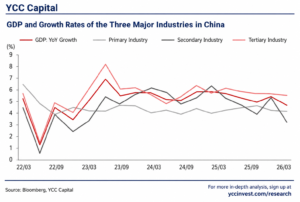
China’s second-quarter economic data paints a picture that is simultaneously reassuring in the short term and increasingly concerning beneath the surface. Headline GDP growth slowed to 4.3% year-over-year, missing market expectations of 4.5% and decelerating sharply from 5.0% in the first quarter. While June activity indicators—including industrial production and retail sales—surprised positively, these improvements were largely cyclical rather than structural.
The broader message is difficult to ignore. China’s economy is increasingly dependent on external demand and high-tech manufacturing while traditional domestic growth engines—property, private investment, and household confidence—remain deeply impaired. The divergence between resilient production and weak domestic demand continues to widen, creating an increasingly unbalanced recovery.
For investors, this resembles a company that continues reporting respectable revenue growth while its underlying customer base steadily weakens. Strong exports and industrial output keep headline numbers respectable, but the foundations supporting long-term growth continue to erode.
From YCC Capital’s perspective, the latest data reinforce our view that China’s economy is entering a prolonged period of structurally slower expansion. Additional fiscal easing may cushion the downturn, but policymakers appear increasingly constrained by rising debt burdens, demographic headwinds, and diminishing returns from traditional stimulus.
YCC Perspective: The Recovery Remains Uneven
Economic recoveries rarely move in straight lines. Instead, they resemble climbing a mountain in thick fog—occasional clearings create optimism before another steep ascent emerges. China’s latest macroeconomic data fit this pattern precisely.
June’s stronger industrial production and modest rebound in consumption have understandably improved market sentiment. Yet focusing solely on one month’s figures risks overlooking the broader trajectory. The second-quarter GDP slowdown demonstrates that China’s underlying growth momentum continues to weaken despite numerous rounds of targeted policy support.
Rather than signaling a new acceleration cycle, June’s improvements likely reflect temporary policy support, low-base effects, and resilient export demand. None fundamentally alter the structural challenges facing the Chinese economy.
Our assessment remains cautious. While cyclical rebounds are likely over coming quarters, the probability of returning to the high-growth model that characterized previous decades appears increasingly remote.
Growth Slows More Than Expected
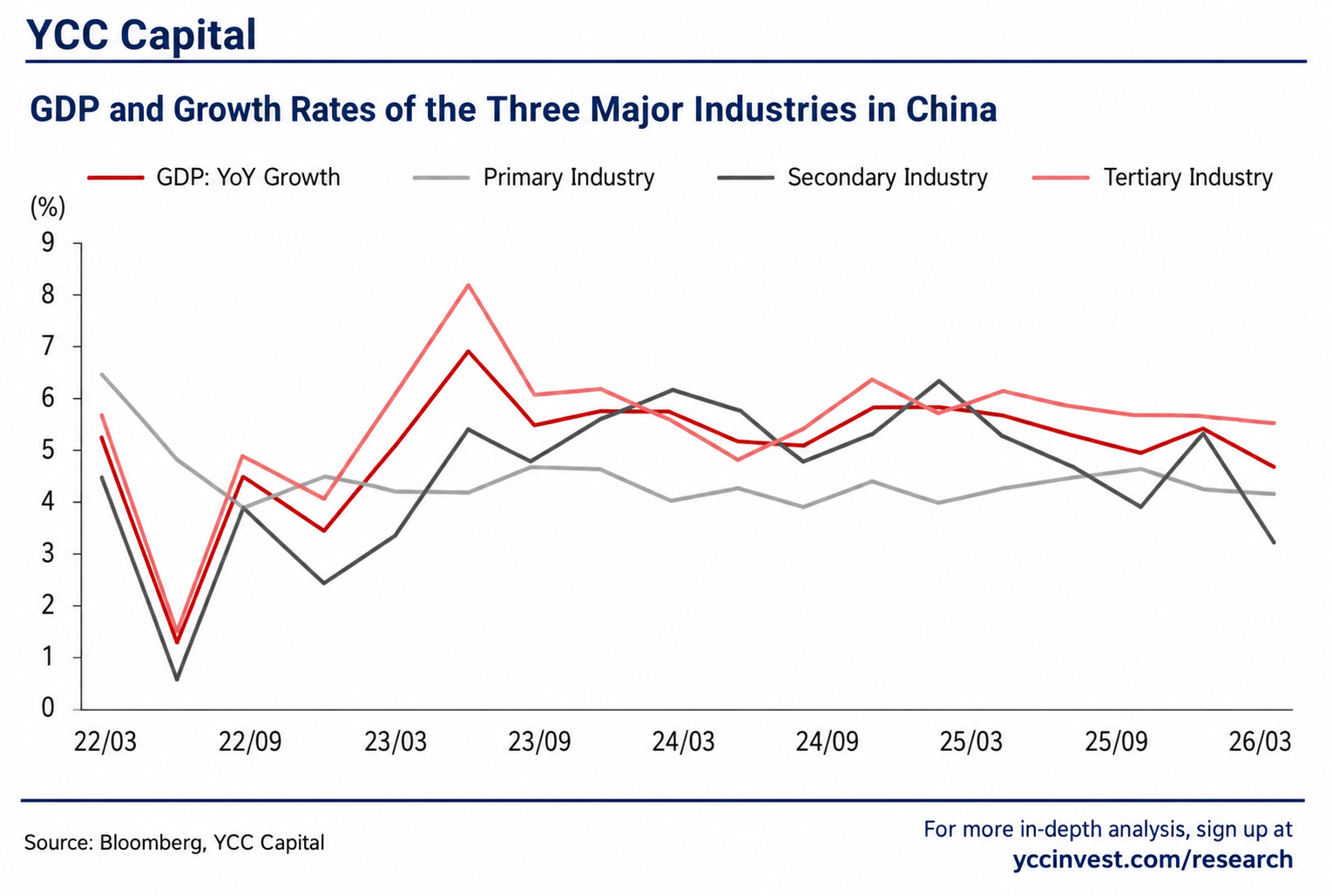
China’s economy expanded 4.3% year-over-year in the second quarter, below both consensus expectations and the previous quarter’s 5.0% pace.
On a sequential basis, GDP increased 0.9% quarter-over-quarter, matching expectations but slowing from 1.3% previously.
Although headline growth remains respectable by international standards, composition matters far more than the aggregate figure.
The slowdown reflects persistent weakness across several domestic sectors:
- Property investment remains deeply negative.
- Fixed asset investment continues contracting.
- Private sector confidence remains subdued.
- Household consumption has yet to recover meaningfully.
- Government fiscal support has moderated following front-loaded spending earlier in the year.
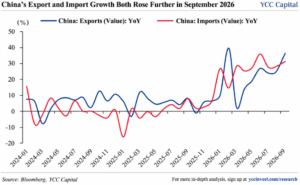
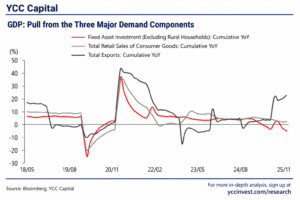
Meanwhile, stronger exports and resilient manufacturing production prevented an even sharper slowdown.
This growing dependence on external demand leaves China increasingly vulnerable to shifts in global trade conditions.
Unlike previous recoveries driven by synchronized improvements across investment, consumption, and manufacturing, today’s expansion resembles a stool balanced unevenly on a single leg.
Industrial Production Continues to Outperform Domestic Demand
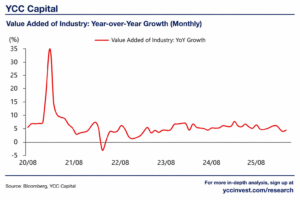
One of the brightest spots within the June data was industrial production.
Industrial output increased 5.3% year-over-year, comfortably exceeding expectations of 4.7%.
The improvement reflects several supportive factors:
- Strong overseas demand.
- Inventory rebuilding among global manufacturers.
- Recovery in export-oriented industries.
- Improved factory utilization rates.
High-tech manufacturing remains especially impressive.
Industries including semiconductors, computing equipment, aerospace, transportation equipment, and advanced electronics continue delivering double-digit production growth.
This divergence highlights one of China’s defining economic characteristics today.
Rather than broad-based industrial expansion, growth has become increasingly concentrated in strategic sectors heavily supported by industrial policy.
Traditional industries continue experiencing significantly weaker investment and profitability.
The resulting “K-shaped” recovery—where advanced manufacturing thrives while conventional sectors stagnate—has become increasingly pronounced.
For investors, this concentration creates opportunities in selected industries but raises broader macroeconomic concerns regarding employment, income growth, and domestic demand.
Services Continue Recovering—but Momentum Is Moderating
China’s service sector remained relatively resilient.
The services production index increased 4.7% year-over-year during June.
Information technology services, software, commercial services, and leasing activities continue outperforming broader economic activity.
Digitalization, artificial intelligence investment, and cloud infrastructure remain powerful structural tailwinds.
However, financial services growth moderated as equity market activity softened during June.
Meanwhile, many consumer-facing service industries continue recovering only gradually.
While service consumption remains considerably healthier than goods consumption, overall momentum has begun stabilizing rather than accelerating.
This reflects an economy where households remain willing to spend selectively on experiences while remaining cautious regarding discretionary purchases.
Consumption Is Improving—but Consumers Remain Cautious
Retail sales surprised positively during June.
Headline retail sales increased 1.0% year-over-year, outperforming expectations following several weak months.
At first glance, this appears encouraging.
However, much of the improvement stemmed from:
- Calendar effects.
- Low comparison bases.
- Provincial consumption voucher programs.
- Additional “trade-in” subsidies.
These temporary supports should not be mistaken for sustained demand recovery.
Several durable goods categories—including automobiles, household appliances, furniture, and construction materials—continue recording weak underlying demand.
The fading impact of previous trade-in programs is becoming increasingly visible.
Service consumption remains healthier than goods spending, supported by tourism, entertainment, restaurants, and leisure activities.
Yet households continue displaying elevated precautionary savings behavior.
The average Chinese consumer today resembles someone who recently experienced a financial setback. Even after receiving a pay raise, spending habits remain conservative because confidence—not income alone—drives purchasing decisions.
Until household balance sheets improve more materially, consumption is unlikely to become China’s primary growth engine.
Property Remains China’s Largest Structural Headwind
No sector illustrates China’s challenges more clearly than real estate.
Despite numerous policy adjustments, the housing market remains firmly in correction.
June data showed:
- Property investment declining 26.0% year-over-year.
- New home sales remaining weak.
- Property developer financing continuing to deteriorate.
- Construction starts falling sharply.
- Housing completions weakening further.
Although transaction volumes have stabilized modestly in certain major cities, this represents stabilization at depressed levels rather than genuine recovery.
Developers continue facing financing constraints.
Local governments remain highly dependent on land sales that have yet to recover.
Households remain reluctant to purchase additional property amid uncertain price expectations.
Unlike previous cycles, policymakers appear unwilling to engineer another debt-driven housing boom.
This marks an important structural shift.
Real estate is transitioning from being China’s principal growth engine toward becoming a long-term drag on economic activity.
That adjustment will likely require years rather than quarters.
Investment Weakness Reflects Private Sector Caution
Fixed asset investment continued deteriorating.
Investment declined 5.7% during the first half of the year, significantly weaker than expectations.
Private investment remained especially soft.
Manufacturing investment improved slightly during June but remains historically subdued.
Business surveys continue indicating cautious capital expenditure intentions despite relatively stable financing conditions.
This reflects an important distinction.
Capital availability is no longer the primary constraint.
Confidence is.
Many firms possess sufficient liquidity to invest but remain reluctant due to uncertain future demand.
High-tech industries continue attracting substantial capital expenditure, particularly artificial intelligence infrastructure, semiconductors, and advanced manufacturing.
Traditional industries, however, remain reluctant to expand capacity amid weak profitability and uncertain demand.
The investment landscape therefore increasingly mirrors two separate economies operating simultaneously.
Infrastructure Spending Has Lost Momentum
Infrastructure investment also weakened.
Earlier fiscal stimulus provided meaningful support during the first quarter.
However, government spending slowed noticeably during the second quarter following front-loaded bond issuance.
Net government financing declined compared with last year, reducing infrastructure investment momentum.
Although additional fiscal measures remain likely during the second half, policymakers appear increasingly focused on improving spending efficiency rather than maximizing headline stimulus.
Given already elevated debt burdens among many local governments, another large-scale infrastructure expansion appears unlikely.
Fiscal policy should therefore provide stabilization rather than powerful acceleration.
China’s Growth Model Continues to Shift
The latest data reinforce a broader transformation underway.
For decades, China’s economy relied on four interconnected engines:
- Property development.
- Infrastructure investment.
- Manufacturing expansion.
- Export growth.
Today, only two remain providing meaningful support.
Exports continue benefiting from resilient global demand.
High-tech manufacturing continues attracting strategic investment.
Meanwhile, property has entered prolonged adjustment while infrastructure faces fiscal constraints.
Consumption remains insufficiently strong to replace these traditional drivers.
This evolving composition suggests China’s long-term trend growth is likely settling at a structurally lower level than investors became accustomed to during previous decades.
Rather than cyclical weakness alone, the economy increasingly reflects structural maturation.
Commodity Market Implications
For commodity investors, the picture remains mixed.
Domestic demand-sensitive commodities—including steel, iron ore, cement, and construction materials—continue facing pressure from weak property investment and subdued infrastructure spending.
However, industrial production remains sufficiently resilient to prevent a sharp collapse in raw material demand.
Meanwhile, stronger exports continue supporting manufacturing-related commodity consumption.
Looking ahead, several forces should shape commodity performance.
Energy markets remain vulnerable to geopolitical supply disruptions despite slowing domestic demand.
Base metals may find support from ongoing investment in electrification, semiconductors, artificial intelligence infrastructure, and renewable energy.
Precious metals face competing influences.
Higher U.S. interest rate expectations strengthen the U.S. dollar, limiting upside potential, while geopolitical uncertainty continues supporting safe-haven demand.
Overall, we expect domestic-demand commodities to remain range-bound rather than entering a sustained bull market.
Investment Implications
For global investors, China’s latest data reinforce several strategic conclusions.
First, broad-based optimism toward Chinese assets remains difficult to justify while domestic demand continues weakening.
Second, selective opportunities continue emerging in export-oriented manufacturing, semiconductors, artificial intelligence infrastructure, and advanced industrial technology.
Third, sectors tied to residential property and traditional construction remain fundamentally challenged.
Globally, the data strengthen the relative attractiveness of diversified international portfolios.
The United States continues demonstrating stronger structural productivity growth, healthier household consumption, and more dynamic private investment.
Japan, despite cyclical challenges, continues benefiting from corporate governance reforms, moderate inflation, rising wages, and improving capital allocation, supporting a constructive long-term investment outlook.
China will undoubtedly remain one of the world’s largest economies.
However, size alone should not be confused with investment attractiveness.
Increasingly, successful investing in China requires precision rather than broad market exposure.
Strategic Outlook
China’s second-quarter slowdown should not be viewed as an isolated disappointment.
Rather, it represents another milestone in a longer transition toward slower, more selective, and increasingly policy-dependent growth.
Additional fiscal easing and accommodative monetary policy will likely provide periodic support.
Yet stimulus can soften structural adjustment; it cannot eliminate it.
As investors, we often encounter the temptation to extrapolate one strong month into an entirely new trend. Markets frequently reward optimism in the short run, but durable returns are usually generated by identifying the deeper forces shaping economic cycles.
The June rebound offered encouraging signs.
The second-quarter GDP report reminded investors that the underlying journey remains considerably more challenging.
From YCC Capital’s perspective, the balance of evidence continues favoring cautious positioning toward China’s broad economy while remaining constructive on selective globally competitive industries capable of benefiting from enduring technological and export-driven trends.
Editorial Board
Ken Cao
Chief Strategist, Global Investment Strategy
Le Gao
Managing Analyst
Yui Nabeshima
Strategist
Mai Ikeda
Research Analyst
IMPORTANT DISCLAIMER
“This research report is provided for informational and educational purposes only and does not constitute an offer to sell or a solicitation of an offer to buy any securities, financial instruments, or investment products. It is not intended as investment, legal, accounting, or tax advice and should not be relied upon as such. The views, opinions, and projections expressed herein are those of YCC Capital Management and its research personnel as of the date of publication and are subject to change without notice. Past performance is not indicative of future results.
YCC Capital Management, its affiliates, principals, and employees may hold long or short positions in securities or instruments discussed in this report and may trade for their own accounts or for client accounts in a manner inconsistent with the recommendations herein. This report is based on publicly available information and data believed to be reliable, but YCC Capital makes no representation or warranty, express or implied, as to the accuracy, completeness, or timeliness of such information. Forward-looking statements involve risks and uncertainties that could cause actual results to differ materially from those projected.
Recipients of this report should conduct their own independent due diligence and consult with their own financial, legal, and tax advisors before making any investment decisions. YCC Capital accepts no liability for any loss or damage arising from the use of or reliance on this report or its contents.
This report is intended solely for the use of the intended recipient(s) and may not be reproduced or redistributed for commercial purposes without the prior written consent of YCC Capital. © 2026 YCC Capital. All rights reserved. YCC Capital’s flagship vehicle, the YCC International Value Fund, LP, maintains a concentrated global macro value strategy with a focus on capital-flow-driven mispricings and asymmetric hedging opportunities. The Fund is registered in the State of Delaware, U.S. and structured as a 506(c) fund. Performance data, where referenced, has been verified by independent third parties including NAV Consulting; however, individual investor results may vary.”
Contact Us
YCC Capital Research
Email: ir@yccinvest.com
Sign up for our free daily market insights at www.yccinvest.com
China’s Consumer Mirage: Why Better Employment Data Is Hiding a More Fragile Recovery
The Era of the Creditless Recovery: Why China’s New Economy Is Breaking the Old Financial Cycle
China’s Recovery Is Losing Altitude: Exports Mask a Deepening Domestic Slowdown