YCC CAPITAL
Global Strategy
July 6, 2026
Executive Summary
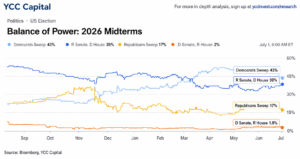
Markets often focus on the next inflation print or the next Federal Reserve meeting. Yet the deeper driver of asset prices is frequently political incentives. As the United States approaches the 2026 midterm elections, macro policy is increasingly being shaped not simply by economic objectives but by electoral strategy. Understanding this interaction between politics and markets is becoming essential for investors.
At YCC Capital, our base case remains that U.S. inflation is approaching a cyclical peak despite continued producer price pressures. Meanwhile, the Trump administration is likely to intensify the use of executive authorities—including tariffs, foreign policy initiatives, and border security measures—to offset domestic political constraints. Rather than pursuing difficult legislative battles, Washington is increasingly relying on areas where presidential discretion remains strongest.
This combination should produce a market environment characterized by moderating inflation, elevated geopolitical headlines, persistent trade frictions, and relatively resilient U.S. economic performance compared with most developed peers. Investors should expect more political volatility than macroeconomic deterioration.
Producer Prices Remain Elevated, but Underlying Inflation Momentum Is Beginning to Cool
The latest Producer Price Index (PPI) data illustrates an important distinction between headline inflation and underlying pricing pressure. While headline producer inflation continues to appear elevated, much of the increase reflects energy-related effects rather than broad-based inflationary acceleration.
According to recent U.S. Labor Department data, headline PPI rose 6.5% year-over-year in May, the strongest reading since late 2022 and slightly above consensus expectations. Energy prices surged more than 10% on a monthly basis, accounting for a substantial share of the increase. However, the underlying picture appears considerably more constructive.
Core PPI, excluding food and energy, increased 4.9% year-over-year, below market expectations of 5.4%. Monthly core producer inflation similarly rose only 0.4%, modestly below consensus estimates.
This divergence matters. Commodity-driven inflation tends to reverse more quickly than wage-driven or services inflation. While headline numbers understandably capture investor attention, monetary policymakers generally focus on the persistence of inflation rather than temporary energy shocks.
The current environment increasingly resembles the latter stages of previous inflation cycles, when headline inflation temporarily overshoots before gradually easing as commodity pressures stabilize.
Source: Bloomberg, YCC Capital.
Middle East Stabilization Could Mark the Turning Point for Inflation
One of the largest macro variables over the coming quarters remains the evolution of Middle East geopolitics.
Our baseline assumption is that negotiations between Washington and Tehran continue progressing despite periodic setbacks. Although regional flashpoints—including Israel and Lebanon—are likely to generate recurring episodes of volatility, the broader diplomatic framework appears sufficiently established to reduce the probability of a sustained energy shock.
Political negotiations rarely proceed in straight lines. Like commercial mergers, agreements frequently experience public disagreements before ultimately reaching implementation.
Should current negotiations continue broadly along their present trajectory, Brent crude is likely to remain within approximately a US$70–90 per barrel range. Such pricing would allow U.S. inflation to gradually moderate through the second half of the year.
Under our central scenario:
- Headline CPI finishes the year around 3.6%–3.8%.
- Core CPI moderates toward approximately 2.7%–2.8%.
- Headline PCE declines to roughly 3.3%–3.5%.
- Core PCE falls toward 3.0%–3.2%.
These outcomes would compare favorably with the Federal Reserve’s own projections and reinforce expectations that inflation has entered a slower but sustainable disinflationary path.
Politics Is Becoming the Dominant Macro Variable
As the 2026 midterm elections approach, the Trump administration’s policy priorities increasingly reflect electoral rather than purely economic considerations.
Domestic legislation remains constrained by congressional arithmetic, procedural delays, and persistent inflation concerns. Consequently, the White House is likely to rely increasingly on policy areas where executive authority is strongest.
Foreign affairs, tariffs, border enforcement, sanctions, and national security all fall into this category.
This represents what can best be described as an “external solutions to internal challenges” strategy. Rather than attempting to solve every domestic issue before voters head to the polls, the administration is likely to emphasize visible demonstrations of executive action abroad while limiting exposure to politically difficult domestic negotiations.
For markets, this implies a higher frequency of geopolitical announcements without necessarily implying a proportional deterioration in underlying macroeconomic fundamentals.
The Midterm Elections: Republicans Face a Difficult House Map
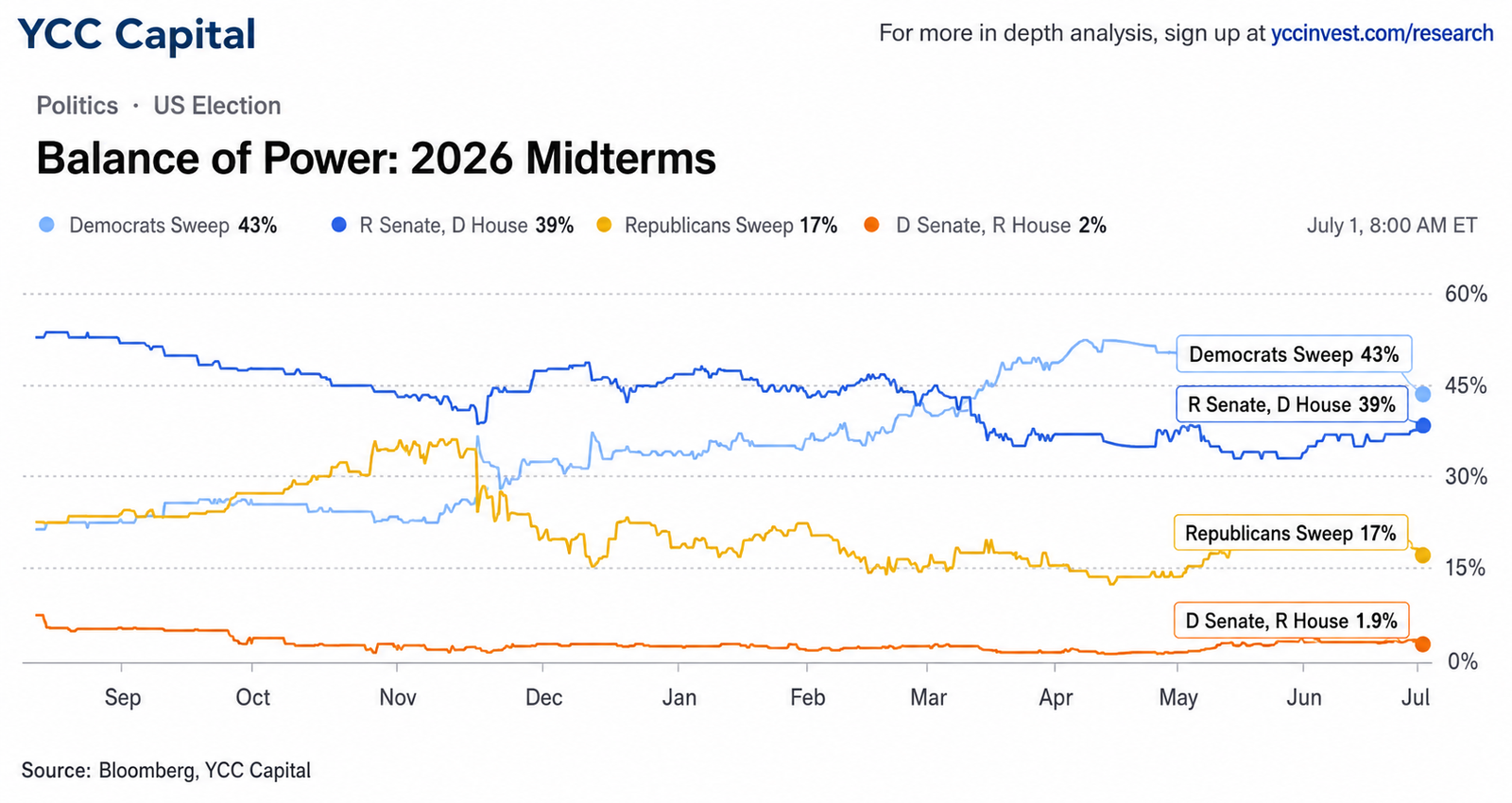
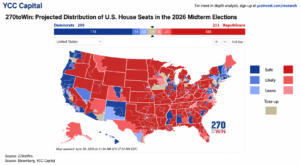
Prediction markets and polling currently point toward an increasingly challenging environment for Republicans in the House of Representatives.
Recent market pricing suggests Democrats possess a high probability of reclaiming the House, reflecting both historical midterm dynamics and continued voter dissatisfaction regarding living costs.
This would not represent an unusual political development. American voters have historically used midterm elections to rebalance power away from the governing party.
Republicans currently maintain only a narrow House majority, leaving little room for electoral underperformance. Even modest shifts among competitive districts could prove sufficient to transfer control.
Although Republican-led states have pursued redistricting efforts designed to improve electoral positioning, Democrats require relatively limited gains among competitive districts to regain a governing majority.
Current projections therefore continue to favor Democratic control of the House following the election.
Source: Bloomberg, YCC Capital.
The Senate Remains a Different Story
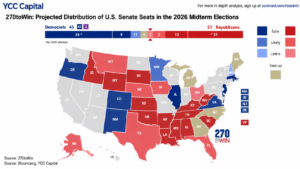
While the House appears increasingly competitive, the Senate presents Republicans with a substantially stronger defensive position.
Republicans currently maintain a 53–47 Senate majority.
Although Democrats need only four net gains to reclaim control, the electoral geography presents considerable obstacles.
Several Democratic-held seats—including Michigan and Georgia—remain highly competitive. Meanwhile, opportunities for Democrats to capture Republican-held seats remain limited primarily to a handful of competitive states such as Maine and North Carolina.
Based on current polling trends, Republicans appear more likely than not to retain Senate control, albeit with a narrower majority.
Maintaining Senate control would preserve the administration’s ability to confirm judicial appointments, executive nominees, and many elements of the broader policy agenda, even under a divided Congress.
Why Tariffs Remain Central to Trump’s Strategy
Among all policy tools available to the administration, tariffs remain perhaps the most politically valuable.
They offer several simultaneous advantages:
First, tariff revenue provides measurable fiscal support. Since implementation, tariff collections have materially strengthened federal revenues while modestly reducing fiscal deficits.
Second, tariffs reinforce the administration’s manufacturing narrative by emphasizing industrial reshoring and domestic production.
Third, tariffs communicate political resolve to core supporters without requiring congressional approval.
However, recent legal developments have complicated implementation.
The U.S. Supreme Court ruled that the International Emergency Economic Powers Act (IEEPA) does not authorize broad unilateral tariff increases of the scale previously attempted. This significantly reduced the legal foundation supporting earlier tariff initiatives.
The ruling also coincided with softer tariff revenues, widening trade deficits, and stronger import growth.
Rather than abandoning the broader strategy, the administration has begun relying increasingly upon alternative legal authorities.
Source: Bloomberg, YCC Capital.
Section 301 Could Become the Next Major Trade Weapon
Attention is now shifting toward Section 301 investigations conducted by the Office of the United States Trade Representative.
The administration has accelerated multiple investigations covering numerous trading partners, potentially laying the legal groundwork for a new generation of targeted tariffs after temporary measures expire.
Unlike previous universal tariff proposals, these actions would likely focus more heavily on specific industries, supply chains, and strategic sectors.
This approach provides greater legal durability while allowing policymakers to emphasize protection of domestic manufacturing during the election campaign.
For investors, the implication is clear.
Trade tensions are unlikely to disappear even if legal challenges reshape their implementation. Instead, trade policy is evolving from broad universal tariffs toward increasingly selective industrial protection.
Geopolitics: Less Middle East Escalation, Greater Western Hemisphere Focus
One notable feature of current U.S. strategy is the apparent shift in geopolitical priorities.
Rather than becoming increasingly entangled in prolonged Middle Eastern confrontation, Washington appears increasingly focused on maintaining regional stability while redirecting strategic attention toward the Western Hemisphere.
Several priorities illustrate this shift:
The administration has intensified sanctions targeting Cuba while seeking greater influence over regional energy flows.
Washington has also emphasized strategic interests surrounding the Panama Canal, highlighting supply chain security and infrastructure control.
Meanwhile, Arctic security—including Greenland’s strategic significance and critical mineral resources—has re-emerged as a longer-term national security priority.
Taken together, these initiatives suggest a modernized version of the Monroe Doctrine: emphasizing America’s immediate strategic neighborhood while limiting exposure to more unpredictable overseas conflicts.
For financial markets, this may reduce the probability of sustained oil-price shocks while increasing strategic competition across logistics, shipping, infrastructure, and critical minerals.
The Federal Reserve Enters a New Phase
The Federal Reserve has maintained policy rates while communicating a cautious approach toward future decisions.
Kevin Warsh’s early public appearances have attracted considerable market attention, with investors interpreting his remarks as signaling a disciplined commitment to inflation control alongside institutional modernization.
Although policy remains data dependent, markets increasingly recognize that the inflation outlook may permit greater flexibility later in the cycle if disinflation continues.
The interaction between fiscal policy, trade policy, and monetary policy therefore becomes increasingly important.
Should tariffs support government revenues while inflation moderates, the Federal Reserve may eventually gain greater room to normalize policy without sacrificing credibility.
YCC Capital Strategic View
Investing often resembles navigating changing weather rather than predicting a single destination. A sailor cannot control shifting winds, but successful navigation depends upon recognizing when prevailing conditions begin to change.
Today’s macro environment presents a similar challenge.
Political headlines are likely to remain loud. Trade disputes will periodically dominate news cycles. Election uncertainty will generate bouts of volatility. Yet beneath the political noise, the underlying economic backdrop appears more constructive than many investors appreciate.
Our baseline outlook remains cautiously optimistic toward U.S. assets. Inflation is likely moving toward moderation rather than renewed acceleration, economic growth remains comparatively resilient, and corporate earnings continue benefiting from structural investment in artificial intelligence, industrial reshoring, and productivity-enhancing technologies.
Conversely, we remain more cautious toward China’s medium-term outlook. Structural property weakness, demographic headwinds, subdued private-sector confidence, and persistent geopolitical tensions continue to constrain long-term growth prospects despite periodic policy stimulus.
For investors, separating political volatility from economic fundamentals will remain one of the defining competitive advantages over the coming year.
Editorial Board
Ken Cao — Chief Strategist, Global Investment Strategy
Le Gao — Managing Analyst
Yui Nabeshima — Strategist
Mai Ikeda — Research Analyst
IMPORTANT DISCLAIMER
This research report is provided for informational and educational purposes only and does not constitute an offer to sell or a solicitation of an offer to buy any securities, financial instruments, or investment products. It is not intended as investment, legal, accounting, or tax advice and should not be relied upon as such. The views, opinions, and projections expressed herein are those of YCC Capital Management and its research personnel as of the date of publication and are subject to change without notice. Past performance is not indicative of future results.
YCC Capital Management, its affiliates, principals, and employees may hold long or short positions in securities or instruments discussed in this report and may trade for their own accounts or for client accounts in a manner inconsistent with the recommendations herein. This report is based on publicly available information and data believed to be reliable, but YCC Capital makes no representation or warranty, express or implied, as to the accuracy, completeness, or timeliness of such information. Forward-looking statements involve risks and uncertainties that could cause actual results to differ materially from those projected.
Recipients of this report should conduct their own independent due diligence and consult with their own financial, legal, and tax advisors before making any investment decisions. YCC Capital accepts no liability for any loss or damage arising from the use of or reliance on this report or its contents.
This report is intended solely for the use of the intended recipient(s) and may not be reproduced or redistributed for commercial purposes without the prior written consent of YCC Capital. © 2026 YCC Capital. All rights reserved. YCC Capital’s flagship vehicle, the YCC International Value Fund, LP, maintains a concentrated global macro value strategy with a focus on capital-flow-driven mispricings and asymmetric hedging opportunities. The Fund is registered in the State of Delaware, U.S. and structured as a Rule 506(c) fund. Performance data, where referenced, has been verified by independent third parties including NAV Consulting; however, individual investor results may vary.
Contact Us
YCC Capital Research
Email: ir@yccinvest.com
Sign up for our free daily market insights at www.yccinvest.com.
For more related research:
Trump’s Political Playbook: Winning Abroad to Stabilize at Home
Investors in Xi’s China Faced a Lost Decade
Has Peak Hawkishness Arrived? Why the Fed’s Toughest Message May Also Mark the Turning Point