YCC CAPITAL
Global Fixed Income & Currency Strategy
September 26, 2026
Bloomberg, YCC Capital
The macro picture entering the fourth quarter is becoming more complicated, but not necessarily more fragile. The U.S. economy continues to demonstrate an ability to absorb shocks that would normally have produced a sharper slowdown: higher oil prices, renewed Federal Reserve tightening, expensive mortgages and persistent geopolitical uncertainty. August retail sales and payrolls surprised materially to the upside, while AI-related capital expenditure remains a powerful structural support.
Yet resilience has a price. Stronger demand, firmer employment and an oil shock centered on the Middle East give the Fed less room to declare victory over inflation. Our base case is therefore a pause in October followed by another 25bp rate increase in December. We do not interpret this as the beginning of a sustained hiking cycle. Rather, it looks more like an insurance premium against inflation becoming embedded again.
For investors, that distinction matters enormously. A single additional hike is a repricing event. A new hiking cycle would be a regime change.
Middle East: The Oil Risk Has Become a Two-Chokepoint Problem
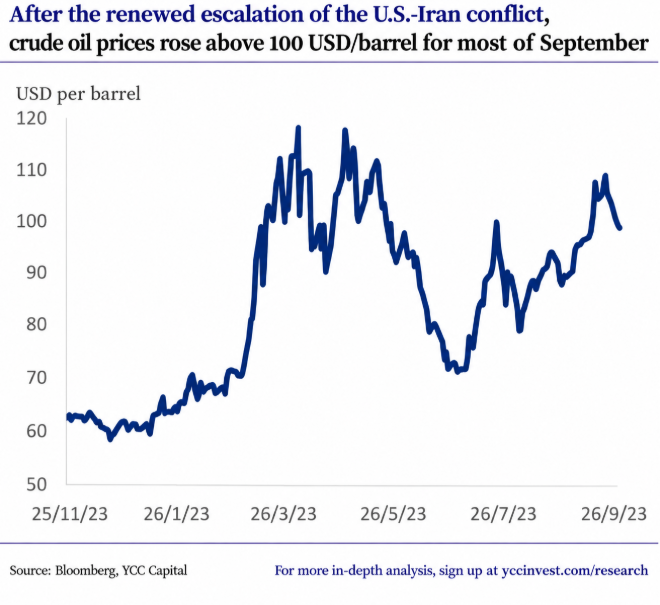
 September marked a renewed escalation in U.S.-Iran tensions after August briefly appeared to favor diplomacy over military confrontation. Military activity intensified in early September around southern Iran and the Strait of Hormuz, while the disruption subsequently spread toward Saudi energy infrastructure and Red Sea transportation routes.
The important change is not simply that Hormuz remains dangerous. The risk architecture has broadened.
Saudi Arabia’s East-West pipeline, which connects eastern oil-producing regions with the Red Sea port of Yanbu, was temporarily disrupted following a drone attack. The pipeline has capacity of roughly 4–5 million barrels per day, equivalent to approximately 4%–5% of global oil supply, and represents one of the most important alternatives when Hormuz is impaired.
At the same time, threats around the Bab el-Mandeb and Red Sea shipping corridor have increased. That creates the possibility of a simultaneous Hormuz-plus-Red-Sea bottleneck. Brent consequently climbed above $100/bbl during September, reaching roughly $108.75/bbl on September 15, before diplomatic signals helped bring prices back toward $99 by September 23.
Our assessment is that Hormuz is likely to remain in a state of partial opening combined with high-risk transportation for a meaningful portion of the fourth quarter. Full normalization probably requires a more formal political or ceasefire agreement.
We therefore raise our year-end Brent baseline from $80–90/bbl to $90–100/bbl, with much of the fourth quarter potentially trading within a $90–110/bbl range. A renewed military escalation or additional restrictions on Hormuz could push Brent toward $110–120/bbl or higher.
Oil shocks rarely move through the economy like a light switch. They behave more like water slowly finding cracks in a building: transportation first, then corporate margins, household purchasing power and ultimately inflation expectations. That delayed transmission is one reason the Fed cannot comfortably ignore today’s energy shock.
The U.S. Economy: Resilient, but Increasingly K-Shaped
August data strengthened our conviction that the U.S. economy remains more resilient than headline recession concerns suggest.
Retail sales increased 1.2% month over month, reversing July’s revised 0.5% decline and exceeding the 0.8% consensus expectation. Gasoline-station sales jumped 3.1%, but this was not merely an oil-price story. Excluding gasoline, retail sales still rose approximately 1.1%, while inflation-adjusted sales increased around 0.8%.
The GDP-relevant retail control group was even stronger, rising 1.4%, compared with a 0.4% decline in July. Non-store retailing increased 2.6%, electronics and appliance sales 1.6%, restaurant spending 1.2%, and auto-related sales 0.6%.
This is the American economy’s recurring surprise: the consumer bends, but has not yet broken.
Manufacturing tells a different story. Industrial production was approximately flat in August, while manufacturing output declined 0.3%. Motor vehicle and parts production fell 1.2%, computer and electronics output declined 0.5%, and business-equipment production fell 0.5%.
We do not read this as the end of the AI investment cycle. Data centers, servers, networking equipment and semiconductors should continue supporting equipment investment. Instead, the divergence is becoming clearer: AI-intensive investment remains strong while traditional manufacturing struggles.
Housing remains the clearest weak point. Housing starts declined 2.6% to an annualized 1.275 million units. Single-family starts rebounded 7.6%, but multifamily construction fell 22.5%. Building permits dropped 2.7% to 1.394 million, while existing-home sales declined 2.0% to an annualized 3.98 million. With 30-year mortgage rates around 6.81% following the Fed’s September increase, affordability remains heavily constrained.
Inflation and Employment Complicate the Fed’s Job
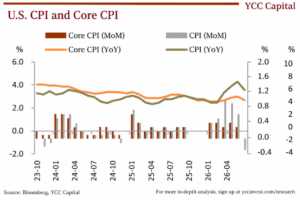
August core CPI accelerated more than expected on a monthly basis. Importantly, however, the composition was less alarming than the headline suggests. Lodging away from home, transportation services, tuition and wireless-service charges contributed disproportionately, and several components appear seasonal or potentially one-off.
Year-over-year headline CPI remained around 3.4%, while core CPI eased approximately 0.1 percentage point to 2.4%.
We continue to believe the peak inflation phase has passed. The risk, however, has become less comfortable because elevated oil prices can feed into core inflation with a lag.
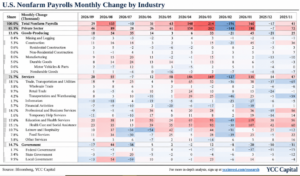
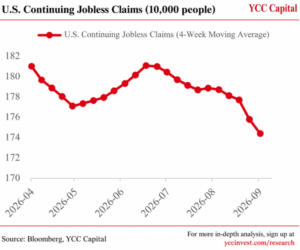
Employment delivered an equally important surprise. Nonfarm payrolls increased 162,000 in August versus consensus expectations of roughly 55,000, while June and July payrolls were revised upward by a combined 55,000. Unemployment edged from 4.09% to 4.14%, but labor-force participation simultaneously increased 0.2 percentage point to 61.6%, making the unemployment-rate increase considerably less troubling.
Average hourly earnings rose 0.27% month over month, compared with 0.16% in July.
The message is not that the labor market has returned to boom conditions. It is that the feared rapid deterioration has not materialized.
Fed Strategy: Pause in October, Hike in December
The Federal Reserve raised its target range by 25bp to 3.75%–4.00% in September. The meeting delivered several hawkish signals, including stronger growth assumptions, lower unemployment projections and higher inflation forecasts.
The dot plot was particularly notable. Of 18 officials submitting projections, 12 expected another 25bp increase this year, four anticipated two additional increases, and only two expected no further hike.
Even so, we expect the Fed to pause in October. Monetary policy operates with long and variable lags, and policymakers have good reason to observe how higher financing costs and the energy shock affect demand before tightening again.
December is different.
For the Fed to remain on hold then, we believe several conditions would likely need to converge: monthly core PCE inflation sustainably around 0.2% or lower, a clearer upward trend in unemployment, and meaningful normalization of Hormuz accompanied by lower oil prices. These outcomes are plausible eventually, but three months may simply be too short.
Our base case is therefore another 25bp December hike without a subsequent continuous hiking cycle.
Dollar: Strong, but Not a One-Way Trade
The dollar index recovered sharply from a September 8 low near 98.86, moving above 100 following the Fed decision and reaching approximately 101.1 on September 23.
The near-term support is straightforward: resilient U.S. growth, a hawkish Fed, higher oil prices and geopolitical safe-haven demand.
Yet we do not see the ingredients for an extended one-direction dollar surge. Inflation remains elevated but does not yet resemble a broad loss of price stability. Other major central banks have also become less accommodative, reducing the scope for U.S. policy divergence to widen indefinitely. Market pricing may also be discounting more Fed tightening than ultimately occurs.
Our fourth-quarter framework is therefore high-level, two-way consolidation, with the dollar finishing the year modestly below current levels but without a dramatic decline.
YCC Strategic View
The fourth-quarter macro environment is best understood as a contest between American resilience and tightening financial conditions. Consumption and AI investment remain the two strongest pillars beneath U.S. growth, while housing and conventional manufacturing carry most of the strain.
For markets, the central question is not whether the Fed has suddenly embarked on another long hiking campaign. We do not believe it has. The more important issue is how long rates must remain restrictive when oil is near $100, employment remains functional and demand refuses to cool quickly.
That is an uncomfortable combination for duration, but it is not synonymous with an American recession. The U.S. economy has repeatedly demonstrated more shock absorption than expected. We remain cautiously constructive on its medium-term capacity to adjust, while recognizing that the path through the fourth quarter is likely to remain unusually volatile.
The key risks are clear: a renewed Middle East escalation and nonlinear oil-price shock; unexpectedly persistent inflation forcing repeated Fed hikes; or a sharp reversal in AI investment. On the other side, stronger productivity gains and sustained AI capital expenditure could allow U.S. growth to remain firmer than current tightening conditions would normally imply.
Editorial Board
Ken Cao, Chief Strategist, Global Investment Strategy; Le Gao, Managing Analyst; Yui Nabeshima, Strategist; Mai Ikeda, Research Analyst.
IMPORTANT DISCLAIMER
This research report is provided for informational and educational purposes only and does not constitute an offer to sell or a solicitation of an offer to buy any securities, financial instruments, or investment products. It is not intended as investment, legal, accounting, or tax advice and should not be relied upon as such. The views, opinions, and projections expressed herein are those of YCC Capital Management and its research personnel as of the date of publication and are subject to change without notice. Past performance is not indicative of future results.
YCC Capital Management, its affiliates, principals, and employees may hold long or short positions in securities or instruments discussed in this report and may trade for their own accounts or for client accounts in a manner inconsistent with the recommendations herein. This report is based on publicly available information and data believed to be reliable, but YCC Capital makes no representation or warranty, express or implied, as to the accuracy, completeness, or timeliness of such information. Forward-looking statements involve risks and uncertainties that could cause actual results to differ materially from those projected.
Recipients of this report should conduct their own independent due diligence and consult with their own financial, legal, and tax advisors before making any investment decisions. YCC Capital accepts no liability for any loss or damage arising from the use of or reliance on this report or its contents.
This report is intended solely for the use of the intended recipient(s) and may not be reproduced or redistributed for commercial purposes without the prior written consent of YCC Capital. © 2026 YCC Capital. All rights reserved. YCC Capital’s flagship vehicle, the YCC International Value Fund, LP, maintains a concentrated global macro value strategy with a focus on capital-flow-driven mispricings and asymmetric hedging opportunities. The Fund is registered in the State of Delaware, U.S and structured as a 506(c) fund. Performance data, where referenced, has been verified by independent third parties including NAV Consulting; however, individual investor results may vary.
Contact Us
For research inquiries, contact ir@yccinvest.com. Sign up for YCC Capital’s free daily market newsletter at yccinvest.com for ongoing macro, markets and investment strategy insights.
YCC Capital Research | Sign up for free daily market insight at www.yccinvest.com
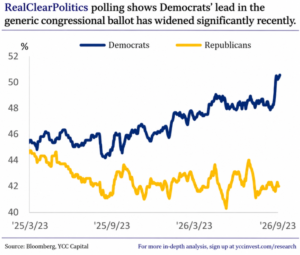
Election-related figures in the source material were cross-checked against current public information. As of the latest available RealClearPolling data, the generic congressional ballot average is approximately 50.6% Democratic versus 41.9% Republican; prediction-market pricing remains fluid and should be treated as market-implied pricing rather than an election forecast. realclearpolling.com
Warsh Draws the Line: The Fed’s Rate Hike Is a Warning, Not an Ending
The Warsh Shock: The Fed’s Hawkish Reset Forces a Full Market Repricing
The Quiet Hawk: Warsh Wants Markets to Fear the Fed—Without Promising a Hike
The Yen’s Real Battle: Why BOJ Tightening Alone Will Not Be Enough
The Fed’s Hawkish Reset: From “When to Cut” to “Whether to Hike Again”