YCC CAPITAL
Global Fixed Income & Currency Strategy
October 1, 2026
YCC Perspective
The most important market signal today is not simply that Treasury yields are rising. It is why they are rising. Resilient U.S. activity, renewed energy-price risk, a Federal Reserve increasingly uncomfortable with inflation, and an extraordinary AI infrastructure investment cycle are all competing for capital at the same time.
That combination is pushing the long end of the Treasury curve higher even as U.S. equities—particularly AI-linked technology—continue to absorb the pressure surprisingly well. The result is an unusual market: monetary conditions are becoming more restrictive, yet the companies closest to the AI capital-spending cycle are behaving as though a new investment supercycle has begun.
Our central view is that the Fed is likely to remain restrictive in the near term, with another rate increase a meaningful possibility as policymakers confront persistent inflation. Yet the picture should change as we move into 2027. If the energy shock fades and elevated borrowing costs increasingly restrain demand, the conditions for eventual policy easing can re-emerge.
For investors, that means living with two clocks: the inflation clock, which is currently keeping rates high, and the growth clock, which is gradually transmitting those rates into the real economy.
Treasury Yields Are Sending a Message
U.S. Treasury yields moved sharply higher as markets absorbed stronger economic data, renewed geopolitical uncertainty and increasingly hawkish Federal Reserve communication. The 30-year Treasury yield briefly reached 5.5252%, its highest level since 2004, while the 10-year yield approached 5.23% intraday.
The move reflects more than monetary policy. AI infrastructure requires enormous amounts of capital for data centers, semiconductors, memory, networking equipment and power infrastructure. At the same time, government financing needs remain substantial. Capital has therefore become a more contested resource.
Think of the bond market as the price of renting money. When governments, corporations and a rapidly expanding technology investment cycle all arrive at the rental counter together, the price naturally rises.
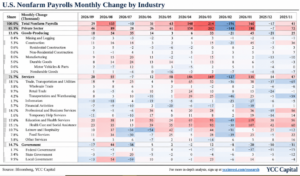
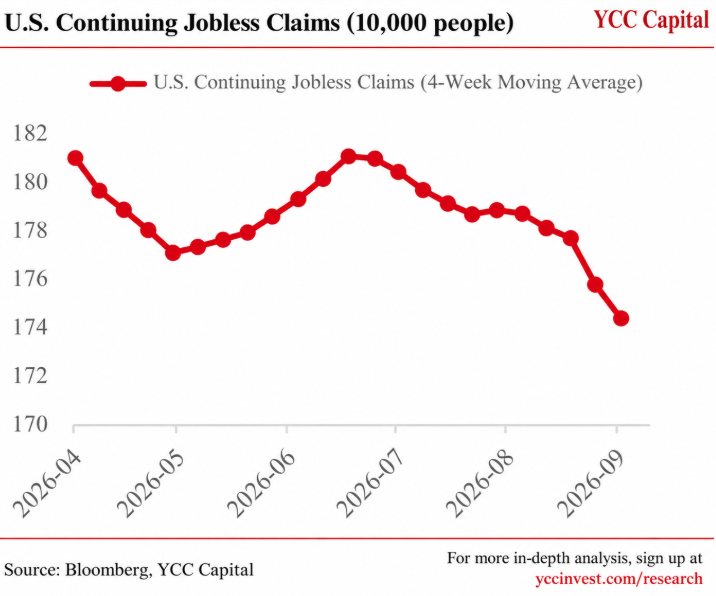
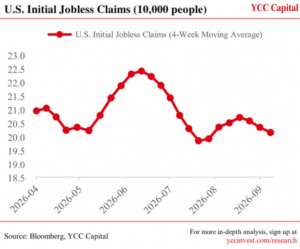
U.S. economic activity has given the Fed little reason to rush toward accommodation. The September preliminary S&P U.S. Composite PMI rose to 58.4 from 56.0 in August, reaching its highest level since July 2021. Labor-market indicators also remain consistent with an economy that has not fallen into broad contraction.
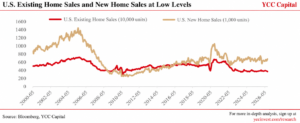
There are nevertheless pockets of weakness. Existing- and new-home sales remain subdued, while the University of Michigan consumer sentiment index stood at 48.1, pointing to a household sector that feels considerably less comfortable than headline growth data might suggest.
This distinction matters. The U.S. economy remains resilient, but resilience should not be confused with immunity to high rates.
Hormuz Keeps an Inflation Risk Premium Alive
The Middle East remains an important variable for global rates.
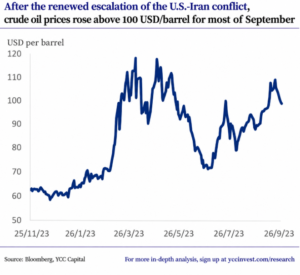
Prospects for restoring normal shipping through the Strait of Hormuz remain uncertain. Diplomatic proposals briefly reduced market anxiety, but negotiations failed to produce a durable resolution. The implication for investors is straightforward: energy markets must continue carrying a geopolitical risk premium.
Oil matters to the Fed because an energy shock can migrate beyond gasoline and utility bills. Higher transportation, manufacturing and logistics costs can eventually affect broader pricing behavior.
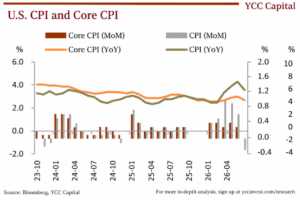
The critical question is therefore not whether oil rises for several weeks, but whether higher energy costs become embedded in underlying inflation. If that happens, expectations for eventual Fed easing would need to move further into the future.
The Fed Is Leaning Against Inflation Again
Recent Federal Reserve communication shows a broad concern that inflation remains too elevated for comfort.
New York Fed President John Williams has indicated that another increase this year could represent a reasonable policy path given current inflation risks, while emphasizing that policy remains dependent on incoming employment, inflation and financial-condition data.
Cleveland Fed President Beth Hammack has emphasized resilient output, a labor market near full employment and inflation risks that remain tilted upward. Higher long-term Treasury yields tighten financial conditions, but in her framing they do not necessarily indicate that markets have lost confidence in the Fed’s inflation-fighting credibility.
Philadelphia Fed President Anna Paulson has highlighted resilient consumption, AI investment and labor-market conditions while placing underlying inflation around 2.5%–3%, still meaningfully above the Fed’s 2% objective. Energy prices, Middle East developments and AI-related construction demand represent additional potential sources of inflation pressure.
Minneapolis Fed President Neel Kashkari has similarly stressed that inflation pressures extend beyond volatile food and energy categories. Fed Governor Michael Barr has pointed to strong growth and resilient employment alongside inflation that has not yet established a convincing path back toward target.
Vice Chair Philip Jefferson, meanwhile, focused his latest remarks on discount-window modernization and Treasury-market functioning rather than the near-term policy-rate trajectory. Improving the discount window could reduce the probability that banks are forced to sell Treasury securities during periods of stress, strengthening the resilience of both Treasury and short-term funding markets.
Market pricing reflects this more hawkish environment. Fed funds futures indicated substantial expectations for additional tightening through the remaining 2026 meetings.
AI Is Keeping the Equity Market Afloat—but Narrow
The equity market is telling a very different story from the bond market.
Over the latest week, the S&P 500 gained 1.21% and the Nasdaq 100 rose 3.25%, while the Russell 2000 declined 0.8%. That divergence is important. Investors are not indiscriminately buying risk. Capital remains concentrated in large technology companies and businesses positioned directly inside the AI investment chain.
The renewed enthusiasm around personal AI agents has reinforced expectations that AI commercialization is moving beyond model training toward a broader computing ecosystem. At the same time, investors are beginning to consider the disruptive implications of AI agents for conventional software, online travel and some internet-platform business models.
We see a meaningful distinction between the infrastructure layer and the application layer.
For application businesses, monetization frequently depends on assumptions about future customer adoption, willingness to pay and competitive positioning. Hardware economics are easier to observe in real time. Accelerators, memory and related infrastructure have orders, shipments and revenue recognition that investors can monitor.
That does not make every AI hardware company attractive at every valuation. It does mean that, in a high-rate environment, companies with genuine technological barriers, visible customer demand and an ability to convert revenue growth into profits and cash flow deserve particular attention.
Anyone who has run a business recognizes the distinction. A packed store means little if every sale loses money. In markets, excitement may bring customers through the door; cash generation determines who can keep the lights on.
A Resilient America, but an Uneven Expansion
The broader macro picture is therefore more complicated than either “strong economy” or “high rates” suggests.
AI-related capital expenditure is accelerating, but investment outside the technology infrastructure complex is less impressive. Capacity utilization remains relatively soft, housing activity is subdued, and high financing costs increasingly punish businesses with weak earnings and inadequate cash flow.
This creates a two-speed economy. At the front of the train sit AI infrastructure, major technology companies and businesses with strong balance sheets. Further back, interest-sensitive industries are already feeling the gradient.
For markets, narrow leadership is not automatically bearish. It does, however, increase sensitivity to disappointment. When a relatively small group of companies carries a disproportionate share of index performance, earnings delivery becomes more important.
Strategic View: High Rates Today, More Flexibility Tomorrow
Our base case remains cautiously constructive on the United States while recognizing that the bond market has entered a difficult phase.
Persistent inflation and energy uncertainty can keep long-term Treasury yields elevated in the near term. Another Fed tightening step remains plausible if inflation fails to moderate. Investors should therefore avoid assuming that duration will immediately provide protection simply because policy rates are already high.
Looking further into 2027, the balance can change. High rates work with a lag. Eventually mortgages reset, refinancing becomes more expensive, corporate investment decisions become harder and consumers become more selective. If the energy shock simultaneously fades, inflation pressure should become easier to contain, reopening the door to eventual easing.
In equities, we continue to see the strongest fundamental case in AI infrastructure businesses where technological advantage is reinforced by observable demand, earnings and cash generation. The market is increasingly separating companies that merely tell an AI story from companies being paid to build the machinery behind it.
The next phase of this cycle may therefore be less about whether AI remains powerful and more about who can turn extraordinary investment into durable economics.
Key Risk
The principal macro risk is a sustained increase in energy prices that passes through into core inflation. Such an outcome could postpone eventual Fed easing, keep financial conditions restrictive for longer and push long-term Treasury yields still higher.
Sources: Bloomberg, YCC Capital
Editorial Board
Ken Cao, Chief Strategist, Global Investment Strategy; Le Gao, Managing Analyst; Yui Nabeshima, Strategist; Mai Ikeda, Research Analyst.
IMPORTANT DISCLAIMER
This research report is provided for informational and educational purposes only and does not constitute an offer to sell or a solicitation of an offer to buy any securities, financial instruments, or investment products. It is not intended as investment, legal, accounting, or tax advice and should not be relied upon as such. The views, opinions, and projections expressed herein are those of YCC Capital Management and its research personnel as of the date of publication and are subject to change without notice. Past performance is not indicative of future results.
YCC Capital Management, its affiliates, principals, and employees may hold long or short positions in securities or instruments discussed in this report and may trade for their own accounts or for client accounts in a manner inconsistent with the recommendations herein. This report is based on publicly available information and data believed to be reliable, but YCC Capital makes no representation or warranty, express or implied, as to the accuracy, completeness, or timeliness of such information. Forward-looking statements involve risks and uncertainties that could cause actual results to differ materially from those projected.
Recipients of this report should conduct their own independent due diligence and consult with their own financial, legal, and tax advisors before making any investment decisions. YCC Capital accepts no liability for any loss or damage arising from the use of or reliance on this report or its contents.
This report is intended solely for the use of the intended recipient(s) and may not be reproduced or redistributed for commercial purposes without the prior written consent of YCC Capital. © 2026 YCC Capital. All rights reserved. YCC Capital’s flagship vehicle, the YCC International Value Fund, LP, maintains a concentrated global macro value strategy with a focus on capital-flow-driven mispricings and asymmetric hedging opportunities. The Fund is registered in the State of Delaware, U.S and structured as a 506(c) fund. Performance data, where referenced, has been verified by independent third parties including NAV Consulting; however, individual investor results may vary.
Contact Us
For research inquiries, contact ir@yccinvest.com.
For free daily market insight and YCC Capital’s latest global macro research, sign up at yccinvest.com.
YCC Capital Research | Sign up for free daily market insight at www.yccinvest.com
For more related research:
Has Peak Hawkishness Arrived? Why the Fed’s Toughest Message May Also Mark the Turning Point
Asset Divergence Under Repeated Geopolitical Shocks
Oil, Rates, and Risk: Why the Middle East Shock Is Repricing Global Fixed Income
The Fed’s Hawkish Turn: One More Hike, Not a New Hiking Cycle