YCC CAPITAL
Emerging Markets & China Strategy
September 10, 2026
YCC Capital Perspective
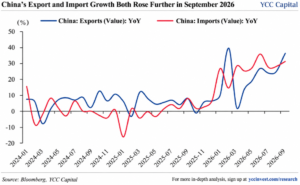
China’s August trade numbers look spectacular at first glance. Exports surged 25.0% year over year to $401.44 billion, imports climbed 28.2% to $282.36 billion, and the monthly trade surplus reached $119.09 billion. Yet this is one of those macro prints where the headline tells only half the story.
The underlying picture is considerably less comfortable. Much of the acceleration is concentrated in AI-related electronics, semiconductors, computing equipment, and selected capital goods. Meanwhile, traditional exports are growing much more slowly, European demand is weak, and some of the strongest technology categories are being driven primarily by higher prices rather than rising shipment volumes.
In everyday life, there is a difference between earning more because you sold twice as many products and earning more because the same product suddenly became twice as expensive. China’s current trade boom increasingly resembles the latter. That distinction matters because price-led growth can look extraordinary right up until pricing power fades.
Headline Strength Is Real, but the Base Is Narrow
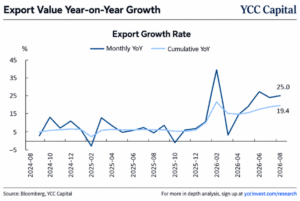
August exports rose 25.0% year over year, accelerating from 23.9% in July. For January through August, exports increased 19.4%, compared with 18.5% during the first seven months of the year.
Three forces contributed to the strong result.
First, comparison effects were unusually favorable. Exports had risen only 4.2% in August 2025, mechanically magnifying this year’s year-over-year reading.
Second, global manufacturing activity remained resilient while the AI investment cycle continued to support demand for semiconductors and computing hardware. Global manufacturing PMI edged higher from 52.1 to 52.3 in August. China’s position within the Asian electronics supply chain therefore continued to generate substantial export value.
Third, earlier port disruptions created some temporary catch-up. Operations at major eastern Chinese ports, including Shanghai and Ningbo-Zhoushan, normalized after weather-related interruptions, allowing previously delayed cargo to move through the system.
None of these supports should be dismissed. But neither should they be extrapolated mechanically into 2027.
AI Is Carrying an Increasing Share of the Load
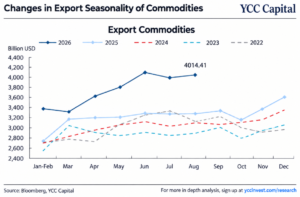
Technology exports dramatically outperformed the aggregate.
Integrated-circuit export value jumped 129.8% year over year. Automatic data-processing equipment exports rose 76.5%, mobile phones increased 29.6%, and automobiles and chassis climbed 43.0%. Refined petroleum-product exports increased 80.5%.
Traditional manufactured goods were far less dynamic. Toy exports increased 15.3%, footwear 11.4%, and luggage 11.1%, all substantially below the overall 25.0% export growth rate. Ceramic products fell 25.7%.
Geographically, exports to the United States rose a striking 34.4%, up sharply from 17.0% in July. Exports to South Korea increased 49.3%, Russia 38.7%, and ASEAN 30.2%.
Europe is the obvious weak link. Exports to the European Union grew only 6.6%, down from 16.0% in July. The divergence reinforces our view that China is not experiencing a broad-based renaissance in external demand. Rather, unusually strong performance in a limited number of products and markets is carrying the aggregate number.
The Semiconductor Numbers Deserve More Scrutiny
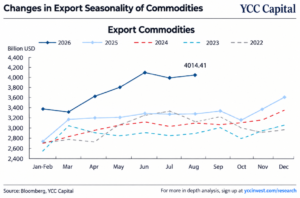
The most important statistic in the August trade data may not be 25.0%.
Integrated-circuit export value increased 129.8%, yet export volume declined 7.9%. Implied export prices therefore rose roughly 149.7%.
That is an extraordinary divergence.
It suggests that China’s semiconductor export boom is being powered by a changing product mix, tight supply in higher-end components, and sharply higher unit values rather than an equivalent expansion in physical demand.
This does not mean AI demand is collapsing. Higher-value chips can legitimately generate much greater revenue without requiring proportional volume growth. But from a macro perspective, value growth driven by price is inherently less reassuring than synchronized growth in both prices and quantities.
For China to demonstrate that the current external-demand cycle has truly broadened, we would prefer to see today’s “lower volume, higher price” pattern evolve into rising volumes alongside firm pricing.
Until then, the headline numbers deserve a meaningful discount.
Source: Bloomberg, YCC Capital
Imports Tell the Same AI Story
August imports reached $282.36 billion, increasing 28.2% year over year, up from 27.6% in July. January-August imports rose 26.9%.
Again, the strength was heavily concentrated.
Imports of automatic data-processing equipment surged 209.1%. Integrated-circuit imports increased 83.6%, while electrical and mechanical-product imports climbed 51.7%. Imports from South Korea jumped 108.1%, consistent with aggressive semiconductor procurement and continued investment throughout the AI hardware chain.
Commodity imports were more mixed. Coal and lignite imports increased 48.6%, unwrought copper 28.5%, and copper ores and concentrates 24.7%.
Energy told a different story. Crude-oil imports fell 8.8%, while refined-product imports declined 13.4%. Restrictions affecting traffic through the Strait of Hormuz, elevated tanker freight rates, and longer transit times constrained arrivals from the Middle East.
Automotive imports were also weak. Automobile and chassis imports fell 32.4%, while auto-parts imports dropped 34.6%.
Imports from India increased 49.5%, Russia 47.0%, ASEAN 35.0%, and the United States 17.8%. Imports from the European Union grew only 0.7%.
Again, this is not the profile of a broadly accelerating domestic economy. It looks much more like concentrated industrial procurement centered on electronics, AI infrastructure, and selected raw materials.
The Fourth Quarter Gets Harder
We expect export growth to remain comparatively firm in the near term, but the arithmetic becomes less forgiving as the fourth quarter progresses.
The favorable base effect will diminish because China’s AI-related trade acceleration began gaining momentum in late 2025. That means increasingly difficult year-over-year comparisons.
The second risk is profitability. The global AI investment cycle currently follows a familiar chain: financing supports capital expenditure, capital expenditure builds computing capacity, and that capacity eventually has to produce sufficient revenue and cash flow to justify the investment.
The spending side of that equation has moved much faster than the profit side.
For the current cycle to remain durable, hyperscalers and major technology companies need to keep raising AI capital-expenditure guidance, data-center occupancy and GPU utilization must remain high, and AI applications must generate sufficient revenue to cover depreciation, electricity, infrastructure, and financing costs.
China is particularly exposed to any interruption in this chain because so much of its recent trade acceleration is concentrated in precisely those hardware categories.
Washington Adds Another Layer of Risk
The approaching U.S. midterm elections may also increase policy uncertainty around AI infrastructure and China-related technology controls.
Debates over fiscal spending, semiconductor subsidies, data-center electricity and water approvals, AI regulation, and restrictions on advanced chips and computing equipment could affect corporate investment decisions.
Washington may also continue tightening controls on advanced GPUs, semiconductor-manufacturing equipment, and related technologies.
From the U.S. perspective, we remain cautiously constructive. America continues to possess the deepest capital markets, leading hyperscale computing platforms, major semiconductor intellectual property, and strong incentives to expand domestic AI infrastructure. Policy disagreement may create volatility, but it does not necessarily undermine the longer-term U.S. technology-investment cycle.
For China, however, the same policy environment creates asymmetric downside. Restrictions can disrupt access to high-end equipment, alter Asian supply-chain orders, and limit the durability of AI-related export growth.
YCC Strategic View
China’s August trade performance is unquestionably strong, but it is not yet broad enough for us to interpret it as a durable macro turning point.
A $119.09 billion monthly trade surplus, 25% export growth, and extraordinary semiconductor export values create an impressive façade. Underneath it, the structure is less robust: technology products dominate, European demand is soft, traditional goods are lagging, and semiconductor volumes remain weak relative to prices.
Our preferred confirmation signal is straightforward: export volumes must begin rising alongside prices.
Until that happens, China’s trade engine looks powerful but increasingly dependent on a narrow AI hardware boom whose sustainability rests on global capital expenditure, elevated semiconductor pricing, and a favorable policy environment. Those are substantial dependencies, and we believe investors should treat the current numbers with more caution than the headlines suggest.
Source: Bloomberg, YCC Capital
Editorial Board
Ken Cao, Chief Strategist, Global Investment Strategy; Le Gao, Managing Analyst; Yui Nabeshima, Strategist; Mai Ikeda, Research Analyst.
IMPORTANT DISCLAIMER
This research report is provided for informational and educational purposes only and does not constitute an offer to sell or a solicitation of an offer to buy any securities, financial instruments, or investment products. It is not intended as investment, legal, accounting, or tax advice and should not be relied upon as such. The views, opinions, and projections expressed herein are those of YCC Capital Management and its research personnel as of the date of publication and are subject to change without notice. Past performance is not indicative of future results.
YCC Capital Management, its affiliates, principals, and employees may hold long or short positions in securities or instruments discussed in this report and may trade for their own accounts or for client accounts in a manner inconsistent with the recommendations herein. This report is based on publicly available information and data believed to be reliable, but YCC Capital makes no representation or warranty, express or implied, as to the accuracy, completeness, or timeliness of such information. Forward-looking statements involve risks and uncertainties that could cause actual results to differ materially from those projected.
Recipients of this report should conduct their own independent due diligence and consult with their own financial, legal, and tax advisors before making any investment decisions. YCC Capital accepts no liability for any loss or damage arising from the use of or reliance on this report or its contents.
This report is intended solely for the use of the intended recipient(s) and may not be reproduced or redistributed for commercial purposes without the prior written consent of YCC Capital. © 2026 YCC Capital. All rights reserved. YCC Capital’s flagship vehicle, the YCC International Value Fund, LP, maintains a concentrated global macro value strategy with a focus on capital-flow-driven mispricings and asymmetric hedging opportunities. The Fund is registered in the State of Delaware, U.S and structured as a 506(c) fund. Performance data, where referenced, has been verified by independent third parties including NAV Consulting; however, individual investor results may vary.
Contact Us
For research inquiries, contact ir@yccinvest.com.
Sign up for free daily market insight at yccinvest.com.
YCC CAPITAL | Emerging Markets & China Strategy
YCC Capital Research | Sign up for free daily market insight at www.yccinvest.com
For more related research:
The Hidden Force Crushing the Japanese Yen is About to Reverse
Gold’s Second Act: Why the $5,000 Threshold Is Back in Play
The Bank of Japan Just Sent a Warning to the Entire Financial World