YCC CAPITAL
U.S. Bond Strategy
August 26, 2026
The U.S. fiscal debate has crossed an important threshold. The issue is no longer whether federal debt is “high” in an abstract sense; markets already know that. The more consequential question is how a nearly $40 trillion sovereign balance sheet behaves when refinancing costs remain elevated, political incentives discourage meaningful consolidation, and investors increasingly demand compensation for duration and policy uncertainty.
Our view is deliberately more balanced than the most bearish fiscal narratives. America is not approaching an imminent sovereign funding crisis. The United States retains the world’s deepest capital markets, the dominant reserve currency, exceptional technological capacity and a tax base supported by a large, innovative private economy. Those advantages matter. Yet privilege is not the same as immunity. The cost of fiscal indiscipline is increasingly appearing where bond investors can see it most clearly: the term premium.
The Fiscal Arithmetic Is Becoming Harder to Ignore
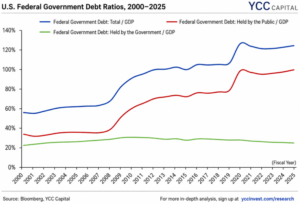
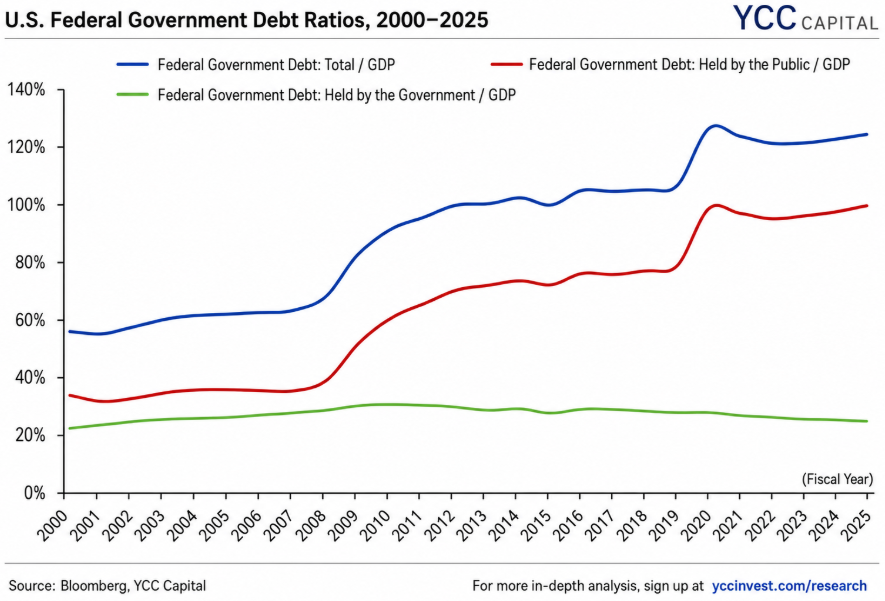
Federal debt stood near $39.8 trillion at the end of July 2026, with roughly $32 trillion held by the public and the remainder largely represented by intragovernmental holdings. Publicly held debt is the economically important portion because it must ultimately be absorbed by households, institutions, banks, foreign reserve managers and the Federal Reserve.
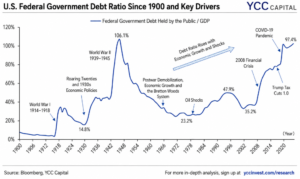
The trajectory is more significant than the headline number. Debt held by the public is around the size of annual U.S. GDP, and CBO projections point to continued increases over the coming decade. For fiscal 2026, CBO expects a deficit of roughly $1.9 trillion, or 5.8% of GDP, while debt held by the public reaches approximately 101% of GDP. Net interest costs alone are projected at roughly 3.3% of GDP.
That last figure is the one investors should keep on the dashboard.
For years, Washington could treat low interest rates as a kind of financial suspension system: debt rose, but servicing costs absorbed the bumps. That suspension is now stiffer. Federal net interest expense rose from about $352 billion in FY2021 to nearly $970 billion in FY2025, and the trillion-dollar annual interest bill has effectively arrived.
For anyone who has refinanced a mortgage after years of unusually cheap money, the mechanism is familiar. The house has not changed, but the monthly payment has. Washington faces the same mathematics on a vastly larger scale.
Refinancing Risk Matters More Than the Debt Headline
The maturity structure of Treasury borrowing amplifies the sensitivity of the fiscal position to prevailing rates. At the end of June 2026, roughly $10.3 trillion of marketable interest-bearing Treasury debt was scheduled to mature within twelve months, approximately one-third of the outstanding stock. Securities maturing within five years represented more than two-thirds of the total.
Treasury bills have also become an increasingly important funding tool. Between early 2023 and mid-2026, bills accounted for roughly 84% of newly issued marketable Treasury securities by gross issuance, versus approximately 76% during 2018–2022.
There is sound logic behind this approach. Bills generally reduce near-term borrowing costs, satisfy enormous institutional demand for liquid collateral and support the plumbing of the dollar funding system. But short-term financing creates a treadmill: Treasury must keep returning to market.
The result is not conventional default risk. It is repricing risk. Every large refinancing wave converts yesterday’s interest-rate environment into today’s budget expense.
That helps explain why we expect the long end of the Treasury curve to remain structurally more volatile than investors became accustomed to during the post-global-financial-crisis era.
Foreign Demand Remains Powerful—but It Is No Longer Infinite
Foreign and international investors remain indispensable to the Treasury market. As of early 2026 they held approximately $9.5 trillion, or about 32.6% of marketable Treasury securities. Japan remained the largest individual foreign holder, followed by the United Kingdom and China.
This is still a remarkable vote of confidence in U.S. capital markets. No competing sovereign bond market combines Treasury-like scale, liquidity, legal protections, collateral utility and convertibility.
Yet the direction of travel deserves attention. Foreign ownership represented close to half of marketable Treasuries in the early 2010s. Today it is closer to one-third. The difference has increasingly been absorbed domestically.
China deserves particular caution. Beijing has steadily reduced its Treasury exposure, but that shift should not automatically be interpreted as evidence that the renminbi is becoming a credible substitute for the dollar. China continues to face capital controls, policy opacity, weak domestic demand, property-sector stress and considerable uncertainty surrounding private-property rights and capital mobility. Those constraints substantially limit the international reserve role of RMB assets.
Diversification away from the dollar can therefore occur without creating a true dollar replacement. Gold is the clearest beneficiary.
The Political Ratchet Is the Core Fiscal Problem
American debt accumulation is not explained by one administration or one party. The deeper problem is a bipartisan political ratchet.
Republican governments generally find it politically easier to reduce taxes than to reduce popular entitlement programs or defense spending. Democratic governments generally find it easier to expand social programs and public investment than to raise sufficient revenue to pay for them. Over successive election cycles, the combination becomes simple: tax cuts stick, spending sticks, and the debt compounds.
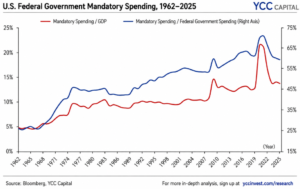
Mandatory spending illustrates why consolidation is so difficult. Social Security, Medicare, Medicaid and related programs now dominate the federal expenditure structure, supported by powerful demographic and political constituencies. Aging makes the arithmetic progressively less forgiving.
This is why another round of discretionary spending restraint alone cannot solve the problem. A durable stabilization program would eventually require some combination of entitlement reform, broader revenue collection and faster nominal economic growth.
The political system has shown little appetite for that bargain.
Tariffs Are Not a Substitute for Fiscal Reform
The Trump administration has attempted to combine domestic tax reductions, spending restraint and substantially higher tariffs. Tariffs can generate meaningful revenue, and CBO estimates that higher tariffs materially reduce projected cumulative deficits relative to a no-tariff baseline.
But tariffs cannot carry the fiscal system on their own.
Historically, customs duties represented only a small fraction of federal revenue in the modern income-tax era. Higher tariffs also involve second-order effects: they can raise import costs, alter supply chains, invite retaliation and contribute to inflation at precisely the time when Treasury would benefit from lower nominal financing costs.
A government cannot sustainably fix a structural budget deficit by taxing the loading dock.
The more constructive U.S. case is that the 2025 reconciliation legislation may support near-term activity and private-sector investment, while America’s productivity upside—particularly from AI, energy infrastructure and automation—can improve the denominator of the debt-to-GDP equation. We remain cautiously optimistic that U.S. growth capacity is stronger than static fiscal projections imply. But growth can soften the adjustment; it cannot eliminate the need for fiscal discipline.
The Fed Is Now Part of the Fiscal Conversation
Kevin Warsh assumed the Federal Reserve chairmanship in May 2026. Markets will understandably scrutinize the relationship between fiscal conditions and monetary policy more closely under the new leadership.
The risk is fiscal dominance: a situation in which the central bank becomes increasingly constrained by the government’s financing burden. With net interest expense already around 3% of GDP, every sustained increase in rates has a visible budgetary cost.
We do not believe the Federal Reserve has lost its independence. That conclusion would be premature. The July FOMC maintained the federal funds target range rather than delivering the easier policy that fiscal considerations alone might favor, and several policymakers remained concerned enough about inflation to prefer tighter policy.
That distinction matters. U.S. institutional credibility has been tested many times and has generally proved more resilient than pessimists expected.
Still, investors should watch the boundary carefully. If markets ever conclude that monetary policy is being set primarily to contain Treasury financing costs rather than maintain price stability, the paradox would be immediate: attempts to suppress rates could raise inflation expectations and the term premium, ultimately making long-term borrowing more expensive.
YCC Strategy View: Higher Term Premium, Not a Dollar Collapse
The investment conclusion is not “sell America.”
It is that the market price of financing America is changing.
We continue to view Treasury bills and shorter-duration government securities as attractive liquidity instruments, while the long end requires greater compensation for supply, inflation and political uncertainty. Curve steepening remains a more credible medium-term expression of fiscal deterioration than an outright Treasury solvency thesis.
We are also skeptical of simplistic de-dollarization narratives. The dollar’s share of global reserves has declined over time and central banks have accumulated more gold, but replacing the dollar requires an alternative with comparable market depth, legal certainty, convertibility and geopolitical reach. Neither China nor any other major economy currently offers the complete package.
America therefore retains enormous financial advantages. But those advantages are now being spent more aggressively.
The central question for the next decade is whether Washington treats reserve-currency status as permanent entitlement or renewable trust. Markets are unlikely to stage a dramatic vote of no confidence overnight. They are more likely to charge a little more each year.
For bond investors, that slow repricing may ultimately matter more than the $40 trillion headline itself.
Source: Bloomberg, YCC Capital
Editorial Board
Ken Cao, Chief Strategist, Global Investment Strategy
Le Gao, Managing Analyst
Yui Nabeshima, Strategist
Mai Ikeda, Research Analyst
IMPORTANT DISCLAIMER
“This research report is provided for informational and educational purposes only and does not constitute an offer to sell or a solicitation of an offer to buy any securities, financial instruments, or investment products. It is not intended as investment, legal, accounting, or tax advice and should not be relied upon as such. The views, opinions, and projections expressed herein are those of YCC Capital Management and its research personnel as of the date of publication and are subject to change without notice. Past performance is not indicative of future results.
YCC Capital Management, its affiliates, principals, and employees may hold long or short positions in securities or instruments discussed in this report and may trade for their own accounts or for client accounts in a manner inconsistent with the recommendations herein. This report is based on publicly available information and data believed to be reliable, but YCC Capital makes no representation or warranty, express or implied, as to the accuracy, completeness, or timeliness of such information. Forward-looking statements involve risks and uncertainties that could cause actual results to differ materially from those projected.
Recipients of this report should conduct their own independent due diligence and consult with their own financial, legal, and tax advisors before making any investment decisions. YCC Capital accepts no liability for any loss or damage arising from the use of or reliance on this report or its contents.
This report is intended solely for the use of the intended recipient(s) and may not be reproduced or redistributed for commercial purposes without the prior written consent of YCC Capital. © 2026 YCC Capital. All rights reserved. YCC Capital’s flagship vehicle, the YCC International Value Fund, LP, maintains a concentrated global macro value strategy with a focus on capital-flow-driven mispricings and asymmetric hedging opportunities. The Fund is registered in the State of Delaware, U.S and structured as a 506(c) fund. Performance data, where referenced, has been verified by independent third parties including NAV Consulting; however, individual investor results may vary.”
Contact Us
For research inquiries, please contact ir@yccinvest.com.
Sign up for YCC Capital’s free daily market insight at yccinvest.com.
YCC Capital Research | Sign up for free daily market insight at www.yccinvest.com
The principal fiscal statistics and historical arguments above are grounded in the uploaded research material. Current CBO data confirm a projected FY2026 deficit of $1.9 trillion, public debt of 101% of GDP and net interest costs of 3.3% of GDP; the Federal Reserve confirms Kevin Warsh assumed the chairmanship on May 22, 2026. (cbo.gov)
For more related research:
Trump’s Election Playbook: Inflation, Tariffs and Geopolitics Enter a New Phase
Trump’s Political Playbook: Winning Abroad to Stabilize at Home
The Hidden Force Crushing the Japanese Yen is About to Reverse
The Long End Is Sending a Message: What Can Cool U.S. Treasury Yields?