YCC CAPITAL
U.S. Bond Strategy
September 22, 2026
The Federal Reserve’s September decision matters less for the 25-basis-point rate increase itself than for what it revealed about the reaction function of the new policy regime. The FOMC voted unanimously to raise the federal funds target range to 3.75%–4.00%, but the more important message came from Chair Kevin Warsh: the Fed is not prepared to tolerate a renewed broadening of inflation simply because some of the initial price pressure originates on the supply side.
At YCC Capital, we believe markets have underestimated Warsh’s willingness to defend price stability. Investors looking for a predictable sequence—one hike followed quickly by a pause—may be applying yesterday’s playbook to a different central bank. The September meeting suggests policy will remain genuinely data-dependent, and that means both inflation breadth and the economic cost of tighter financial conditions now matter more than comfortable narratives about “normalization.”
A Hike Designed to Remove Accommodation
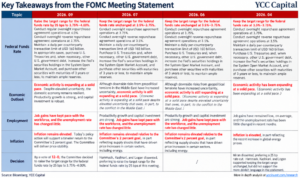
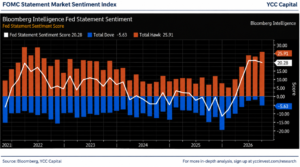
The FOMC raised rates by 25 basis points in a 12–0 vote, characterizing the move as removing “a dose of accommodation.” The statement emphasized resilient domestic spending, strong productivity and capital investment, while arguing that tighter policy should produce a more timely return of inflation toward the Fed’s 2% objective.
That wording matters. Since July, economic activity and employment have proved firmer than expected, while underlying inflation trends over the summer have shown insufficient improvement. At the same time, geopolitical risks and their potential inflation consequences have complicated the policy outlook.
The September dot plot reinforced the hawkish message. Of the 18 officials submitting projections, 16 believed another rate increase would be appropriate before year-end. Twelve projected another 25 basis points of tightening, while four anticipated an additional 50 basis points. The median projected policy rate for both the end of 2026 and 2027 stood at 4.1%.
Warsh himself declined to provide a rate forecast and stressed that he would not prejudge future decisions. That combination—a hawkish committee distribution but an intentionally noncommittal chair—makes the next move conditional rather than predetermined. It does not, however, support the comfortable assumption that September was necessarily the final hike.
Warsh Is Not the Market’s Messenger
The first major conclusion from September is that Warsh’s commitment to price stability appears stronger than markets had assumed.
A central bank cannot manufacture oil, natural gas or electricity, and monetary tightening cannot repair supply disruptions. But Warsh made clear that the Fed is concerned about second- and third-round effects—the process through which an initially concentrated price shock spreads into wages, services and broader inflation expectations.
This distinction is crucial. The Fed may look through the first spark, but it cannot ignore the fire if it begins moving from room to room.
Warsh also pushed back against the idea that markets had forced the Fed’s hand, emphasizing that the decision belonged to the FOMC itself. On political pressure for lower rates, his formulation that central-bank independence is a “two-way street” was equally significant. The institutional message is that independence means neither mechanically resisting political pressure nor accommodating it; policy should instead follow the Fed’s assessment of its mandate.
For bond investors, this reduces the usefulness of inferring monetary policy from appointment politics alone. The more relevant variables are inflation persistence, inflation breadth, employment resilience and financial conditions.
The Long End Refused to Cooperate
The second—and potentially more consequential—lesson was the Treasury market’s reaction.
A popular pre-meeting argument held that tighter short-term policy could ultimately push long-term yields lower. Higher policy rates could weaken future growth, reduce future inflation, or accomplish both. Yet that textbook response did not materialize.
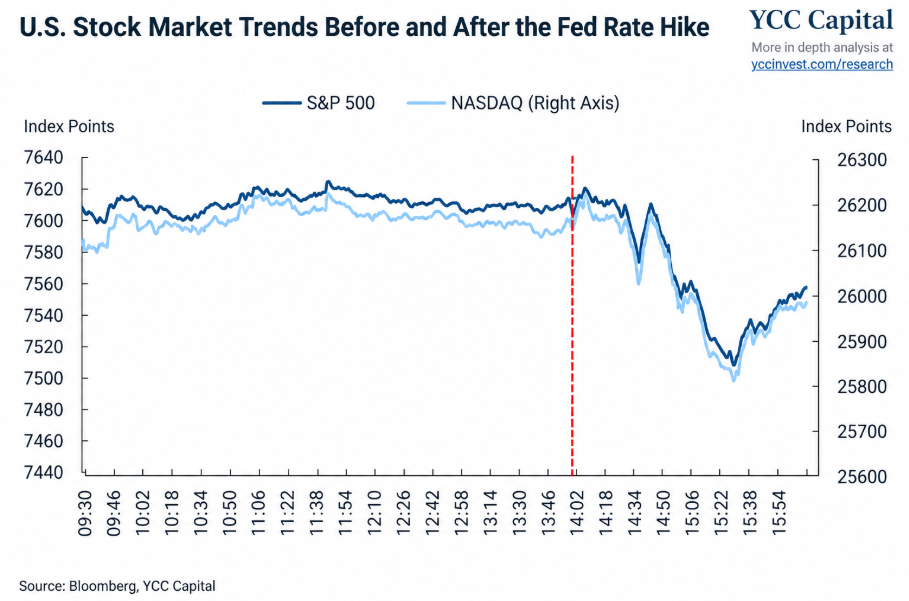
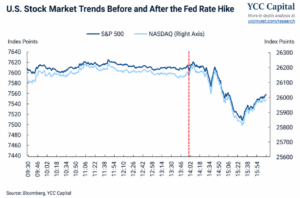
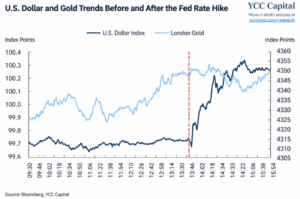
The two-year Treasury yield rose roughly 13 basis points, while the 10-year yield increased around 7 basis points, flattening the curve. The dollar index gained approximately 0.6%, while the S&P 500 fell about 0.8% and the Nasdaq declined roughly 0.7%.
The market therefore traded not the well-anticipated 25-basis-point hike, but the implications of a Fed willing to remain restrictive. The charts accompanying the September market reaction similarly show the post-decision repricing across equities, the dollar, gold and both ends of the Treasury curve.
This is where monetary policy collides with fiscal arithmetic.
If Fed tightening fails to pull long yields lower, the constraint on the long end may increasingly sit outside the central bank. Persistent fiscal deficits require substantial Treasury issuance. Higher rates also gradually increase federal refinancing costs. Without corresponding fiscal adjustment, rising interest expense can create additional financing needs, potentially lifting term premiums and keeping long-term yields elevated.
It resembles a household refinancing a mortgage at a higher rate while continuing to expand its monthly spending: raising the cost of money alone does not repair the balance sheet. Eventually, the financing requirement itself becomes part of the price.
For U.S. duration, this means inflation expectations are only one side of the equation. Treasury supply, fiscal trajectories and term premium deserve equal attention.
AI Is Becoming a Macro Variable
The third message was quieter but strategically important. Warsh acknowledged that the enormous financing requirements associated with artificial intelligence investment can contribute to upward pressure on long-term yields.
AI is no longer merely an equity-sector story. Data centers, semiconductors, power generation, transmission infrastructure and associated capital expenditure require extraordinary quantities of capital. When private-sector financing demand expands at the same time that the federal government remains a major borrower, the competition for capital can influence the entire yield curve.
Yet the Fed did not pair September’s rate increase with an additional signal of balance-sheet tightening.
We interpret that omission as deliberate restraint. With long yields already rising, simultaneously asking markets to price higher policy rates and an accelerated withdrawal of liquidity could have produced unnecessarily severe financial tightening. The Fed retains balance-sheet flexibility, but September suggests it does not currently want to stack every tightening instrument on top of another.
What Would Stop the Hiking Cycle?
Investors should avoid mechanically extrapolating either the latest inflation print or the latest Fed decision. The appropriate framework is a balance between two policy costs: allowing inflation to broaden versus tightening until economically sensitive sectors begin to fracture.
On inflation, headline and year-over-year PCE readings are insufficient by themselves. We would focus increasingly on inflation breadth—including the proportion of detailed PCE components experiencing annual price increases above 2% and 3%. If year-over-year inflation remains elevated while sequential momentum and breadth begin clearly retreating, the case for stopping becomes materially stronger.
The growth side deserves equal attention. Higher rates cannot create energy supply, but they can raise mortgage rates and corporate financing costs immediately. Housing, retail activity, employment and investment outside the AI complex therefore become important warning gauges.
If those areas deteriorate while inflation breadth contracts, further tightening becomes progressively harder to justify. Conversely, if inflation continues spreading while employment remains resilient, another increase before year-end remains entirely consistent with the September policy framework.
YCC Strategic View
The September meeting argues against treating the 25-basis-point hike as a neat conclusion to the tightening story. Warsh appears determined to establish anti-inflation credibility while preserving enough flexibility to respond if restrictive rates begin inflicting disproportionate damage on growth.
For markets, the bigger challenge may be the long end. Even a credible inflation-fighting Fed cannot single-handedly neutralize fiscal issuance, rising refinancing costs and capital-intensive AI investment. That combination can keep term premiums firmer than investors accustomed to the post-2008 environment might expect.
Our cautiously constructive long-term view of the United States therefore coexists with greater near-term respect for Treasury volatility. America retains unusually deep capital markets, strong productivity potential and a powerful investment cycle. But strong economies can still produce difficult bond markets. September was a useful reminder that sometimes the most important signal is not that the Fed raised rates—it is that long rates rose with it.
Source: Bloomberg, YCC Capital
Editorial Board
Ken Cao, Chief Strategist, Global Investment Strategy; Le Gao, Managing Analyst; Yui Nabeshima, Strategist; Mai Ikeda, Research Analyst.
IMPORTANT DISCLAIMER
This research report is provided for informational and educational purposes only and does not constitute an offer to sell or a solicitation of an offer to buy any securities, financial instruments, or investment products. It is not intended as investment, legal, accounting, or tax advice and should not be relied upon as such. The views, opinions, and projections expressed herein are those of YCC Capital Management and its research personnel as of the date of publication and are subject to change without notice. Past performance is not indicative of future results.
YCC Capital Management, its affiliates, principals, and employees may hold long or short positions in securities or instruments discussed in this report and may trade for their own accounts or for client accounts in a manner inconsistent with the recommendations herein. This report is based on publicly available information and data believed to be reliable, but YCC Capital makes no representation or warranty, express or implied, as to the accuracy, completeness, or timeliness of such information. Forward-looking statements involve risks and uncertainties that could cause actual results to differ materially from those projected.
Recipients of this report should conduct their own independent due diligence and consult with their own financial, legal, and tax advisors before making any investment decisions. YCC Capital accepts no liability for any loss or damage arising from the use of or reliance on this report or its contents.
This report is intended solely for the use of the intended recipient(s) and may not be reproduced or redistributed for commercial purposes without the prior written consent of YCC Capital. © 2026 YCC Capital. All rights reserved. YCC Capital’s flagship vehicle, the YCC International Value Fund, LP, maintains a concentrated global macro value strategy with a focus on capital-flow-driven mispricings and asymmetric hedging opportunities. The Fund is registered in the State of Delaware, U.S and structured as a 506(c) fund. Performance data, where referenced, has been verified by independent third parties including NAV Consulting; however, individual investor results may vary.
Contact Us
For research inquiries, contact ir@yccinvest.com. Sign up for free daily market insight at yccinvest.com.
YCC Capital Research | Sign up for free daily market insight at www.yccinvest.com
For more related research:
The Warsh Shock: The Fed’s Hawkish Reset Forces a Full Market Repricing
The Yen’s Real Battle: Why BOJ Tightening Alone Will Not Be Enough
The Quiet Hawk: Warsh Wants Markets to Fear the Fed—Without Promising a Hike
The Fed’s Hawkish Reset: From “When to Cut” to “Whether to Hike Again”