YCC CAPITAL
Global Fixed Income & Currency Strategy
August 10, 2026
YCC Perspective
The yen’s violent rebound after coordinated U.S.-Japan intervention has reopened a deceptively simple question: was the currency merely weak, or had it become genuinely mispriced?
Our conclusion is that both can be true. The yen had clearly overshot fundamentals when USD/JPY approached 164, but the forces behind its multi-year depreciation have not disappeared. Intervention can change the speed of the train; it cannot, by itself, change the direction of the tracks.
For investors, that distinction matters. Japan is not facing permanent decline. Many of today’s pressures are cyclical: unfavorable energy costs, a still-wide yield gap with the United States, and unusually powerful carry-trade momentum. Japan’s long-term investment case remains supported by improving corporate governance, stronger capital discipline and normalization after decades of distorted monetary settings. The near-term currency problem, however, is real.
Intervention Finally Drew a Line
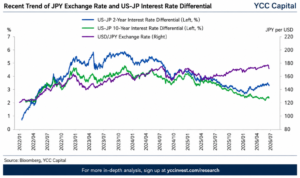
The yen has weakened dramatically since 2021, moving from roughly ¥100 per dollar toward ¥160. It briefly stabilized in the first half of 2025 as the dollar softened and monetary-policy expectations began to diverge, with the Federal Reserve easing while the Bank of Japan gradually normalized policy. Depreciation resumed later, however, and USD/JPY reached 163.99 on July 23, 2026—around its weakest level in nearly four decades.
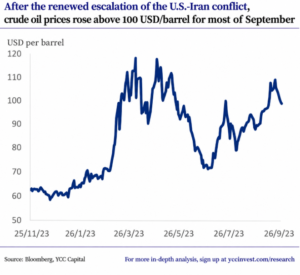
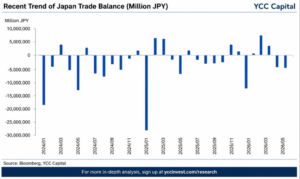
Three forces have been particularly important. First, Japan’s fiscal expansion and relatively accommodative policy posture have kept investors wary of the interaction between debt servicing and monetary normalization. Second, higher energy prices associated with Middle East instability have damaged Japan’s terms of trade, pushing the trade balance back toward deficit from May. Third, markets have become increasingly sensitive to the possibility that U.S. rates remain higher for longer, or even rise faster than Japanese rates.
The interesting feature is that the yen has recently weakened even as the 10-year U.S.-Japan yield spread narrowed. The traditional compass stopped pointing north. Shorter-dated rate differentials have become more informative, suggesting investors increasingly care about the next few central-bank meetings rather than simply the long-run yield gap.
Japan had already spent heavily defending the currency. Intervention between April 29 and May 1, 2024 approached ¥10 trillion, followed by more than ¥5 trillion in July. Those operations totaled roughly ¥15.3 trillion. Between April 28 and May 27, 2026, authorities deployed another approximately ¥11.73 trillion. Each episode bought time, but the depreciation trend eventually returned.
That changed materially on July 30. During New York trading, USD/JPY fell from around 162.8 to 157.8 in roughly 50 minutes, implying an appreciation of about five yen and an intraday move of roughly 3.3%. A second jump followed after the New York Fed, acting under Treasury direction, conducted rate checks with market participants. On July 31, U.S. authorities reportedly participated directly in yen purchases.
The intervention was subsequently acknowledged by both governments. It represented the first coordinated U.S.-Japan currency intervention in roughly 15 years.
The strategic logic extends beyond Japan. A disorderly yen decline raises imported inflation for Japanese households—the kind of pressure consumers feel not in economic models but at the supermarket, the petrol station and in monthly utility bills. For Washington, persistent Japanese reserve liquidation could eventually translate into Treasury selling, potentially putting additional upward pressure on already-elevated long-term U.S. yields. Supporting yen stability therefore also helps protect the plumbing of the dollar-based financial system.
Japan’s planned use of the Federal Reserve’s Foreign and International Monetary Authorities repo facility is important in this context. FIMA allows approved foreign monetary authorities to obtain temporary dollar liquidity against U.S. Treasury collateral rather than selling those Treasuries outright.
By August 4, USD/JPY had retreated to 157.7455, leaving the yen roughly 4% stronger than its recent trough.
History Says Intervention Works—But Usually as a Circuit Breaker
The historical record is clear: coordinated interv
ention can be extremely effective in the short term, particularly when it alters market expectations.
The 1985 Plaza Accord helped engineer a dramatic dollar decline, with the yen strengthening from roughly ¥250 per dollar to around ¥120 in less than three years. In 1995, coordinated G7 action moved in the opposite direction and helped end an extreme yen-appreciation cycle after USD/JPY had fallen below 80.
During the 1998 Asian financial crisis, Japan’s unilateral intervention had achieved relatively little despite substantial spending. Joint U.S.-Japan action proved more powerful: USD/JPY fell from around 146 to 136 in two days, and the yen later appreciated toward 102 over the following year as broader crisis dynamics shifted.
The 2011 intervention after the Great East Japan Earthquake offers another useful precedent. Safe-haven flows had driven the yen toward a postwar high around 76 per dollar. Coordinated G7 selling of yen quickly disrupted the appreciation trend, although the currency briefly revisited those levels months later before entering a durable depreciation cycle.
The lesson is not that intervention is ineffective. It is that intervention works best when fundamentals are ready to cooperate. Policymakers can break a speculative feedback loop, but they cannot indefinitely overpower productivity, trade flows and interest-rate differentials.
Is the Yen Actually Undervalued?
YCC Capital estimates the yen’s equilibrium value using a cointegration framework covering quarterly observations from the first quarter of 1990 through the first quarter of 2026, a total of 145 observations.
The framework uses five core variables: relative U.S.-Japan GDP per capita as a productivity proxy; relative CPI levels as a purchasing-power indicator; the 10-year U.S.-Japan government-bond yield differential; Japan’s trade balance as a percentage of GDP; and the difference between U.S. and Japanese public-debt ratios.
ADF testing indicates the relevant series are integrated of order one. A basic OLS specification exhibits serial correlation, so two additional approaches are used: one incorporating AR(1) and AR(2) residual terms, and another incorporating lagged USD/JPY. Both materially improve residual behavior, with Durbin-Watson statistics moving toward two. Residual stationarity supports a long-run cointegrating relationship.
The most consistent result is the interest-rate channel. The U.S.-Japan yield differential carries a positive and statistically significant coefficient across all three specifications, confirming that wider U.S. yield premiums remain a central driver of USD/JPY.
Japan’s trade balance carries the expected negative sign: larger surpluses tend to support the yen. Relative productivity also points toward long-run yen weakness as U.S. per-capita output has outpaced Japan. Yet this should not be mistaken for a verdict on Japan’s long-term investability. Productivity differentials evolve slowly, while corporate restructuring and improving returns on capital can materially strengthen Japan’s equity and investment backdrop even during a soft currency cycle.
The public-debt result is more counterintuitive. Faster relative U.S. debt expansion has historically been associated with a higher USD/JPY rate. One plausible explanation is portfolio behavior: deeper Treasury issuance creates additional high-yielding dollar assets that can be financed through low-cost yen borrowing, reinforcing carry demand.
Our Valuation Range
The three specifications produce markedly different equilibrium estimates for the first quarter of 2026:
| Model | Estimated Equilibrium USD/JPY |
|---|---|
| Fundamental OLS specification | 140.3 |
| AR-corrected specification | 155.4 |
| Lagged-exchange-rate specification | 152.8 |
Source: Bloomberg, YCC Capital
The range is broad, but the conclusion is surprisingly consistent. At 163.99, the yen had become undervalued even after allowing for negative long-run forces. The market had run ahead of the economics.
Yet valuation alone is a poor timing tool. In the AR-corrected model, the combined AR coefficients total 0.911, implying that only about 8.9% of the prior deviation from equilibrium fades each quarter. In the lagged-exchange-rate model, the previous quarter’s USD/JPY coefficient is 0.921, meaning new information accounts for only around 7.9% of the adjustment in a typical quarter.
Currencies have memory. Once a one-way trade becomes embedded in hedging programs, systematic strategies and corporate behavior, mispricing can survive much longer than investors expect.
Strategic View
We therefore see coordinated intervention as a meaningful near-term brake on yen depreciation, but not yet a secular turning point. The area above 160 now carries substantially greater policy risk, and speculative short-yen positions face a less attractive asymmetry than they did before July 30.
A more durable yen recovery would require some combination of further Bank of Japan normalization, narrower U.S.-Japan rate differentials, softer global energy prices and an improvement in Japan’s trade balance. The United States, meanwhile, remains comparatively resilient, and we remain cautiously constructive on its medium-term outlook despite elevated fiscal and Treasury-market risks.
Japan’s currency weakness should be treated as a cyclical macro challenge, not a declaration that Japan’s broader renewal has failed. The yen can remain structurally soft while Japanese assets become structurally more compelling.
Source: Bloomberg, YCC Capital
Editorial Board
Ken Cao, Chief Strategist, Global Investment Strategy; Le Gao, Managing Analyst; Yui Nabeshima, Strategist; Mai Ikeda, Research Analyst.
IMPORTANT DISCLAIMER
This research report is provided for informational and educational purposes only and does not constitute an offer to sell or a solicitation of an offer to buy any securities, financial instruments, or investment products. It is not intended as investment, legal, accounting, or tax advice and should not be relied upon as such. The views, opinions, and projections expressed herein are those of YCC Capital Management and its research personnel as of the date of publication and are subject to change without notice. Past performance is not indicative of future results.
YCC Capital Management, its affiliates, principals, and employees may hold long or short positions in securities or instruments discussed in this report and may trade for their own accounts or for client accounts in a manner inconsistent with the recommendations herein. This report is based on publicly available information and data believed to be reliable, but YCC Capital makes no representation or warranty, express or implied, as to the accuracy, completeness, or timeliness of such information. Forward-looking statements involve risks and uncertainties that could cause actual results to differ materially from those projected.
Recipients of this report should conduct their own independent due diligence and consult with their own financial, legal, and tax advisors before making any investment decisions. YCC Capital accepts no liability for any loss or damage arising from the use of or reliance on this report or its contents.
This report is intended solely for the use of the intended recipient(s) and may not be reproduced or redistributed for commercial purposes without the prior written consent of YCC Capital. © 2026 YCC Capital. All rights reserved. YCC Capital’s flagship vehicle, the YCC International Value Fund, LP, maintains a concentrated global macro value strategy with a focus on capital-flow-driven mispricings and asymmetric hedging opportunities. The Fund is registered in the State of Delaware, U.S and structured as a 506(c) fund. Performance data, where referenced, has been verified by independent third parties including NAV Consulting; however, individual investor results may vary.
Contact Us
For research inquiries, contact ir@yccinvest.com. For free daily market insight from YCC Capital, sign up at yccinvest.com.
YCC Capital Research | Sign up for free daily market insight at www.yccinvest.com
For more related research:
The Bank of Japan Just Sent a Warning to the Entire Financial World
The Hike That May Never Come: Positioning for a Hawkish Fed Without Chasing the Fear