YCC CAPITAL
Global Fixed Income & Currency Strategy
July 28, 2026
Executive Summary
Markets often resemble an experienced marathon runner approaching the final hill. Fatigue is visible, confidence begins to waver, and every upward step feels increasingly difficult. Yet many of the strongest rallies begin only after that final climb. Today’s U.S. Treasury market appears to be approaching precisely such a moment.
During the past week, investors navigated an unusually challenging combination of geopolitical uncertainty, renewed energy inflation, elevated Treasury yields, and persistent questions surrounding the long-term economics of artificial intelligence investment. Despite generally solid earnings from major U.S. technology companies, equity leadership continued to rotate while fixed income markets increasingly shifted their focus toward inflation risks rather than slowing growth.
At YCC Capital, we believe the most important development has been the composition—not merely the magnitude—of the recent increase in Treasury yields. Unlike earlier moves during May and June, which were primarily driven by stronger growth expectations and higher terminal-rate assumptions, the latest surge has been overwhelmingly concentrated in short-term Treasury yields and reflects a renewed repricing of inflation risks. This distinction carries important implications for investors across global asset classes.
The coming week may prove pivotal. Markets face an unusually dense calendar that includes the July Federal Open Market Committee (FOMC) meeting, the Bank of Japan policy decision, second-quarter U.S. GDP data, and June PCE inflation figures. Together, these events could temporarily push Treasury yields higher before financial conditions eventually begin exerting a stronger restraining influence on economic activity later this quarter.
Our base case remains that the U.S. economy continues to demonstrate resilience, although tighter financial conditions should gradually slow activity as the third quarter progresses. Accordingly, we believe Treasury yields may experience one final upward test before entering a more sustainable period of stabilization.
YCC Perspective
Every investment cycle teaches the same lesson in a different form: markets rarely reverse when consensus expects them to. Instead, turning points often arrive only after investors have become convinced that prevailing trends will continue indefinitely.
Today’s Treasury market reflects that psychology. Rising oil prices, renewed geopolitical uncertainty, and persistent inflation concerns have convinced many participants that yields must continue climbing. While further upside risks certainly remain over the near term, history suggests that such late-cycle consensus positioning often marks the final phase rather than the beginning of a prolonged trend.
For long-term investors, understanding where yields are coming from matters just as much as where they are headed.
Global Markets Review: Energy Once Again Takes Center Stage
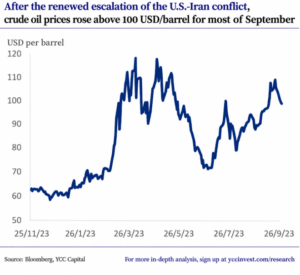
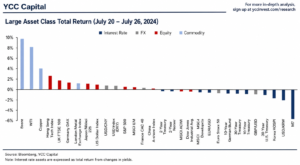
Global financial markets remained heavily influenced by geopolitical developments throughout the past week. Escalating tensions in the Middle East increased concerns surrounding shipping routes through the Red Sea and Strait of Hormuz, prompting another sharp rise in crude oil prices and reigniting fears of renewed global inflationary pressure.
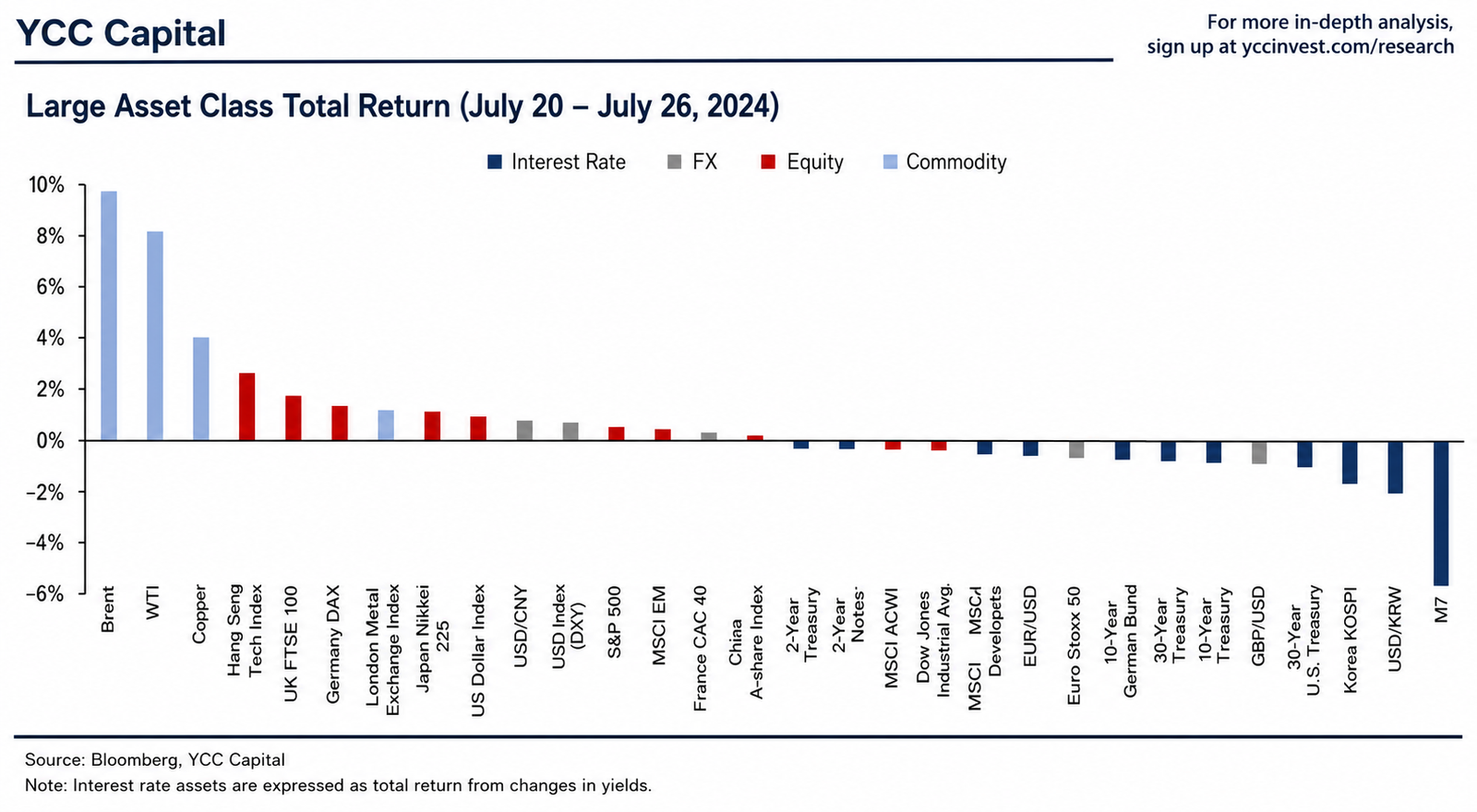
Brent crude advanced nearly 10% during the week, briefly trading above $100 per barrel and becoming the strongest-performing major global asset class. The move reinforced expectations that energy markets remain highly sensitive to geopolitical developments and that inflation risks have not fully disappeared from the macroeconomic landscape.
Meanwhile, the U.S. dollar strengthened alongside Treasury yields, creating additional headwinds for global risk assets. Equity performance became increasingly fragmented across regions. European equity markets, benefiting from their relatively defensive sector composition, posted modest gains. In contrast, technology-heavy U.S. indices experienced renewed pressure despite earnings that generally exceeded consensus expectations. South Korean equities also underperformed amid weakness across semiconductor shares.
The divergence highlights an increasingly selective market environment in which investors are rewarding stability while becoming more cautious toward sectors requiring substantial future capital investment.
Technology earnings illustrated this dynamic particularly well. Alphabet reported results that comfortably exceeded expectations, with cloud computing growth confirming that enterprise demand for artificial intelligence remains exceptionally robust. Yet investors remained unconvinced that elevated AI-related capital expenditures will generate sufficient returns on invested capital over time. Strong revenue growth alone was no longer enough; markets increasingly demanded visible improvements in cash flow generation and profitability.
Intel similarly delivered results that surpassed expectations, but the positive surprise failed to produce a lasting improvement in broader market sentiment. Investors continue distinguishing between strong current earnings and confidence in future capital efficiency.
This evolving market psychology suggests that valuation discipline is gradually replacing enthusiasm as the dominant driver of technology performance.
Why Treasury Yields Are Rising: Looking Beneath the Surface
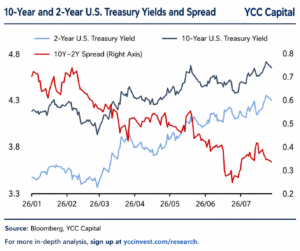
The recent climb in U.S. Treasury yields has been both rapid and consequential. Since the beginning of July, the 10-year Treasury yield has risen by more than 20 basis points, reaching an intraday high of approximately 4.71%. Equally notable, the two-year Treasury yield has climbed from roughly 4.13% to 4.37%, signaling that investors have materially repriced the outlook for near-term monetary policy. Rather than reflecting optimism about stronger long-term economic growth, this move has been concentrated at the front end of the yield curve—a crucial distinction for understanding what markets are pricing today.
During May and June, higher Treasury yields were largely driven by improving growth expectations and assumptions that the Federal Reserve would maintain restrictive policy for longer. The latest move tells a different story. Since late June, almost four-fifths of the increase in the 10-year yield can be attributed to the rise in two-year yields, with only a modest contribution coming from changes in the term spread. In other words, markets are not demanding substantially higher compensation for holding long-duration bonds. Instead, they are increasingly concerned that inflation may remain more persistent than previously expected.
A useful way to understand this shift is to imagine driving through dense fog. When visibility deteriorates, drivers naturally slow down—not because the road itself has changed, but because uncertainty has increased. Financial markets behave similarly. Investors today are demanding higher compensation not simply because they expect inflation to be higher, but because they are less certain about how inflation will evolve over the coming quarters.
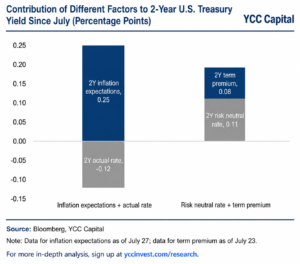
The report’s decomposition of Treasury yields supports this interpretation. Inflation expectations embedded in Treasury Inflation-Protected Securities (TIPS) account for roughly half of the recent increase in two-year yields, while a higher inflation risk premium explains much of the remainder. Real interest rates, by contrast, have played a comparatively limited role. This suggests that investors are pricing both a modestly higher inflation trajectory and greater uncertainty surrounding that outlook.
The catalyst has been a familiar combination of geopolitical and policy developments. Renewed conflict in the Middle East has driven crude oil prices sharply higher, reviving concerns over imported inflation. At the same time, markets have interpreted the extension of U.S. tariff policies as another factor that could place upward pressure on consumer prices over the medium term. Neither development necessarily guarantees a sustained inflation resurgence, but together they have been sufficient to alter market psychology.
Importantly, however, inflation expectations remain far more restrained than they were during the energy shock earlier this year. Despite oil prices briefly approaching $100 per barrel, inflation break-even rates have increased only modestly. This restraint suggests that investors believe the economic and political environment will eventually limit the duration of elevated energy prices.
At YCC Capital, we share that assessment. While geopolitical tensions are unlikely to disappear quickly, markets have become increasingly accustomed to distinguishing between temporary supply disruptions and structural energy shortages. Previous episodes have demonstrated that elevated prices often accelerate policy responses, inventory adjustments, and alternative supply routes. Over time, these mechanisms tend to reduce the macroeconomic impact of regional conflicts.
Oil Markets, Geopolitics, and Inflation: A More Nuanced Risk
The recent escalation in tensions involving Iran has understandably drawn comparisons with previous oil shocks. Shipping risks through the Strait of Hormuz have once again become a focal point for investors, contributing to a rapid increase in crude prices and renewed inflation concerns.
Nevertheless, several important differences distinguish the current environment from historical energy crises.
First, global supply chains have become significantly more diversified. Energy exporters including Saudi Arabia, the United Arab Emirates, and Iraq continue investing in infrastructure that reduces dependence on the Strait of Hormuz as the sole export corridor. While these projects cannot eliminate geopolitical risks, they substantially reduce the probability of a prolonged global supply disruption.
Second, financial markets appear increasingly skeptical that geopolitical confrontations necessarily translate into permanent energy shortages. Investors have repeatedly observed that political incentives often encourage de-escalation once economic costs begin rising. Energy markets remain volatile, but the threshold required to generate another sustained inflation cycle appears considerably higher than it was several years ago.
This perspective helps explain why inflation expectations have remained relatively contained despite the dramatic movement in crude oil prices.
For bond investors, that distinction matters enormously. Temporary inflation scares can produce meaningful short-term volatility in Treasury markets without fundamentally altering the medium-term disinflationary trend. As a result, while yields may continue rising over the next several weeks, the probability of a prolonged structural bear market in government bonds remains considerably lower than headline price movements alone might suggest.
Our Treasury Outlook: Higher Before Lower
The coming weeks are likely to represent the most challenging period for fixed-income markets during the current quarter.
We expect the combination of the July FOMC meeting, the Bank of Japan policy decision, second-quarter U.S. GDP, and June PCE inflation data to reinforce market caution. Together, these events may push the 10-year Treasury yield toward a range of approximately 4.70%–4.80%, representing a likely cyclical high for the current phase of the market.
However, we do not believe such elevated yields will persist indefinitely.
Financial conditions have tightened materially over recent months. Higher borrowing costs are gradually filtering through mortgage markets, corporate financing, commercial real estate, and consumer credit. These effects rarely appear immediately; instead, they accumulate gradually before becoming increasingly visible in economic data.
As the calendar moves into August and September, investors are likely to shift their attention away from inflation fears and toward signs of slowing demand. Should this transition occur, expectations for additional policy tightening would likely diminish, allowing Treasury yields to stabilize and eventually retrace part of their recent increase.
Accordingly, our base-case outlook for the third quarter remains one of “higher first, lower later.”
This sequence is important for portfolio positioning. Investors should resist interpreting every increase in Treasury yields as evidence that the long-term bond market has fundamentally changed direction. Instead, much of the current adjustment reflects short-term uncertainty rather than a permanent reassessment of equilibrium interest rates.
The July FOMC Preview: A Hawkish Hold Remains the Most Likely Outcome
This week’s Federal Reserve meeting represents the central event for global financial markets. While policymakers are widely expected to leave the federal funds rate unchanged, the tone of the meeting may ultimately matter far more than the policy decision itself.
Consensus among economists has shifted toward a prolonged pause in policy adjustments. Bloomberg surveys conducted during the second half of July indicate that most economists expect the Federal Reserve to maintain current policy settings well into next year, with the first rate cut not arriving until the second half of 2027. Market pricing, however, tells a noticeably different story. Federal funds futures have increasingly reflected concerns that inflation risks could force the Fed to remain restrictive for longer—or even contemplate additional tightening if incoming data deteriorates.
As of late July, futures markets implied roughly a 38% probability of another rate increase at this meeting while pricing nearly 44 basis points of cumulative tightening by the end of 2026. Although such expectations may ultimately prove excessive, they underscore how dramatically investor sentiment has shifted following higher oil prices, resilient economic activity, and renewed tariff-related inflation concerns.
At YCC Capital, we believe the Federal Reserve’s communication strategy is likely to emphasize credibility rather than flexibility. Chair Kevin Warsh has increasingly sought to avoid rigid forward guidance, preferring instead to emphasize that future decisions remain data dependent. In the current environment, however, abandoning forward guidance does not necessarily imply a dovish stance. On the contrary, policymakers are likely to stress that inflation risks remain tilted to the upside and that monetary policy must remain sufficiently restrictive until there is greater confidence that price stability has been restored.
Investors should therefore focus less on whether interest rates change immediately and more on how policymakers describe the balance of risks. Markets have already demonstrated remarkable sensitivity to subtle shifts in language. A single sentence acknowledging persistent inflation pressures could reinforce expectations that policy will remain tighter for longer, providing additional upward pressure on Treasury yields even in the absence of any immediate rate action.
For equity markets, the implications are similarly important. Higher discount rates disproportionately affect longer-duration assets, particularly high-growth technology companies whose valuations rely heavily on future earnings. This dynamic helps explain why strong corporate earnings have recently struggled to generate sustained share-price appreciation. The challenge is no longer revenue growth alone—it is the valuation framework through which those earnings are discounted.
The Bank of Japan: An Underappreciated Source of Global Liquidity Risk
Although the Federal Reserve will dominate headlines, investors should not overlook the Bank of Japan’s policy meeting later this week. In recent years, Japanese monetary policy has increasingly become a global market variable rather than merely a domestic one.
The consensus expectation remains that the Bank of Japan will leave its policy rate unchanged. Nevertheless, market participants continue to assign a meaningful probability to another rate increase before year-end, most likely at the October or December meeting.
The primary reason lies not only in inflation but also in the Japanese yen.
The yen has weakened substantially against the U.S. dollar, approaching levels near ¥164 per dollar, while speculative short positioning has returned to extremes last observed during the summer of 2024. Such crowded positioning leaves markets vulnerable to sudden reversals should the Bank of Japan deliver even modestly hawkish guidance.
Currency markets often behave like tightly stretched rubber bands. They can remain extended for prolonged periods before snapping back with surprising speed. A stronger yen could trigger an unwinding of carry trades, forcing leveraged investors to reduce positions across multiple asset classes simultaneously.
The experience of 2024 demonstrated how rapidly these adjustments can ripple through global financial markets. While today’s carry-trade exposure appears smaller than during that earlier episode, the underlying mechanism remains unchanged. Japanese investors represent one of the world’s largest holders of overseas fixed-income assets, including U.S. Treasuries. Any shift in domestic monetary policy that encourages capital repatriation could amplify existing volatility in global bond markets.
Our expectation is that any adjustment would likely prove more orderly than in 2024. Japan’s economy has continued to normalize gradually, and policymakers have become increasingly careful about communicating policy changes well in advance. Nonetheless, even a modest strengthening of the yen could temporarily tighten global financial conditions by reducing liquidity and increasing bond-market volatility.
From a strategic perspective, investors should recognize that Japanese monetary policy is no longer an isolated domestic issue. It has become an important component of the broader global liquidity cycle.
U.S. Economic Outlook: Growth Remains Resilient, But Watch the Composition
Beyond central bank meetings, this week’s release of second-quarter U.S. GDP will provide another important test of the economy’s underlying momentum.
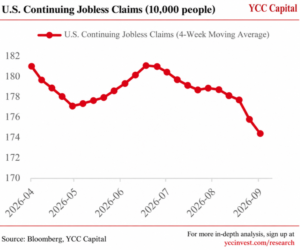
Recent economic data continue to paint a picture of resilience. Initial unemployment claims remain near historically low levels, suggesting that labor-market conditions have softened only modestly despite higher interest rates. At the same time, business activity surveys remain comfortably in expansion territory. The July S&P Global Services PMI rose to 53.6, exceeding expectations and reaching its strongest level since late 2025, while the Manufacturing PMI also remained above the expansion threshold.
These indicators reinforce our broader view that the U.S. economy continues to outperform many global peers despite increasingly restrictive financial conditions.
Consensus expectations point to annualized second-quarter GDP growth of approximately 2.1% to 2.2%. The Atlanta Federal Reserve’s GDPNow model, however, projects a more moderate pace near 1.7%, reflecting a larger drag from net exports. While the difference is notable, it is less important than the composition of growth itself.
At YCC Capital, we believe investors should focus on three underlying questions rather than the headline GDP figure alone.
First, has household consumption begun to reaccelerate, or is consumer spending continuing its gradual moderation? Consumption remains the largest component of U.S. economic activity, and any sustained weakening would carry important implications for corporate earnings and monetary policy.
Second, is artificial intelligence investment continuing to provide an expanding contribution to economic growth? Capital spending related to AI infrastructure has been one of the defining drivers of business investment over the past year. Investors increasingly want evidence that these expenditures are translating into broader productivity gains rather than simply raising corporate capital budgets.
Third, and perhaps most importantly, how strong is what might be described as the economy’s “core GDP”? Temporary fluctuations in inventories, government spending, and trade flows can significantly distort quarterly growth figures. A more meaningful measure is the strength of underlying private domestic demand after excluding these volatile components.
If core demand remains healthy, the U.S. economy is likely to retain sufficient momentum to avoid a meaningful slowdown during the second half of the year. That would support our constructive medium-term outlook for U.S. assets, even if markets experience additional short-term volatility.
Investment Implications: Positioning for the Final Phase of the Rates Adjustment
Markets are entering what is likely to be one of the most delicate phases of the current macroeconomic cycle. Inflation risks have resurfaced, geopolitical tensions remain elevated, and central banks continue to prioritize credibility over accommodation. At the same time, economic fundamentals—particularly in the United States—remain sufficiently resilient to prevent an imminent recession. The result is an environment in which volatility may rise even as the medium-term investment outlook gradually improves.
For fixed-income investors, patience is likely to be rewarded. Should the 10-year Treasury yield temporarily rise toward the 4.7%–4.8% range, duration risk would become increasingly attractive from a strategic perspective. Historically, periods when markets aggressively price higher policy rates near the end of a tightening cycle have often created compelling entry points for long-term investors. While timing the exact peak is rarely possible, gradually extending duration as yields approach cyclical highs offers an increasingly favorable risk-reward profile.
Equity investors should prepare for continued style rotation rather than broad market weakness. The first half of the AI investment cycle was characterized by enthusiasm and multiple expansion. The next phase is likely to reward execution. Companies capable of converting AI-related investment into measurable productivity gains, expanding margins, and stronger free cash flow are likely to outperform businesses that continue to rely primarily on ambitious long-term narratives.
This distinction is becoming increasingly important. Investors are no longer asking whether artificial intelligence represents a transformational technology—they broadly agree that it does. Instead, they are asking which companies will earn attractive returns on the extraordinary capital currently being deployed. As in previous technology cycles, leadership is likely to become progressively narrower.
Currency markets also deserve close attention. A more hawkish-than-expected Bank of Japan could trigger additional yen appreciation, leading to another partial unwinding of global carry trades. Although we expect any adjustment to be considerably smaller than the sharp market dislocations witnessed during 2024, investors should nevertheless anticipate episodes of elevated volatility across foreign exchange and global bond markets.
Commodity markets remain dominated by geopolitical developments. Oil prices are likely to stay sensitive to developments in the Middle East, and any disruption to energy supply routes could temporarily reinforce inflation expectations. Nevertheless, our central scenario does not assume a prolonged structural energy shock. As additional export infrastructure comes online and producers continue adapting to evolving geopolitical conditions, the inflationary impact of higher crude prices should gradually diminish.
Taken together, these dynamics argue for disciplined portfolio construction rather than aggressive tactical positioning. Diversification across asset classes, careful management of duration exposure, and an emphasis on companies with durable earnings quality remain the most effective strategies in an environment where macro uncertainty remains elevated but long-term opportunities continue to emerge.
Strategic Conclusion: Volatility Is Not the Same as Structural Change
Financial markets have a tendency to confuse short-term turbulence with long-term transformation. Sharp moves in Treasury yields, dramatic swings in oil prices, and rapidly changing policy expectations often create the impression that the investment landscape has fundamentally shifted. More often than not, however, these episodes represent temporary adjustments within a broader cycle rather than the beginning of an entirely new regime.
At YCC Capital, we believe the current environment fits that description.
The recent increase in Treasury yields has been driven primarily by inflation expectations and higher inflation risk premiums rather than by a wholesale reassessment of long-term economic growth. While that distinction may appear technical, it has profound implications for asset allocation. Inflation fears can drive yields sharply higher over short periods, but they rarely sustain permanently higher interest rates unless accompanied by structurally stronger growth and accelerating wage pressures. Current evidence does not yet support such a conclusion.
The U.S. economy continues to demonstrate impressive resilience. Consumer spending remains relatively healthy, labor-market conditions are stable, and business investment—particularly in artificial intelligence infrastructure—continues to provide meaningful support for growth. These strengths justify cautious optimism toward U.S. assets over the medium term, even if financial markets experience additional bouts of volatility during the weeks ahead.
Japan presents a different but equally important story. Policy normalization is progressing gradually, reflecting an economy that continues to emerge from decades of exceptionally accommodative monetary policy. While any shift by the Bank of Japan may temporarily tighten global liquidity through a stronger yen and reduced carry-trade activity, we view these adjustments as cyclical rather than structural. Japan’s long-term investment outlook continues to improve as corporate governance reforms, shareholder-friendly policies, and steady economic normalization reshape the country’s capital markets.
By contrast, China’s economic challenges remain considerably more persistent. Weak domestic demand, ongoing strains in the property sector, elevated local government debt, and slowing demographic momentum continue to constrain the country’s growth potential. While targeted policy support may occasionally stabilize activity, these measures are unlikely to reverse the broader structural headwinds facing the Chinese economy. Investors should therefore remain selective and avoid assuming that cyclical stimulus alone will restore China’s previous growth trajectory.
The coming weeks may well represent the most difficult stretch for bond markets during the current quarter. Treasury yields could move modestly higher as investors digest central bank meetings and another round of important economic data. Yet markets rarely move in straight lines. Once tighter financial conditions begin exerting greater pressure on economic activity during August and September, we expect investor attention to shift gradually from inflation risks toward growth moderation. That transition should provide a more supportive backdrop for fixed income while reducing pressure on longer-duration assets.
Successful investing often resembles navigating through changing weather rather than predicting a single destination. Storm clouds may temporarily darken the horizon, but disciplined investors recognize the difference between passing turbulence and a permanent change in climate. We believe today’s environment calls for precisely that discipline: remaining patient through near-term volatility while preparing for opportunities that are likely to emerge as the current adjustment in global interest rates approaches its conclusion.
Source: Bloomberg, YCC Capital.
Editorial Board
Ken Cao
Chief Strategist, Global Investment Strategy
Le Gao
Managing Analyst
Yui Nabeshima
Strategist
Mai Ikeda
Research Analyst
IMPORTANT DISCLAIMER
This research report is provided for informational and educational purposes only and does not constitute an offer to sell or a solicitation of an offer to buy any securities, financial instruments, or investment products. It is not intended as investment, legal, accounting, or tax advice and should not be relied upon as such. The views, opinions, and projections expressed herein are those of YCC Capital Management and its research personnel as of the date of publication and are subject to change without notice. Past performance is not indicative of future results.
YCC Capital Management, its affiliates, principals, and employees may hold long or short positions in securities or instruments discussed in this report and may trade for their own accounts or for client accounts in a manner inconsistent with the recommendations herein. This report is based on publicly available information and data believed to be reliable, but YCC Capital makes no representation or warranty, express or implied, as to the accuracy, completeness, or timeliness of such information. Forward-looking statements involve risks and uncertainties that could cause actual results to differ materially from those projected.
Recipients of this report should conduct their own independent due diligence and consult with their own financial, legal, and tax advisors before making any investment decisions. YCC Capital accepts no liability for any loss or damage arising from the use of or reliance on this report or its contents.
This report is intended solely for the use of the intended recipient(s) and may not be reproduced or redistributed for commercial purposes without the prior written consent of YCC Capital. © 2026 YCC Capital. All rights reserved. YCC Capital’s flagship vehicle, the YCC International Value Fund, LP, maintains a concentrated global macro value strategy with a focus on capital-flow-driven mispricings and asymmetric hedging opportunities. The Fund is registered in the State of Delaware, U.S., and structured as a 506(c) fund. Performance data, where referenced, has been verified by independent third parties including NAV Consulting; however, individual investor results may vary.
Contact Us
YCC Capital Research
For complimentary daily macro research, investment strategy, and market commentary, sign up for our free newsletter at www.yccinvest.com.
YCC Capital Research | Sign up for free daily market insight at www.yccinvest.com
For more related research:
Trump’s Political Playbook: Winning Abroad to Stabilize at Home(Opens in a new browser tab)
The Warsh Shock: The Fed’s Hawkish Reset Forces a Full Market Repricing(Opens in a new browser tab)