YCC CAPITAL
Global Strategy
July 3, 2026
Executive Perspective
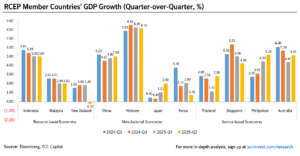
There are moments in global markets when the dominant narrative changes almost overnight. Investors entered 2026 expecting trade disputes and tariff negotiations to dictate Asia’s economic outlook. Instead, a different set of forces rapidly took center stage.
Artificial intelligence has evolved from a technological theme into one of the world’s largest capital expenditure cycles. At the same time, geopolitical tensions across the Middle East have reshaped energy markets, inflation expectations, and monetary policy across Asia-Pacific. Together, these developments have fundamentally altered the economic trajectory of the Regional Comprehensive Economic Partnership (RCEP).
The result is a region increasingly divided not by geography, but by industrial positioning. Economies deeply embedded within the AI supply chain continue to outperform. Resource exporters benefit from higher commodity prices but face tighter monetary conditions. Tourism-dependent economies remain vulnerable to softer global travel demand, elevated inflation, and weaker household spending.
At YCC Capital, we believe investors should increasingly view the RCEP bloc through this structural lens rather than treating the region as a homogeneous growth story. The AI investment cycle remains in its early stages, suggesting that the divergence between manufacturing leaders and consumption-led economies is likely to persist well into 2027.
Like the early years of electrification or the internet revolution, today’s AI boom is not lifting every boat equally. It is rewarding those building the infrastructure of tomorrow while exposing the structural weaknesses of economies still reliant on yesterday’s engines of growth.
Sources: Bloomberg, YCC Capital.
A Fundamental Shift in the Drivers of Regional Growth
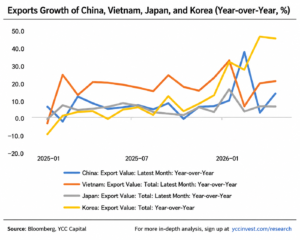
During the first half of 2026, three themes replaced tariff concerns as the dominant drivers of regional performance:
- The global AI investment boom
- Escalating geopolitical tensions in the Middle East
- Renewed monetary tightening across many central banks
This combination produced one of the widest performance gaps among RCEP economies in recent years.
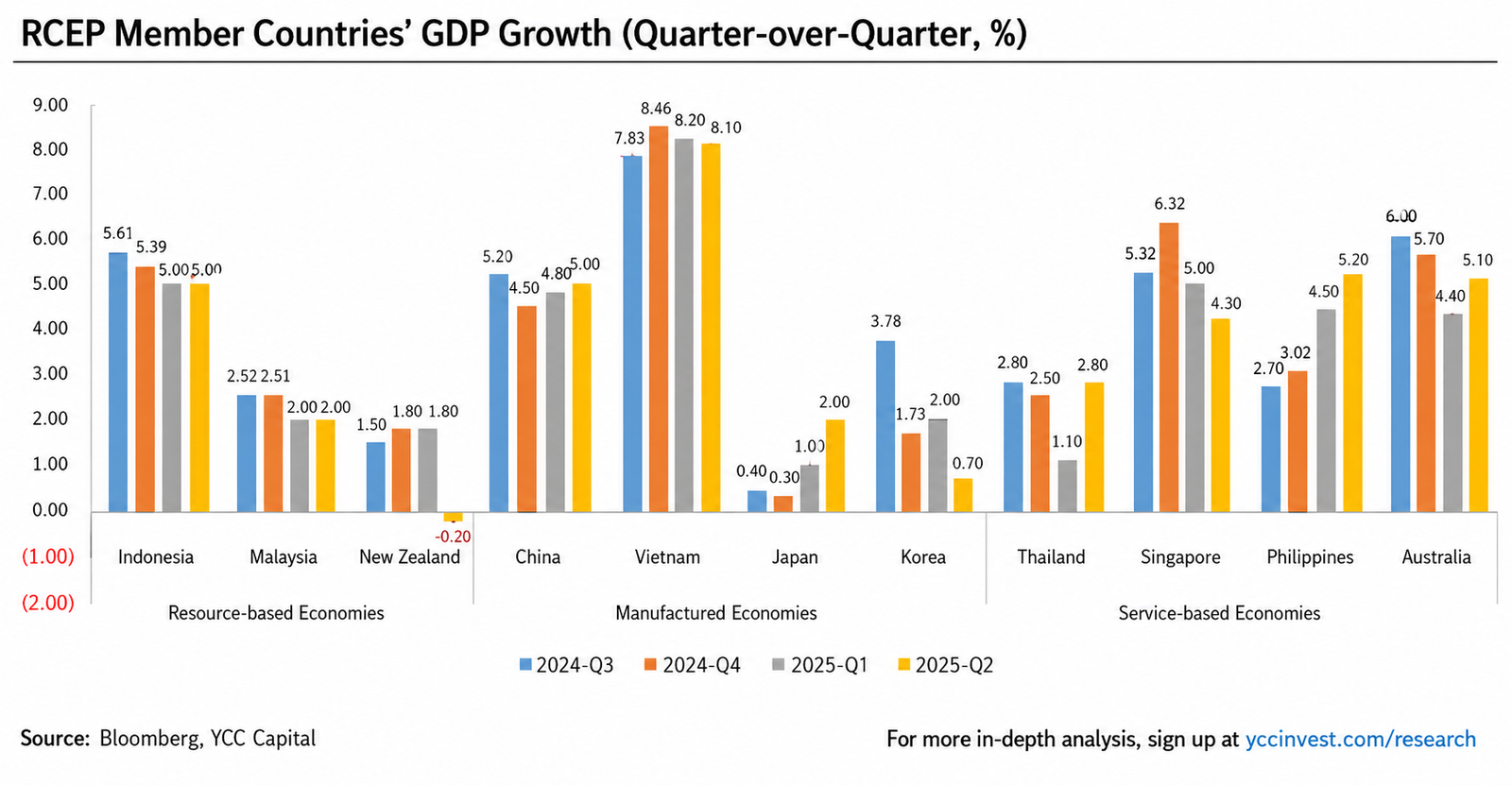
Rather than moving together, regional economies increasingly separated into three distinct groups:
Manufacturing economies, including South Korea, Japan, Vietnam and China, delivered the strongest overall growth thanks to booming semiconductor and AI hardware demand.
Resource exporters, including Australia, Indonesia and New Zealand, benefited from higher commodity prices but faced rising inflation and tighter financial conditions.
Service-oriented economies, including Thailand and the Philippines, experienced noticeably weaker momentum as tourism slowed while domestic consumption remained under pressure.
This evolving hierarchy is unlikely to reverse quickly. Instead, it reflects structural changes in the global economy rather than a temporary cyclical fluctuation.
Manufacturing Economies Become the Primary Winners of the AI Investment Cycle
The defining economic story of 2026 is not simply higher semiconductor demand.
It is the emergence of an entirely new investment supercycle.
Unlike previous technology booms that depended largely on smartphone upgrades or PC replacement cycles, today’s AI expansion requires enormous investments across multiple layers of hardware simultaneously:
- GPU clusters
- High-bandwidth memory (HBM)
- Advanced DRAM
- NAND flash
- Optical networking
- Data center infrastructure
- Semiconductor manufacturing equipment
- Advanced packaging
- Precision industrial components
This breadth has fundamentally changed semiconductor demand dynamics.
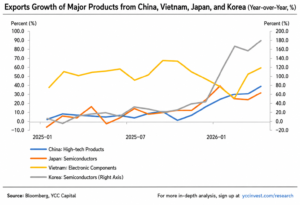
Historically, semiconductor markets experienced relatively predictable three-to-four-year cycles. However, the current AI infrastructure buildout has disrupted that pattern. Global semiconductor shipments have continued accelerating rather than peaking, supporting manufacturing activity across Asia for nearly a year.
South Korea has emerged as perhaps the clearest beneficiary.
Its global leadership in high-bandwidth memory allows firms such as Samsung Electronics and SK Hynix to capture extraordinary pricing power as AI accelerators increasingly require faster memory solutions. The transition from model training toward AI agents and physical AI applications further expands long-term demand.
Japan occupies a different—but equally important—position.
Rather than dominating chip production itself, Japanese firms continue to supply critical semiconductor equipment, specialty chemicals, and advanced manufacturing technologies. As AI investment broadens, Japan’s competitive advantages in robotics, industrial automation and precision engineering become increasingly valuable.
Vietnam continues climbing the manufacturing value chain.
Having already become an important production base for Apple, Samsung and other multinational manufacturers, Vietnam is now gradually expanding beyond assembly toward semiconductor packaging, testing and precision components.
China remains an indispensable manufacturing platform within global supply chains despite persistent geopolitical headwinds. Industrial upgrading continues across advanced manufacturing, although structural challenges surrounding demographics, property markets and capital allocation continue to weigh on the country’s broader long-term outlook.
From an investment perspective, AI remains the single most important structural growth driver across the manufacturing economies.
Commodity Exporters Enjoy Stronger Prices—but Face New Constraints
Resource-exporting economies experienced a more complicated first half.
The Middle East conflict sharply increased prices for oil, coal, palm oil and other commodities beginning in March, improving export revenues for Australia and Indonesia.
However, this commodity rally differs fundamentally from previous cycles.
Prices have risen primarily because of supply disruptions rather than booming global demand.
That distinction matters.
When commodity prices rise because supplies become constrained, exporters receive higher prices without necessarily experiencing significant increases in export volumes. Economic growth therefore improves, but less dramatically than during traditional commodity supercycles.
Australia illustrates this dynamic particularly well.
Higher energy prices support national income while AI-related data center investment continues driving business capital expenditure. Yet elevated inflation has forced the Reserve Bank of Australia into additional policy tightening, weighing on household consumption.
Indonesia presents a similarly mixed picture.
Domestic demand remains relatively resilient, supported by government spending initiatives and infrastructure investment. However, rupiah depreciation, capital outflows and policy uncertainty continue limiting private investment confidence.
New Zealand has benefited less directly from commodity markets because dairy prices remain influenced by agricultural supply conditions rather than energy markets.
Looking ahead, resource exporters should continue outperforming many service-oriented economies, although tighter monetary policy will increasingly offset some of the benefits from stronger commodity prices.
Tourism-Dependent Economies Continue Facing Headwinds
Not every economy benefits equally from AI.
Thailand and the Philippines demonstrate this divergence clearly.
International tourism softened noticeably during the first half of 2026 as geopolitical uncertainty increased transportation costs and weakened travel demand.
For Thailand, tourism remains a critical pillar of economic activity. Household debt also remains elevated, limiting consumer spending even as inflation gradually rises.
The Philippines faces an even more difficult combination of challenges.
Its heavy dependence on imported Middle Eastern energy exposes the economy to significant imported inflation whenever oil prices rise. Inflation remains among the highest within the RCEP region, forcing tighter monetary policy despite relatively weak economic growth.
Malaysia and Singapore stand apart from this group.
Although both maintain important service sectors, each has also developed deep integration into global electronics and semiconductor supply chains.
Singapore benefits simultaneously from electronics exports, financial services and AI-related investment.
Malaysia continues strengthening its position in semiconductor testing, packaging and advanced electronics manufacturing.
Their greater industrial diversification should allow both economies to outperform many other service-oriented peers.
Monetary Policy Enters a New Phase
Central bank priorities have shifted materially during 2026.
Earlier expectations for gradual easing have instead given way to renewed tightening as energy-driven inflation complicates policy decisions.
Resource-exporting economies have adopted the most hawkish stance.
Australia continues prioritizing inflation control.
Indonesia faces the additional challenge of defending its currency while maintaining capital inflows.
Manufacturing economies remain somewhat more balanced.
Japan continues gradually normalizing monetary policy after decades of extraordinary accommodation. Korea increasingly signals further tightening as AI-driven investment strengthens domestic growth.
Vietnam remains focused on supporting expansion through fiscal rather than monetary stimulus.
Among service economies, policy divergence has widened considerably.
Singapore tightened policy preemptively.
Malaysia remains relatively comfortable maintaining current settings.
Thailand continues prioritizing growth.
The Philippines faces perhaps the most difficult balancing act, confronting both elevated inflation and slowing domestic demand simultaneously.
Fiscal Policy Is Shifting from Energy Relief Toward AI Infrastructure
Fiscal policy has also entered a new phase.
During the first half of the year, governments concentrated primarily on energy subsidies and tax relief to cushion households from higher fuel prices.
That approach is now gradually evolving.
Increasingly, public investment is flowing toward AI infrastructure, semiconductor ecosystems, digital networks and advanced manufacturing.
Japan has substantially expanded budget support for advanced semiconductors and artificial intelligence.
South Korea has nearly tripled AI-related fiscal allocations while encouraging deeper cooperation between domestic champions and global technology leaders.
Singapore continues expanding tax incentives for enterprise AI adoption.
Australia, New Zealand and Malaysia are also directing greater public resources toward technology upgrading.
At YCC Capital, we believe this transition represents one of the most important long-term developments within the region.
Governments are no longer merely responding to inflation.
They are actively competing to secure positions within tomorrow’s AI economy.
Financial Markets: Leadership Is Shifting Back Toward Fundamentals
One of the defining characteristics of the first half of 2026 was that geopolitical headlines often overwhelmed economic fundamentals. Energy supply disruptions, military escalation in the Middle East, and the resulting spike in commodity prices dominated investor sentiment across virtually every major asset class.
As we move into the second half of the year, that balance is beginning to change.
Provided geopolitical tensions continue to stabilize, markets are likely to refocus on the variables that ultimately drive long-term returns: corporate earnings, productivity, monetary policy, and capital investment. In our view, the AI investment cycle—not geopolitical volatility—will increasingly determine regional asset performance.
This shift favors economies capable of generating sustained earnings growth through technology leadership rather than those relying solely on cyclical commodity windfalls.
Currency Outlook
Resource Currencies Should Lead Regional Performance
Among RCEP economies, resource-exporting currencies are positioned to remain relatively resilient.
The Australian dollar should continue benefiting from comparatively high interest rates, resilient commodity prices, and robust foreign capital inflows linked to AI infrastructure investment. Although inflation remains above the Reserve Bank of Australia’s preferred range, tighter monetary policy has enhanced the currency’s attractiveness relative to many regional peers.
Indonesia presents a more complicated picture.
While elevated commodity prices continue supporting export revenues, the rupiah remains vulnerable to capital outflows and policy uncertainty. Bank Indonesia has demonstrated its willingness to defend currency stability through higher interest rates, implying that exchange-rate stability will remain a policy priority even if economic growth moderates somewhat.
New Zealand occupies a middle ground. Stable monetary policy and gradually recovering domestic demand should provide modest support for the New Zealand dollar, although weaker dairy price momentum limits upside relative to Australia.
Manufacturing Economies Show Improving Currency Fundamentals
Japan’s currency outlook has improved meaningfully.
The Bank of Japan’s gradual normalization of monetary policy marks a structural turning point after decades of extraordinary accommodation. While additional rate increases are likely to remain cautious, the policy direction itself should provide incremental support for the yen over time.
South Korea’s won is similarly positioned to strengthen gradually.
Exceptional semiconductor exports, rising corporate profitability, and improving monetary policy expectations create a favorable macro backdrop. Continued strength in AI hardware demand should further reinforce external balances.
Vietnam’s managed exchange-rate framework should continue limiting volatility, with relatively stable currency performance expected despite continued rapid industrial expansion.
China’s renminbi remains constrained by structural challenges. Although advanced manufacturing exports continue to perform relatively well, ongoing weakness in the property sector, subdued private-sector confidence, and persistent capital outflow pressures are likely to limit sustained appreciation.
Service Economies Remain Mixed
Singapore maintains one of the strongest macroeconomic foundations within the region.
Its exchange-rate-centered monetary framework, healthy fiscal position, and diversified export base should continue supporting the Singapore dollar.
Malaysia also appears relatively well positioned.
Stronger semiconductor exports and energy-related revenues provide support for the ringgit, while relatively contained inflation reduces pressure for aggressive monetary tightening.
Thailand’s baht, by contrast, remains vulnerable to slower tourism recovery and weaker domestic demand.
The Philippine peso continues facing competing forces. Higher interest rates provide some support, but slowing economic momentum and persistent inflation continue weighing on investor confidence.
Fixed Income Outlook
Bond markets across the region increasingly reflect divergent inflation trajectories.
Resource-exporting economies are likely to experience the greatest upward pressure on government bond yields.
Australia remains particularly exposed.
Sticky services inflation, resilient labor markets, and continued central bank tightening suggest Australian government bond yields could remain elevated for an extended period.
Indonesia similarly faces upward pressure as policymakers continue balancing inflation control, currency stability, and capital flows.
Among manufacturing economies, Japan’s bond market is entering a historic transition.
The gradual normalization of Japanese monetary policy implies higher government bond yields than investors have become accustomed to over the past decade. Although the pace of adjustment should remain measured, the direction is unmistakably upward.
South Korea is likely to experience a similar, albeit less dramatic, trajectory as stronger AI-led growth gradually tightens financial conditions.
Vietnam remains the notable exception, where relatively accommodative liquidity conditions should keep government bond markets comparatively stable.
Service-oriented economies display greater divergence.
Singapore and Malaysia appear likely to maintain relatively stable yield environments, while the Philippines could continue facing upward pressure due to persistent inflation. Thailand’s government bond market should remain supported by relatively accommodative policy settings.
Equity Markets: The AI Supercycle Is Far From Over
The strongest investment opportunities within RCEP continue to reside in manufacturing economies directly connected to the AI ecosystem.
Some investors argue that semiconductor valuations have become stretched.
While headline multiples have certainly expanded, we believe the comparison with previous technology cycles can be misleading.
Traditional technology booms were largely driven by consumer demand.
Today’s AI cycle is fundamentally an infrastructure investment cycle.
Data centers, networking equipment, advanced packaging, memory, power management, robotics, industrial automation, and enterprise AI software are all experiencing simultaneous capital expenditure growth.
This creates a much broader earnings expansion than previous semiconductor cycles.
South Korea remains one of the clearest beneficiaries.
The country’s dominance in advanced memory technologies positions it at the center of next-generation AI infrastructure. Long-term supply agreements and continued capacity expansion provide visibility into future earnings growth.
Japan similarly stands to benefit as industrial automation, robotics, precision manufacturing, and semiconductor equipment demand continue expanding alongside global AI deployment.
Vietnam’s rapidly evolving manufacturing ecosystem offers another compelling structural story.
Rather than serving merely as a low-cost assembly hub, Vietnam is steadily moving into higher-value semiconductor packaging, electronics manufacturing, and precision engineering.
Malaysia and Singapore also remain attractive beneficiaries through semiconductor services, electronics exports, and digital infrastructure investment.
By contrast, resource exporters should continue generating respectable, though less spectacular, equity returns. Higher commodity prices support earnings, but tighter monetary conditions and slowing consumer demand are likely to moderate overall performance.
Service-oriented economies remain the least attractive from an equity perspective.
Thailand faces slower tourism recovery, elevated household leverage, and soft domestic consumption.
The Philippines continues grappling with one of the region’s most challenging macroeconomic combinations: persistent inflation, slowing growth, and tightening monetary policy.
Strategic Investment Conclusions
The first half of 2026 demonstrated that the world’s investment map is being redrawn.
Trade policy has become less influential than technological leadership.
Commodity cycles are increasingly shaped by geopolitics rather than demand alone.
Central banks are once again confronting inflation rather than deflation.
Most importantly, artificial intelligence has become the largest coordinated investment theme across the global economy.
At YCC Capital, we believe investors should think less about countries and more about economic ecosystems.
The most attractive opportunities increasingly lie where AI capital expenditure, advanced manufacturing, semiconductor innovation, and productivity improvements intersect.
That points overwhelmingly toward manufacturing-led economies across Northeast Asia and selected Southeast Asian markets.
Resource exporters remain attractive tactical allocations, particularly while commodity prices remain elevated, although tighter monetary conditions argue for greater selectivity.
Service-heavy economies require greater caution until domestic demand, tourism, and inflation dynamics improve more meaningfully.
Looking beyond 2026, the AI investment cycle appears closer to its beginning than its end.
History rarely remembers the companies that consumed transformative technologies. It remembers those that built the infrastructure enabling them. Railroads powered industrialization. Fiber-optic networks underpinned the internet age. Today, semiconductor fabs, memory chips, advanced robotics, and AI data centers are becoming the new foundations of the digital economy.
For long-term investors, understanding this distinction may prove more important than predicting the next quarter’s GDP figures.
In our assessment, the structural winners of this new investment era are becoming increasingly visible—and the divergence between leaders and laggards is only beginning.
Sources: Bloomberg, YCC Capital.
Editorial Board
Ken Cao
Chief Strategist, Global Investment Strategy
Le Gao
Managing Analyst
Yui Nabeshima
Strategist
Mai Ikeda
Research Analyst
IMPORTANT DISCLAIMER
This research report is provided for informational and educational purposes only and does not constitute an offer to sell or a solicitation of an offer to buy any securities, financial instruments, or investment products. It is not intended as investment, legal, accounting, or tax advice and should not be relied upon as such. The views, opinions, and projections expressed herein are those of YCC Capital Management and its research personnel as of the date of publication and are subject to change without notice. Past performance is not indicative of future results.
YCC Capital Management, its affiliates, principals, and employees may hold long or short positions in securities or instruments discussed in this report and may trade for their own accounts or for client accounts in a manner inconsistent with the recommendations herein. This report is based on publicly available information and data believed to be reliable, but YCC Capital makes no representation or warranty, express or implied, as to the accuracy, completeness, or timeliness of such information. Forward-looking statements involve risks and uncertainties that could cause actual results to differ materially from those projected.
Recipients of this report should conduct their own independent due diligence and consult with their own financial, legal, and tax advisors before making any investment decisions. YCC Capital accepts no liability for any loss or damage arising from the use of or reliance on this report or its contents.
This report is intended solely for the use of the intended recipient(s) and may not be reproduced or redistributed for commercial purposes without the prior written consent of YCC Capital. © 2026 YCC Capital. All rights reserved. YCC Capital’s flagship vehicle, the YCC International Value Fund, LP, maintains a concentrated global macro value strategy with a focus on capital-flow-driven mispricings and asymmetric hedging opportunities. The Fund is registered in the State of Delaware, U.S., and structured as a 506(c) fund. Performance data, where referenced, has been verified by independent third parties including NAV Consulting; however, individual investor results may vary.
Contact Us
YCC Capital Management
Investor Relations
Email: ir@yccinvest.com
For complimentary daily macro research, market intelligence, and investment insights, visit www.yccinvest.com and subscribe to the YCC Capital Daily Market Insight newsletter.
YCC Capital Research | Sign up for free daily market insight at www.yccinvest.com
For more related research:
The AI Gold Rush Is Far From Over—But the Margin for Error Is Shrinking
The Energy Shock Is Fading—Now Markets Must Price the Next Liquidity Cycle
The AI Economy Has Two Engines: Why Demand Booms Today and Productivity Wins Tomorrow