YCC CAPITAL
Emerging Markets & China Strategy
June 30, 2026
Executive Perspective
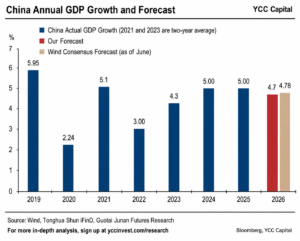
Markets often resemble an experienced sailor navigating changing tides. Calm waters can create the illusion of stability, while the strongest undercurrents remain invisible beneath the surface. China’s economy today fits that description remarkably well. Headline growth continues to hover around official targets, yet underneath lies one of the largest reallocations of capital, labor, and political priorities in decades.
At YCC Capital, we believe investors should resist viewing China through either excessively pessimistic or overly optimistic lenses. Instead, the current environment should be understood as a prolonged transition from a property-led economy toward one increasingly dependent on advanced manufacturing, strategic technology, exports, and state-directed industrial policy. This transition is producing winners and losers simultaneously, creating a pronounced K-shaped economy that is likely to remain the defining feature of China’s macro landscape over the coming several years.
The second half of 2026 is therefore unlikely to deliver either a dramatic acceleration or a hard landing. Rather, policymakers appear increasingly willing to tolerate moderate growth in exchange for structural reforms, industrial upgrading, and financial stability. While targeted policy support should prevent a severe downturn, the economy continues to face significant headwinds from weak domestic demand, lingering property weakness, unfavorable demographics, and an increasingly uncertain global environment.
Against this backdrop, we expect China’s economy to remain resilient in externally oriented manufacturing sectors while domestic consumption and property continue to recover only gradually. Export competitiveness, technological upgrading, and selective fiscal support should offset part—but not all—of the structural drag from deleveraging and slowing household confidence.
China’s Economy: Stable Growth Masks Structural Divergence
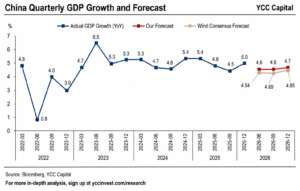
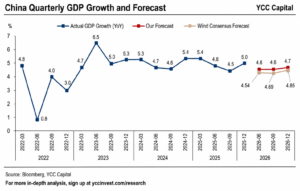
China entered 2026 with stronger-than-expected momentum. The first quarter benefited from robust exports, resilient industrial production, and continued investment in high-technology manufacturing. However, momentum moderated noticeably beginning in April as fiscal spending slowed, domestic demand weakened more than anticipated, and geopolitical disruptions in the Middle East temporarily affected global production chains.
Rather than signaling a new recession, the slowdown reflects the increasingly uneven nature of China’s growth model. Export-oriented industries continue to outperform while domestically focused sectors remain under pressure.
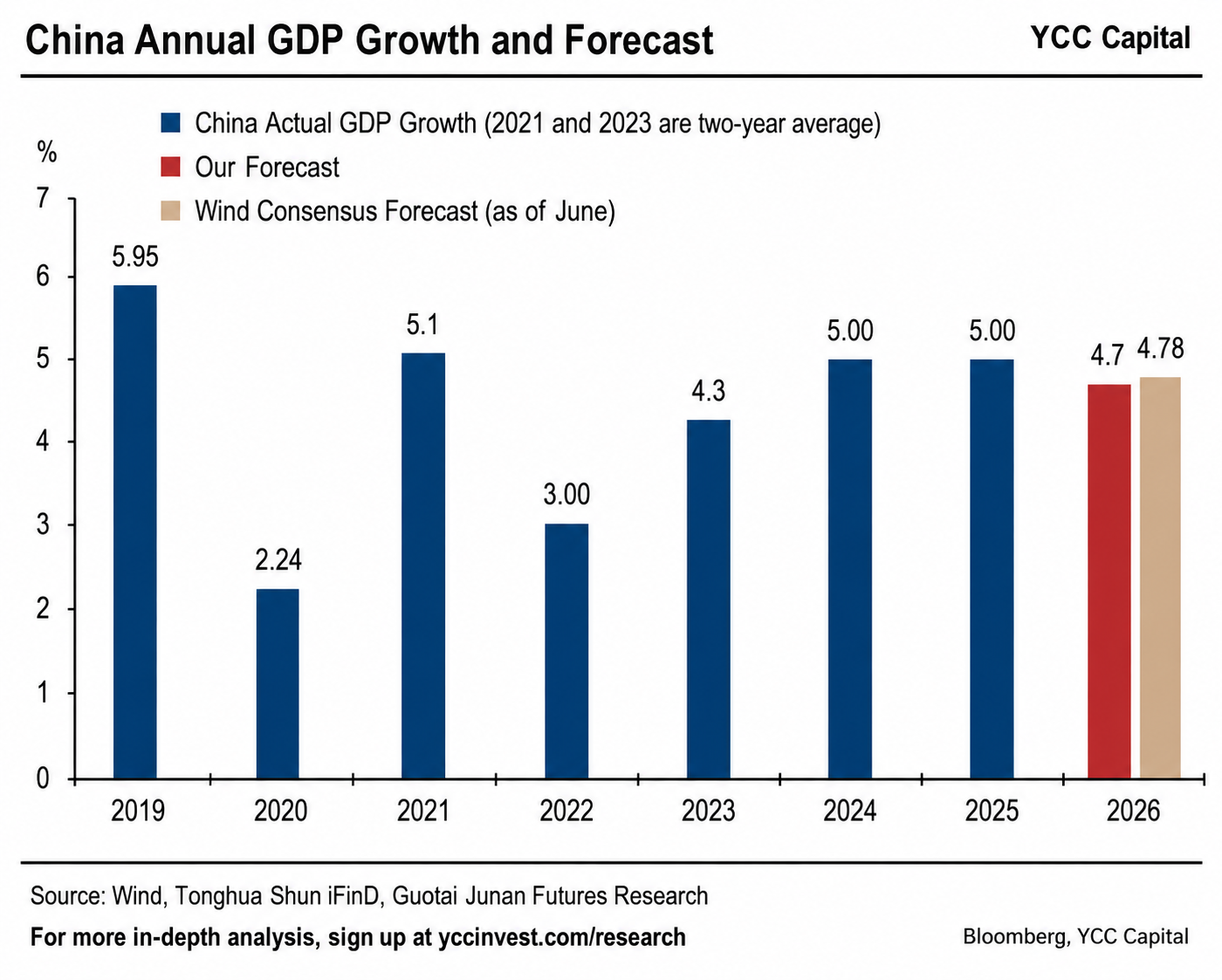
We expect GDP growth to follow a pattern of moderation before stabilizing later in the year.
Our base case projects:
- Q2 GDP growth: 4.6%
- Q3 GDP growth: 4.7%
- Q4 GDP growth: 4.7%
Full-year GDP is expected to expand by approximately 4.7%, comfortably within the government’s stated target range of 4–5%.
The second half should benefit from easier year-over-year comparisons, gradual fiscal acceleration, and implementation of several structural policy initiatives. Nevertheless, growth is unlikely to return to the rapid pace experienced during previous stimulus cycles, reflecting policymakers’ preference for higher-quality expansion over headline speed.
Manufacturing Has Become China’s New Growth Engine
One of the defining characteristics of China’s post-pandemic economy has been the widening gap between production and consumption.
Industrial production continues to significantly outperform retail spending, highlighting China’s increasing dependence on external demand and technological upgrading.
Between January and May, industrial value-added grew 5.4%, substantially exceeding retail sales growth of only 1.4%.
This divergence reflects two powerful global forces.
First, the ongoing AI revolution has triggered an unprecedented wave of investment in semiconductors, data infrastructure, industrial automation, and advanced electronics. Chinese manufacturers remain deeply integrated into these global supply chains despite geopolitical tensions.
Second, global re-industrialization has encouraged multinational firms to diversify production networks. Although some manufacturing has migrated elsewhere in Asia, China’s sophisticated supplier ecosystem continues to provide significant competitive advantages in many high-value manufacturing sectors.
High-technology industries have therefore increasingly diverged from traditional manufacturing, reinforcing the country’s transition toward “new productive forces.”
Property Is No Longer Driving Growth
Perhaps the most profound structural shift underway is the diminished role of real estate.
Property investment remains the weakest component of China’s economy. During the first five months of 2026, real estate investment declined 16.2% year-over-year, marking an extraordinary 46 consecutive months of contraction.
Several years ago, such a decline would almost certainly have pushed China into recession. Today, the macroeconomic impact is considerably smaller because technology-intensive industries now account for a larger share of economic activity than construction.
Nevertheless, real estate remains an important drag on household wealth, consumer confidence, and commodity demand.
Encouragingly, leading indicators suggest stabilization rather than continued collapse.
Tier-one cities have experienced noticeable improvements in housing prices and transaction volumes as inventories gradually normalize. However, these improvements remain geographically concentrated and insufficient to drive a nationwide recovery.
China’s property market appears to be establishing a cyclical floor rather than beginning a new expansion. Excess inventory remains elevated, and meaningful recovery will likely require continued policy support alongside sustained inventory reduction.
For global investors, this distinction is critical. The era in which Chinese real estate served as the principal engine of commodity demand has likely ended.
Infrastructure Spending Faces New Constraints
Infrastructure investment has traditionally served as Beijing’s preferred counter-cyclical policy tool.
This time, however, local government debt has fundamentally altered that equation.
Broad infrastructure investment slowed steadily during the first four months of 2026, reflecting an accelerated campaign to reduce local government financial risks.
Although government bond issuance has proceeded relatively quickly this year, fiscal spending has become increasingly selective rather than expansionary.
Rather than maximizing headline investment, policymakers now appear focused on balancing economic stabilization with debt sustainability.
This represents an important philosophical shift in Chinese policymaking.
Instead of repeating the massive infrastructure stimulus programs that characterized previous downturns, Beijing increasingly favors targeted investment supporting long-term productivity improvements.
Manufacturing Investment Enters a More Mature Phase
Manufacturing investment has successfully offset much of the weakness originating from property over recent years.
However, after several years of exceptionally rapid expansion, signs of overcapacity have become increasingly visible across multiple industries.
Low producer prices, compressed corporate margins, and declining capacity utilization prompted authorities to intensify their campaign against excessive industrial competition—commonly referred to as the “anti-involution” initiative.
The objective is straightforward: improve industrial profitability rather than maximize production volume.
This policy shift will likely moderate manufacturing investment growth in the near term while improving the sector’s long-term sustainability.
Investment should therefore transition from aggressive expansion toward a more balanced trajectory during the second half of the year.
Consumers Continue to Lag Behind
The greatest weakness in China’s recovery remains household consumption.
Retail sales contracted modestly during May, while discretionary spending—particularly automobiles, home appliances, and housing-related goods—remained under considerable pressure.
Service consumption has been notably stronger than goods consumption, reflecting changing consumer preferences as well as lingering weakness in the property market.
Several structural challenges continue to constrain household spending:
Property prices remain subdued, limiting wealth effects.
Household leverage remains historically elevated.
Income growth continues to disappoint.
Population decline has become increasingly pronounced.
Indeed, China’s population has now declined for four consecutive years, reducing long-term consumption potential while reinforcing broader demographic challenges.
Although government subsidy programs temporarily boosted durable goods purchases in 2025, these measures created unusually high comparison bases that weigh on current retail growth.
As those base effects fade during late 2026 and into 2027, consumer spending should gradually stabilize. However, a broad-based consumption boom remains unlikely without stronger household income growth and greater confidence in the housing market.
Exports Remain the Brightest Spot
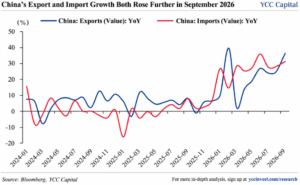
Exports have once again exceeded expectations.
During the first four months of 2026, exports increased 14.5%, the strongest comparable performance since 2022.
Several factors contributed to this resilience.
Energy price volatility associated with Middle Eastern geopolitical tensions temporarily enhanced China’s manufacturing competitiveness.
AI-related industries—including semiconductors, electronics, and new energy vehicles—continued recording impressive export growth.
Meanwhile, renewed trade dialogue between Washington and Beijing reduced immediate policy uncertainty.
Recent negotiations produced progress on tariff reductions, agricultural market access, aviation purchases, and bilateral economic coordination.
While structural strategic competition between the United States and China remains intact, incremental improvements in commercial relations reduce near-term downside risks for exporters.
Nonetheless, investors should avoid extrapolating recent export strength indefinitely.
An appreciating renminbi could gradually erode competitiveness in lower value-added manufacturing.
Moreover, global demand remains vulnerable should the AI investment cycle lose momentum or developed-market growth weaken materially.
Inflation Finally Begins to Normalize
Producer prices have finally returned to positive territory after 41 consecutive months of deflation.
Higher energy prices have been the principal catalyst, improving corporate profitability and government tax revenues.
Looking ahead, however, recent geopolitical developments suggest oil prices may gradually moderate, limiting additional upside for producer inflation.
Consumer inflation remains subdued but should improve modestly as pork prices stabilize following government efforts to address excessive competition within the livestock industry.
Overall, inflation is likely to normalize gradually rather than accelerate sharply.
Credit Growth Remains Soft
Private-sector borrowing demand remains weak despite accommodative financial conditions.
Loan growth slowed to 5.6% in April, the weakest pace in approximately a decade.
Households remain reluctant to borrow amid continued housing uncertainty, while businesses demonstrate greater caution regarding new investment.
Instead, government bond issuance has become the principal driver supporting aggregate financing growth.
This divergence between credit expansion and broader social financing underscores an important reality: liquidity is available, but confidence remains scarce.
Policy Outlook: Stability First, Reform Second
Unlike previous economic slowdowns, policymakers appear increasingly comfortable allowing moderate growth while emphasizing structural reform.
Monetary policy is expected to remain supportive, although large-scale interest rate cuts appear unlikely.
The People’s Bank of China has already lowered several structural lending facilities while shifting its communication toward maintaining orderly money-market conditions rather than aggressively easing policy.
We expect additional interest-rate reductions, if any, to remain modest—likely totaling no more than 10 basis points during the remainder of the year.
Fiscal policy will likewise emphasize targeted support over broad stimulus.
Priority areas include:
- Resolving local government debt risks
- Supporting strategic industries
- Financing major national infrastructure projects
- Strengthening technological self-sufficiency
- Continuing industrial restructuring
Among structural reforms, the government’s intensified campaign against excessive competition—or “anti-involution”—may become one of the defining economic themes of 2026.
Authorities increasingly recognize that endless capacity expansion without profitability ultimately weakens corporate balance sheets, depresses prices, and discourages innovation.
YCC Capital Strategic View
Investing during periods of structural transition is rarely comfortable.
History shows that economies undergoing profound transformation seldom move in straight lines. Japan experienced similar adjustments after its property bubble. South Korea’s industrial evolution followed decades of uneven reforms. Even the United States required multiple cycles before today’s technology leadership emerged.
China’s transition will likely prove no different.
The country’s industrial capabilities remain formidable, particularly in advanced manufacturing, AI supply chains, and export competitiveness. Yet these strengths coexist with persistent weaknesses in domestic consumption, demographics, real estate, and local government finances.
For global investors, the key takeaway is not whether China grows at 4.5% or 5.0%. Rather, the critical question is where growth originates.
The answer is becoming increasingly clear: technology, advanced manufacturing, exports, and strategic industrial policy will continue to outperform traditional property-driven sectors.
Nevertheless, we remain cautious on China’s broader macro outlook over the medium term. Structural demographic decline, elevated debt burdens, weaker household confidence, and diminishing returns from state-led investment suggest that sustained acceleration remains challenging without more comprehensive market-oriented reforms.
By contrast, the United States continues to benefit from stronger productivity growth, deep capital markets, and global leadership in AI innovation. While cyclical volatility should be expected, we remain cautiously constructive on the long-term outlook for U.S. assets.
As global capital continues to search for resilience rather than simply growth, portfolio allocation will increasingly reward economies capable of combining innovation, institutional strength, and financial flexibility. That distinction is becoming more important than ever.
Sources: Bloomberg, YCC Capital.
Editorial Board
Ken Cao
Chief Strategist, Global Investment Strategy
Le Gao
Managing Analyst
Yui Nabeshima
Strategist
Mai Ikeda
Research Analyst
IMPORTANT DISCLAIMER
This research report is provided for informational and educational purposes only and does not constitute an offer to sell or a solicitation of an offer to buy any securities, financial instruments, or investment products. It is not intended as investment, legal, accounting, or tax advice and should not be relied upon as such. The views, opinions, and projections expressed herein are those of YCC Capital Management and its research personnel as of the date of publication and are subject to change without notice. Past performance is not indicative of future results.
YCC Capital Management, its affiliates, principals, and employees may hold long or short positions in securities or instruments discussed in this report and may trade for their own accounts or for client accounts in a manner inconsistent with the recommendations herein. This report is based on publicly available information and data believed to be reliable, but YCC Capital makes no representation or warranty, express or implied, as to the accuracy, completeness, or timeliness of such information. Forward-looking statements involve risks and uncertainties that could cause actual results to differ materially from those projected.
Recipients of this report should conduct their own independent due diligence and consult with their own financial, legal, and tax advisors before making any investment decisions. YCC Capital accepts no liability for any loss or damage arising from the use of or reliance on this report or its contents.
This report is intended solely for the use of the intended recipient(s) and may not be reproduced or redistributed for commercial purposes without the prior written consent of YCC Capital.
© 2026 YCC Capital. All rights reserved.
YCC Capital’s flagship vehicle, the YCC International Value Fund, LP, maintains a concentrated global macro value strategy with a focus on capital-flow-driven mispricings and asymmetric hedging opportunities. The Fund is registered in the State of Delaware, U.S. and structured as a Rule 506(c) private fund. Performance data, where referenced, has been verified by independent third parties including NAV Consulting; however, individual investor results may vary.
Contact Us
For institutional inquiries, media requests, or investment research:
Email: ir@yccinvest.com
Subscribe to our free daily macro and market insights at:
YCC Capital Research | Sign up for free daily market insight at www.yccinvest.com
For more related research:
The Energy Shock Is Fading—Now Markets Must Price the Next Liquidity Cycle
China’s Recovery Is Losing Altitude: Exports Mask a Deepening Domestic Slowdown
China’s Consumer Mirage: Why Better Employment Data Is Hiding a More Fragile Recovery
China’s Uneven Recovery: Exports Power Ahead While Domestic Demand Remains Stuck in Low Gear