YCC CAPITAL
Global Strategy
July 4, 2026
Executive Perspective
Financial markets often resemble long-distance endurance races rather than sprints. During periods of calm, investors tend to focus on incremental improvements in growth and earnings. Yet when a geopolitical shock suddenly disrupts critical supply chains, the resilience of an economy is determined less by headline GDP figures than by its ability to absorb higher costs without triggering financial instability.
Europe now finds itself precisely in such an environment.
Although the worst fears surrounding Middle East energy disruptions have eased, the aftershocks continue to ripple through inflation, industrial production, exports, and consumer confidence. Lower oil prices may gradually relieve pressure during the second half of the year, but the structural damage inflicted by elevated energy costs, weak investment, and persistent trade uncertainty cannot be reversed overnight.
At YCC Capital, our assessment remains that Europe is entering a prolonged phase of low-growth normalization rather than a powerful cyclical rebound. Growth is likely to stabilize, but expectations for a vigorous recovery remain premature.
Europe: Recovery Under Pressure from Energy Costs
Energy Shock Pushes the Eurozone Back Toward Stagnation
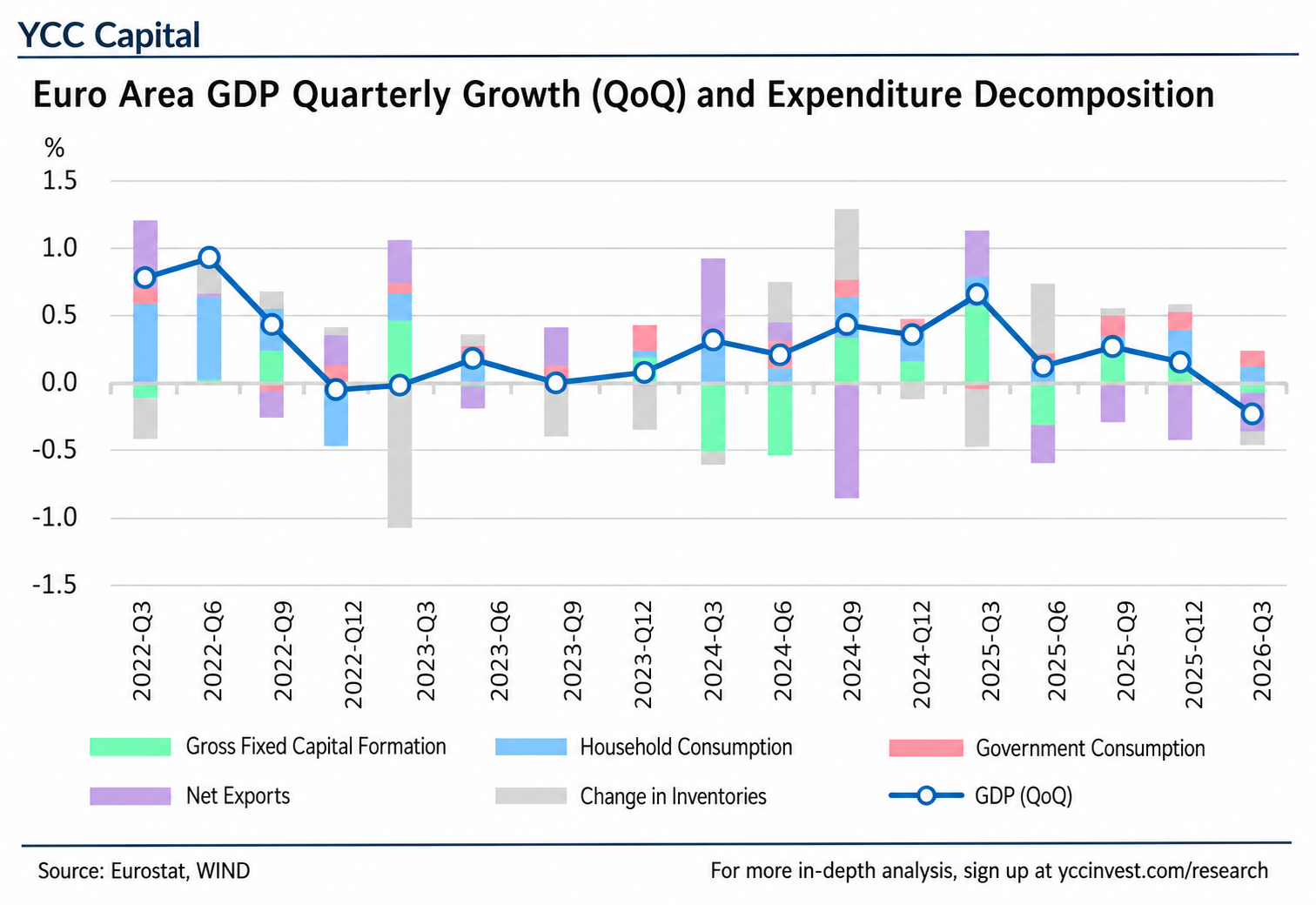
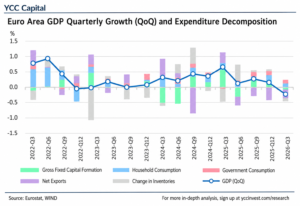
The Eurozone economy weakened considerably during the first quarter of 2026, highlighting the vulnerability of an import-dependent economic bloc to external energy disruptions. Real GDP expanded only 0.3% year-over-year, while quarterly GDP contracted 0.2%, marking the region’s first sequential decline since 2020.
Several factors converged simultaneously.
The temporary disruption of shipping through the Strait of Hormuz sharply increased LNG and crude oil prices, raising production costs across Europe’s industrial base. Higher input costs compressed corporate profit margins, discouraged fixed investment, and weakened the international competitiveness of European exports.
At the same time, the unwinding of precautionary export activity ahead of anticipated U.S. tariff measures created significant distortions. Irish multinational pharmaceutical companies had accelerated exports during late 2025, leaving an unusually weak export base during the first quarter of 2026.
While government spending and household consumption continued providing modest support, business investment and net exports became significant drags on overall growth.
Fixed investment declined by 0.3% quarter-over-quarter, while net exports made the largest negative contribution to GDP as exports slipped and imports increased alongside higher energy bills. Government expenditure remained the principal stabilizing force for domestic demand.
Diverging National Performances
Economic performance varied substantially across major European economies.
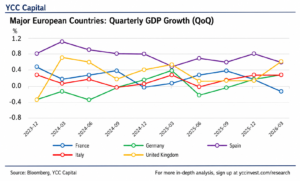
Germany demonstrated modest resilience with quarterly GDP growth of 0.3%, its strongest quarterly expansion in a year, although underlying industrial conditions remained fragile.
France experienced its first quarterly contraction since 2020, reflecting weaker domestic demand and deteriorating business confidence.
Spain once again emerged as Europe’s strongest performer. Tourism, renewable energy investment, food production, and agricultural exports allowed Spanish GDP to expand by 0.6%, extending an impressive streak of sustained quarterly growth.
Italy maintained relatively stable momentum through moderate domestic demand and continued industrial resilience.
Ireland represented the largest outlier, with GDP collapsing over 12% quarter-on-quarter, largely reflecting extraordinary swings in multinational pharmaceutical exports rather than broad domestic weakness.
Consumer Spending Loses Momentum
High Energy Bills Are Reshaping Household Behavior
For most households, inflation is experienced less through economic statistics than through everyday purchases.
A family may postpone replacing a vehicle, dine out less frequently, or delay home renovations—not because employment has deteriorated, but because higher utility bills steadily erode disposable income.
That pattern increasingly characterizes consumer behavior across Europe.
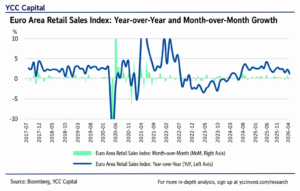
Retail sales slowed noticeably during the first four months of 2026 as rising energy prices reduced purchasing power and encouraged precautionary savings. Germany and France both experienced weaker retail activity compared with 2025 averages.
Although UK retail sales appeared comparatively robust, much of the apparent strength reflected temporary factors including favorable base effects, higher nominal prices, and unusually warm weather that accelerated seasonal purchases rather than signaling a durable improvement in household demand.
Consumer Confidence Remains Fragile
Labor markets have remained relatively stable, with Eurozone unemployment fluctuating around 6.3–6.4%.
However, wage growth has slowed significantly from the elevated pace recorded during 2024. Real purchasing power has therefore weakened as inflation accelerated once again.
Consumer confidence deteriorated sharply during the height of Middle East tensions before recovering modestly as geopolitical risks eased. Nevertheless, confidence indicators remain well below 2025 averages.
Service-sector activity has also weakened, suggesting that households continue exercising caution regarding discretionary spending.
Taken together, subdued wage growth, cautious consumers, and slowing services activity imply that consumption will remain a relatively weak pillar of European growth throughout much of 2026.
Industrial Recovery Faces Structural Obstacles
Europe’s industrial sector remains exceptionally sensitive to energy costs.
Unlike commodity-exporting economies, Europe imports much of its energy needs, making industrial production particularly vulnerable to disruptions in global oil and natural gas markets.
Energy-intensive industries—including chemicals, steel, and heavy manufacturing—have experienced significant cost pressures throughout 2026.
Adding further complexity, trade protectionism and supply-chain disruptions continue weighing on manufacturing. European automobile producers face mounting competitive pressure from Chinese electric vehicle manufacturers, while semiconductor supply chains remain exposed to geopolitical uncertainty.
Industrial production across the Eurozone declined on average during the first four months of 2026.
Germany experienced the weakest performance among major economies owing to its heavy dependence on manufacturing exports and energy-intensive production.
France proved comparatively more resilient because of its higher degree of energy independence and stronger aerospace, defense, and pharmaceutical sectors.
The United Kingdom also experienced weaker industrial output as higher energy costs filtered through domestic production.
External Trade Remains Under Pressure
Tariffs Continue to Cast a Shadow
Although headline tariff disputes have become less prominent than during earlier periods of trade tensions, their effects remain visible in trade flows.
Eurozone exports declined during early 2026, while imports increased primarily because higher energy prices inflated import values.
Trade surpluses narrowed substantially.
The principal drag did not originate from Germany or France alone but also reflected sharp swings among smaller economies, particularly Ireland following its earlier surge in pharmaceutical exports.
Meanwhile, U.S. imports from the Eurozone remained materially below year-earlier levels despite gradual improvement in monthly growth rates.
Tariff-related uncertainty has therefore diminished but has not disappeared.
Businesses remain reluctant to commit long-term investment while policy risks surrounding U.S.-European trade relations continue to evolve.
Inflation: The Peak May Be Near
Energy Drove the Latest Inflation Wave
Inflation accelerated meaningfully across the Eurozone during the first half of 2026.
Headline inflation increased from 1.7% in January to 2.8% by June, primarily reflecting surging energy prices following Middle East supply disruptions.
Core inflation also moved higher as increased production costs gradually passed through into services and other consumer prices.
Food inflation moderated, but energy inflation rose sharply, becoming the dominant driver of headline CPI.
The United Kingdom followed a somewhat different trajectory.
British inflation moderated modestly during the first half of the year despite rising energy prices, largely because previous price increases created favorable statistical base effects and because Britain’s price transmission mechanism tends to operate with longer lags.
This delay suggests that UK inflation risks may become more pronounced later in the year even as Eurozone inflation begins easing.
Oil Prices Should Ease—but Inflation Will Not Disappear
Our baseline expectation is that international crude oil markets gradually return toward balance.
Improving U.S.–Iran diplomatic engagement and the restoration of shipping capacity through the Strait of Hormuz should gradually reduce geopolitical risk premiums embedded in energy markets.
Rather than remaining above $90 per barrel, crude oil prices are likely to stabilize within a $70–90 per barrel range.
Lower oil prices should quickly reduce Eurozone energy inflation.
However, inflation is unlikely to return immediately to central bank targets.
Producer prices remain elevated, and wage dynamics continue supporting services inflation.
Consequently, headline inflation should gradually decline while core inflation proves considerably more persistent.
The United Kingdom is likely to experience an even slower adjustment because energy costs typically pass through to consumers with a lag of approximately three months.
Growth Outlook: Recovery Will Be Slow and Uneven
Looking ahead, Europe appears set for stabilization rather than acceleration.
Several positive developments are emerging.
Lower energy prices should gradually improve household purchasing power.
Trade balances may improve as energy import costs normalize.
Business confidence could stabilize if geopolitical tensions continue easing.
Yet substantial structural challenges remain.
Industrial supply chains have already suffered lasting damage from elevated production costs.
Investment appetite remains subdued.
Trade friction with both the United States and China continues creating uncertainty.
Fiscal flexibility has narrowed considerably after years of higher government borrowing associated with energy support measures and defense spending.
Consequently, Europe is unlikely to experience a rapid cyclical rebound during the remainder of 2026.
Instead, growth is expected to recover only gradually, with domestic consumption and services providing limited support while manufacturing remains constrained.
Monetary Policy: The ECB Keeps Tightening Bias Alive
The European Central Bank has entered a distinctly different phase of the policy cycle.
On June 11, the ECB raised all three of its key policy rates by 25 basis points, lifting the deposit facility rate to 2.25%, the main refinancing rate to 2.40%, and the marginal lending facility to 2.65%. This marked the first rate increase since September 2023 and formally brought the previous easing cycle to an end.
The message accompanying the decision was equally important.
Rather than signaling a predetermined tightening path, President Christine Lagarde emphasized that policy would remain strictly data dependent, with inflation developments—particularly those stemming from geopolitical risks—remaining the central focus.
The ECB simultaneously revised its own forecasts higher for inflation while lowering its growth outlook, acknowledging that Europe now faces an increasingly uncomfortable combination of slowing economic activity alongside renewed price pressures.
This is an environment central bankers dislike most.
Unlike demand-driven inflation, imported energy inflation offers policymakers few attractive options. Raising rates cannot produce more crude oil or reopen shipping lanes through the Strait of Hormuz. Yet failing to respond risks allowing inflation expectations to become unanchored.
The ECB therefore finds itself balancing between two imperfect choices: tightening enough to preserve credibility while avoiding unnecessary damage to an already fragile economy.
Our ECB Outlook
Our base case remains that the ECB is likely to pause for the remainder of 2026.
If Middle East tensions continue to ease and Brent crude gradually stabilizes within the US$70–90 per barrel range, imported inflation should moderate steadily throughout the second half of the year.
Under this scenario, policymakers would gain sufficient confidence that inflation is moving back toward target without requiring additional tightening.
Maintaining current interest rates would also allow the Governing Council to observe the delayed effects of previous tightening on credit growth, business investment, and household spending.
However, the option of another increase has clearly not disappeared.
Should geopolitical tensions flare up again—particularly if oil prices experience another sustained surge—the ECB may judge that a final 25-basis-point “insurance” hike becomes necessary to prevent a second wave of inflation from taking hold.
Such a move would likely occur during the September meeting rather than later in the year, when economic weakness could become more pronounced.
At YCC Capital, we assign a higher probability to an extended pause than to renewed tightening, but we believe markets continue to underestimate how reluctant the ECB will be to declare victory over inflation prematurely.
The Bank of England Faces an Even Narrower Path
If the ECB faces a difficult balancing act, the Bank of England faces an even more complicated one.
At its June monetary policy meeting, the Monetary Policy Committee voted 7–2 to maintain Bank Rate at 3.75%. While the majority favored waiting for additional data, two members voted for an immediate rate increase, highlighting growing internal concern regarding inflation persistence.
Governor Andrew Bailey emphasized that although international oil prices had recently moderated, several months of elevated energy costs had yet to fully filter through the British economy.
Unlike many continental European countries, Britain’s pricing mechanism tends to transmit wholesale energy costs into consumer prices more gradually.
Consequently, inflation risks have been delayed rather than eliminated.
At the same time, policymakers acknowledged several emerging weaknesses.
Employment conditions have softened.
Financial conditions have tightened materially.
Business investment remains cautious.
Consumer confidence has failed to recover convincingly.
Taken together, these forces argue against aggressive tightening despite lingering inflation risks.
Our Bank of England Outlook
We expect the Bank of England to remain firmly on hold under our baseline scenario.
Should oil prices continue easing and imported inflation gradually moderate, maintaining the current 3.75% policy rate should prove sufficiently restrictive to guide inflation lower without unnecessarily intensifying the economic slowdown.
However, policymakers have deliberately preserved flexibility.
If higher energy costs begin triggering broader wage negotiations and a sustained wage-price spiral develops, the Bank could respond with one additional 25-basis-point preventive rate increase, lifting Bank Rate to 4.00%.
This would not reflect confidence in economic strength.
Rather, it would represent an effort to prevent temporary inflation from becoming permanently embedded in inflation expectations.
In other words, policy tightening would be undertaken to preserve long-term stability rather than to restrain excessive growth.
Strategic Investment Implications
The second half of 2026 is likely to be defined less by synchronized global expansion than by increasingly divergent regional trajectories.
For Europe, the principal challenge is not whether recession can be avoided—it probably can—but whether growth can recover sufficiently to restore business confidence after multiple years of structural shocks.
Our assessment remains cautious.
The easing of energy prices should provide welcome relief, but several headwinds remain firmly in place:
Persistent trade uncertainty continues to discourage long-term capital expenditure, while elevated production costs have permanently impaired portions of Europe’s manufacturing base. Fiscal flexibility is increasingly constrained by higher debt burdens, leaving governments with limited capacity to offset private-sector weakness through large-scale stimulus. At the same time, inflation is likely to moderate only gradually, restricting the ECB’s ability to support growth through easier monetary policy.
Collectively, these factors point toward an environment of subdued expansion rather than a powerful cyclical rebound.
For investors, this suggests emphasizing quality over cyclicality.
Companies with strong balance sheets, durable pricing power, recurring cash flows, and limited dependence on energy-intensive production should continue outperforming businesses whose earnings remain highly sensitive to fluctuations in commodity prices or global trade.
Fixed-income markets may also become increasingly attractive as policy rates approach their cyclical peak, although we believe markets remain overly optimistic regarding the timing and magnitude of eventual easing.
YCC Capital Strategic View
Markets frequently assume that once energy prices decline, economic normalization follows automatically.
History suggests otherwise.
Energy shocks resemble throwing a stone into a calm lake. The splash is immediate, but the ripples continue expanding long after the initial impact has faded. Corporate investment decisions postponed today may not return for years. Supply chains disrupted by higher costs often relocate permanently. Consumer confidence damaged by repeated inflation episodes recovers far more slowly than gasoline prices decline.
Europe therefore enters the second half of 2026 with reasons for cautious optimism—but not complacency.
Growth should stabilize.
Inflation should gradually cool.
Financial conditions should become more predictable.
Yet the combination of structurally weaker productivity, persistent geopolitical uncertainty, and constrained fiscal capacity implies that Europe’s recovery will remain measured rather than dramatic.
From a global asset allocation perspective, we continue to favor regions demonstrating stronger structural earnings growth, healthier demographic trends, and greater policy flexibility. Europe remains investable, but selectivity is essential. Investors should prioritize resilience over optimism and quality over cyclical beta.
In our view, the era of effortless post-pandemic recoveries has given way to one in which disciplined capital allocation—not simply market exposure—will increasingly determine long-term investment success.
Editorial Board
Ken Cao
Chief Strategist, Global Investment Strategy
Le Gao
Managing Analyst
Yui Nabeshima
Strategist
Mai Ikeda
Research Analyst
IMPORTANT DISCLAIMER
This research report is provided for informational and educational purposes only and does not constitute an offer to sell or a solicitation of an offer to buy any securities, financial instruments, or investment products. It is not intended as investment, legal, accounting, or tax advice and should not be relied upon as such. The views, opinions, forecasts, and projections expressed herein are those of YCC Capital Management and its research personnel as of the date of publication and are subject to change without notice. Past performance is not indicative of future results.
This publication has been prepared using information believed to be reliable, including publicly available economic statistics, market data, and independent third-party sources. While every reasonable effort has been made to ensure accuracy, YCC Capital Management makes no representation or warranty, express or implied, regarding the completeness, accuracy, or timeliness of the information contained herein. Forecasts and forward-looking statements inherently involve uncertainty and are subject to numerous economic, geopolitical, financial, and market risks that could cause actual outcomes to differ materially from those discussed in this report.
Nothing contained in this report should be interpreted as personalized investment advice or a recommendation to purchase, sell, or hold any particular security, asset class, investment strategy, or financial instrument. Investors should conduct their own independent research and consult qualified financial, legal, accounting, and tax professionals before making any investment decisions.
YCC Capital Management, its affiliates, principals, partners, employees, and related investment vehicles may from time to time hold long or short positions in securities, currencies, commodities, derivatives, or other financial instruments referenced in this report and may execute transactions that differ from the views expressed herein.
Although every effort has been made to present balanced analysis, market conditions evolve rapidly and opinions may change without prior notice. YCC Capital assumes no responsibility or liability for any direct or consequential loss arising from the use of this publication or reliance upon any information contained herein.
This report may not be reproduced, redistributed, transmitted, quoted, or published for commercial purposes without the prior written consent of YCC Capital Management.
© 2026 YCC Capital. All rights reserved.
YCC Capital’s flagship investment vehicle, the YCC International Value Fund, LP, maintains a concentrated global macro value strategy focused on identifying capital-flow-driven market dislocations and asymmetric risk-reward opportunities across global asset classes. The Fund is registered in the State of Delaware, United States, and is structured as a Rule 506(c) private investment fund. Where referenced, performance information has been independently verified by third-party administrators, including NAV Consulting, although individual investor results may differ depending on subscription timing and individual circumstances.
Contact Us
YCC Capital Research
For complimentary daily macroeconomic research, market strategy updates, and investment insights from the YCC Capital Research team, subscribe to our free daily newsletter at www.yccinvest.com.
YCC Capital Research | Sign up for free daily market insight at www.yccinvest.com
For more related research:
Asset Divergence Under Repeated Geopolitical Shocks
Peace Priced In, Pain Still Ahead: Why the U.S.–Iran Accord Does Not End the Economic Aftershocks
The Energy Shock Is Fading—Now Markets Must Price the Next Liquidity Cycle
When the Tide Recedes: Why the U.S. Dollar Is Entering a New Era of Two-Way Risk
Has Peak Hawkishness Arrived? Why the Fed’s Toughest Message May Also Mark the Turning Point