YCC CAPITAL
Innovation Themes & Strategy
July 12, 2026
Executive Perspective

Every technological revolution begins with excitement but ultimately succeeds through reinvention rather than invention.
The arrival of electricity did not immediately transform manufacturing. Early factories simply replaced steam engines with electric motors while preserving the same layouts, workflows, and management structures. Only decades later, when factories reorganized production around distributed power systems, did productivity truly accelerate.
Artificial intelligence has entered a remarkably similar phase.
Today’s frontier models are capable of writing software, drafting legal contracts, summarizing research, and solving increasingly sophisticated reasoning problems. Yet for most enterprises, these breakthroughs remain largely additive rather than transformative. Employees produce presentations faster, programmers write code more efficiently, and customer service representatives resolve tickets more quickly. These are meaningful improvements, but they fall well short of the productivity revolution investors increasingly assume is inevitable.
At YCC Capital, we believe the next stage of the AI cycle will be determined far less by model intelligence than by organizational adaptability.
The central investment question is no longer whether large language models will become more capable. They almost certainly will. Instead, the question is whether corporations can redesign decades-old operating models, fragmented data architectures, and entrenched incentive systems quickly enough to convert technological capability into sustainable economic value.
This organizational bottleneck has become the defining constraint on AI diffusion—and, by extension, the key variable governing both AI valuations and macroeconomic productivity.
The Real Productivity Revolution Begins Inside the Enterprise
Much of today’s public discussion continues to frame AI through the lens of labor replacement. Headlines routinely ask whether machines will replace accountants, software engineers, lawyers, or financial analysts.
This framing misses the more consequential economic story.
Historically, general-purpose technologies rarely generate transformational productivity simply by substituting for individual workers. Instead, they reshape entire organizations.
A company does not become dramatically more productive because one employee drafts emails twice as quickly. It becomes more productive when information moves faster, decisions become more automated, coordination costs collapse, and organizational bottlenecks disappear.
AI therefore should not be evaluated primarily through consumer adoption statistics, subscription growth, benchmark scores, or chatbot usage.
Instead, investors should ask four far more important questions:
- Has AI entered mission-critical workflows?
- Has it fundamentally changed organizational decision-making?
- Has it generated measurable and repeatable returns on investment?
- Has it translated into higher economy-wide productivity?
Until these conditions are met, stronger models alone will not justify permanently higher valuations.
This distinction explains why today’s AI boom resembles previous technology revolutions far more than many investors appreciate.
Electricity, the internet, cloud computing, and smartphones all experienced extended periods during which technological capability advanced far faster than organizational adaptation.
AI is unlikely to prove different.
Technology Evolves Quickly. Organizations Do Not.
Technology is a fast-moving variable.
Corporate structures are not.
Many executives underestimate how deeply today’s enterprises remain anchored to organizational designs created decades before AI existed.
Legacy approval processes.
Departmental silos.
Fragmented databases.
Disconnected software systems.
Rigid reporting structures.
These institutional layers accumulate over decades, creating what software engineers commonly describe as technical debt.
Replacing them is extraordinarily difficult.
Anyone who has renovated an old home understands this challenge intuitively.
Painting the walls is easy.
Replacing the foundation is not.
Enterprise AI faces exactly the same problem.
Adding an AI assistant to existing workflows resembles repainting the house. Rebuilding workflows around autonomous AI agents requires reconstructing the foundation itself.
The latter creates lasting productivity gains.
The former mainly improves convenience.
Three Structural Barriers Slowing AI Adoption
Barrier One: Enterprise Data Remains Fragmented
Modern AI thrives on clean, structured, accessible information.
Most enterprises possess precisely the opposite.
Public internet data—the material used to train foundation models—is relatively standardized and widely accessible.
Corporate knowledge is neither.
Critical information remains scattered across ERP systems, CRM databases, procurement platforms, legal archives, customer support records, engineering documentation, spreadsheets, emails, and countless undocumented employee processes.
More importantly, enterprise data carries institutional context.
A contract means little without understanding internal legal standards.
A customer interaction log means little without historical relationship knowledge.
A financial report often depends upon unique accounting conventions developed over many years.
Consequently, the challenge facing enterprise AI is not simply better models—it is transforming fragmented institutional knowledge into machine-readable organizational capital.
Data governance, permissions, APIs, compliance frameworks, and standardized architectures increasingly determine AI success far more than raw model capability.
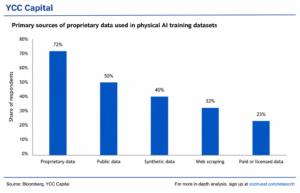
This dynamic becomes even more pronounced in physical AI applications.
Recent industry surveys indicate that proprietary enterprise data now represents the dominant source of training information for robotics and embodied AI systems, substantially exceeding reliance on public datasets.
The more specialized an industry becomes, the more valuable—and difficult to utilize—its proprietary data becomes.
Barrier Two: Technical Debt
The second obstacle is legacy technology.
Few large organizations operate on modern digital foundations.
Instead, they rely upon decades of accumulated software patches, legacy databases, custom interfaces, and highly specialized code that remains mission-critical despite its age.
Many government agencies illustrate this challenge.
The U.S. Social Security Administration, for example, continues to rely heavily on COBOL systems originally developed decades ago. Although modernization efforts continue, replacing core infrastructure has proven extraordinarily difficult because operational continuity cannot be compromised.
The lesson extends well beyond government.
Banks.
Insurance companies.
Hospitals.
Manufacturers.
Telecommunications providers.
All depend upon deeply interconnected legacy systems that cannot simply be replaced because AI has become more capable.
Even when organizations recognize the need for modernization, migration risks—including cybersecurity vulnerabilities, operational disruptions, regulatory complications, and data integrity concerns—slow implementation dramatically.
AI capability has accelerated exponentially.
Institutional modernization has not.
Barrier Three: Organizational Incentives
Perhaps the least appreciated constraint is organizational behavior itself.
Technology adoption is rarely determined by technology alone.
It is governed by incentives.
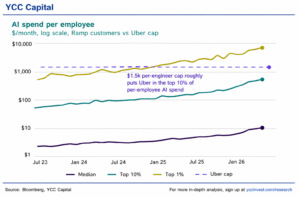
Many technology firms initially encouraged widespread AI usage internally, only to discover that computing expenses expanded much faster than expected.
In several widely discussed corporate cases, token consumption surged so rapidly that management imposed monthly usage caps despite enthusiastic employee adoption.
Higher AI utilization did not automatically translate into higher corporate productivity.
Instead, organizations frequently observed a phenomenon that might be described as “token inflation.”
Employees generated multiple drafts.
Repeated identical prompts.
Low-value experimentation.
Cosmetic formatting improvements.
Incremental productivity gains at the individual level accumulated substantial infrastructure costs without producing equivalent improvements in enterprise performance.
Recent earnings-call analysis reinforces this reality.
Across numerous S&P 500 companies discussing AI initiatives, only a small minority have explicitly attributed measurable revenue growth directly to AI deployment.
Cost savings remain considerably easier to quantify than revenue creation.
This distinction matters enormously.
Financial markets ultimately value durable cash flows rather than technological enthusiasm.
AI-Native Companies Hold a Structural Advantage
One increasingly visible divide separates AI-native firms from traditional incumbents.
AI-native companies build organizations around machine intelligence from day one.
Their data architectures.
Workflow designs.
Permission structures.
Decision frameworks.
And software ecosystems are designed with autonomous agents already in mind.
Traditional enterprises face a far more difficult task.
They must retrofit AI into organizations designed for humans.
The challenge is therefore not whether employees know how to use ChatGPT or other large language models.
The challenge is whether leadership is willing to redesign authority structures, approval chains, departmental responsibilities, and performance measurement systems.
That represents organizational transformation rather than software adoption.
History suggests such transitions unfold gradually.
Why Investors Should Remain Micro-Optimistic but Macro-Cautious
At the company level, optimism remains justified.
The economics surrounding AI infrastructure continue to strengthen.
Foundation models become more capable.
Inference costs continue falling.
Cloud infrastructure expands rapidly.
Semiconductor demand remains exceptionally robust.
Enterprise software vendors continue embedding AI across product suites.
Viewed individually, many firms are already realizing meaningful operational improvements.
At the macroeconomic level, however, the picture remains considerably more nuanced.
Despite extraordinary public attention, AI-generated revenues remain modest relative to the overall U.S. economy.
Moreover, many AI benefits appear as consumer surplus rather than measured GDP.
Search engines, online maps, and digital encyclopedias created enormous societal value that traditional economic statistics captured only imperfectly.
AI will likely follow a similar pattern.
Yet capital markets ultimately require monetizable earnings.
Revenue.
Margins.
Cash flow.
Without these, elevated valuations become increasingly difficult to sustain.
Ironically, the scenario that maximizes AI profitability may simultaneously create significant labor market disruption.
Rapid AI penetration strengthens corporate returns but intensifies employment pressures and income redistribution challenges.
Slower adoption softens labor-market disruption but delays investment returns, potentially reigniting concerns regarding AI overinvestment and valuation excess.
This tension explains why AI penetration has become the common variable linking technological optimism, labor-market stability, and financial-market expectations.
YCC Capital Strategic View
Investors should resist evaluating AI solely through headline announcements, benchmark scores, or product launches.
Instead, the next phase of the AI investment cycle will increasingly depend upon organizational adoption rather than technological innovation.
We believe four indicators deserve particularly close attention.
First, whether AI becomes embedded within core production systems rather than remaining a productivity assistant.
Second, whether enterprises redesign workflows around AI agents instead of merely adding AI to existing processes.
Third, whether measurable returns on investment become sustainable beyond isolated cost reductions.
Finally, whether aggregate productivity growth accelerates across the broader economy rather than remaining concentrated within a handful of technology leaders.
Model intelligence is the fast-moving variable.
Organizational transformation is the slow-moving variable.
Capital markets often reward the first.
Long-term economic growth depends upon the second.
The defining moment of the AI revolution will not arrive when models become incrementally smarter.
It will arrive when enterprises finally rebuild themselves around what those models make possible.
That transition has begun—but it is still in its early chapters.
Investment Implications
The investment implications of the organizational adoption gap extend well beyond the AI sector itself. While investors naturally gravitate toward semiconductor manufacturers, hyperscale cloud providers, and leading foundation model developers, the next phase of value creation is increasingly likely to emerge from companies that successfully integrate AI into enterprise operations rather than simply selling AI infrastructure.
History provides a useful guide. During the internet revolution, the greatest long-term winners were not necessarily the firms that built networking equipment or internet browsers. Many of those businesses experienced spectacular booms followed by painful consolidations. Instead, enduring value accrued to companies that fundamentally redesigned commerce, logistics, advertising, payments, and software around internet-native business models.
Artificial intelligence is beginning to follow the same trajectory.
Infrastructure remains essential, and demand for advanced computing, networking equipment, memory, power systems, and data center construction should remain robust for years. The rapid improvement in model efficiency continues to expand the addressable market by lowering inference costs and making AI economically viable for a wider range of enterprises. This remains one of the strongest secular investment themes globally.
However, infrastructure spending alone should not be mistaken for productivity transformation.
The more difficult—and ultimately more valuable—investment question concerns identifying which industries possess both the operational flexibility and organizational willingness to redesign themselves around AI-enabled workflows.
These firms are likely to experience structurally higher returns on invested capital over time.
By contrast, industries burdened by highly fragmented data, stringent regulatory constraints, or deeply entrenched legacy systems may continue deploying AI aggressively while realizing only incremental financial benefits.
The distinction between AI spending and AI monetization will become increasingly important as investors move beyond the initial excitement surrounding generative AI.
Sector Winners and Losers
Enterprise Software
Enterprise software remains one of the clearest beneficiaries of this transition.
The next generation of software will no longer function merely as digital record-keeping systems. Increasingly, software platforms will become operational decision engines capable of coordinating autonomous agents, managing workflows, allocating resources, and continuously optimizing business processes.
The competitive advantage will therefore shift away from standalone AI models toward enterprise ecosystems capable of integrating data, governance, compliance, and workflow automation into a unified operating environment.
Companies with deep customer relationships, extensive proprietary datasets, and mission-critical software installations possess significant structural advantages.
Cloud Infrastructure
Cloud providers remain indispensable beneficiaries of AI expansion.
As enterprises deploy larger AI workloads, demand for compute, storage, networking, cybersecurity, and orchestration services should continue rising.
Importantly, declining inference costs do not necessarily reduce cloud demand.
Historically, lower computing costs have consistently stimulated additional consumption—a phenomenon commonly referred to as Jevons’ Paradox.
As AI becomes cheaper, organizations simply deploy it more broadly across their operations.
Rather than reducing infrastructure demand, falling costs may accelerate overall adoption.
Semiconductors
The semiconductor ecosystem continues to occupy the foundation of the AI investment cycle.
Demand extends well beyond graphics processing units.
Networking chips.
High-bandwidth memory.
Power management systems.
Advanced packaging.
Optical interconnects.
Custom AI accelerators.
Each represents an increasingly critical component of next-generation AI infrastructure.
Nevertheless, investors should distinguish between cyclical revenue acceleration and permanently sustainable profitability.
Hardware investment cycles have historically experienced periods of exuberance followed by capacity normalization.
Maintaining discipline around valuation remains essential.
Consulting and Systems Integration
One underappreciated beneficiary may prove to be enterprise consulting firms and systems integrators.
If AI adoption increasingly depends upon organizational redesign rather than model intelligence, then implementation expertise becomes a scarce resource.
Many corporations do not require another chatbot.
They require assistance rebuilding procurement systems, compliance procedures, reporting structures, cybersecurity architecture, and operational governance around AI-enabled workflows.
This creates a multi-year demand cycle for digital transformation services.
Labor Markets
Labor markets represent the most politically sensitive variable in the AI transition.
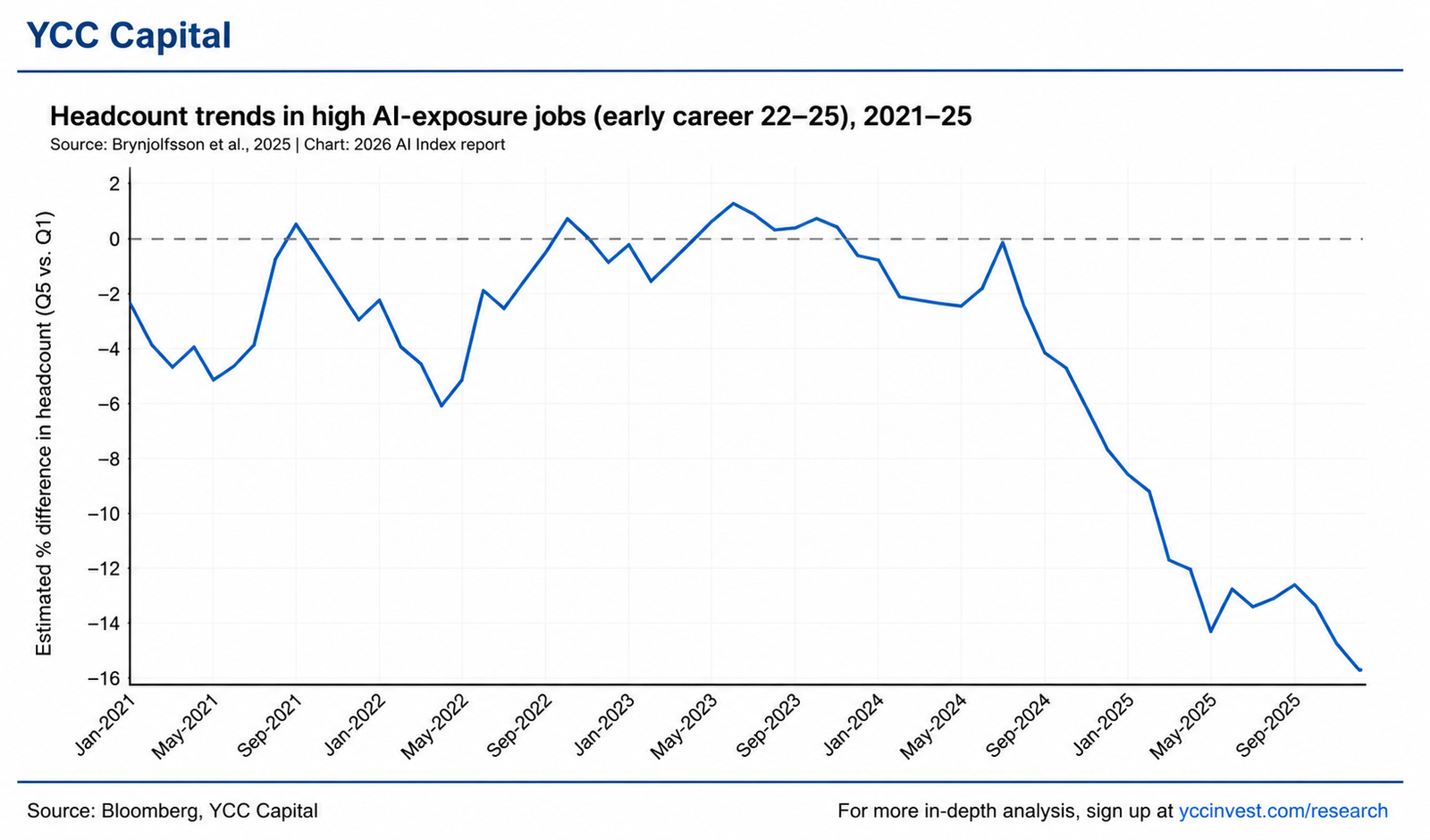
The earliest employment effects are increasingly visible among entry-level knowledge workers.
Recent research suggests that younger professionals employed in highly AI-exposed occupations have experienced relatively weaker hiring trends than comparable groups in previous years.
This should not necessarily be interpreted as large-scale technological unemployment.
Instead, it reflects a gradual change in hiring dynamics.
Companies that previously recruited multiple junior analysts may now require fewer entry-level employees because AI handles portions of documentation, coding, research, and administrative preparation.
This phenomenon creates an important macroeconomic trade-off.
Faster enterprise AI adoption improves productivity but potentially slows early-career employment opportunities.
Slower adoption preserves employment in the short run but delays broader productivity gains.
Governments, regulators, and corporations will increasingly need to balance these competing objectives.
The Next Competitive Battlefield: Organizational Intelligence
The first phase of the AI race focused on computational intelligence.
Who could build the largest models?
Who possessed the fastest chips?
Who controlled the largest datasets?
The second phase increasingly revolves around organizational intelligence.
Which companies can redesign themselves fastest?
Which management teams are willing to abandon legacy processes?
Which enterprises possess sufficiently clean data architectures?
Which organizations can integrate humans and AI agents into a cohesive operating model?
These questions may ultimately determine competitive leadership far more than incremental differences in benchmark performance between foundation models.
Indeed, many frontier AI models already exceed the practical capabilities required for a wide range of commercial applications.
The constraint has shifted away from model intelligence toward enterprise execution.
In many respects, the limiting factor is no longer technology.
It is management.
Conclusion
Artificial intelligence continues to represent one of the most profound technological transformations of the modern era. Yet history suggests that investors should distinguish carefully between technological breakthroughs and economic revolutions.
The market has largely priced in continued advances in model capability.
Whether those capabilities translate into durable earnings growth now depends upon a much slower process: organizational reinvention.
As enterprises confront fragmented data, aging technology infrastructure, regulatory complexity, and entrenched corporate incentives, AI adoption will likely proceed unevenly across industries.
This divergence will create both winners and losers.
Some firms will successfully redesign themselves around AI-native operating models, unlocking substantial productivity gains and durable competitive advantages.
Others may spend aggressively on AI tools while realizing only marginal improvements in financial performance.
At YCC Capital, we remain constructive on the long-term trajectory of artificial intelligence, particularly across U.S. innovation ecosystems, cloud infrastructure, enterprise software, and semiconductor supply chains. At the same time, we remain measured regarding the pace at which AI will reshape the broader economy, recognizing that organizational transformation is inherently slower than technological innovation.
Investors should therefore maintain a dual perspective: micro-level optimism grounded in accelerating technological progress, coupled with macro-level caution as enterprises navigate the difficult process of restructuring decades-old institutions.
The most valuable AI company of the next decade may not be the one with the smartest model.
It may be the one that teaches entire organizations how to work differently.
Key Risks
Our constructive long-term outlook is subject to several important risks.
First, current measurements of AI exposure across occupations remain incomplete and may underestimate or overstate the pace of labor-market disruption, making employment projections inherently uncertain.
Second, AI agent capabilities may evolve more slowly than expected. If autonomous systems fail to achieve reliable enterprise-grade performance, the anticipated productivity gains and associated investment returns could be materially delayed.
Third, a renewed inflation cycle driven by unexpectedly accommodative global monetary policy could weaken corporate investment appetite, compress technology spending, and delay AI deployment. Under such a scenario, enterprises may prioritize broad cost reductions through conventional restructuring rather than AI-led productivity enhancement, increasing investor concerns over the return on substantial AI capital expenditures.
Sources: Bloomberg, YCC Capital
Editorial Board
Ken Cao
Chief Strategist, Global Investment Strategy
Le Gao
Managing Analyst
Yui Nabeshima
Strategist
Mai Ikeda
Research Analyst
IMPORTANT DISCLAIMER
This research report is provided for informational and educational purposes only and does not constitute an offer to sell or a solicitation of an offer to buy any securities, financial instruments, or investment products. It is not intended as investment, legal, accounting, or tax advice and should not be relied upon as such. The views, opinions, and projections expressed herein are those of YCC Capital Management and its research personnel as of the date of publication and are subject to change without notice. Past performance is not indicative of future results.
YCC Capital Management, its affiliates, principals, and employees may hold long or short positions in securities or instruments discussed in this report and may trade for their own accounts or for client accounts in a manner inconsistent with the recommendations herein. This report is based on publicly available information and data believed to be reliable, but YCC Capital makes no representation or warranty, express or implied, as to the accuracy, completeness, or timeliness of such information. Forward-looking statements involve risks and uncertainties that could cause actual results to differ materially from those projected.
Recipients of this report should conduct their own independent due diligence and consult with their own financial, legal, and tax advisors before making any investment decisions. YCC Capital accepts no liability for any loss or damage arising from the use of or reliance on this report or its contents.
This report is intended solely for the use of the intended recipient(s) and may not be reproduced or redistributed for commercial purposes without the prior written consent of YCC Capital. © 2026 YCC Capital. All rights reserved. YCC Capital’s flagship vehicle, the YCC International Value Fund, LP, maintains a concentrated global macro value strategy with a focus on capital-flow-driven mispricings and asymmetric hedging opportunities. The Fund is registered in the State of Delaware, U.S. and structured as a 506(c) fund. Performance data, where referenced, has been verified by independent third parties including NAV Consulting; however, individual investor results may vary.
Contact Us
YCC Capital Research
Email: ir@yccinvest.com
Sign up for our free daily market insights and macro research at www.yccinvest.com.
For more related research:
The AI Gold Rush Is Far From Over—But the Margin for Error Is Shrinking(Opens in a new browser tab)
The AI Economy Has Two Engines: Why Demand Booms Today and Productivity Wins Tomorrow
After the Dollar: The Next Monetary Order and the Strategic Choices Facing China