YCC CAPITAL
Emerging Markets & China Strategy
Date: July 12, 2026
Executive Summary
Walking through a port such as Shanghai, Ningbo or Shenzhen offers a useful reminder of how globalization has evolved. Twenty years ago, endless rows of containers were filled largely with toys, garments and inexpensive household products destined for American and European consumers. Today, many of those containers carry electric vehicles, industrial machinery, lithium batteries, semiconductor components, precision instruments and increasingly sophisticated intermediate goods that are embedded deep inside global manufacturing supply chains.
That transformation tells a much bigger story than simple export growth. It reflects China’s steady migration from being primarily the world’s assembly line toward becoming one of the world’s largest suppliers of industrial capital goods and manufacturing inputs.
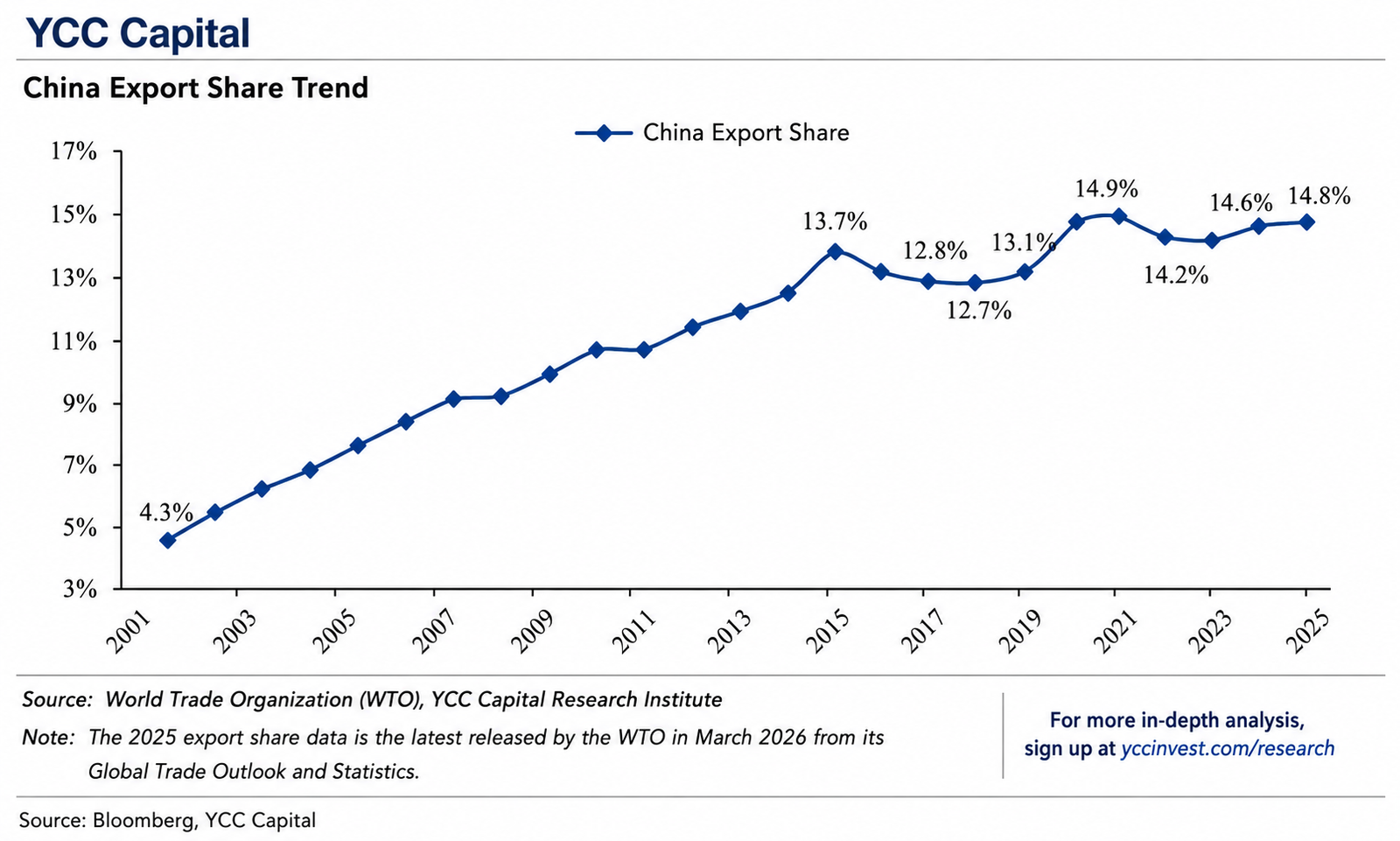
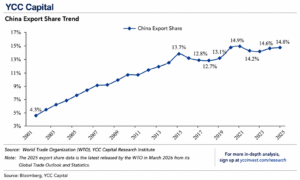
Despite an increasingly hostile geopolitical environment—including tariffs, supply-chain diversification, technology restrictions and rising protectionism—China’s share of global merchandise exports has remained remarkably resilient. According to the latest WTO estimates, China’s global export share climbed from just 4.3% in 2001 to 14.8% in 2025, approaching historical highs despite years of escalating trade tensions.
At first glance, this appears paradoxical. Conventional wisdom suggested that tariffs and “decoupling” would produce a sustained decline in China’s export dominance. Instead, China’s exporters adapted. They shifted toward higher-value manufacturing, expanded aggressively into emerging markets, strengthened regional supply chains, and increasingly supplied intermediate goods rather than only finished consumer products.
Yet success has also generated its own vulnerabilities.
As China’s manufacturing footprint expands, political resistance abroad is becoming increasingly intense. Industrial policies across the United States, Europe, India and parts of Southeast Asia increasingly seek to reduce dependence on Chinese manufacturing while simultaneously rebuilding domestic production capacity. Rather than disappearing, globalization is becoming fragmented into overlapping regional production networks.
From YCC Capital’s perspective, this distinction matters enormously.
The key question is no longer whether China can continue exporting large volumes of goods. Rather, investors should ask whether China’s expanding export sector can continue offsetting mounting domestic structural weaknesses—including property-sector contraction, demographic decline, soft household consumption, and declining private-sector confidence.
Exports remain one of China’s strongest cyclical pillars. They are unlikely, however, to fully compensate for broader structural headwinds over the coming decade.
YCC Perspective
Financial markets often focus on quarterly export numbers, but long-term competitive dynamics resemble a marathon far more than a sprint.
A runner who accelerates early eventually faces stronger competition from rivals who adapt their own strategies. China’s export sector has become that early leader. Decades of investment in infrastructure, logistics, manufacturing clusters and engineering talent created extraordinary economies of scale. Those advantages remain significant today.
However, every competitive advantage eventually provokes a response.
Governments increasingly view supply chains through the lens of national security rather than pure economic efficiency. Trade policy has consequently become an extension of industrial policy, making future export growth increasingly dependent on geopolitics rather than simply production costs.
For investors, this means distinguishing between China’s manufacturing competitiveness, which remains formidable, and China’s macroeconomic outlook, which faces considerably greater challenges.
China’s Rising Share of Global Exports (2001–2025)
China’s accession to the World Trade Organization in 2001 fundamentally altered the structure of global commerce.
Membership provided Chinese manufacturers with greater access to international markets while simultaneously encouraging unprecedented inflows of foreign direct investment. International companies relocated production to China, attracted by abundant labor, improving infrastructure, expanding supplier ecosystems and relatively low production costs.
The results were dramatic.
China’s share of global merchandise exports rose steadily from 4.3% in 2001 to 13.7% by 2015, representing one of the fastest expansions in modern trade history. During this period, China increasingly became the central manufacturing hub for countless multinational supply chains.
Several episodes during this expansion deserve particular attention.
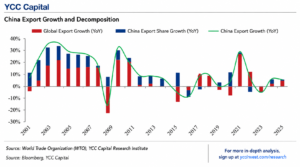
First, China’s export share continued rising even during periods when global trade itself weakened. During both the Global Financial Crisis and subsequent cyclical downturns, China’s relative competitiveness improved despite slower worldwide demand. In other words, China was not simply benefiting from a larger global market—it was steadily capturing market share from competing producers.
Second, the first meaningful slowdown in China’s export share occurred before the formal escalation of U.S.–China trade tensions.
Between 2015 and 2017, China’s global export share slipped modestly from 13.7% to 12.8%, reflecting the gradual relocation of lower-value manufacturing industries toward lower-cost economies such as Vietnam, Bangladesh and Cambodia. Rising wages, land prices and environmental compliance costs made certain labor-intensive industries less competitive.
This distinction is important because it demonstrates that structural upgrading—not tariffs alone—was already reshaping China’s manufacturing base.
Trade friction accelerated an existing trend rather than creating it.
Third, although the U.S. tariff campaign beginning in 2018 temporarily reduced China’s export share, the impact proved less durable than many observers anticipated.
China’s export share dipped modestly during 2018 before recovering during 2019 as manufacturers adapted through supply-chain adjustments, transshipment routes, overseas assembly operations and broader geographic diversification.
The COVID pandemic then created an extraordinary temporary boost.
China reopened manufacturing earlier than most competing economies, allowing its factories to supply products while much of the rest of the world remained constrained by lockdowns. This temporary “supply substitution” effect pushed China’s export share to approximately 14.9% during 2021, the highest level on record at the time.
Some normalization followed in 2022 as competing production capacity returned.
However, beginning in 2024 China’s export share resumed its upward trajectory despite intensifying geopolitical pressure. This renewed strength reflected a structural evolution rather than another temporary pandemic-related distortion.
Instead of relying primarily on inexpensive consumer products, Chinese exporters increasingly captured demand in higher-value industrial sectors where global investment remained strong.
From YCC Capital’s perspective, this represents the single most important development in understanding China’s modern export performance.
The composition of exports has become significantly more important than the absolute volume of exports.
Traditional labor-intensive industries have gradually become less central to China’s external sector. In their place, advanced manufacturing, industrial equipment, renewable-energy technologies and sophisticated intermediate goods increasingly define China’s competitive advantage.
This transition helps explain why trade restrictions have slowed—but not reversed—China’s export expansion.
Unlike garments or footwear, complex industrial products are considerably more difficult to replace quickly. They often require extensive supplier networks, accumulated engineering expertise, advanced logistics systems and significant manufacturing scale—all areas where China continues to maintain meaningful advantages.
Nevertheless, investors should avoid interpreting these achievements as evidence that China’s economic challenges have disappeared.
Export strength continues to mask significant domestic imbalances. Manufacturing investment remains considerably stronger than household consumption, while domestic demand continues to lag productive capacity. This imbalance contributes to persistent deflationary pressures, corporate margin compression and increasing dependence on overseas markets for incremental growth.
That dynamic may ultimately become the defining challenge of China’s next stage of economic development: a world-class manufacturing system increasingly constrained by relatively weak domestic demand.
The Structural Upgrade of China’s Export Basket
If China’s export story over the past two decades can be summarized in one sentence, it is this: the country has steadily moved up the manufacturing value chain.
Twenty years ago, China’s comparative advantage rested primarily on inexpensive labor and enormous production capacity for consumer goods. Today, its strongest export engines increasingly lie in industrial equipment, advanced manufacturing, transportation equipment, electronic components and intermediate goods that enable production elsewhere.
This evolution is more significant than many headline trade statistics suggest.
Countries rarely become wealthier simply by exporting larger quantities of the same products. Instead, long-term income growth is usually associated with producing increasingly sophisticated goods that require greater technological capability, engineering expertise and accumulated industrial know-how. China has spent much of the past decade pursuing precisely this transition.
From “Made in China” to “Built into Global Manufacturing”
China’s export portfolio remains heavily concentrated in industrial manufactured goods.
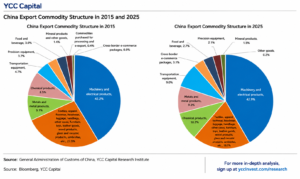
Mechanical and electrical products now account for roughly 43% of total exports, comfortably remaining the country’s largest export category. Labor-intensive products—including apparel, furniture, footwear and toys—still represent an important segment but have declined substantially as a share of total exports. Chemicals, metals, transportation equipment and machinery have all gained importance over the past decade.
The shift reflects more than industrial upgrading.
It also demonstrates how China’s role inside global supply chains has evolved.
Rather than shipping only finished products to consumers, Chinese firms increasingly supply components that other manufacturers require before final assembly occurs. Semiconductor components, electric motors, batteries, transformers, industrial robots, machine tools and precision equipment increasingly form the backbone of export growth.
For investors, this distinction matters enormously because intermediate goods tend to exhibit greater pricing power and stronger customer relationships than commoditized consumer products.
Replacing a T-shirt supplier is relatively straightforward.
Replacing a supplier of industrial robotics, automotive components or precision machinery is considerably more difficult.
That difference helps explain why China’s export competitiveness has proven far more durable than many expected after the onset of trade tensions.
Electric Vehicles Lead a New Generation of Export Growth
Perhaps no sector better illustrates China’s industrial transformation than the automotive industry.
Between 2015 and 2025, vehicles and automotive components became the single largest contributor to China’s expanding global export share.
Automobile exports reached approximately 7.1 million units during 2025, making China the world’s largest automobile exporter. Particularly striking was the performance of new-energy vehicles, whose exports roughly doubled to approximately 2.6 million units.
Unlike earlier generations of Chinese exports, this success no longer depends primarily on inexpensive assembly labor.
Instead, competitive advantages increasingly derive from vertically integrated supply chains, battery manufacturing, software integration, component ecosystems and economies of scale that few competitors currently match.
The emergence of domestic battery champions has reinforced this advantage by lowering production costs while improving technological capabilities across the broader electric vehicle ecosystem.
However, growing success has inevitably attracted greater political scrutiny.
Anti-subsidy investigations across Europe, additional tariffs in North America and domestic industrial policies designed to encourage local production all illustrate a broader trend: governments increasingly view electric vehicles through both economic and strategic lenses.
From YCC Capital’s perspective, future export growth in EVs will therefore depend as much on diplomatic and regulatory developments as on manufacturing competitiveness alone.
Machinery and Industrial Equipment Continue to Expand
Another major contributor to China’s export resilience has been industrial machinery.
As factories around the world invest in automation, digitalization and productivity improvements, demand for manufacturing equipment has expanded considerably.
Exports of machine tools, automated data-processing equipment and industrial machinery have benefited from this global investment cycle.
Artificial intelligence has accelerated this trend further.
The rapid expansion of cloud computing infrastructure, data centers, semiconductor fabrication facilities and advanced manufacturing has generated rising demand for equipment throughout the electronics supply chain.
China occupies an increasingly important position within this ecosystem.
Although restrictions on leading-edge semiconductor technology remain significant, Chinese manufacturers continue to expand exports across numerous adjacent categories including transformers, power equipment, electrical machinery and industrial automation systems.
In many cases, China does not necessarily dominate the most technologically advanced components.
Instead, it excels at manufacturing the vast industrial ecosystem surrounding them.
This broader industrial capability often receives less attention than semiconductor headlines but arguably represents an equally important competitive advantage.
Shipbuilding Has Become a Quiet Strategic Strength
Shipbuilding rarely dominates financial headlines.
Yet it has become one of China’s strongest industrial success stories.
Between 2015 and 2025, China’s ship exports more than doubled while new shipbuilding orders expanded dramatically.
The country has steadily strengthened its position as the world’s largest commercial shipbuilder, benefiting from integrated steel production, efficient industrial clusters, engineering expertise and substantial economies of scale.
Shipping itself forms the foundation of international commerce.
As global trade evolves, demand for container vessels, LNG carriers, specialized industrial ships and energy transportation continues to support long-term order books.
Unlike many consumer industries, commercial shipbuilding typically involves multi-year production cycles, providing greater revenue visibility for manufacturers.
Cross-Border E-Commerce Has Changed Export Distribution
One of the least appreciated developments over the past decade has been the explosive growth of cross-border e-commerce.
Rather than relying exclusively on traditional wholesale distributors, manufacturers increasingly sell directly to consumers worldwide through digital platforms.
Cross-border e-commerce shipments have become an increasingly meaningful contributor to China’s export expansion.
This transformation resembles the difference between traditional bookstores and online retailers.
The underlying product may remain unchanged.
The distribution model becomes dramatically more efficient.
Chinese manufacturers increasingly combine manufacturing advantages with sophisticated logistics networks, digital marketing capabilities and integrated online sales channels, allowing even relatively small firms to reach global consumers directly.
This structural evolution has broadened the export base while reducing dependence on traditional trading intermediaries.
Traditional Labor-Intensive Industries Continue to Retreat
Not every industry has benefited equally.
The most significant drag on China’s global export share has come from traditional labor-intensive sectors.
Apparel remains the clearest example.
Between 2015 and 2025, clothing made the largest negative contribution to China’s export share, while footwear and other labor-intensive consumer products also declined.
The reasons are largely structural.
China has become wealthier.
Average wages have increased substantially.
Land prices, environmental standards and compliance costs have all risen.
These developments naturally encourage production of lower-value goods to migrate toward lower-cost economies.
Vietnam and Bangladesh have emerged as major beneficiaries.
Their apparel industries expanded rapidly over the past decade, steadily capturing market share previously dominated by Chinese producers.
Importantly, this migration should not necessarily be viewed as evidence of declining competitiveness.
Instead, it resembles the historical evolution experienced by Japan, South Korea and Taiwan during earlier stages of development.
As incomes rise, economies typically relinquish lower-value manufacturing while concentrating increasingly on higher-value production.
China appears to be following a similar trajectory.
YCC Capital’s Strategic View
China’s export structure is becoming simultaneously stronger and more vulnerable.
It is stronger because sophisticated manufacturing sectors generally enjoy higher barriers to entry, greater technological content and more resilient competitive advantages than labor-intensive industries.
Yet it is also becoming more vulnerable because these same sectors increasingly intersect with geopolitical competition.
Electric vehicles, batteries, semiconductors, renewable energy equipment, telecommunications infrastructure and industrial automation have all become strategic industries where governments actively intervene through subsidies, tariffs and industrial policy.
In other words, China’s export challenge is gradually shifting.
The primary question is no longer whether Chinese firms can compete globally.
They clearly can.
The more important question is whether global political systems will continue allowing markets alone to determine purchasing decisions.
That distinction is likely to define the next decade of international trade.
Geographic Diversification Has Become China’s Most Important Strategic Advantage
While the composition of China’s exports has changed dramatically over the past decade, an equally important transformation has occurred in where those exports are going.
For years, discussions surrounding China’s trade outlook were dominated by one question: How dependent is China on the U.S. market?
Today, that question is becoming increasingly outdated.
China has not replaced the United States with a single alternative destination. Instead, it has gradually built a far broader export network spanning Southeast Asia, Latin America, the Middle East, Africa and parts of Eurasia. This diversification has significantly reduced China’s vulnerability to shocks originating in any one economy while simultaneously reinforcing its role at the center of numerous regional manufacturing ecosystems.
From YCC Capital’s perspective, this geographic shift has become every bit as important as China’s industrial upgrading.
The resilience of China’s export sector increasingly reflects market diversification rather than market concentration.
The Era of Overdependence on Developed Markets Is Ending
China’s ten largest export destinations still account for more than 70% of total exports. However, the concentration within that group has changed materially.
By 2025, China’s largest export markets consisted of ASEAN, the European Union, the United States, Hong Kong, Japan, South Korea, India, Russia, Mexico and the United Kingdom.
The most notable development is that ASEAN has overtaken both the United States and the European Union to become China’s largest export destination.
This represents far more than a statistical milestone.
It reflects the emergence of Asia as an increasingly integrated manufacturing ecosystem in which production is distributed across multiple countries while China remains the dominant supplier of industrial inputs, machinery and intermediate goods.
Meanwhile, the combined share of China’s top ten export markets has gradually declined, indicating that export growth is becoming more geographically diversified rather than increasingly concentrated.
For investors, this reduces exposure to single-country political risks while expanding opportunities across faster-growing emerging economies.
ASEAN Has Become the New Anchor of China’s External Trade
No region illustrates China’s strategic repositioning better than Southeast Asia.
Over the past decade, ASEAN economies have accelerated industrialization while simultaneously attracting substantial foreign direct investment. Multinational corporations relocating portions of their production away from China have frequently chosen Vietnam, Indonesia, Thailand and Malaysia.
At first glance, this appears detrimental to China.
The reality is considerably more nuanced.
Many factories established in Southeast Asia continue relying heavily on Chinese machinery, industrial equipment, electronic components and production materials. Instead of replacing Chinese manufacturing, many have become extensions of broader regional supply chains.
Consequently, China’s exports to ASEAN have grown consistently despite the relocation of certain assembly operations.
Intermediate goods and capital equipment have led this expansion.
Electrical equipment, machinery, industrial components and manufacturing inputs increasingly dominate trade flows between China and Southeast Asia.
In many respects, ASEAN’s industrial rise has strengthened rather than weakened China’s position within regional supply chains.
China increasingly supplies the factories that ultimately manufacture products destined for global consumers.
This represents an important shift from being solely an exporter of finished products toward becoming the principal supplier of industrial production itself.
Emerging Markets Are Becoming the Next Engine of Growth
Beyond Southeast Asia, China’s commercial relationships with Africa, Latin America and the Gulf region have strengthened steadily.
Infrastructure investment associated with the Belt and Road Initiative has expanded transportation links, logistics networks and commercial relationships across numerous developing economies.
These regions possess characteristics that complement China’s industrial strengths.
Many remain in relatively early stages of industrialization and urbanization.
Demand for electrical infrastructure, construction materials, transportation equipment, industrial machinery and manufacturing technology continues expanding as populations grow and economic development progresses.
China, meanwhile, possesses the manufacturing capacity to satisfy these requirements at competitive prices.
The relationship is therefore increasingly complementary rather than directly competitive.
Between 2015 and 2025, China’s share of imports across Gulf economies, Africa and Latin America rose meaningfully, underscoring the country’s expanding commercial influence beyond traditional developed markets.
Unlike mature economies where consumer demand often dominates imports, many emerging markets import primarily to build productive capacity.
That distinction is strategically significant.
Factories require machinery before they produce goods.
Cities require infrastructure before households increase discretionary consumption.
Consequently, demand for capital goods and industrial equipment often exhibits greater persistence than purely consumer-driven imports.
Russia Has Become an Increasingly Important Market
Russia represents one of the most dramatic changes in China’s export geography.
Following the outbreak of the Russia-Ukraine conflict and the withdrawal of numerous Western companies, Chinese firms rapidly expanded their presence across multiple sectors.
Automobiles, machinery, industrial equipment, consumer electronics and household goods all experienced significant increases in market share.
China has consequently become Russia’s largest import supplier.
From a purely commercial perspective, this expansion has partially offset weaker demand elsewhere.
However, investors should recognize that Russia’s growing importance also introduces geopolitical complexity.
Sanctions, financial restrictions and evolving diplomatic relationships create uncertainties that differ markedly from traditional commercial risks.
Although Russia currently represents an attractive export destination for many Chinese manufacturers, long-term investment decisions should continue accounting for elevated political and regulatory uncertainty.
India Presents Opportunity—but Also Limits
India is frequently viewed as China’s next major export opportunity.
Its large population, expanding middle class and accelerating economic growth undoubtedly support rising import demand.
Yet India’s relationship with Chinese manufacturing differs meaningfully from that of Southeast Asia.
New Delhi has actively pursued industrial policies designed to reduce dependence on Chinese imports while encouraging domestic production across strategic industries.
Consequently, although India’s imports from China have continued expanding, the increase has been more gradual than observed across ASEAN.
India remains an attractive growth market.
It is unlikely, however, to become as deeply integrated into Chinese industrial supply chains as Southeast Asia over the foreseeable future.
This reflects both economic considerations and broader geopolitical competition.
North America Is Being Reshaped Through Mexico
Perhaps the most overlooked consequence of U.S.-China trade tensions has been Mexico’s emergence as a manufacturing bridge between Asia and North America.
Nearshoring has encouraged numerous manufacturers to expand production inside Mexico while maintaining significant sourcing relationships with Chinese suppliers.
Rather than exporting finished products directly into the United States, many companies now ship machinery, industrial equipment and intermediate components into Mexico before final assembly occurs.
Mexico therefore functions less as a replacement for China than as an extension of broader North American manufacturing.
Chinese exports to Mexico have increased accordingly.
This demonstrates a recurring theme throughout global trade over the past decade.
Supply chains rarely disappear.
They evolve.
Production becomes geographically more complex without necessarily eliminating China’s central role.
The United States Remains the Largest Strategic Challenge
Despite successful diversification, the United States remains China’s single most important geopolitical trading relationship.
The decline in direct export dependence has been unmistakable.
China’s share of exports destined for the United States has fallen substantially over the past decade, while the share of U.S. imports sourced directly from China has also declined.
Trade restrictions, tariffs, export controls and industrial subsidies have fundamentally reshaped bilateral commerce.
Moreover, these developments increasingly enjoy bipartisan political support in Washington, suggesting that they are unlikely to reverse quickly regardless of electoral outcomes.
Nevertheless, it would be premature to conclude that economic decoupling is complete.
Commercial ties remain extensive.
Many supply chains continue involving Chinese components either directly or indirectly through third countries.
Complete separation would require enormous capital investment, higher production costs and years of industrial adjustment.
From YCC Capital’s perspective, selective decoupling—not comprehensive disengagement—remains the more probable long-term scenario.
Strategic sectors such as semiconductors, telecommunications, advanced computing and critical minerals will likely continue experiencing greater political intervention.
Consumer goods, industrial components and many intermediate products, by contrast, are likely to remain substantially interconnected.
Europe Faces a Different Challenge
Europe presents a more nuanced picture.
Economic growth across much of the continent has slowed materially since the energy crisis triggered by the Russia-Ukraine conflict.
Weak manufacturing activity and subdued domestic demand have limited import growth overall.
Yet even as Europe’s share of China’s total exports has declined modestly, Chinese products have generally strengthened their competitive position within European markets.
Lower production costs, integrated supply chains and scale efficiencies continue making Chinese manufacturers highly competitive across numerous industrial sectors.
However, Europe increasingly seeks to balance economic efficiency with industrial resilience.
Investigations into electric vehicles, renewable energy products and industrial subsidies illustrate that European policymakers, like their American counterparts, are placing greater emphasis on strategic autonomy.
This does not imply the end of commercial engagement.
It does suggest that future market access will increasingly depend on political negotiations as well as competitive pricing.
YCC Capital’s Strategic View
China’s export geography today is considerably healthier than many investors appreciate.
No single market now determines the trajectory of Chinese exports.
Instead, a diversified network of emerging economies increasingly provides incremental growth, while regional manufacturing integration strengthens China’s role within global industrial production.
At the same time, diversification should not be mistaken for immunity.
The broader geopolitical environment continues moving toward greater fragmentation, industrial policy and strategic competition. Export resilience alone cannot fully offset domestic structural weaknesses, particularly soft household consumption, an aging population and persistent pressure on the property sector.
China’s external sector is likely to remain a source of strength over the medium term. Whether it can continue carrying the broader economy will depend increasingly on domestic reforms rather than export performance alone.
2026 Outlook: China’s Export Momentum Is Likely to Continue—but So Will Global Resistance
Forecasting China’s exports has become considerably more complex than simply estimating global GDP growth or world trade volumes.
The forces shaping Chinese exports today are increasingly structural rather than cyclical. Artificial intelligence, energy security, industrial policy and geopolitical competition are exerting as much influence over trade flows as consumer demand or monetary policy.
Viewed through that lens, YCC Capital expects China’s share of global merchandise exports to remain resilient over the medium term, although the path forward is likely to become increasingly uneven.
The central question is no longer whether China can manufacture competitively. It is whether global political and economic systems will continue allowing that competitiveness to translate into market share at the same pace as during the previous two decades.
Artificial Intelligence Is Creating an Entirely New Export Cycle
Every major technological revolution generates new waves of international trade.
The personal computer boom transformed semiconductor exports.
The smartphone era reshaped electronics supply chains.
Artificial intelligence is now beginning to create another comparable investment cycle.
Unlike consumer technologies, AI requires enormous physical infrastructure.
Data centers require servers.
Servers require processors.
Processors require advanced manufacturing equipment.
Factories producing these components require automation systems, industrial machinery, transformers, cooling systems, electrical equipment and increasingly sophisticated precision manufacturing.
China participates across much of this industrial ecosystem.
Although export controls continue restricting China’s access to the most advanced semiconductor technologies, Chinese firms remain highly competitive across numerous adjacent industries including electrical machinery, industrial automation, power equipment, batteries, electronic components and manufacturing hardware.
Recent export performance reflects this trend.
Shipments of integrated circuits, automatic data-processing equipment and related electronics have expanded rapidly, becoming among the largest contributors to overall export growth.
This illustrates an important investment principle.
Sometimes the most attractive opportunities do not emerge from the technology receiving the headlines.
Instead, they emerge from the industrial suppliers enabling that technology to exist.
During the California Gold Rush, many merchants selling tools ultimately earned more stable profits than miners searching for gold.
China increasingly occupies a comparable position within portions of the global AI supply chain.
Energy Security Will Continue Supporting Green Manufacturing
Another structural force likely to sustain Chinese exports is the global transition toward cleaner and more secure energy systems.
Recent geopolitical conflicts have highlighted the vulnerabilities associated with dependence on imported fossil fuels.
Energy security has therefore become a strategic objective alongside environmental sustainability.
Electric vehicles, batteries, solar modules, power storage systems and electrical infrastructure increasingly satisfy both priorities.
China currently maintains substantial advantages across each of these industries.
Years of manufacturing investment, integrated supply chains and economies of scale have significantly reduced production costs while improving product quality.
Consequently, Chinese renewable-energy equipment remains highly competitive across both developed and emerging markets.
Nevertheless, investors should distinguish between strong global demand and unrestricted market access.
Governments increasingly support domestic renewable industries through subsidies, procurement rules and tariff protection.
The United States has expanded incentives for local clean-energy manufacturing under successive industrial policies, while Europe has become increasingly willing to investigate imported products perceived to benefit from state support.
The result is likely to be continued growth in worldwide demand accompanied by more fragmented regional production.
China should remain a leading supplier.
Its market share may increasingly depend on local production partnerships, overseas manufacturing facilities and multinational investment strategies rather than exports alone.
Emerging Markets Will Remain the Largest Source of Incremental Demand
Perhaps the strongest structural support for China’s exports lies outside the developed world.
Large portions of Southeast Asia, Africa, the Middle East and Latin America remain early in their industrialization process.
Urbanization continues.
Infrastructure investment remains substantial.
Electricity demand continues rising.
Transportation networks continue expanding.
Each of these trends generates demand for industrial equipment, construction materials, electrical machinery and manufacturing technology—precisely the categories where Chinese firms possess considerable competitive strengths.
Unlike consumer spending cycles, industrialization tends to unfold over many years.
Factories require continuous investment.
Power grids require modernization.
Transportation systems require ongoing expansion.
These structural needs provide a relatively stable foundation for long-term export demand.
Consequently, YCC Capital expects emerging markets to remain China’s most important source of incremental export growth throughout the remainder of this decade.
But China’s Biggest Constraint Lies at Home
Strong exports should not obscure China’s broader macroeconomic challenges.
Indeed, one of the defining characteristics of China’s current economy is the widening gap between manufacturing strength and domestic demand.
Industrial production continues expanding rapidly.
Household consumption remains comparatively subdued.
Property investment continues adjusting after years of excess leverage.
Demographic trends have turned increasingly unfavorable.
Private-sector confidence remains weaker than policymakers would prefer.
These factors matter because a healthy economy cannot indefinitely rely upon external demand to absorb expanding productive capacity.
History provides numerous examples.
Germany and Japan both built extraordinary export-oriented manufacturing sectors.
Yet both eventually confronted demographic pressures and slowing domestic demand that limited broader economic expansion.
China now faces a comparable challenge, albeit on a much larger scale.
From YCC Capital’s perspective, exports can cushion cyclical weakness.
They cannot permanently substitute for durable improvements in domestic consumption, productivity growth and private investment confidence.
This distinction is particularly important for global investors evaluating China’s long-term trajectory.
The country’s manufacturing sector may continue outperforming.
The broader economy may still experience slower trend growth.
Investment Implications
Several strategic conclusions emerge from this analysis.
First, China’s manufacturing competitiveness remains significantly stronger than many market narratives imply.
Despite tariffs, export controls and geopolitical tensions, Chinese firms continue gaining global market share across numerous advanced industrial sectors.
Second, supply-chain diversification should not be confused with supply-chain abandonment.
Production is becoming geographically distributed, but China frequently remains the principal supplier of machinery, intermediate goods and industrial inputs supporting manufacturing elsewhere.
Third, investors should increasingly differentiate between sectors.
Companies exposed to advanced manufacturing, industrial automation, electrical equipment, renewable energy technologies and AI-related supply chains are likely to enjoy more durable structural support than businesses concentrated in labor-intensive consumer manufacturing.
Fourth, geopolitical risk deserves a permanent valuation premium.
Industrial policy has become a central feature of international competition.
Future investment returns will increasingly depend upon understanding government incentives, trade policy and regional production strategies alongside traditional financial metrics.
Finally, investors should avoid viewing China’s export resilience as synonymous with overall economic strength.
The export sector represents one of China’s greatest competitive advantages.
It also increasingly carries the burden of compensating for weaknesses elsewhere in the economy.
That is a challenging position for any country to sustain indefinitely.
YCC Capital Conclusion
China’s export sector has entered a new phase of development.
The era when inexpensive labor alone powered export growth has largely passed. In its place stands a considerably more sophisticated industrial ecosystem centered on advanced manufacturing, intermediate goods, renewable energy technologies, transportation equipment and increasingly AI-enabled production.
This transformation explains why China’s global export share has remained resilient despite years of tariffs, technology restrictions and geopolitical fragmentation.
Yet success abroad should not obscure challenges at home.
The world is becoming less willing to depend overwhelmingly on any single manufacturing center, regardless of efficiency. Governments increasingly view supply chains as matters of national security, while many multinational corporations continue diversifying production across multiple jurisdictions.
China therefore enters the next decade from a position of considerable industrial strength but rising strategic complexity.
For investors, the most productive framework is neither unqualified optimism nor excessive pessimism. Rather, it is to recognize two realities simultaneously: China’s manufacturing capabilities remain among the strongest in the world, while its broader economic model faces mounting structural constraints that exports alone cannot fully resolve.
The next chapter of global trade will not be defined by whether China continues exporting. It almost certainly will.
Instead, it will be defined by how successfully China adapts to a world that increasingly values resilience, redundancy and geopolitical alignment alongside efficiency.
Editorial Board
Ken Cao
Chief Strategist, Global Investment Strategy
Le Gao
Managing Analyst
Yui Nabeshima
Strategist
Mai Ikeda
Research Analyst
IMPORTANT DISCLAIMER
This research report is provided for informational and educational purposes only and does not constitute an offer to sell or a solicitation of an offer to buy any securities, financial instruments, or investment products. It is not intended as investment, legal, accounting, or tax advice and should not be relied upon as such. The views, opinions, and projections expressed herein are those of YCC Capital Management and its research personnel as of the date of publication and are subject to change without notice. Past performance is not indicative of future results.
YCC Capital Management, its affiliates, principals, and employees may hold long or short positions in securities or instruments discussed in this report and may trade for their own accounts or for client accounts in a manner inconsistent with the recommendations herein. This report is based on publicly available information and data believed to be reliable, but YCC Capital makes no representation or warranty, express or implied, as to the accuracy, completeness, or timeliness of such information. Forward-looking statements involve risks and uncertainties that could cause actual results to differ materially from those projected.
Recipients of this report should conduct their own independent due diligence and consult with their own financial, legal, and tax advisors before making any investment decisions. YCC Capital accepts no liability for any loss or damage arising from the use of or reliance on this report or its contents.
This report is intended solely for the use of the intended recipient(s) and may not be reproduced or redistributed for commercial purposes without the prior written consent of YCC Capital.
© 2026 YCC Capital. All rights reserved.
YCC Capital’s flagship vehicle, the YCC International Value Fund, LP, maintains a concentrated global macro value strategy focused on capital-flow-driven market mispricings, asymmetric risk management, and long-duration investment opportunities. The Fund is registered in the State of Delaware, United States, and is structured as a Rule 506(c) private investment vehicle. Where performance data is referenced, such information has been independently verified by third-party administrators including NAV Consulting; however, individual investor results may differ depending on subscription timing, fees, and capital activity.
Nothing contained in this publication should be interpreted as a guarantee of future performance or investment results. Estimates, forecasts and opinions represent the judgment of YCC Capital as of the publication date and may change without notice as market conditions evolve.
Contact Us
YCC Capital Research
Email: ir@yccinvest.com
For institutional inquiries, media requests, partnership opportunities, or to discuss our latest macro research, please contact the YCC Capital Research team at ir@yccinvest.com.
To receive our free daily global macro and market insights, subscribe at:
YCC Capital Research
Global perspectives. Independent thinking. Long-term investing.
For more related research:
China’s Recovery Is Losing Altitude: Exports Mask a Deepening Domestic Slowdown
Oil After the Shock: Why Tight Supply Is Likely to Keep Inflation Elevated Through Year-End