YCC CAPITAL
Innovation Themes & Strategy
Date: July 2, 2026
Executive Perspective
Every major technological revolution begins with excitement, enormous capital spending, and widespread predictions that the economy has entered an entirely new era. Railroads, electricity, automobiles, the internet—all followed remarkably similar paths. Investors initially overestimated the short-term economic transformation while underestimating the profound long-term changes that eventually unfolded.
Artificial intelligence appears to be following that same historical script.
The current AI cycle is often described as a productivity revolution, yet much of what markets are experiencing today is not productivity—it is demand. Massive investment in semiconductors, hyperscale data centers, networking infrastructure, cloud computing, and enterprise software has become one of the largest capital expenditure cycles in decades. Those investments are already reshaping business cycles, financial markets, and monetary policy.
The productivity revolution, however, remains largely ahead of us.
This distinction is critical because it explains why AI has already transformed the U.S. economy while its macroeconomic influence in China remains considerably more limited despite equally impressive technological advances.
At YCC Capital, we believe investors should evaluate AI through two entirely different macroeconomic lenses.
The first is AI as a cyclical demand shock, capable of altering economic expansions, inflation dynamics, and capital markets over the next several years.
The second is AI as a structural productivity revolution, capable of permanently lifting potential economic growth—but only if technological diffusion, institutional adaptation, and labor-market adjustment successfully occur.
Confusing these two mechanisms has become one of the biggest analytical mistakes in today’s macro debate.
AI Operates Through Two Separate Economic Channels
Macroeconomics traditionally distinguishes between two different questions.
The first asks why economies fluctuate over business cycles.
The second asks why economies become richer over decades.
Artificial intelligence influences both, but through fundamentally different mechanisms.
During the early stages of adoption, AI behaves primarily as an investment shock. Firms dramatically increase capital expenditure before productivity improvements are fully realized. Data centers, advanced chips, networking equipment, cloud infrastructure, software development, and organizational restructuring all require enormous investment long before measurable productivity gains appear in official statistics.
Economists Erik Brynjolfsson, Daniel Rock, and Chad Syverson describe this phenomenon as the Productivity J-Curve. During the early phase of a general-purpose technology, businesses devote enormous resources toward intangible investments—organizational redesign, employee training, workflow transformation, and software integration—that national accounting systems fail to capture adequately.
As a result, productivity often appears disappointingly weak precisely when technological investment is strongest.
History repeatedly demonstrates this pattern.
Electricity required decades before factory designs evolved enough to unlock its full efficiency gains. Likewise, the internet generated massive investment during the 1990s while economy-wide productivity improvements only became fully visible years later.
Artificial intelligence appears to be progressing through a remarkably similar trajectory.
AI Has Already Reshaped the U.S. Business Cycle
Perhaps nowhere is AI’s cyclical impact more evident than in the United States.
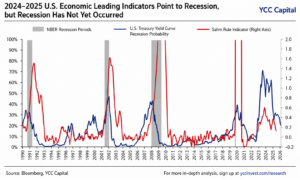
Conventional macroeconomic models suggested that America’s aggressive monetary tightening following the post-pandemic inflation surge would eventually push the economy into recession. Yield-curve inversion, weakening employment indicators, and slowing housing activity all historically pointed toward a meaningful downturn.
Instead, recession never arrived.
The missing variable was AI.
Large technology companies initiated one of the largest investment booms in modern corporate history. Spending on semiconductor infrastructure, cloud capacity, GPU clusters, and AI software accelerated despite elevated interest rates.
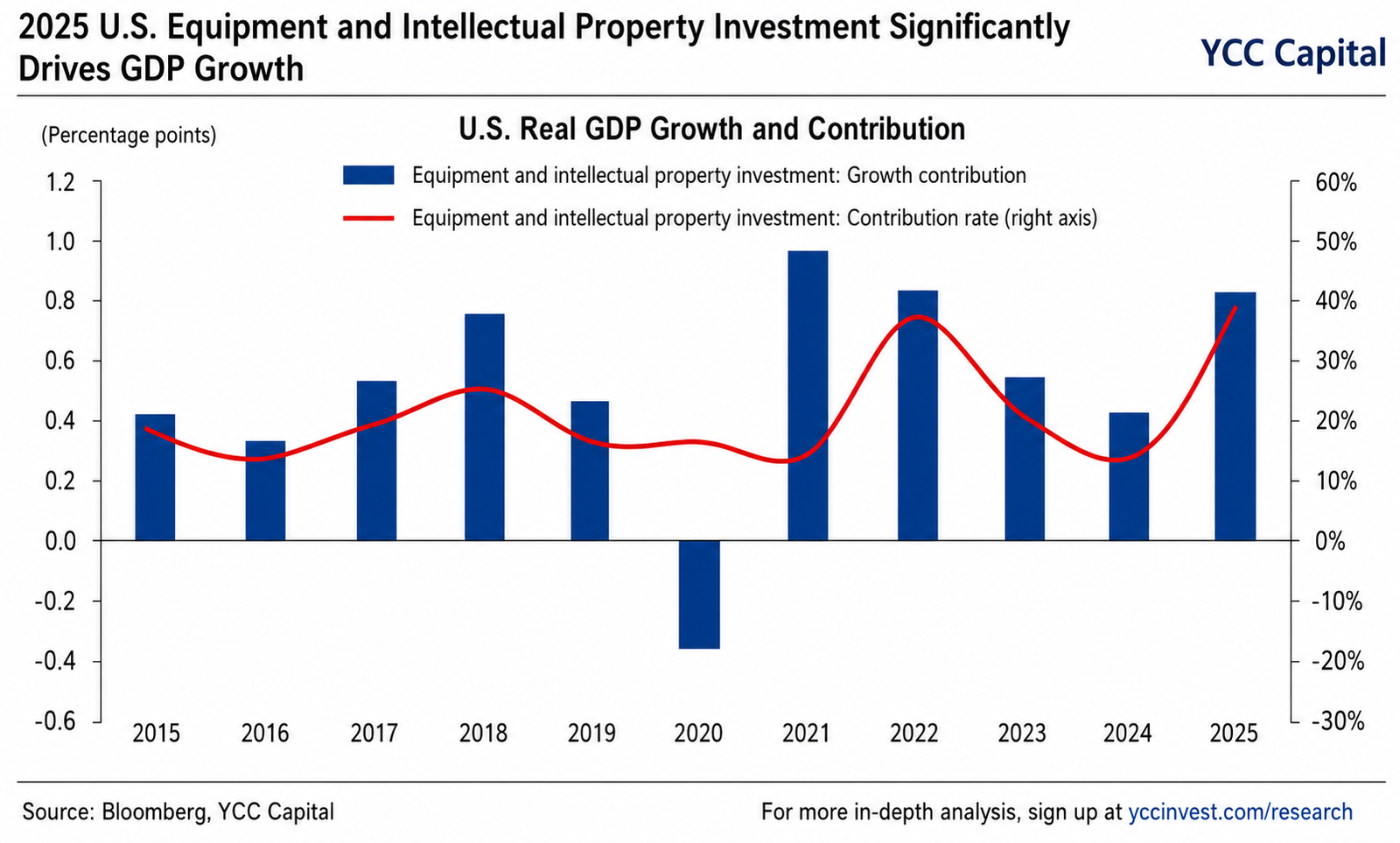
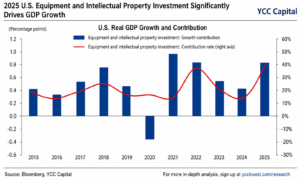
According to the report, equipment and intellectual property investment contributed approximately 0.8 percentage points to U.S. GDP growth in 2025 despite representing only a modest share of the economy. Their contribution accounted for roughly 40% of total economic growth, highlighting how concentrated AI-driven investment has become.
Equally important was the wealth effect.
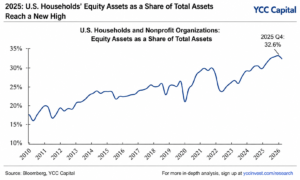
U.S. household equity holdings climbed to record levels as AI optimism fueled one of the strongest technology-led bull markets in decades. Rising financial wealth supported consumer spending even as labor market momentum moderated.
This combination fundamentally altered the expected business cycle.
Instead of the anticipated “soft landing,” the economy effectively experienced what many analysts described as a “no landing” scenario.
Yet beneath the surface, important fractures emerged.
Employment growth slowed.
Housing investment weakened.
Interest-sensitive sectors continued struggling.
Meanwhile, AI-related industries, capital owners, and high-income households captured a disproportionate share of economic gains.
The result has been an increasingly pronounced K-shaped economy, where extraordinary technological prosperity coexists with broader economic unease.
Why AI Complicates Monetary Policy
AI investment creates a unique policy challenge because it simultaneously expands both demand and future productive capacity.
Traditional macroeconomic theory often emphasizes the long-run deflationary effects of technological progress. Higher productivity generally lowers production costs and increases supply.
However, the early stages of technological revolutions frequently generate inflationary pressures rather than disinflation.
Companies compete aggressively for scarce computing resources.
Construction of data centers intensifies.
Specialized labor becomes increasingly expensive.
Semiconductor supply chains tighten.
Organizational restructuring requires significant upfront expenditure.
Consequently, central banks must distinguish between temporary investment-driven inflation and structural productivity improvements that may only materialize years later.
This timing mismatch complicates monetary policy considerably.
The Federal Reserve therefore faces an unusual dilemma: restraining inflation risks suppressing one of the world’s most important productivity investment cycles, while remaining too accommodative risks amplifying financial excesses and speculative capital allocation.
China’s AI Boom Is Real—but Its Macroeconomic Impact Remains Limited
China’s AI sector has expanded rapidly across high-technology manufacturing, digital services, and export industries.
Investment in information services has accelerated.
High-technology industrial production continues outperforming traditional sectors.
Exports of integrated circuits, computing equipment, and AI-related hardware have become increasingly important contributors to China’s external trade performance.
Nevertheless, the overall macroeconomic effect remains far smaller than in the United States.
Several structural reasons explain this divergence.
First, China’s AI ecosystem remains significantly smaller in capital expenditure.
While China’s largest technology firms are increasing investment rapidly, combined spending still trails America’s hyperscale cloud providers by a substantial margin. U.S. technology giants continue investing several multiples more into frontier AI infrastructure than their Chinese counterparts.
Second, China’s development model differs fundamentally.
American AI expansion is largely private-sector driven, emphasizing proprietary models, commercial software subscriptions, hyperscale cloud services, and aggressive infrastructure deployment.
China’s approach places greater emphasis on government guidance, industrial coordination, open-source models, and downstream applications.
This strategy may ultimately support broad technology adoption, but it currently generates less measurable investment spending and weaker direct contributions to GDP.
Third—and perhaps most importantly—China remains trapped within a broader structural transition.
The country’s traditional growth engines, particularly real estate and infrastructure, continue slowing faster than new industries can replace them.
High-technology investment represents an expanding share of economic activity, but it remains insufficient to offset ongoing weakness in property markets, local government financing, and traditional fixed-asset investment.
Consequently, AI currently produces impressive sectoral growth without generating a comparable acceleration in aggregate economic performance.
From YCC Capital’s perspective, this reinforces a broader structural concern.
China’s technological achievements should not be confused with a comprehensive macroeconomic recovery. Innovation can create world-class companies while the broader economy continues facing demographic headwinds, property-sector adjustment, weak household confidence, and persistent balance-sheet constraints.
The Productivity Revolution Remains Ahead
While economists broadly agree that AI will eventually increase total factor productivity (TFP), substantial disagreement remains regarding timing and magnitude.
Optimistic forecasts envision AI raising productivity by roughly 30% over the coming decade, assuming rapid technological adoption, widespread automation of cognitive work, and accelerated scientific discovery.
More cautious estimates argue that only a relatively small proportion of current tasks can realistically be automated during the next ten years. Under those assumptions, long-run productivity gains may amount to less than 1% over the same period.
The divergence reflects three fundamental uncertainties.
The first concerns task exposure—how much human work AI can genuinely replace rather than merely assist.
The second involves adoption speed. Successful laboratory demonstrations rarely translate immediately into economy-wide implementation. Businesses require time to redesign workflows, retrain employees, integrate software systems, and establish trust in automated decision-making.
The third involves complementary investment.
AI is not simply software.
It requires organizational transformation, new management structures, digital infrastructure, cybersecurity, regulatory adaptation, and continuous workforce education.
Without these complementary investments, technological capability alone delivers surprisingly little economic value.
Three Constraints Could Delay the AI Dividend
The long-term success of AI ultimately depends on overcoming three important constraints.
The first is time.
General-purpose technologies rarely transform economies overnight.
Steam power, electricity, and the internet all required decades before productivity improvements became fully visible across entire economies.
Artificial intelligence is developing faster than previous technological revolutions, yet meaningful economy-wide productivity gains will likely emerge gradually rather than instantaneously.
The second constraint is geography.
Technology no longer diffuses freely across borders.
Intensifying geopolitical competition has transformed AI into a strategic national capability.
Export controls, semiconductor restrictions, investment screening, and technology fragmentation increasingly shape global innovation.
Countries able to integrate AI throughout their economies will likely widen productivity advantages over those unable to secure advanced computing resources.
The third constraint is income distribution.
Technological progress often increases aggregate prosperity while simultaneously widening inequality.
Workers whose productivity is enhanced by AI may enjoy higher wages.
Others may experience displacement, slower income growth, or declining labor-market participation.
If capital captures a disproportionate share of AI-generated wealth while labor income stagnates, aggregate demand may weaken despite rising productivity.
This represents one of the most important macroeconomic risks associated with the AI revolution.
As every family knows, a household’s future depends not merely on how much income it earns, but on how that income is shared among its members. Economies function in much the same way. Productivity alone cannot sustain prosperity if purchasing power becomes increasingly concentrated.
YCC Strategic View
Artificial intelligence should not be viewed as a single economic event.
It represents two separate revolutions unfolding simultaneously.
The first is already visible.
A historic investment cycle is reshaping financial markets, business investment, and macroeconomic fluctuations.
The second remains largely ahead.
A genuine productivity revolution capable of lifting long-run economic growth will require years of technological diffusion, institutional reform, workforce adaptation, and complementary investment.
For investors, distinguishing between these two phases will become increasingly important.
The United States currently maintains a meaningful advantage because its capital markets, venture ecosystem, corporate governance, and private-sector investment capacity allow AI investment to scale rapidly. While valuation risks deserve careful monitoring, America’s innovation ecosystem continues providing structural support for long-term leadership.
China will undoubtedly remain an important AI competitor and continue producing significant technological breakthroughs. However, the country’s broader macroeconomic challenges—including weak domestic demand, demographic pressures, ongoing property-sector adjustment, and a more constrained capital allocation environment—suggest that AI alone is unlikely to restore the economy’s previous growth trajectory.
Ultimately, history suggests that technological revolutions reward patience more than excitement.
The headlines are written during the investment boom.
The true economic transformation arrives years later.
Policy Implications
The emergence of AI as both a cyclical demand driver and a structural productivity engine requires policymakers to rethink traditional macroeconomic frameworks. Fiscal policy, industrial strategy, monetary policy, education, and financial regulation can no longer be designed independently. Instead, they must evolve together to maximize the long-run benefits of AI while minimizing its transitional costs.
From YCC Capital’s perspective, the greatest policy mistake would be to focus exclusively on encouraging AI investment while neglecting the institutional reforms necessary for productivity gains to diffuse throughout the broader economy. Capital expenditure is merely the first chapter of the AI story; productivity and rising living standards are the ultimate objective.
1. Encourage Productive AI Investment Rather Than Investment for Its Own Sake
Although AI investment has become the defining capital expenditure theme of this decade, not every dollar spent creates lasting economic value.
History offers numerous examples—from railway speculation in the nineteenth century to the dot-com bubble in the late 1990s—where excessive investment temporarily inflated growth before painful corrections followed. The lesson is not to avoid technological investment, but to distinguish productive investment from speculative excess.
For economies still searching for new growth engines, particularly those undergoing structural transformation, expanding AI investment remains an important priority. However, capital should be directed toward economically viable infrastructure rather than politically motivated projects or duplicated capacity.
Governments should encourage collaboration between private capital, venture investors, research institutions, and public infrastructure programs. Well-designed incentives should reward measurable productivity improvements rather than headline investment figures.
The objective is sustainable capital formation—not another investment bubble.
2. Accelerate the Commercial Adoption of AI
Perhaps the largest gap in today’s AI economy is not technological capability but commercialization.
Leading frontier models continue demonstrating impressive performance across coding, research, design, customer service, logistics, and scientific discovery. Yet many enterprises remain uncertain about how to integrate these tools into everyday operations.
Closing this implementation gap should become a central policy objective.
Governments can facilitate adoption by supporting industry-specific AI platforms, encouraging standardized digital infrastructure, and reducing regulatory uncertainty surrounding deployment. Small and medium-sized enterprises, which often lack the financial resources of multinational corporations, should receive particular attention because widespread adoption—not isolated technological excellence—ultimately determines aggregate productivity.
Healthcare offers an instructive example.
Developing a sophisticated diagnostic AI model represents only the beginning. The true productivity gains emerge once hospitals redesign workflows, physicians receive appropriate training, insurance systems incorporate new technologies, and patients develop confidence in AI-assisted medical care.
The same principle applies across manufacturing, finance, education, transportation, energy, and professional services.
Technology alone does not transform economies.
Organizations do.
3. Strengthen Capital Markets to Finance Innovation
One of the defining characteristics of the American AI boom has been the interaction between technological innovation and deep capital markets.
Rising equity valuations have allowed technology firms to finance unprecedented levels of investment while simultaneously generating substantial household wealth through stock ownership. This virtuous cycle has reinforced business investment, consumer confidence, and economic resilience.
Countries seeking to replicate similar innovation ecosystems must recognize that healthy capital markets are not a luxury—they are an essential component of technological leadership.
This requires improving investor protection, encouraging long-term institutional capital, supporting high-quality public listings, and strengthening corporate governance.
Pension funds, insurance companies, sovereign investment vehicles, and other long-duration investors can provide the patient capital necessary for AI projects whose economic returns may take years to materialize.
Equally important, broader household participation in capital markets allows technological progress to translate into rising personal wealth rather than concentrating exclusively among founders and venture capital firms.
Innovation becomes politically and socially sustainable when ordinary households share in its financial rewards.
4. Invest in Human Capital as Aggressively as Physical Capital
Artificial intelligence will undoubtedly reshape labor markets.
Some occupations will disappear.
Many more will change fundamentally.
Entirely new professions will emerge.
The challenge is not simply protecting existing jobs but preparing workers for continuously evolving careers.
Lifelong learning should therefore become a cornerstone of economic policy.
Educational systems must shift away from front-loaded models, where most formal education occurs before age twenty-five, toward continuous skill development throughout working life.
Workers should have access to affordable retraining, digital literacy programs, professional certification, and mid-career education that enables them to adapt alongside technological progress.
Businesses also bear responsibility.
Firms investing heavily in AI should simultaneously invest in employee reskilling rather than viewing automation solely as a mechanism for reducing labor costs.
The most successful organizations will likely prove to be those combining advanced AI systems with highly skilled human workers rather than replacing people wherever possible.
5. Preserve Social Cohesion During Technological Transformation
Perhaps the greatest long-term risk associated with AI is not technological failure but social fragmentation.
Economic history repeatedly demonstrates that periods of rapid innovation often generate temporary inequality before institutions adapt.
If the majority of AI-generated gains accrue to capital owners while wage growth stagnates for large segments of society, political resistance to technological progress could intensify.
Maintaining social cohesion therefore requires modernizing income distribution mechanisms alongside technological advancement.
Rather than discouraging innovation, policymakers should ensure that its benefits become broadly shared.
Possible approaches include expanding employee ownership programs, strengthening workforce retraining initiatives, improving unemployment transition support, modernizing social insurance systems, and encouraging broader household participation in financial markets.
The objective should not be to slow innovation but to broaden participation in its rewards.
As history consistently reminds us, societies embrace technological revolutions most enthusiastically when prosperity becomes widely shared rather than narrowly concentrated.
Investment Conclusions
Artificial intelligence is no longer a speculative future theme.
It has already become one of the defining macroeconomic forces shaping global markets.
Yet investors should resist viewing AI through a single narrative.
The current investment cycle and the future productivity revolution represent two distinct phases of the same transformation.
The first is already driving capital expenditure, corporate earnings, financial market performance, and monetary policy.
The second—higher productivity, stronger potential growth, and rising living standards—will unfold much more gradually.
This distinction has important investment implications.
Over the next several years, beneficiaries are likely to remain concentrated in semiconductor producers, cloud infrastructure providers, networking equipment manufacturers, cybersecurity firms, enterprise software developers, and selected industrial automation leaders.
Over the following decade, however, the largest winners may shift toward companies successfully applying AI across traditional industries—including healthcare, manufacturing, logistics, financial services, energy, education, and professional services—where productivity gains become embedded throughout the broader economy.
Markets often reward those who correctly identify technological revolutions.
They reward even more those who correctly identify which phase of the revolution the world is actually experiencing.
At YCC Capital, we believe investors are still largely navigating the investment phase.
The productivity phase has only just begun.
Editorial Board
Ken Cao
Chief Strategist, Global Investment Strategy
Le Gao
Managing Analyst
Yui Nabeshima
Strategist
Mai Ikeda
Research Analyst
IMPORTANT DISCLAIMER
This research report is provided for informational and educational purposes only and does not constitute an offer to sell or a solicitation of an offer to buy any securities, financial instruments, or investment products. It is not intended as investment, legal, accounting, or tax advice and should not be relied upon as such. The views, opinions, and projections expressed herein are those of YCC Capital Management and its research personnel as of the date of publication and are subject to change without notice. Past performance is not indicative of future results.
YCC Capital Management, its affiliates, principals, and employees may hold long or short positions in securities or instruments discussed in this report and may trade for their own accounts or for client accounts in a manner inconsistent with the recommendations herein. This report is based on publicly available information believed to be reliable; however, YCC Capital makes no representation or warranty, express or implied, as to the accuracy, completeness, or timeliness of such information. Forward-looking statements involve risks and uncertainties that could cause actual results to differ materially from those projected.
Recipients should conduct their own independent due diligence and consult with qualified financial, legal, accounting, and tax advisers before making investment decisions. YCC Capital accepts no liability for any loss arising from the use of this report or its contents.
This report may not be reproduced or redistributed for commercial purposes without prior written consent of YCC Capital.
© 2026 YCC Capital. All rights reserved.
YCC Capital’s flagship vehicle, the YCC International Value Fund, LP, maintains a concentrated global macro value strategy focused on capital-flow-driven mispricing and asymmetric hedging opportunities. The Fund is registered in the State of Delaware, United States, and is structured as a Rule 506(c) investment vehicle. Performance data, where referenced, has been independently verified by third parties, including NAV Consulting; however, individual investor results may differ.
Contact Us
YCC Capital Research
Email: ir@yccinvest.com
Sign up for complimentary daily macro and market intelligence at www.yccinvest.com
YCC Capital Research | Sign up for free daily market insight at www.yccinvest.com
For more related research:
The AI Gold Rush Is Far From Over—But the Margin for Error Is Shrinking
Has Peak Hawkishness Arrived? Why the Fed’s Toughest Message May Also Mark the Turning Point
The Energy Shock Is Fading—Now Markets Must Price the Next Liquidity Cycle