YCC CAPITAL
Global Strategy
July 7, 2026
Executive Summary
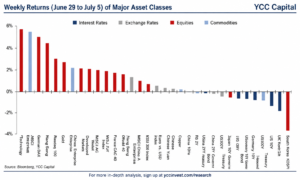
The first half of 2026 reminded investors that financial markets rarely move in straight lines. They move through narratives. Just as a marathon runner constantly adjusts pace according to terrain rather than following a rigid timetable, global markets spent the past six months continuously rewriting their expectations for U.S. growth and Federal Reserve policy.
Three distinct narratives dominated the first half of the year. Markets initially embraced the idea of a soft landing accompanied by further policy easing. That confidence then gave way to concerns over stagflation as geopolitical tensions in the Middle East pushed energy prices sharply higher. Finally, a powerful combination of resilient U.S. economic activity and another wave of AI-driven capital expenditure convinced investors that America might be entering another expansionary cycle, prompting expectations that the Federal Reserve could eventually return to rate hikes.
At YCC Capital, we believe the market has become overly confident in the last of these narratives.
While the U.S. economy continues to outperform most developed markets, the current expansion remains unusually uneven. Much of the recent strength reflects temporary fiscal impulses, exceptional AI investment and one-off demand drivers rather than a broad-based acceleration in household consumption and private investment. As these temporary supports fade during the second half of the year, markets are likely to reassess the probability of renewed monetary tightening.
Instead of a sustained hiking cycle, we expect macro liquidity conditions to gradually improve during the third quarter, creating a more constructive backdrop for risk assets while simultaneously capping further increases in Treasury yields.
The investment landscape therefore becomes increasingly selective. Technology earnings, rather than macroeconomic headlines alone, are likely to determine leadership within equities, while fixed income markets should continue oscillating within broad trading ranges instead of developing sustained directional trends.
YCC Perspective
One of the greatest investing mistakes is confusing momentum with permanence.
History repeatedly shows that markets tend to extrapolate today’s strongest trend indefinitely into the future. During the housing boom, investors believed property prices could only rise. During the internet revolution, profitability became almost irrelevant. Today, many investors increasingly assume that AI investment alone can permanently elevate U.S. economic growth and justify another Federal Reserve tightening cycle.
Reality is rarely that simple.
Artificial intelligence unquestionably represents one of the most important technological revolutions in decades. However, technological revolutions do not eliminate business cycles. They reshape them.
At YCC Capital, our base case remains cautiously constructive on the U.S. economy while remaining skeptical that current growth is sufficiently broad-based to justify another sustained period of monetary tightening.
Global Markets in the First Half of 2026
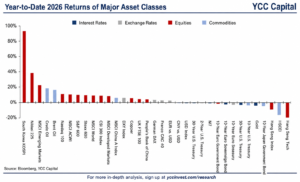
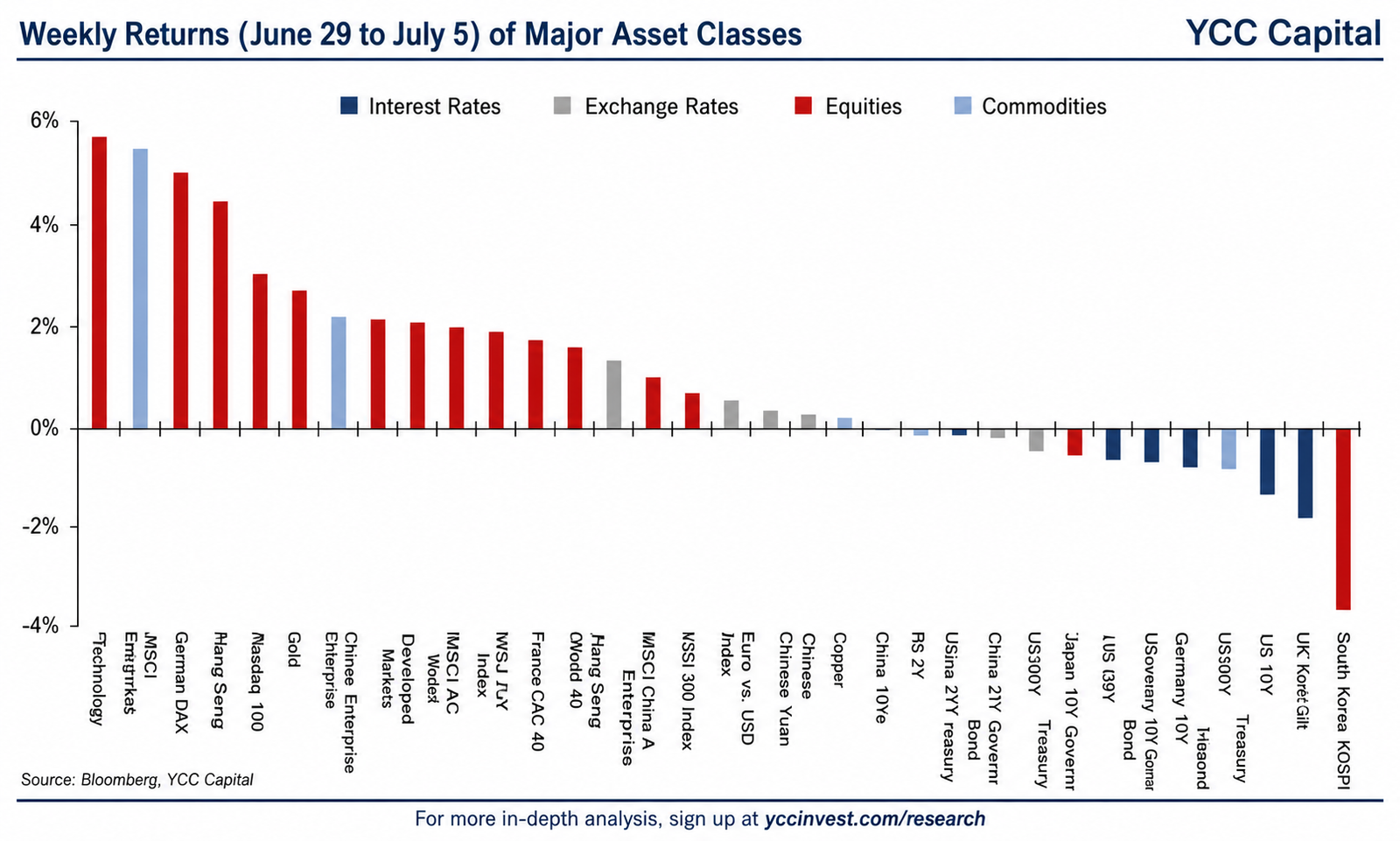
Global asset performance during the first six months of 2026 reflected an unusually concentrated leadership structure.
Equities dramatically outperformed most traditional asset classes, supported by accelerating investment into artificial intelligence infrastructure, resilient corporate earnings and continued optimism surrounding productivity gains from next-generation computing technologies.
Asian equity markets emerged as some of the strongest performers globally. Japan continued benefiting from structural corporate reforms, improving shareholder returns and persistent foreign capital inflows. South Korea also experienced strong gains as semiconductor demand recovered alongside global AI infrastructure spending.
Meanwhile, emerging markets generally outperformed developed markets, although performance remained highly uneven across regions. Countries benefiting from technology exports, commodity production or resilient domestic demand substantially outpaced economies facing persistent structural challenges. China, despite periodic policy support, continued to struggle with weak private-sector confidence, ongoing property market adjustments and declining demographic momentum, limiting broader investor enthusiasm.
Commodity markets told a more complicated story.
Oil prices remained elevated for much of the first half as geopolitical tensions involving Iran supported risk premiums across energy markets. Gold experienced a powerful rally early in the year before retreating as real interest rates increased and markets aggressively priced higher future policy rates.
Fixed income investors faced another challenging environment.
Long-duration government bonds continued to underperform amid persistent inflation concerns and repeated upward revisions to interest rate expectations. Rather than providing diversification benefits, sovereign bonds frequently moved in tandem with changing inflation expectations, reinforcing the increasingly complex relationship between equity and fixed income markets.
Three Distinct Market Narratives
Phase One: The Soft Landing Consensus
The year began with broad confidence that inflation was gradually coming under control while economic growth remained resilient enough to avoid recession.
Labor markets continued cooling without collapsing. Consumer spending moderated but remained healthy. Inflation gradually trended lower.
Markets therefore priced multiple Federal Reserve rate cuts throughout 2026.
Treasury yields drifted lower while growth stocks regained leadership.
For many investors, it appeared that the Federal Reserve had engineered one of the most successful soft landings in modern history.
That narrative would not survive long.
Phase Two: The Return of Stagflation Fears
The geopolitical landscape changed dramatically following renewed tensions involving Iran.
Oil prices rose rapidly, pushing inflation expectations sharply higher.
Markets quickly shifted away from pricing monetary easing toward anticipating defensive policy tightening aimed at preventing another inflation cycle.
This represented an important distinction.
Markets were no longer expecting rate hikes because growth was accelerating.
They were expecting rate hikes because inflation risk had returned.
Real yields actually remained relatively stable during much of this period while inflation expectations accounted for the majority of Treasury yield increases.
Commodity markets significantly outperformed while longer-duration bonds weakened.
Investors increasingly questioned whether the inflation battle had truly been won.
Phase Three: The AI Expansion Narrative
The final months of the first half produced another major shift.
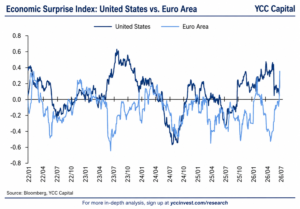
Strong GDP components, continued labor market resilience and extraordinary levels of AI-related capital expenditure encouraged markets to embrace an entirely different explanation for higher interest rates.
Instead of temporary inflation pressures, investors increasingly believed the U.S. economy had entered a new expansion cycle.
Large-scale AI infrastructure investment strengthened productivity expectations while corporate earnings remained robust.
Federal funds futures gradually shifted from expecting additional easing toward pricing the possibility that the Federal Reserve could eventually resume policy tightening during 2027.
This marked one of the most dramatic expectation reversals witnessed in recent years.
The market was no longer asking whether rate cuts would occur.
Instead, it began asking whether the next move could actually be another rate increase.
Why We Remain Skeptical of Another Hiking Cycle
Despite improving economic momentum, YCC Capital believes several structural constraints make another Federal Reserve hiking cycle substantially more difficult than markets currently assume.
First, the U.S. economy remains characterized by significant K-shaped divergence.
Large technology firms continue generating extraordinary earnings growth while many smaller businesses face considerably tighter financing conditions. High-income households maintain healthy balance sheets whereas lower-income consumers increasingly experience financial stress from elevated borrowing costs.
Such uneven expansion is fundamentally different from the synchronized growth typically associated with sustainable monetary tightening.
Second, much of recent economic strength appears to reflect temporary policy support.
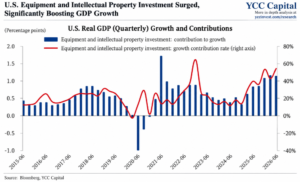
Fiscal stimulus measures, infrastructure spending and exceptional AI investment have all contributed meaningfully to recent GDP growth.
However, temporary policy impulses eventually fade.
Unless private-sector demand increasingly replaces public-sector support, underlying growth could moderate during the second half of the year.
Third, political considerations cannot be ignored.
As the U.S. moves closer toward another election cycle, additional monetary tightening would inevitably face increased political scrutiny. While the Federal Reserve remains institutionally independent, political pressure surrounding interest rate decisions historically intensifies during election periods.
Finally, the AI revolution itself introduces considerable uncertainty.
Although AI investment is clearly transforming capital expenditure, the ultimate transmission into broader productivity, employment and inflation remains highly uncertain.
Technological revolutions often generate periods of exceptional investment before eventually producing more balanced economic outcomes.
Markets may currently be overestimating how quickly AI spending will translate into economy-wide inflationary pressure.
Liquidity Should Gradually Improve
Looking ahead, we believe macro liquidity conditions are likely to improve during the third quarter.
Several developments support this view.
Economic data released during August and September should provide greater clarity regarding whether recent growth strength represented genuine acceleration or temporary distortions.
Meanwhile, earlier fiscal support measures are expected to gradually diminish, reducing one important source of above-trend demand.
Perhaps most importantly, financial conditions have already tightened considerably simply through rising market expectations of future monetary policy.
Markets often underestimate how expectations themselves affect economic activity.
Businesses delay investment.
Consumers postpone purchases.
Credit conditions tighten.
Financial markets therefore perform part of the Federal Reserve’s work before any actual policy change occurs.
If economic data softens modestly during late summer, markets could gradually unwind current hiking expectations, improving overall liquidity conditions across global financial markets.
Investment Strategy
U.S. Treasuries
We continue to expect the 10-year Treasury yield to trade within a broad 4.2%–4.8% range.
Rather than establishing a sustained directional trend, Treasury markets are likely to remain highly sensitive to incoming inflation data, labor market reports and Federal Reserve communication.
Range trading rather than trend following remains the preferred strategy.
U.S. Equities
Corporate earnings season represents the single most important catalyst for the second half.
AI leaders continue carrying elevated expectations.
Exceptional earnings can justify current valuations.
Anything less may trigger further sector rotation toward more reasonably valued cyclical and equal-weighted equities.
Technology
Technology remains the world’s dominant structural investment theme.
However, investors should increasingly distinguish between companies generating genuine AI monetization and those merely benefiting from optimistic sentiment.
The next stage of the AI cycle will reward earnings quality rather than narrative alone.
Gold
Gold may experience a prolonged consolidation similar to previous periods when rising real yields offset geopolitical uncertainty.
Without renewed deterioration in U.S. fiscal credibility or dollar confidence, sustained upside appears limited in the near term.
Nevertheless, gold continues serving as an important portfolio hedge against unexpected macro shocks.
Strategic Conclusion
The defining question for the second half of 2026 is not whether America remains stronger than most advanced economies.
It clearly does.
The more important question is whether today’s growth represents the beginning of a durable new expansion or simply the peak of an extraordinary investment cycle supported by temporary fiscal impulses and unprecedented AI spending.
At YCC Capital, we believe markets have become somewhat ahead of the underlying macroeconomic reality.
That does not imply recession.
Nor does it imply abandoning risk assets.
Instead, it argues for greater selectivity, disciplined portfolio construction and careful attention to liquidity dynamics as markets gradually reassess the probability of renewed Federal Reserve tightening.
History often reminds investors that sustainable bull markets are built not on enthusiasm alone, but on earnings, cash flows and improving liquidity. Those fundamentals—not headlines—will ultimately determine market leadership during the remainder of 2026.
Key Risks to Our Outlook
No macro framework is complete without acknowledging where it could prove wrong. The second half of 2026 remains unusually dependent on a handful of macro variables that could quickly reshape market pricing.
The first and most immediate risk remains geopolitical escalation. While markets have largely adjusted to the current level of Middle East tensions, any renewed disruption to global energy supplies could once again lift crude oil prices sharply higher. Such an outcome would immediately complicate the Federal Reserve’s inflation outlook, revive stagflation concerns and pressure both equity and bond markets simultaneously.
A second uncertainty comes from U.S. domestic policy. Fiscal policy has become an increasingly important driver of short-term growth over the past year. Unexpected tax measures, tariff adjustments or additional spending initiatives could temporarily extend economic momentum beyond our baseline expectations. Conversely, a faster-than-expected withdrawal of fiscal support would expose underlying weakness in private demand sooner than markets currently anticipate.
Third, inflation itself remains unusually difficult to forecast. While headline inflation has moderated considerably compared with previous years, services inflation and wage dynamics remain sticky. The interaction between AI-driven productivity gains and labor market adjustments is still in its early stages. If productivity improvements materialize faster than expected, inflation could decline without materially slowing economic growth. On the other hand, if labor shortages persist while investment remains elevated, inflation could prove more persistent than consensus forecasts suggest.
Financial stability also deserves careful monitoring. Higher interest rates have not yet fully worked through commercial real estate, regional banking balance sheets, private credit markets and highly leveraged corporate borrowers. History demonstrates that monetary tightening often produces financial stress with significant time lags. While no immediate systemic risks appear evident, investors should remain alert to pockets of liquidity stress that could emerge unexpectedly.
Finally, valuation risk has become increasingly concentrated rather than broad-based. Market leadership remains heavily dependent upon a relatively small group of mega-cap technology companies. If quarterly earnings disappoint or AI investment spending begins normalizing after several years of extraordinary growth, leadership could rotate rapidly toward broader market segments. Such a rotation would not necessarily imply the end of the bull market, but it would likely produce significantly higher volatility than investors have experienced during recent quarters.
Final Strategic View
The first half of 2026 illustrated how rapidly market narratives can evolve. Investors moved from anticipating aggressive monetary easing, to fearing stagflation, and finally to pricing another Federal Reserve tightening cycle—all within six months.
Such dramatic shifts often create opportunities for disciplined investors willing to separate cyclical noise from structural trends.
Our central conclusion remains straightforward.
The United States continues to possess the strongest long-term structural advantages among major developed economies. Deep capital markets, technological leadership, flexible labor markets and continued innovation provide durable foundations for economic resilience. We remain cautiously optimistic regarding the medium-term outlook for U.S. assets.
However, optimism should not be confused with complacency.
Recent economic strength has been narrower than headline indicators suggest. AI investment has undoubtedly become a transformational force, but it has also concentrated capital allocation into a relatively small portion of the economy. Productivity gains will eventually broaden, yet history suggests that technological revolutions rarely proceed in perfectly smooth, uninterrupted lines.
Outside the United States, global opportunities remain selective. Japan continues making meaningful progress through corporate governance reform, improving capital efficiency and rising shareholder returns, supporting our constructive long-term outlook despite cyclical headwinds. Europe faces slower structural growth but may benefit from improving liquidity should global monetary conditions gradually ease. Emerging markets remain highly differentiated, with countries linked to semiconductor production, advanced manufacturing and supply-chain diversification likely to outperform. China, by contrast, continues facing persistent structural challenges including weak household confidence, property market adjustment, deteriorating demographics and declining returns on capital. While tactical rallies remain possible, we continue to believe China’s long-term investment outlook remains constrained by these underlying headwinds.
From an asset allocation perspective, diversification becomes increasingly valuable during periods when macro narratives are changing faster than economic fundamentals. Rather than pursuing aggressive directional positioning, investors should emphasize balance across high-quality equities, selective duration exposure and strategic allocations to real assets capable of hedging geopolitical uncertainty.
As we enter the second half of the year, investors should resist the temptation to chase whichever narrative currently dominates financial headlines. Markets are ultimately driven not by stories alone, but by earnings, productivity, liquidity and valuation. Those four pillars remain considerably more stable than the daily news cycle.
For disciplined long-term investors, periods of heightened uncertainty often provide the best opportunities to accumulate exceptional assets at reasonable prices. Patience, rather than prediction, remains one of the most underappreciated sources of investment outperformance.
Editorial Board
Ken Cao
Chief Strategist, Global Investment Strategy
Le Gao
Managing Analyst
Yui Nabeshima
Strategist
Mai Ikeda
Research Analyst
IMPORTANT DISCLAIMER
This research report is provided for informational and educational purposes only and does not constitute an offer to sell or a solicitation of an offer to buy any securities, financial instruments, or investment products. It is not intended as investment, legal, accounting, or tax advice and should not be relied upon as such. The views, opinions, and projections expressed herein are those of YCC Capital Management and its research personnel as of the date of publication and are subject to change without notice. Past performance is not indicative of future results.
YCC Capital Management, its affiliates, principals, and employees may hold long or short positions in securities or instruments discussed in this report and may trade for their own accounts or for client accounts in a manner inconsistent with the recommendations herein. This report is based on publicly available information and data believed to be reliable, but YCC Capital makes no representation or warranty, express or implied, as to the accuracy, completeness, or timeliness of such information. Forward-looking statements involve risks and uncertainties that could cause actual results to differ materially from those projected.
Recipients of this report should conduct their own independent due diligence and consult with their own financial, legal and tax advisors before making any investment decisions. YCC Capital accepts no liability for any loss or damage arising from the use of or reliance on this report or its contents.
This report is intended solely for the use of the intended recipient(s) and may not be reproduced or redistributed for commercial purposes without the prior written consent of YCC Capital.
© 2026 YCC Capital. All rights reserved.
YCC Capital’s flagship vehicle, the YCC International Value Fund, LP, maintains a concentrated global macro value strategy with a focus on capital-flow-driven mispricings and asymmetric hedging opportunities. The Fund is registered in the State of Delaware, U.S. and structured as a Rule 506(c) private investment fund. Performance data, where referenced, has been verified by independent third parties including NAV Consulting; however, individual investor results may vary.
Contact Us
YCC Capital Research
For complimentary daily macro research, market commentary and investment insights, subscribe at www.yccinvest.com.
YCC CAPITAL | Global Strategy
YCC Capital Research | Sign up for free daily market insight at www.yccinvest.com
For more related research:
Trump’s Political Playbook: Winning Abroad to Stabilize at Home
Gold’s Shakeout Is Not the End of the Bull Market
When the Tide Recedes: Why the U.S. Dollar Is Entering a New Era of Two-Way Risk