YCC CAPITAL
Global Strategy
July 18, 2026
Executive Summary
Markets rarely collapse because a long-term investment story suddenly disappears. More often, they unravel because too many investors crowd into the same trade using borrowed money. The recent correction in South Korean equities fits this pattern almost perfectly.
At first glance, the nearly 25% drawdown in the KOSPI appeared alarming enough to raise questions about whether the global AI investment cycle had finally reached its limits. Yet a closer examination suggests something different. The semiconductor industry’s structural outlook has not fundamentally deteriorated. Instead, Korea has become the first major market to experience a large-scale liquidity shock created by excessive leverage concentrated in a narrow group of technology stocks.
The implications extend well beyond Seoul. South Korea has evolved into one of the most important transmission mechanisms for global technology sentiment. Samsung Electronics and SK Hynix now dominate index composition, ETF flows, retail participation and leveraged trading activity to such an extent that volatility in Korean markets increasingly spills over into U.S., Hong Kong and broader Asian technology equities.
From a macro perspective, Korea today resembles a speedboat moving through rough seas while larger markets resemble ocean liners. The speedboat may be smaller, but the waves it generates can still rock much larger vessels. When leverage becomes excessive, price declines are no longer driven primarily by deteriorating fundamentals but by investors selling because they have no alternative.
YCC Capital believes the current episode should primarily be understood as a liquidity-driven deleveraging event rather than the beginning of a structural bear market for artificial intelligence or memory semiconductors. Nevertheless, liquidity shocks often last longer than investors initially expect, especially when forced selling mechanisms continue feeding upon themselves.
The key question is therefore no longer whether valuations have become attractive. The more important question is whether the deleveraging process has actually finished.
Korea Has Become the Global Amplifier of Technology Risk Appetite
Over the past several years, South Korea has quietly transformed into one of the world’s most leveraged technology equity markets.
This concentration stems from three characteristics.
First, Samsung Electronics and SK Hynix together represent an extraordinary share of market capitalization and trading activity. The two memory-chip manufacturers account for roughly half of KOSPI’s effective technology exposure, making the entire market unusually dependent upon the fortunes of the semiconductor cycle.
Second, leverage has become layered rather than isolated. Retail investors increasingly employ multiple financing channels simultaneously. Traditional margin financing has expanded rapidly. Securities-backed loans allow investors to borrow against existing holdings. Single-stock leveraged ETFs offer two-times daily exposure to individual companies. Options and derivatives add yet another layer of embedded leverage.
Finally, these products interact with one another.
Unlike a traditional investment portfolio, where one investor’s losses need not immediately affect another participant, Korea’s leveraged ecosystem creates automatic selling pressure whenever prices decline.
That makes liquidity—not earnings—the dominant short-term driver.
This distinction is critical.
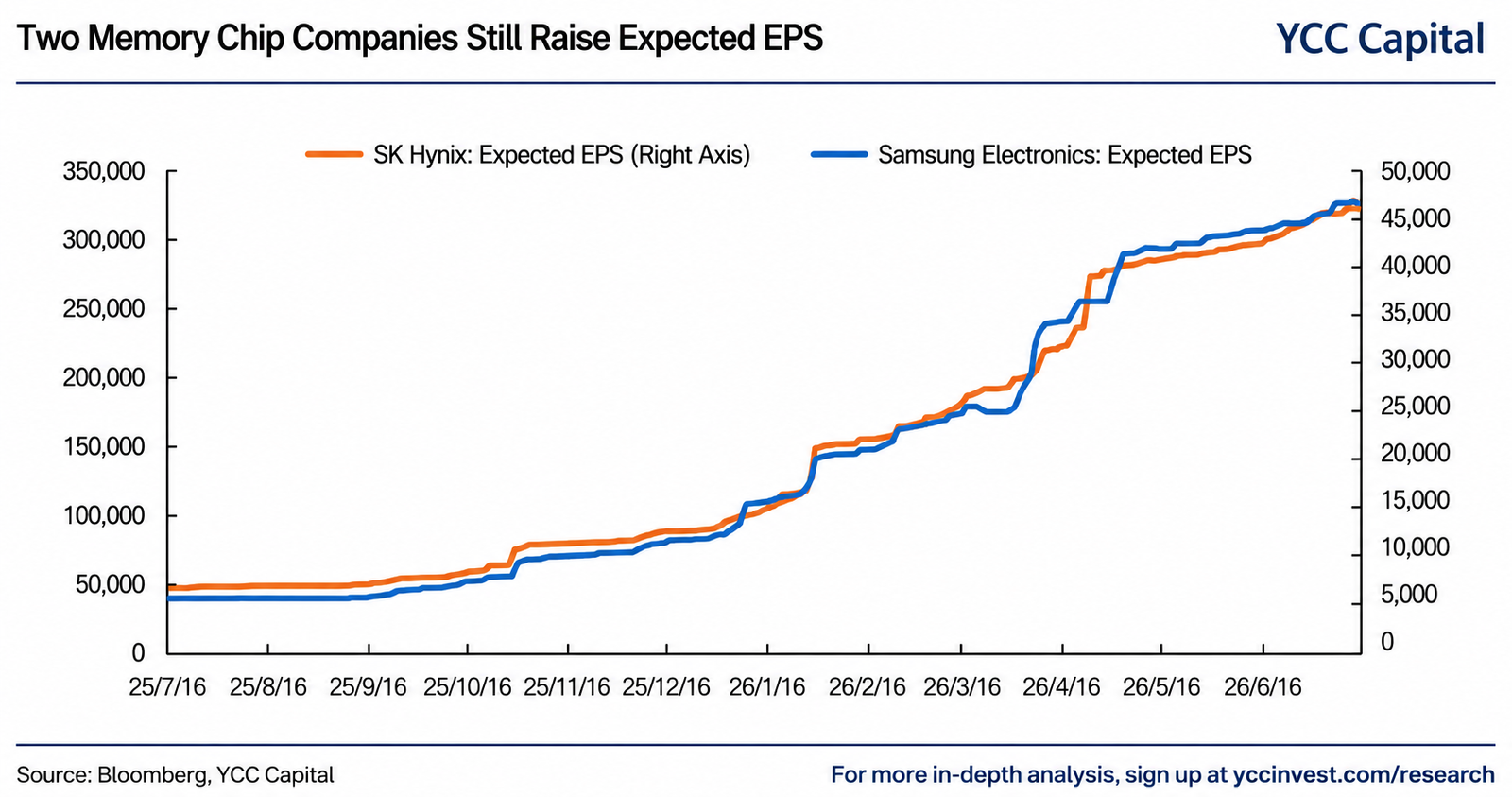
Consensus earnings forecasts for both Samsung Electronics and SK Hynix continue to improve as AI infrastructure investment remains robust. Demand for high-bandwidth memory (HBM), advanced DRAM and AI servers has softened only marginally relative to the extraordinary optimism priced into markets earlier this year. The structural investment case has therefore weakened far less than share prices would suggest.
Instead, investors have been forced to reduce exposure because financing conditions tightened.
History provides several useful parallels.
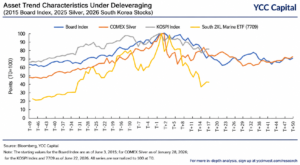
China’s 2015 equity collapse was not initially caused by collapsing corporate earnings. Rather, excessive margin financing eventually overwhelmed the market. Likewise, the precious metals correction earlier this year reflected an unwinding of leveraged positioning more than any dramatic change in long-term supply-demand fundamentals.
Korea now appears to be following a remarkably similar path.
The Market Correction Has Been Violent, but the Volatility Structure Suggests Deleveraging Remains Incomplete
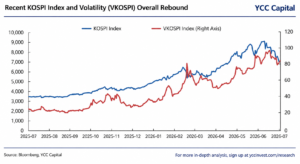
The KOSPI has fallen nearly one-quarter from its June peak, officially entering bear-market territory.
At the same time, implied volatility remains exceptionally elevated. VKOSPI, although below its most extreme readings, continues to trade near the upper end of its historical range, indicating that investors remain engaged in aggressive portfolio repositioning rather than orderly accumulation.
Leverage products have experienced even more dramatic declines.
Many of the recently launched single-stock leveraged ETFs focused on Samsung Electronics and SK Hynix have lost more than 10% in a single trading session, with several falling below their original issue prices.
Assets under management have contracted sharply.
This decline reflects two reinforcing dynamics.
Some investors have redeemed their ETF holdings.
Others have remained invested but experienced substantial mark-to-market losses.
Either outcome produces the same macro consequence: the amount of pro-cyclical capital supporting the market shrinks rapidly.
The contraction has been particularly visible in leveraged products linked to SK Hynix, whose assets have fallen dramatically from recent highs.
For market stability, this matters because leveraged ETFs must rebalance daily.
During rising markets, these products buy additional exposure to maintain target leverage.
During falling markets, they must sell.
This creates negative gamma dynamics, reinforcing existing market moves instead of dampening them.
In extreme trading sessions, the products themselves become sources of additional volatility.
Korea’s Regulatory Framework Reduces Excesses—but Cannot Eliminate Pro-Cyclical Selling
South Korean regulators have not ignored these risks.
Authorities have gradually tightened investor access to leveraged products by raising minimum deposit requirements, expanding mandatory investor education, suspending approvals for additional single-stock leveraged ETFs and restricting promotional activity.
Beginning in August 2026, minimum deposits required for participation in certain leveraged ETF products will rise substantially, while educational requirements become more stringent.
These measures should reduce future speculative participation.
However, they do little to address existing positions.
The more important vulnerability lies within margin financing itself.
Although maintenance ratios differ among brokerage firms, many retail margin accounts operate around maintenance collateral requirements of roughly 140%.
Once collateral values fall below required thresholds, investors receive margin calls.
Failure to provide additional capital within the required period allows brokerages to liquidate positions automatically.
Importantly, this process is highly pro-cyclical.
When many investors breach collateral thresholds simultaneously, forced liquidation accelerates market declines, triggering additional margin calls elsewhere.
The mechanism resembles a line of falling dominoes rather than isolated individual events.
Daily ETF rebalancing and broker-enforced liquidations therefore reinforce one another.
Neither mechanism alone would necessarily destabilize markets.
Together, however, they create powerful negative feedback loops.
Measuring the Progress of the Deleveraging Cycle
YCC Capital monitors four broad categories of financial conditions to assess whether Korea’s deleveraging process is approaching completion.
Margin Financing Has Declined Only Modestly
Headline equity prices have already experienced dramatic declines.
Margin balances have not.
Credit financing outstanding has fallen only modestly from its June peak.
Securities-backed lending has also declined but remains elevated relative to earlier this year.
By contrast, securities borrowing associated with short-selling has contracted sharply.
This distinction is extremely important.
If aggressive new short-selling were driving the correction, securities lending balances would normally expand as bearish investors increased exposure.
Instead, both lending volumes and borrowing values have fallen.
The evidence therefore points overwhelmingly toward long-side liquidation rather than growing bearish speculation.
In other words, the market is still being sold primarily by yesterday’s optimistic investors—not today’s pessimists.
Cash Buffers Are Being Consumed
Another important indicator comes from customer cash balances held within brokerage accounts.
Investor deposits have fallen significantly from recent highs.
Derivative margin deposits have also declined materially.
These cash balances represent more than idle liquidity.
They serve as financial shock absorbers.
When markets decline, investors draw upon these reserves to meet margin calls or selectively add exposure.
Shrinking cash reserves imply that investors possess less flexibility to defend existing positions.
This development deserves particular attention because cash balances have fallen considerably faster than outstanding margin debt.
That combination increases systemic fragility.
Should another wave of selling emerge, investors will have fewer liquid resources available to stabilize portfolios.
Short Sellers Are Not Driving the Correction
One of the more surprising conclusions from Korean financial data is the absence of unusually aggressive short-selling activity.
Outstanding securities loans have declined rather than increased.
The total market value of borrowed securities has also contracted.
These trends contradict the narrative that hedge funds or speculative bears have launched coordinated attacks against Korean technology stocks.
Instead, the dominant force remains forced deleveraging among existing long investors.
That distinction materially changes the outlook.
Short-covering rallies can emerge quickly once bearish positioning becomes crowded.
By contrast, deleveraging cycles driven by margin liquidation often require considerably more time because leverage must first be removed from the financial system.
What Will Determine Whether Korean Equities Stabilize?
Investors should resist focusing exclusively on index levels.
Instead, attention should center on the underlying plumbing of financial markets.
The first condition for stabilization is continued reduction in outstanding margin balances.
Price declines alone do not complete deleveraging.
Debt reduction does.
Current financing balances remain sufficiently elevated that additional forced selling cannot yet be ruled out.
Second, brokerage cash balances must stabilize.
If customer deposits continue falling while leverage remains elevated, financial vulnerability actually increases despite lower equity prices.
A healthier market structure requires leverage to fall while liquidity buffers rebuild.
Third, semiconductor fundamentals must once again become the dominant pricing mechanism.
Eventually, markets transition from liquidity-driven valuation back toward earnings-driven valuation.
The catalysts will likely include stronger cloud capital expenditure, continued growth in AI infrastructure investment, improving HBM and DRAM pricing, favorable corporate guidance from Samsung Electronics and SK Hynix, and confirmation from upcoming U.S. technology earnings.
Finally, policymakers remain an important variable.
Authorities could further tighten leverage rules, restrict new leveraged ETF issuance, adjust margin requirements or introduce stabilization measures.
Such actions may reduce near-term volatility.
However, policy interventions alone rarely eliminate financial excesses if leverage remains fundamentally too high.
YCC Capital Strategy View
Financial markets often resemble mountain climbers ascending with borrowed oxygen.
Everything appears manageable while conditions remain favorable.
But once oxygen begins running low, even small obstacles suddenly become life-threatening.
South Korea currently finds itself in precisely that situation.
The structural AI story remains largely intact.
The memory semiconductor cycle has not fundamentally collapsed.
Yet markets cannot immediately return to normal until leverage is sufficiently reduced.
Our assessment therefore remains constructive over the medium term but cautious over the immediate horizon.
The probability of additional volatility remains elevated until three conditions emerge simultaneously:
- Margin financing continues declining meaningfully.
- Investor cash balances stabilize.
- Semiconductor earnings expectations regain control over market pricing.
Until then, Korea is likely to remain one of the world’s most important transmitters of technology-sector volatility.
For global investors, this means Korean market data should increasingly be viewed not merely as a regional indicator, but as an early warning system for broader technology risk appetite.
Editorial Board
Ken Cao
Chief Strategist, Global Investment Strategy
Le Gao
Managing Analyst
Yui Nabeshima
Strategist
Mai Ikeda
Research Analyst
IMPORTANT DISCLAIMER
This research report is provided for informational and educational purposes only and does not constitute an offer to sell or a solicitation of an offer to buy any securities, financial instruments, or investment products. It is not intended as investment, legal, accounting, or tax advice and should not be relied upon as such. The views, opinions, and projections expressed herein are those of YCC Capital Management and its research personnel as of the date of publication and are subject to change without notice. Past performance is not indicative of future results.
YCC Capital Management, its affiliates, principals, and employees may hold long or short positions in securities or instruments discussed in this report and may trade for their own accounts or for client accounts in a manner inconsistent with the recommendations herein. This report is based on publicly available information and data believed to be reliable, but YCC Capital makes no representation or warranty, express or implied, as to the accuracy, completeness, or timeliness of such information. Forward-looking statements involve risks and uncertainties that could cause actual results to differ materially from those projected.
Recipients of this report should conduct their own independent due diligence and consult with their own financial, legal, and tax advisors before making any investment decisions. YCC Capital accepts no liability for any loss or damage arising from the use of or reliance on this report or its contents.
This report is intended solely for the use of the intended recipient(s) and may not be reproduced or redistributed for commercial purposes without the prior written consent of YCC Capital. © 2026 YCC Capital. All rights reserved.
YCC Capital’s flagship vehicle, the YCC International Value Fund, LP, maintains a concentrated global macro value strategy with a focus on capital-flow-driven mispricings and asymmetric hedging opportunities. The Fund is registered in the State of Delaware, U.S. and structured as a Rule 506(c) private investment fund.
Performance data, where referenced, has been independently verified by third parties including NAV Consulting. Individual investor performance may differ depending on subscription timing, fees, and investment circumstances.
Contact Us
YCC Capital Research
Email: ir@yccinvest.com
For complimentary daily macro and market insights, subscribe at:
YCC Capital Research | Sign up for free daily market insight at www.yccinvest.com
For more related research:
Gold’s Shakeout Is Not the End of the Bull Market
The Era of the Creditless Recovery: Why China’s New Economy Is Breaking the Old Financial Cycle