YCC CAPITAL
Emerging Markets & China Strategy
August 19, 2026
China’s July data tell a remarkably consistent story: the economy is producing more effectively than it is consuming, exporting more convincingly than it is investing, and generating industrial momentum without generating comparable confidence at home. The result is an increasingly pronounced K-shaped economy. Export-oriented technology and AI-linked manufacturing remain energetic, while property, private investment, household credit demand, and discretionary consumption remain weak.
For investors, the distinction matters. Strong headline trade numbers should not be mistaken for a broad-based domestic recovery. China can continue winning export orders while households remain cautious, developers retrench, and private businesses hesitate to borrow. That is exactly what the July data suggest.
Manufacturing Momentum Slips Below the Surface
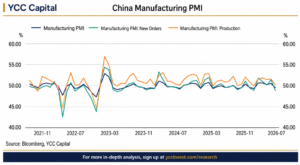
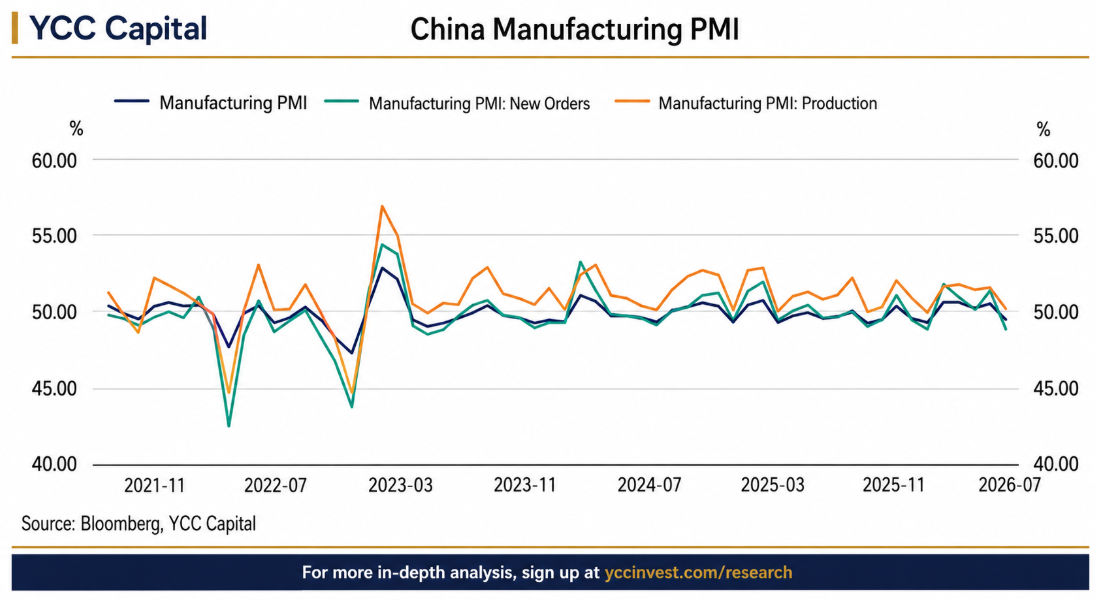
China’s manufacturing PMI fell to 49.2 in July, down 1.1 percentage points from June and below the 50 threshold separating expansion from contraction. The deterioration was broad-based. PMI readings for large, medium-sized, and small enterprises stood at 49.5, 49.7, and 47.4, respectively.
The production index declined to 49.9, while new orders fell more sharply to 48.5, a 2.7-point monthly decline. Raw-material inventories remained subdued at 48.3. Employment improved modestly to 49.0, but that was not enough to offset the broader weakening in demand.
Non-manufacturing activity was similarly soft. The business activity index fell to 49.0, with construction at 47.0 and services at 49.3.
This is the central tension in China’s economy today: factories retain significant productive capacity, but the domestic order book is not keeping pace. It is the economic equivalent of a restaurant with a fully staffed kitchen and plenty of ingredients, but too many empty tables.
Inflation Is Being Imported More Than Created at Home
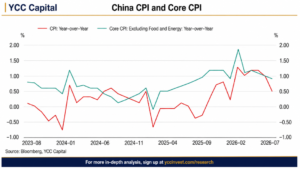
Consumer inflation remained subdued. July CPI rose 0.5% year over year and declined 0.1% month over month. Food prices fell 1.5% from a year earlier, while non-food prices rose 0.9%. Services inflation was firmer at 0.7%, but goods pricing remained restrained.
Pork prices fell 13.3% year over year, contributing to a 6.0% decline in livestock-meat prices. Housing-related consumer prices declined 0.3%.
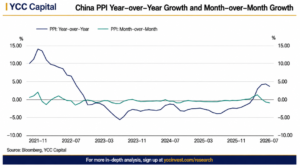
Producer prices told a different story. PPI rose 3.5% year over year, although it declined 0.7% sequentially, while industrial input prices increased 5.5% from a year earlier. Energy, petrochemicals, coal and non-ferrous metals provided much of the inflationary lift, while AI-related investment supported pricing in electronics, computers and communications equipment.
The gap between stronger producer inflation and muted consumer inflation is revealing. China does not currently have a classic demand-driven inflation problem. Instead, higher upstream prices are colliding with weak downstream pricing power. Companies can face rising costs without having sufficient consumer demand to pass them on.
Trade Remains the Brightest Part of the Picture
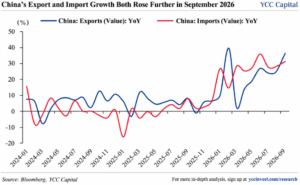
China’s external sector remained exceptionally strong in July. Total imports and exports reached $683.2 billion, up 25.3% year over year. Exports rose 23.9% to $397.85 billion, while imports increased 27.5% to $285.35 billion, producing a trade surplus of $112.5 billion.
Technology-linked trade was particularly powerful. Integrated-circuit exports increased 116.6%, following a 121.9% rise previously, while exports of automatic data-processing equipment and components climbed 67.4%, accelerating from 53.1%.
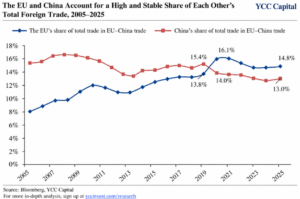
Exports to major markets also remained firm. During the first seven months of the year, exports to the United States increased 17.0%, exports to the European Union rose 16.0%, shipments to ASEAN economies expanded 38.4%, and exports to Japan advanced 14.0%.
We remain cautious about extrapolating this strength indefinitely. China’s export performance is increasingly dependent on global capital expenditure, especially the AI infrastructure cycle, while its domestic economy remains unable to provide an equivalent second engine. Our base case for the United States remains cautiously constructive, which should support external demand, but any moderation in U.S. or global technology investment would expose how dependent China has become on foreign rather than domestic momentum.
Credit Data Show a Confidence Problem
At the end of July, outstanding aggregate social financing reached RMB463.27 trillion, up 7.4% from a year earlier. Yet the composition remains weak.
During the first seven months of 2026, aggregate social financing increased by RMB22.25 trillion, RMB1.74 trillion less than during the same period last year. RMB loans to the real economy increased by RMB10.17 trillion, but that was RMB2.14 trillion less than a year earlier.
Household borrowing was particularly weak. Household loans fell by RMB460.3 billion in July, including a RMB340.0 billion decline in short-term loans and a RMB120.2 billion decline in medium- and long-term loans. That combination points directly to soft consumer borrowing and weak mortgage demand.
Corporate lending was also subdued. Corporate loans declined by RMB130 billion during the month, including declines in both short- and medium-to-long-term borrowing.
Money growth reinforces the message. M2 increased 7.7%, while M1 rose only 4.0%, leaving an M1-M2 gap of -3.7 percentage points. Liquidity exists, but willingness to deploy it remains limited.
Consumption and Investment Continue to Lose Altitude
Industrial value added increased 4.5% year over year in July and 5.3% during the first seven months. Consumption was far less impressive. Retail sales rose just 0.6% in July and 1.2% during January-July.
Weakness was concentrated in economically sensitive categories. Automobile sales fell 17.0%, building materials dropped 14.2%, furniture declined 8.8%, petroleum products fell 7.6%, and household appliances decreased 1.9%.
Fixed-asset investment fell 6.7% during the first seven months. Private investment declined 9.4%, manufacturing investment fell 1.7%, infrastructure investment declined 3.6%, and investment in electricity, heat, gas and water supply contracted 5.3%.
These are not the fingerprints of an economy entering a vigorous private-sector expansion. They are the fingerprints of businesses and households still protecting balance sheets.
Property Is Stabilizing Only in the Loosest Sense
Property remains the most important domestic drag. Real-estate development investment fell 19.2% during January-July, with residential investment down 19.1%.
New-home sales area fell 11.8%, while sales value declined 13.1%. Construction activity remained even weaker: floor space under construction dropped 12.7%, new starts fell 24.0%, and completions declined 23.2%.
Inventory offered one modestly better signal. Commercial housing available for sale totaled 759.11 million square meters at the end of July, down 0.8% year over year.
We would describe this as a search for a floor rather than a recovery. Anyone who has watched a housing downturn firsthand knows the distinction: prices or inventories can stop deteriorating rapidly long before buyers regain enough confidence to commit. China appears closer to that first stage than the second.
YCC Strategic View
China’s July economy is increasingly split between globally competitive production and domestically constrained demand. Exports, semiconductors and AI-linked manufacturing remain strong, but those areas cannot indefinitely offset declining property investment, weak private capital expenditure, poor credit appetite and hesitant consumers.
Policy support will likely intensify, and favorable base effects may improve several year-over-year readings later in 2026. We would not confuse that arithmetic improvement with a durable cyclical turn. The burden of proof remains on domestic demand.
For global investors, China therefore remains a market for selective exposure rather than broad macro optimism. Export champions can perform even while the domestic economy struggles. The opportunity is in identifying those islands of competitiveness without assuming the tide has turned for the entire economy.
Source: Bloomberg, YCC Capital
Editorial Board
Ken Cao, Chief Strategist, Global Investment Strategy; Le Gao, Managing Analyst; Yui Nabeshima, Strategist; Mai Ikeda, Research Analyst.
IMPORTANT DISCLAIMER
This research report is provided for informational and educational purposes only and does not constitute an offer to sell or a solicitation of an offer to buy any securities, financial instruments, or investment products. It is not intended as investment, legal, accounting, or tax advice and should not be relied upon as such. The views, opinions, and projections expressed herein are those of YCC Capital Management and its research personnel as of the date of publication and are subject to change without notice. Past performance is not indicative of future results.
YCC Capital Management, its affiliates, principals, and employees may hold long or short positions in securities or instruments discussed in this report and may trade for their own accounts or for client accounts in a manner inconsistent with the recommendations herein. This report is based on publicly available information and data believed to be reliable, but YCC Capital makes no representation or warranty, express or implied, as to the accuracy, completeness, or timeliness of such information. Forward-looking statements involve risks and uncertainties that could cause actual results to differ materially from those projected.
Recipients of this report should conduct their own independent due diligence and consult with their own financial, legal, and tax advisors before making any investment decisions. YCC Capital accepts no liability for any loss or damage arising from the use of or reliance on this report or its contents.
This report is intended solely for the use of the intended recipient(s) and may not be reproduced or redistributed for commercial purposes without the prior written consent of YCC Capital. © 2026 YCC Capital. All rights reserved. YCC Capital’s flagship vehicle, the YCC International Value Fund, LP, maintains a concentrated global macro value strategy with a focus on capital-flow-driven mispricings and asymmetric hedging opportunities. The Fund is registered in the State of Delaware, U.S and structured as a 506(c) fund. Performance data, where referenced, has been verified by independent third parties including NAV Consulting; however, individual investor results may vary.
Contact Us
For research inquiries, contact ir@yccinvest.com.
Sign up for free daily market insight at yccinvest.com.
YCC Capital Research | Sign up for free daily market insight at www.yccinvest.com
For more related research:
China’s Growth Engine Is Losing Altitude: Exports Still Fly, But Domestic Demand Is Running on Empty
AI’s Reality Check: From Capacity to Cash Flow
China’s Growth Engine Loses Momentum: Why the Q2 GDP Miss Signals a Longer Road to Recovery