YCC CAPITAL
U.S. Bond Strategy
August 20, 2026
The U.S. Treasury has chosen an interesting moment to lean harder into long-duration bond buybacks. On August 19, Treasury announced that between September 9 and November 4 it intends to raise the maximum size of individual liquidity-support buybacks in the 10–20 year and 20–30 year maturity buckets from $2 billion to at least $4 billion.
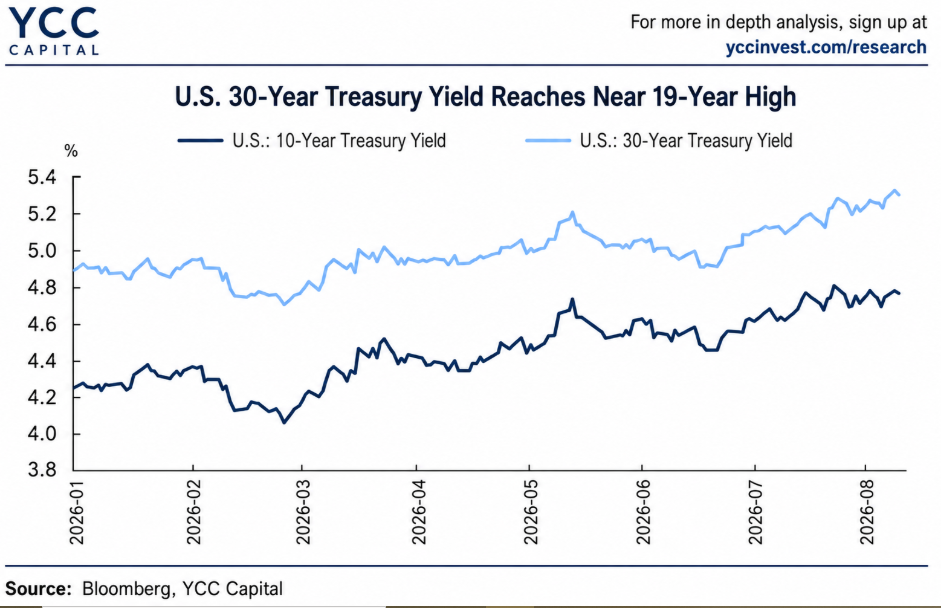
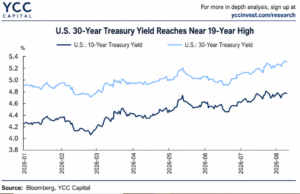
The timing matters. Long-end Treasury yields had already been sending a warning signal. The 30-year yield briefly reached 5.337% on August 18, the highest level since 2007, while the 10-year yield approached 4.739%. Against that backdrop, Treasury’s decision looks less like routine plumbing and more like a defensive adjustment to the market’s duration burden.
Our central view is straightforward: the enlarged buyba
ck program can improve market functioning and temporarily reduce pressure on the long end, but it does not alter the fundamental arithmetic of U.S. fiscal financing. In economic terms, Treasury is partly exchanging duration risk today for refinancing risk tomorrow. That can be useful, especially when long-end liquidity is strained, but it is not a substitute for stronger fiscal credibility, lower inflation risk, or deeper structural demand for long-dated government bonds.
Why Treasury Is Acting Now
Treasury officially describes the expansion as an effort to provide greater liquidity support in longer-dated nominal sectors where market participants have shown consistent interest. That explanation is accurate at the operational level, but it is incomplete from a macro perspective.
When Treasury buys back older long-duration securities, it reduces the amount of duration the private sector must absorb at the margin. Unless the Treasury General Account alone finances those purchases, the cash ultimately has to be replenished through additional issuance elsewhere, most plausibly at shorter maturities. The economic effect therefore resembles a modest maturity transformation: retire some long-duration paper, replace part of the financing burden with shorter-duration debt.
This is why we see the program as liquidity management with a duration-management consequence.
The analogy is similar to refinancing a 30-year mortgage into a shorter reset structure. Your immediate fixed-rate burden can improve, but you have not made the underlying liability disappear. You have changed when and how the risk returns.
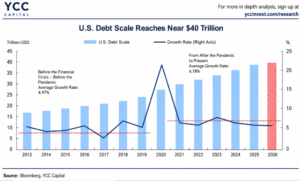
That distinction matters because the U.S. debt stock is now approaching $40 trillion. Relative to that scale, even a meaningfully larger buyback program remains small. Still, financial markets often turn at the margin rather than at the average. When investors are reluctant to warehouse duration, a policy-linked buyer can have an outsized short-term psychological effect.
That was visible immediately after the announcement. The 30-year Treasury yield fell by almost 9 basis points at one point, the 10-year yield declined roughly 3 basis points, while the 2-year yield rose approximately 5 basis points. The curve flattened sharply.
Source: Bloomberg, YCC Capital
The Arithmetic Is Still Small
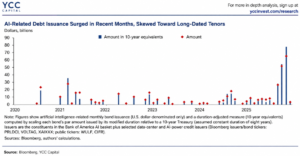
Assume, for illustration, that the maximum size for purchases in the two long-end maturity buckets rises from $2 billion to $4 billion over the coming quarter. Based on the historical cadence of these operations, the theoretical long-duration buyback capacity could increase from roughly $14–16 billion to about $28–32 billion.
That sounds large in isolation. Against a Treasury market approaching $40 trillion, it is not.
The first limitation is simply scale. Tens of billions of dollars cannot materially transform the aggregate supply dynamics of the world’s largest sovereign bond market.
The second limitation is risk substitution. Private investors may hold somewhat less long-duration interest-rate risk, but Treasury must still finance deficits and refinance maturing obligations. Reducing duration outstanding today can increase the frequency with which debt must be rolled over in the future. Duration risk is therefore partly converted into rollover risk.
The third limitation is the most important: long-term yields remain anchored by fundamentals. Fiscal deficits, inflation expectations, real interest rates, term premium and foreign demand for Treasuries will continue to determine where the 10-year and 30-year sectors clear over time.
None of those fundamental forces has been transformed by the buyback announcement.
U.S. inflation remains materially above the world investors became accustomed to in the pre-pandemic decade. Federal spending commitments remain sticky. Debt-service costs remain sensitive to refinancing rates, while the dollar-liquidity system continues to transmit U.S. financial conditions globally.
For that reason, we would not characterize the buyback expansion as a lasting cure for elevated long-end yields.
A Small “Treasury YCC” Effect—But Only at the Margin
In the short run, however, the signal is tradable.
When long-end yields are near multi-decade highs, liquidity discounts are widening and private balance sheets are becoming more reluctant to absorb duration, the appearance of a stable policy-related buyer can change market behavior even if the absolute purchase size is modest.
In that narrow sense, the initiative resembles a miniature Treasury version of yield-curve management. We do not mean formal yield-curve control: there is no announced yield target, no commitment to unlimited purchases and no explicit mechanism linking Treasury actions to a particular level of long-term rates.
But the market effect has a family resemblance. Treasury is responding to stress in the longer-dated market by increasing its willingness to absorb older long-duration securities. That can temporarily compress liquidity premiums, support dealer balance sheets and discourage one-way bearish positioning.
The practical consequence is that investors should distinguish between the level of long yields and the path toward that level. Treasury may not be able to prevent fundamentals from pushing yields higher over time, but it can make the journey less disorderly.
That matters for risk assets. A disorderly 30-year yield spike affects mortgage rates, corporate borrowing costs, equity discount rates and financial conditions far beyond the Treasury market itself. Slowing that transmission is valuable even if the underlying fiscal challenge remains.
Fed and Treasury: Complementary Outcomes, Not a Coordinated Regime
Recent Federal Reserve and Treasury actions can easily be interpreted as a coordinated package. The Fed has paused reserve-management purchases and is limiting liquidity injections, while Treasury is expanding long-end buybacks and adjusting the duration profile of debt held by the market. Superficially, it looks like one institution is managing money while the other manages maturity.
We would resist taking that interpretation too far.
The two institutions have different mandates and different operational objectives. The Federal Reserve remains focused on inflation, employment and reserve conditions. Treasury buybacks are fundamentally instruments of debt management and market liquidity.
The Fed’s pause in reserve-management purchases is also primarily a technical balance-sheet operation. It does not, by itself, signal a change in the monetary-policy stance, nor does it imply that the Fed intends to accommodate an increase in Treasury bill issuance.
Most importantly, Treasury’s long-end buyback program remains too small to suggest that the two institutions are jointly targeting a specific yield, maturity structure or federal financing cost.
What investors are seeing is better described as complementarity of outcomes rather than coordination of policy.
YCC Strategic View
We remain cautiously constructive on the U.S. Treasury market, but the opportunity is increasingly about selectivity rather than a blanket duration bet.
The enlarged buyback program creates a tactical support mechanism for the long end and may reduce the probability of disorderly yield spikes during periods of poor liquidity. That makes outright short-duration positioning at elevated yields less attractive than it was before Treasury showed a greater willingness to intervene in market functioning.
At the same time, investors should not confuse liquidity support with fiscal repair. A $30 billion-scale operation cannot neutralize a debt stock approaching $40 trillion, persistent deficits or a term premium that is being repriced after years of exceptionally cheap money.
Our preferred interpretation is that Treasury is buying time rather than buying a new regime.
Anyone who has refinanced a household loan understands the difference. Changing the maturity schedule can make the next few payments easier to handle, but it does not erase the balance sheet. The U.S. government is doing a much larger, more sophisticated version of the same exercise.
For markets, that is still meaningful. It gives policymakers another tool for smoothing stress, and it reinforces our broader view that U.S. institutions retain substantial capacity to respond pragmatically when market functioning deteriorates. We therefore remain cautiously optimistic on U.S. fixed income over the medium term, while expecting the long end to retain a meaningful fiscal and term-premium risk premium.
The bigger buybacks can bend the curve. They cannot repeal the arithmetic.
Source: Bloomberg, YCC Capital
Editorial Board
Ken Cao, Chief Strategist, Global Investment Strategy; Le Gao, Managing Analyst; Yui Nabeshima, Strategist; Mai Ikeda, Research Analyst.
IMPORTANT DISCLAIMER
This research report is provided for informational and educational purposes only and does not constitute an offer to sell or a solicitation of an offer to buy any securities, financial instruments, or investment products. It is not intended as investment, legal, accounting, or tax advice and should not be relied upon as such. The views, opinions, and projections expressed herein are those of YCC Capital Management and its research personnel as of the date of publication and are subject to change without notice. Past performance is not indicative of future results.
YCC Capital Management, its affiliates, principals, and employees may hold long or short positions in securities or instruments discussed in this report and may trade for their own accounts or for client accounts in a manner inconsistent with the recommendations herein. This report is based on publicly available information and data believed to be reliable, but YCC Capital makes no representation or warranty, express or implied, as to the accuracy, completeness, or timeliness of such information. Forward-looking statements involve risks and uncertainties that could cause actual results to differ materially from those projected.
Recipients of this report should conduct their own independent due diligence and consult with their own financial, legal, and tax advisors before making any investment decisions. YCC Capital accepts no liability for any loss or damage arising from the use of or reliance on this report or its contents.
This report is intended solely for the use of the intended recipient(s) and may not be reproduced or redistributed for commercial purposes without the prior written consent of YCC Capital. © 2026 YCC Capital. All rights reserved. YCC Capital’s flagship vehicle, the YCC International Value Fund, LP, maintains a concentrated global macro value strategy with a focus on capital-flow-driven mispricings and asymmetric hedging opportunities. The Fund is registered in the State of Delaware, U.S and structured as a 506(c) fund. Performance data, where referenced, has been verified by independent third parties including NAV Consulting; however, individual investor results may vary.
Contact Us
For research inquiries, contact ir@yccinvest.com.
Sign up for free daily market insight at yccinvest.com.
YCC CAPITAL | U.S. Bond Strategy
YCC Capital Research | Sign up for free daily market insight at www.yccinvest.com
For more related research:
The Fed’s Hawkish Reset: From “When to Cut” to “Whether to Hike Again”
Oil, Rates, and Risk: Why the Middle East Shock Is Repricing Global Fixed Income
The Dual Nature of Interest Rates: Why U.S. Treasury Yields Are Entering a Higher-for-Longer Regime
The Fed’s Hawkish Pause Raises the Bar: Why Real Yields Now Hold the Key to Global Markets