YCC CAPITAL
U.S. Bond Strategy
September 3, 2026
The most important question facing U.S. monetary policy is no longer simply whether inflation is a few tenths above target. It is whether the Federal Reserve is using a cyclical instrument to confront structural forces that interest rates cannot easily control.
Our view is straightforward. If elevated long-term Treasury yields are increasingly driven by genuine demand for capital, while oil reflects supply and geopolitical constraints and artificial intelligence represents a structural investment cycle, raising short-term rates in an attempt to suppress long yields or cool AI spending risks hitting the wrong target. The first casualty would likely be the non-AI economy: housing, manufacturing, consumption, small businesses and other rate-sensitive sectors.
AI has become too strategically important for the United States to simply switch off when financing costs rise. That implies sustained capital demand, sustained borrowing requirements and, potentially, structurally higher real rates. The irony is that a Federal Reserve trying to demonstrate discipline through higher rates could eventually find itself forced to provide liquidity through its balance sheet to stabilize Treasury markets and the broader dollar-based financial system.
That is the policy contradiction investors should focus on.
A Hawkish Framework Is Not the Same as a Hawkish Reaction Function
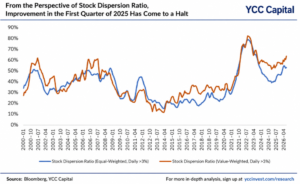
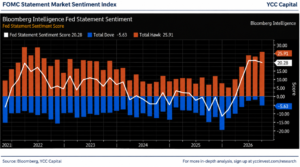
Recent Federal Reserve rhetoric has leaned hawkish, but rhetoric should not be confused with a binding policy path.
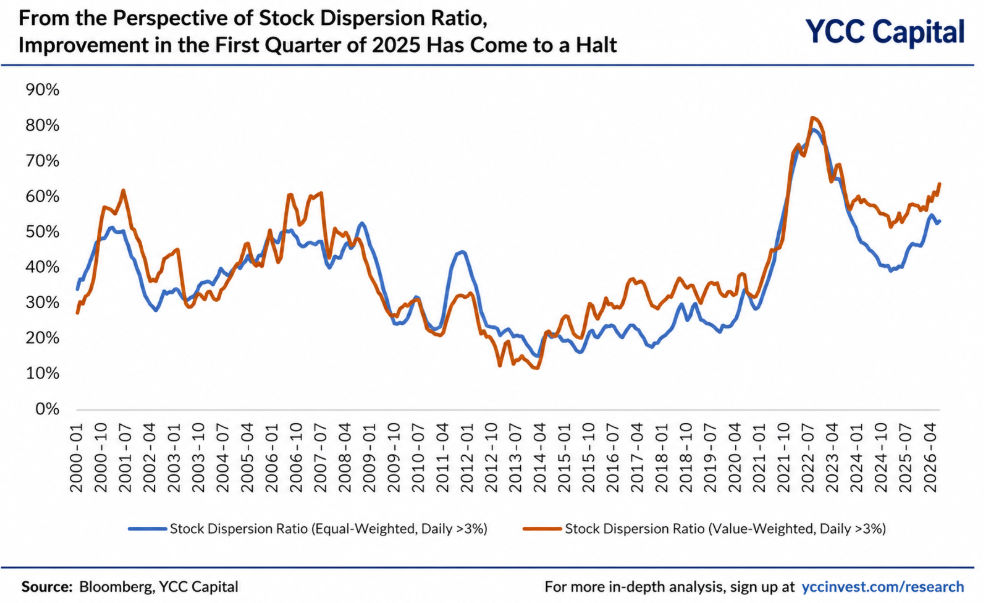
Inflation breadth remains uncomfortable. Roughly 54% of PCE categories have increased by more than 3% over the past twelve months, while about 49% exceed 3% on a six-month annualized basis. Weighting those categories by their actual share of consumer spending produces an even stronger signal: approximately 63.7% of the consumption basket has experienced inflation above 3% over twelve months, and 60.8% on the six-month annualized measure.
For perspective, from 2000 to 2019 the corresponding averages were only about 34.3% and 35.9%. Restricting the comparison to 2015–2019 lowers them further to 30.4% and 32.4%.
Inflation diffusion therefore stopped improving around the first quarter of 2025.
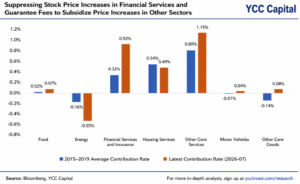
But the composition matters more than the headline. Much of the excess inflation pressure now comes from financial services and insurance, alongside selected core services and goods. Monetary policy is a remarkably blunt instrument against these categories. Higher policy rates cannot directly reverse compensatory insurance repricing, lower medical prices by decree, restore global goods deflation, or resolve an oil supply shock.
Using monetary policy for every problem is rather like adjusting the thermostat when the real problem is a broken window. The room may eventually cool, but the solution is inefficient and someone else pays the heating bill.
The Fed and Markets Are Trapped in a Hall of Mirrors
The interaction between the Federal Reserve and markets has become increasingly reflexive.
Markets attempt to anticipate the Fed. The Fed watches financial conditions and market pricing as inputs into its assessment of the economy. Markets then trade the Fed’s reaction to those same prices. Eventually, communication becomes less a window into the economy and more a mirror reflecting another mirror.
This dynamic worked better during periods of macroeconomic stability, when forward guidance helped anchor expectations. Today, wars, supply chains, AI investment and geopolitical realignment can change inflation and growth trajectories within months—or weeks.
That makes rigid guidance dangerous. A central bank that promises too much either has to violate its commitment when circumstances change or defend an obsolete commitment at the expense of its policy objectives.
Even during the Great Moderation, Federal Reserve projections contained meaningful forecasting errors. Today’s environment is substantially less predictable.
Our conclusion is simple: when monetary policy cannot substitute for structural reform, less communication can sometimes be more useful. The Fed should avoid turning every speech into a tradable event, while investors should spend less time parsing adjectives and more time studying capital flows.
“Hike Rates to Save the Long End” Is the Wrong Diagnosis
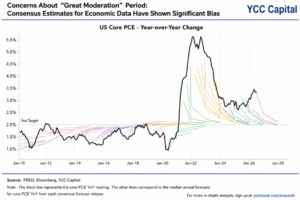
One increasingly popular argument holds that additional Fed tightening could lower long-term Treasury yields by reinforcing inflation credibility.
That logic can work when inflation expectations are genuinely unanchored. It fits today’s market much less comfortably.
Ten-year Treasury yields are around 4.75%, with ten-year real yields near 2.44% and breakeven inflation close to 2.3%. Compare that with August 26, 2022, when Jerome Powell delivered his memorable Jackson Hole warning: the ten-year nominal yield was approximately 3.03%, breakeven inflation around 2.57%, and the real yield roughly 0.5%.
Nominal yields are therefore about 170 basis points higher today, but real yields are roughly 200 basis points higher, even though breakeven inflation is lower.
The message is difficult to miss. Today’s long-end problem is primarily a real-rate problem, not an inflation-expectations problem.
A more hawkish Fed can still compress inflation expectations at the margin, but if expectations are already broadly anchored, the main effect of tighter policy is increasingly transmitted through demand destruction and higher real financing costs.
Nor can another 25-basis-point hike resolve oil-market disruptions caused by war, shipping insecurity or geopolitical competition. A policy rate cannot reopen a blocked shipping lane or rebuild military inventories.
AI Is Becoming the Marginal Buyer of American Capital
The more important structural development is the extraordinary financing appetite of the U.S. AI ecosystem.
AI-linked technology companies accounted for approximately 17.9% of U.S. non-financial corporate bond issuance with maturities of one year or longer in 2023. That share rose to roughly 37.9% in 2026.
In dollar terms, AI-related corporate bond issuance increased from about $45 billion in 2023 and $48 billion in 2024 to roughly $172 billion in 2025. During just the first eight months of 2026, issuance approached $295 billion—more than the previous three years combined.
Source: Bloomberg, YCC Capital.
This changes the transmission of monetary policy.
The largest AI companies can continue financing strategically essential investment even at elevated rates. Real estate developers, manufacturers, consumers and smaller businesses cannot absorb higher borrowing costs nearly as easily.
Raise rates modestly, and AI investment continues while traditional activity weakens. Raise them enough to truly stop AI financing, and large portions of the conventional economy may already be in recession.
Anyone who has run a business recognizes this asymmetry. The project with a potentially transformative payoff usually survives a higher hurdle rate. The marginal expansion, replacement vehicle or new storefront gets cancelled first.
Headline Private Demand Overstates the Breadth of Growth
Private domestic final purchases also look less impressive once their composition is examined.
Recent growth has been slightly weaker than historical averages, with unusually strong equipment investment largely offset by weakness in residential investment. AI spending is doing considerable work beneath the surface.
Import dependence complicates the picture further. Over the latest five quarters, net imports have offset roughly one-third of the estimated gross U.S. growth contribution from AI investment on average. In the first quarter of 2026, AI-related investment contributed an estimated 1.18 percentage points before import adjustment, but only around 0.73 percentage point after accounting for net imports.
That means domestic demand metrics can exaggerate the degree to which AI capital expenditure is heating the U.S. economy itself.
The Next Constraint May Be Liquidity, Not Inflation
AI investment is unlikely to stop. It has become linked not merely to corporate profitability, but also to national competitiveness, the dollar system, fiscal capacity and technological leadership.
For the United States, this is now strategic infrastructure.
That leaves the Federal Reserve with an increasingly awkward trade-off. Treasury issuance cannot simply stop. AI financing is accelerating. Yet the banking system still carries close to $320 billion of unrealized securities losses.
Those losses have become smaller relative to total bank assets, but duration risk does not disappear merely because it remains unrealized. If rates remain high long enough—or rise sufficiently quickly—an accounting problem can become a liquidity problem.
This is where the policy debate may eventually turn. Treasury cash management, maturity adjustments and buybacks can relieve pressure temporarily. The Fed can influence liquidity through shorter-maturity operations. But if both fiscal borrowing and AI capital demand continue expanding, the financial system may eventually require a larger monetary base.
A central bank emphasizing balance-sheet restraint could therefore find itself discussing the end of quantitative tightening—or renewed balance-sheet expansion.
September May Create Noise. AI Monetization Will Determine the Outcome
The September FOMC meeting will likely preserve the core framework used in July: the 2% long-run inflation objective remains intact, but policymakers will distinguish temporary price shocks from persistent inflation trends and will examine a wider basket of indicators rather than reacting mechanically to one PCE print.
Markets may again manufacture a hawkish-versus-dovish drama around small changes in wording.
We believe that misses the decisive variable.
The true question sits in the numerator: Can AI generate revenue and cash flow fast enough to justify the capital being committed to it?
If AI revenues expand rapidly, today’s extraordinary capital expenditure, borrowing and pressure on non-AI sectors can ultimately be understood as the disruptive resource reallocation that accompanies the early stage of a technological revolution.
If monetization disappoints, the same forces will be reclassified very quickly. Capital expenditure becomes leverage. Financing becomes refinancing risk. High valuations become duration risk. Liquidity abundance becomes liquidity dependence.
Our U.S. outlook therefore remains cautiously constructive, but increasingly selective. America possesses the capital markets, technology base and institutional scale required to absorb this investment cycle. The challenge is not whether the country can finance AI. It is whether the returns arrive quickly enough to justify the price being paid for capital.
That—not the latest adjective in a Fed speech—is the variable investors should watch.
Editorial Board
Ken Cao, Chief Strategist, Global Investment Strategy; Le Gao, Managing Analyst; Yui Nabeshima, Strategist; Mai Ikeda, Research Analyst.
IMPORTANT DISCLAIMER
This research report is provided for informational and educational purposes only and does not constitute an offer to sell or a solicitation of an offer to buy any securities, financial instruments, or investment products. It is not intended as investment, legal, accounting, or tax advice and should not be relied upon as such. The views, opinions, and projections expressed herein are those of YCC Capital Management and its research personnel as of the date of publication and are subject to change without notice. Past performance is not indicative of future results.
YCC Capital Management, its affiliates, principals, and employees may hold long or short positions in securities or instruments discussed in this report and may trade for their own accounts or for client accounts in a manner inconsistent with the recommendations herein. This report is based on publicly available information and data believed to be reliable, but YCC Capital makes no representation or warranty, express or implied, as to the accuracy, completeness, or timeliness of such information. Forward-looking statements involve risks and uncertainties that could cause actual results to differ materially from those projected.
Recipients of this report should conduct their own independent due diligence and consult with their own financial, legal, and tax advisors before making any investment decisions. YCC Capital accepts no liability for any loss or damage arising from the use of or reliance on this report or its contents.
This report is intended solely for the use of the intended recipient(s) and may not be reproduced or redistributed for commercial purposes without the prior written consent of YCC Capital. © 2026 YCC Capital. All rights reserved. YCC Capital’s flagship vehicle, the YCC International Value Fund, LP, maintains a concentrated global macro value strategy with a focus on capital-flow-driven mispricings and asymmetric hedging opportunities. The Fund is registered in the State of Delaware, U.S and structured as a 506(c) fund. Performance data, where referenced, has been verified by independent third parties including NAV Consulting; however, individual investor results may vary.
Contact Us
For research inquiries, please contact ir@yccinvest.com. Sign up for YCC Capital’s free daily market insight at yccinvest.com.
YCC Capital Research | Sign up for free daily market insight at www.yccinvest.com
For more related research:
After the Dollar: The Next Monetary Order and the Strategic Choices Facing China
The Fed’s Hawkish Pause Raises the Bar: Why Real Yields Now Hold the Key to Global Markets