YCC CAPITAL
U.S. Bond Strategy
September 18, 2026
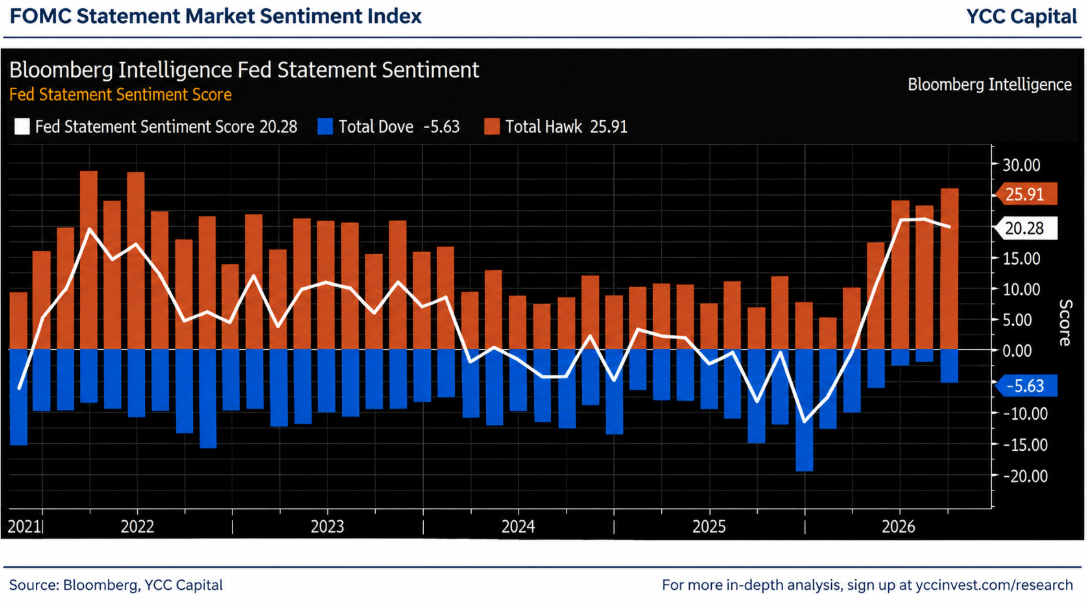
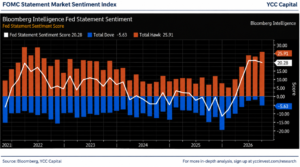
The Federal Reserve has delivered its first rate increase of 2026, but the more important message is not the 25-basis-point move itself. It is the determination behind it. The FOMC unanimously raised the federal-funds target range to 3.75%–4.00%, explicitly stating that the action should support a timelier return of inflation to 2%. (Federal Reserve)
For markets, this is a difficult combination: an economy that remains resilient enough to tolerate tighter policy, inflation still uncomfortable enough to demand it, and geopolitical pressures capable of keeping energy prices elevated. The result is a Federal Reserve willing to keep its foot on the brake even as Treasury yields move into increasingly restrictive territory.
Our central conclusion is straightforward: the near-term pressure on Treasuries has not fully exhausted itself, but the higher yields climb, the closer the market gets to the point where tightening begins to create its own counterforce. Investors should be patient rather than chase the selloff.
A Hike With a Hawkish Signature
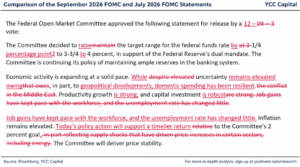
The September decision raised the policy range by 25 basis points from 3.50%–3.75% to 3.75%–4.00%. More revealing than the size was the unanimity: the decision passed 12–0. The Fed described domestic spending as resilient, productivity growth as strong, and capital investment as robust, while emphasizing that inflation remains elevated. (Federal Reserve)
That language matters. Monetary policy sometimes resembles driving through fog: policymakers cannot see the entire road, but they can decide whether the greater danger is accelerating too quickly or braking too late. September makes clear that the Fed currently sees persistent inflation as the more immediate hazard.
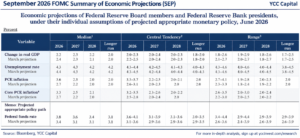
The projections reinforce that message. The September Summary of Economic Projections shows policymakers clustering around materially higher policy rates than previously anticipated, while maintaining relatively constructive expectations for economic activity. (Federal Reserve)
The underlying macro message is therefore unusual but coherent: higher rates are not yet synonymous with recession. The Fed believes the American economy possesses enough underlying resilience to absorb tighter financial conditions.
That distinction is central to our U.S. outlook. We remain cautiously constructive on the longer-term resilience of the U.S. economy, even while recognizing that current rates are becoming increasingly demanding for duration-sensitive assets.
The Yield Curve Is Becoming the Pressure Valve
Treasury yields have responded accordingly. Federal Reserve data show the 10-year constant-maturity Treasury yield reaching roughly 5.00%, with the 2-year around 4.67%, while long-end yields remain substantially higher still. (Federal Reserve)
The rise reflects more than expectations for the overnight policy rate. Three forces are colliding: persistent inflation risk, resilient U.S. growth and capital expenditure, and a geopolitical environment that has elevated the risk premium embedded in energy and long-duration assets.
This creates an increasingly important tension.
Higher yields initially validate the Fed’s tightening campaign by restraining demand. Eventually, however, they begin doing so much tightening themselves that additional increases become progressively harder for the financial system to absorb. Housing, refinancing, corporate borrowing, equity valuations and federal interest expense all encounter the same higher discount rate.
Think of Treasury yields as the water pressure running through the financial system. Raising pressure can improve discipline, but beyond a certain point every weak joint in the plumbing starts to matter.
That is why we are increasingly interested in the peak, rather than extrapolating the rise in yields indefinitely.
Oil Remains the Macro Swing Factor
The next one to two months are likely to be heavily influenced by energy.
Geopolitical disruptions have driven Brent crude into roughly the $105–$110 range in the scenario we are monitoring, reflecting overlapping pressures around the Strait of Hormuz, Red Sea shipping routes and attacks affecting energy infrastructure. These forces matter because oil is no longer merely a commodity-market story. It is feeding directly into the monetary-policy debate.
The Fed cannot produce a barrel of oil or reopen a shipping lane. What it can attempt to prevent is an initial relative-price shock from spreading into wages, services, expectations and broader inflation.
This creates a powerful transmission chain:
Geopolitical stress → higher oil → stronger inflation pressure → tighter Fed expectations → higher Treasury yields → tighter financial conditions.
The chain can also reverse.
If geopolitical pressure stabilizes and crude transitions from a rising trend into a high-level consolidation, the Treasury market would finally gain room to do the same. That is one of the clearest pathways toward a durable yield peak.
Two Roads From Here
We see two principal mechanisms capable of ending the current Treasury selloff.
The first is endogenous. Yields simply become sufficiently high to damage interest-sensitive areas of the economy or financial markets. In that scenario, tightening generates the conditions that eventually suppress yields. The adjustment could be uncomfortable, but it would contain its own stabilizer.
The second is external. Geopolitical pressure moderates, energy prices stop climbing and inflation fears cool. That would allow Treasury yields to transition into a high-level trading range without requiring a significant deterioration in U.S. fundamentals.
The distinction matters enormously for equities. A yield peak caused by easing inflation pressure is fundamentally different from a yield peak caused by financial stress.
At present, we do not believe investors need to make an all-or-nothing bet on either path.
Asset Allocation: Protect First, Add Risk Later
For Treasury investors, patience remains valuable. The Fed’s September communication does not provide a compelling reason to aggressively front-run lower yields. Yet with the 10-year yield around the 5% area, the compensation available in high-quality U.S. duration has become increasingly meaningful. (Federal Reserve) The opportunity becomes more attractive once evidence emerges that oil and long-end yields are losing upward momentum.
For precious metals, hawkish monetary policy remains a near-term headwind. Higher real yields increase the opportunity cost of holding non-yielding assets. Nevertheless, the asymmetric downside is becoming more interesting as nominal yields approach levels that themselves create macroeconomic stress. We would become more constructive when Treasury yields demonstrate clearer signs of peaking.
For equities, the appropriate posture is neither indiscriminate defensiveness nor aggressive risk-taking. Higher discount rates remain a valuation constraint, particularly for long-duration growth assets, but resilient U.S. productivity and investment provide an important fundamental counterweight. A more balanced exposure between value and technology, accompanied by sensible downside protection, appears appropriate while the macro catalyst remains unresolved.
Energy assets deserve particular caution. Much geopolitical stress is already reflected in pricing, which means upside can coexist with increasingly violent reversals. Investors carrying near-term exposure should consider the value of longer-dated downside protection rather than assuming geopolitical premiums move in only one direction.
YCC Strategic View
The September FOMC meeting marks an important transition. The question is no longer whether the Fed is prepared to tighten again. It has demonstrated that it is. The question is how far Treasury yields can rise before the tightening embedded in markets begins doing enough of the Fed’s work for it.
The official record supports the hawkish interpretation: a unanimous 25-basis-point hike, explicit emphasis on elevated inflation, resilient domestic demand and projections consistent with restrictive policy persisting for longer. (Federal Reserve)
But markets are rarely most attractive when the macro story feels comfortable. Sometimes the better opportunity arrives when the price itself has become uncomfortable.
We therefore view the current environment as a waiting game around the Treasury yield peak. Near-term momentum still argues against prematurely fighting higher yields. Medium term, however, the combination of increasingly restrictive financial conditions, greater fiscal sensitivity to borrowing costs and the possibility of eventual energy stabilization should progressively constrain the sustainability of another major leg higher.
The signal we want is not merely one good inflation print. It is a change in trend: stabilization in oil, reduced upward momentum in Treasury yields and evidence that the Fed’s tightening is gaining traction without breaking the underlying U.S. expansion.
When that combination appears, duration could shift from being the source of portfolio pain to one of its more useful sources of asymmetric opportunity.
Source: Bloomberg, YCC Capital.
Editorial Board
Ken Cao, Chief Strategist, Global Investment Strategy; Le Gao, Managing Analyst; Yui Nabeshima, Strategist; Mai Ikeda, Research Analyst.
IMPORTANT DISCLAIMER
This research report is provided for informational and educational purposes only and does not constitute an offer to sell or a solicitation of an offer to buy any securities, financial instruments, or investment products. It is not intended as investment, legal, accounting, or tax advice and should not be relied upon as such. The views, opinions, and projections expressed herein are those of YCC Capital Management and its research personnel as of the date of publication and are subject to change without notice. Past performance is not indicative of future results.
YCC Capital Management, its affiliates, principals, and employees may hold long or short positions in securities or instruments discussed in this report and may trade for their own accounts or for client accounts in a manner inconsistent with the recommendations herein. This report is based on publicly available information and data believed to be reliable, but YCC Capital makes no representation or warranty, express or implied, as to the accuracy, completeness, or timeliness of such information. Forward-looking statements involve risks and uncertainties that could cause actual results to differ materially from those projected.
Recipients of this report should conduct their own independent due diligence and consult with their own financial, legal, and tax advisors before making any investment decisions. YCC Capital accepts no liability for any loss or damage arising from the use of or reliance on this report or its contents.
This report is intended solely for the use of the intended recipient(s) and may not be reproduced or redistributed for commercial purposes without the prior written consent of YCC Capital. © 2026 YCC Capital. All rights reserved. YCC Capital’s flagship vehicle, the YCC International Value Fund, LP, maintains a concentrated global macro value strategy with a focus on capital-flow-driven mispricings and asymmetric hedging opportunities. The Fund is registered in the State of Delaware, U.S and structured as a 506(c) fund. Performance data, where referenced, has been verified by independent third parties including NAV Consulting; however, individual investor results may vary.
Contact Us
For research inquiries, contact ir@yccinvest.com. Sign up for free daily market insight at yccinvest.com.
YCC Capital Research | Sign up for free daily market insight at www.yccinvest.com
For more related research:
Has Peak Hawkishness Arrived? Why the Fed’s Toughest Message May Also Mark the Turning Point
Oil, Rates, and Risk: Why the Middle East Shock Is Repricing Global Fixed Income
The Fed’s Hawkish Pause Raises the Bar: Why Real Yields Now Hold the Key to Global Markets
The Long End Is Sending a Message: What Can Cool U.S. Treasury Yields?