YCC CAPITAL
U.S. Bond Strategy
August 31, 2026
YCC Capital Perspective
Federal Reserve Chairman Kevin Warsh used Jackson Hole to deliver a message that sounded sharper than the policy path it necessarily implies. His emphasis was unmistakably hawkish: inflation remains too high, the 2% target is not negotiable, financial conditions are not meaningfully restrictive, and the Federal Reserve should stop behaving as though markets deserve a running commentary on every future policy move.
Yet the most important conclusion for investors is not that the Fed is preparing an aggressive tightening cycle. We believe Warsh is trying to rebuild monetary-policy credibility while preserving maximum flexibility. The tone is hard; the reaction function is more nuanced.
That distinction matters. Markets heard the knife. We think policy may still prove softer than the rhetoric.
Inflation Is Once Again the Center of Gravity
Warsh placed inflation, rather than growth stabilization, at the center of the Fed’s mandate. Recent improvements in CPI and PCE inflation have not persuaded him that the underlying trend has decisively returned to target.
A particularly important statistic was his observation that roughly 54% of items in the PCE basket are still rising at annual rates above 3%. In other words, inflation is not merely a story about a handful of volatile categories. Its breadth remains uncomfortable.
Warsh also used unusually direct language in assigning responsibility for the inflation experience of the past several years to the central bank itself. His framing suggests that the Fed cannot afford another episode in which improving headline data leads policymakers to declare victory too early.
For markets, the implication is straightforward: if underlying inflation does not move toward 2% clearly and fast enough, additional tightening remains available.
That does not make a hike inevitable. It does mean the burden of proof has shifted. The Fed no longer needs to demonstrate why rates should stay high; incoming inflation data must demonstrate why they should come down.
Anyone who has ever turned off a stove only to discover that the pan is still hot understands the problem. Monetary tightening may already have been applied, but residual heat can linger far longer than expected. Warsh appears determined not to mistake cooling for cold.
Growth Is Not Weak Enough to Force the Fed’s Hand
The second major message was confidence in the resilience of the U.S. economy.
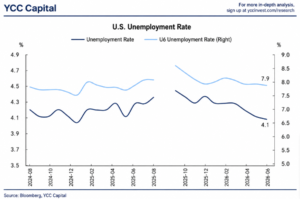
Warsh highlighted continued investment in artificial intelligence, healthy corporate profitability, solid private-sector demand, narrow credit spreads and active corporate financing. He also characterized the labor market as broadly consistent with full employment, while acknowledging pockets of structural pressure in housing and agriculture.
This matters because Warsh does not appear inclined to use monetary easing as a pre-emptive support mechanism for growth.
His preferred division of labor is increasingly clear. Productivity and private capital expenditure should generate economic growth. Markets should determine financial conditions. The Federal Reserve should focus primarily on price stability.
YCC Capital views this framework as important for the medium-term U.S. rates outlook. The American economy still has meaningful sources of endogenous growth, particularly through technology investment and productivity improvement. That gives the Fed more room to tolerate restrictive rates than would be possible in an economy already slipping into broad contraction.
We remain cautiously constructive on the United States for precisely this reason. High rates create real pressure, especially for housing, small businesses and interest-sensitive borrowers, but the economy is not behaving like a system that requires emergency monetary accommodation.
The Fed Wants Out of the Hall of Mirrors
Warsh devoted substantial attention to the dangers of habitual forward guidance.
His concern is that the Federal Reserve signals its intentions, markets trade on those signals, and policymakers then interpret the resulting market prices as information about economic conditions. The process can become circular: the Fed watches markets that are themselves watching the Fed.
It is a monetary-policy hall of mirrors.
Warsh appears to want a quieter central bank—one that does not promise an interest-rate path, does not manufacture excessive certainty, and does not behave as though every market correction requires verbal reassurance.
That approach would weaken the perceived “Fed put.”
From an investment perspective, this may be one of the most consequential changes of the Warsh era. Less forward guidance means greater sensitivity to every inflation release, employment report and policymaker speech. The market will have to infer the reaction function repeatedly rather than simply follow a pre-announced path.
That should produce more frequent repricing across Treasuries, the dollar and risk assets.
The Market Heard a Hawk
The immediate reaction was decisive.
Following Warsh’s remarks, market pricing moved sharply toward a near-term rate increase. CME FedWatch implied a 57% probability of a 25-basis-point September hike, which would lift the policy rate to 3.75%–4.00%.
The Treasury curve bear-flattened as front-end yields rose much faster than long-end yields. Between approximately 9:00 and 16:00, the 6-month, 1-year and 2-year Treasury yields increased by 7.1, 10.8 and 11.6 basis points, respectively. By comparison, 5-year, 10-year and 30-year yields rose 8.1, 4.4 and 1.3 basis points.
The pattern makes sense. Short maturities are much more sensitive to the expected path of policy rates, while Warsh’s renewed commitment to the 2% inflation target helped anchor longer-term inflation expectations.
The foreign-exchange and precious-metals markets told the same story. The U.S. Dollar Index rose from 99.17 at the start of the speech to 99.66 by 16:00, an increase of roughly 0.5%. London gold fell from approximately $4,615 per ounce to $4,456, a decline of about 3.4%.
The dominant trade was a repricing toward higher real interest rates.
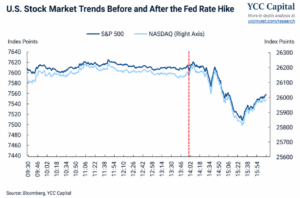
U.S. equities initially responded positively to Warsh’s confidence in AI investment, corporate earnings and economic resilience. But as front-end Treasury yields continued climbing, discount-rate pressure ultimately overwhelmed the growth narrative and stocks retreated.
Sources: Bloomberg, YCC Capital.
Hard Words, Softer Hands
We do not interpret Jackson Hole as a signal that a sequence of rate hikes is imminent.
The deeper objective is credibility.
Fiscal deficits, heavy long-duration Treasury issuance and a structurally higher term premium increasingly complicate monetary policy. If the Fed were to dilute the 2% inflation objective simply because long-term yields or asset prices became uncomfortable, markets could conclude that monetary policy had become subordinate to fiscal financing or financial stability.
Warsh cannot afford that perception.
We therefore expect him to maintain an asymmetric communication strategy: hawkish rhetoric, explicit willingness to tighten, and no promise of accommodation—but a much higher threshold for actually beginning a sustained hiking cycle.
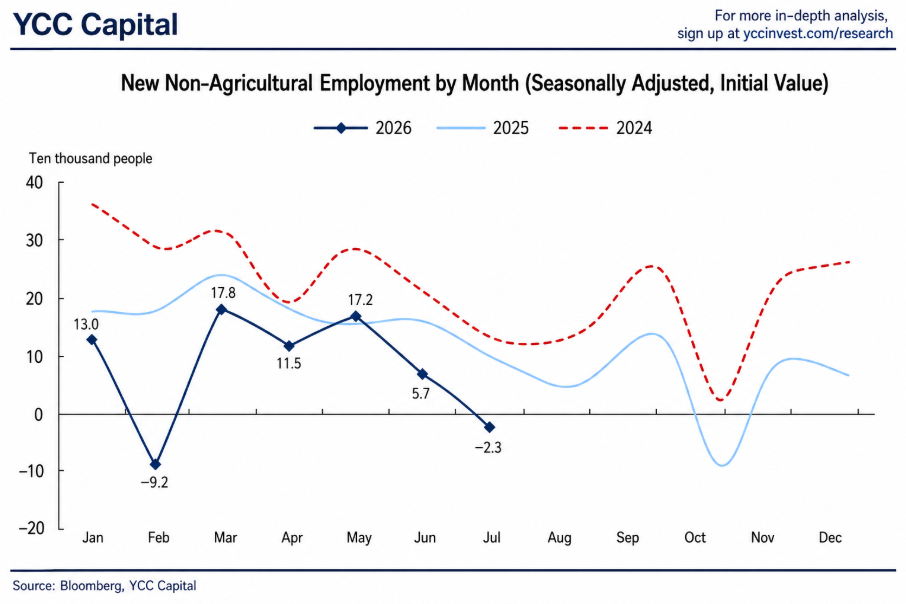
The labor market is cooling at the margin. Growth is becoming less uniform. The cumulative burden of elevated rates is becoming more visible. Unless inflation accelerates materially again, these forces should limit how far the Fed is willing to go.
This is why “hard words, softer hands” is likely to remain the defining pattern.
YCC Strategic View
For Treasury investors, the new regime argues against treating every hawkish speech as the beginning of a straight-line tightening cycle. It also argues against expecting the Fed to rescue duration or risk assets whenever volatility rises.
The front end should remain highly sensitive to inflation and employment surprises. The long end will increasingly be driven by fiscal supply, term premium and confidence in the Fed’s inflation commitment. Bear-flattening episodes may therefore recur whenever markets reprice policy risk sharply.
For the dollar, continued U.S. economic resilience and relatively high real yields remain supportive. For gold and long-duration equities, the key vulnerability is a renewed upward shift in real-rate expectations.
The broader lesson is that Warsh wants investors to stop trading the Federal Reserve as though it were an insurance contract.
That may make markets noisier. It may also make monetary policy more credible.
And credibility, in the end, is precisely what Jackson Hole was about.
Sources: Bloomberg, YCC Capital.
Editorial Board
Ken Cao, Chief Strategist, Global Investment Strategy; Le Gao, Managing Analyst; Yui Nabeshima, Strategist; Mai Ikeda, Research Analyst.
IMPORTANT DISCLAIMER
This research report is provided for informational and educational purposes only and does not constitute an offer to sell or a solicitation of an offer to buy any securities, financial instruments, or investment products. It is not intended as investment, legal, accounting, or tax advice and should not be relied upon as such. The views, opinions, and projections expressed herein are those of YCC Capital Management and its research personnel as of the date of publication and are subject to change without notice. Past performance is not indicative of future results.
YCC Capital Management, its affiliates, principals, and employees may hold long or short positions in securities or instruments discussed in this report and may trade for their own accounts or for client accounts in a manner inconsistent with the recommendations herein. This report is based on publicly available information and data believed to be reliable, but YCC Capital makes no representation or warranty, express or implied, as to the accuracy, completeness, or timeliness of such information. Forward-looking statements involve risks and uncertainties that could cause actual results to differ materially from those projected.
Recipients of this report should conduct their own independent due diligence and consult with their own financial, legal, and tax advisors before making any investment decisions. YCC Capital accepts no liability for any loss or damage arising from the use of or reliance on this report or its contents.
This report is intended solely for the use of the intended recipient(s) and may not be reproduced or redistributed for commercial purposes without the prior written consent of YCC Capital. © 2026 YCC Capital. All rights reserved. YCC Capital’s flagship vehicle, the YCC International Value Fund, LP, maintains a concentrated global macro value strategy with a focus on capital-flow-driven mispricings and asymmetric hedging opportunities. The Fund is registered in the State of Delaware, U.S and structured as a 506(c) fund. Performance data, where referenced, has been verified by independent third parties including NAV Consulting; however, individual investor results may vary.
Contact Us
For research inquiries, contact ir@yccinvest.com.
Sign up for free daily market insight at yccinvest.com.
YCC Capital Research | Sign up for free daily market insight at www.yccinvest.com
For more related research:
The Fed’s Hawkish Reset: From “When to Cut” to “Whether to Hike Again”
The Warsh Shock: The Fed’s Hawkish Reset Forces a Full Market Repricing