YCC CAPITAL
U.S. Themes & Strategy
August 27, 2026
America is not simply moving through another business cycle. It is attempting something harder: rebuilding strategic industrial capacity while carrying the fiscal legacy of the pandemic, structurally higher capital needs and an economy whose traditional sectors are increasingly uneven.
At YCC Capital, we believe many features that appear contradictory—high long-term interest rates, soft hiring, resilient consumption, enormous AI investment and widening K-shaped outcomes—make more sense when viewed as the price of transformation rather than evidence that transformation has failed.
The United States is effectively renovating the house while still living in it. Anyone who has gone through a major renovation understands the experience: the bill arrives before the new kitchen works, the hallway is covered in dust, and daily life becomes less comfortable long before the finished structure adds value. The economic equivalent is already visible. Capital is being redirected from short-cycle consumption toward long-duration investment, while interest rates, affordability and parts of the labor market absorb the disruption.
Our central conclusion is cautiously constructive. The transition is expensive, politically difficult and increasingly unequal, but the United States has found a credible industrial anchor in AI. That substantially improves the odds that the current reindustrialization effort develops into something more durable than previous attempts.
Source: Bloomberg, YCC Capital.
The United States Is Rebuilding Strategic Capacity, Not Recreating the 1950s
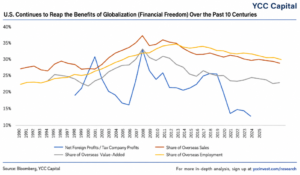
American concern over industrial decline is not new. Industrial-policy debates were already active in Washington in the early 1980s, and the modern reshoring cycle accelerated after the 2008 financial crisis. The Obama administration’s Advanced Manufacturing Partnership in 2011 captured the aspiration neatly: invent in America and manufacture in America.
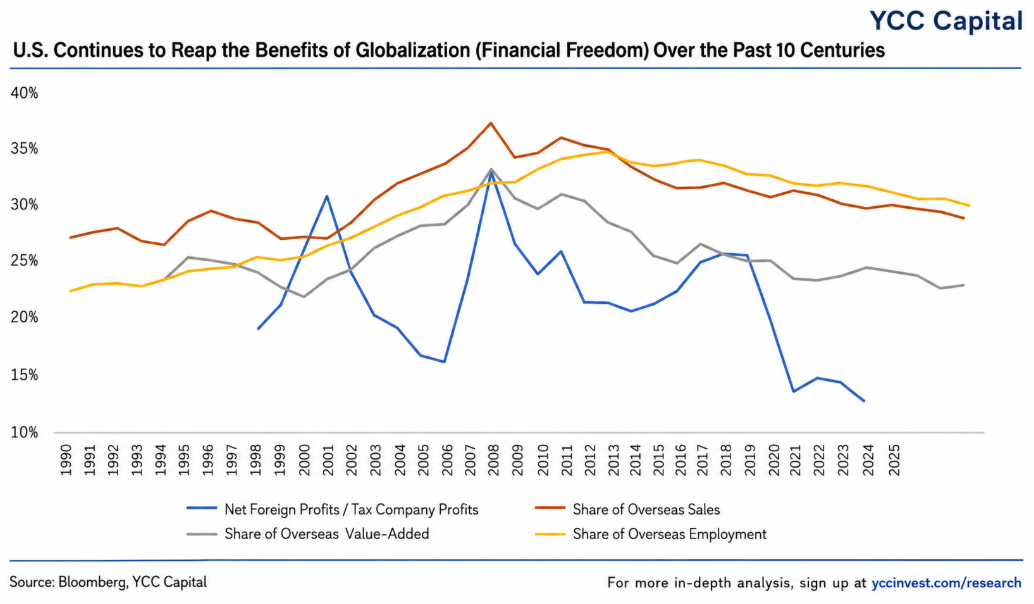
Yet aspiration was not enough. During the first decade of this century, U.S. corporations continued to benefit enormously from globalization, overseas profits and relatively low inflation. Cross-border financial integration remained extremely high, and there was little economic incentive to accept the near-term cost of rebuilding domestic capacity.
The pandemic changed that calculation. Supply-chain disruption exposed the fragility of critical inputs, while emergency fiscal policy added roughly $4 trillion of cumulative deficit pressure relative to a pre-pandemic baseline, excluding associated interest expense. In effect, several years of fiscal capacity were consumed rapidly.
The labor side has also shifted. By the second quarter of 2026, labor income represented about 52.4% of total income, roughly three percentage points below its 2010–2019 steady-state range and near the lowest level in the available data. At the same time, government transfers remain materially more important to household income than they were in earlier decades.
This combination created urgency. The Infrastructure Investment and Jobs Act, CHIPS and Science Act and Inflation Reduction Act were all launched before ChatGPT became a mass-market phenomenon. Washington already understood that the next strategic frontier might involve semiconductors, clean energy, quantum computing, biotechnology or AI. What it lacked was a technology with sufficiently broad commercial potential, sufficiently large capital requirements and sufficiently strong U.S. comparative advantages to organize the investment cycle around.
AI supplied that missing center of gravity.
The key analytical mistake is to judge reindustrialization only by total factory employment. America is not attempting to reproduce twentieth-century mass-employment industrialization. It is rebuilding twenty-first-century strategic manufacturing capacity—fabs, data centers, advanced machinery, power infrastructure, software, high-end computing and critical supply chains.
Employment data already show strength in the front end of this process: factory construction and related activity have expanded materially since 2010. Output data make the change still clearer. Investment is concentrated at both the front end, where facilities are being built, and the back end, where strategic manufacturing, batteries, vehicles, grid equipment and AI-related capacity are entering production.
This also explains why old industrial indicators can mislead. A modern automated semiconductor facility or data center does not translate output into employment or electricity consumption in the same proportions as a twentieth-century factory. Much of the new capacity is still under construction, being installed or moving through ramp-up phases.
Source: Bloomberg, YCC Capital.
High Rates Are Part of the Bill
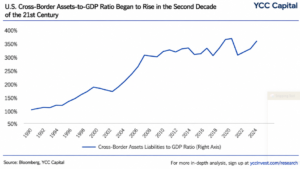
The second major implication of this transition is that structurally higher long-term rates are not simply a Federal Reserve story.
After depreciation, U.S. net national saving has moved close to zero. Persistent government dissaving absorbs much of the surplus generated by households and businesses just as private-sector demand for capital is accelerating across AI infrastructure, information equipment, manufacturing and utilities.
That imbalance matters for Treasuries. With foreign official holdings no longer expanding rapidly enough to absorb incremental duration automatically, more long-dated government debt must clear through price-sensitive private investors. Unless either fiscal deficits or private investment adjusts sharply, equilibrium requires a higher real yield, a higher term premium, or both.
The political hierarchy is becoming clearer. Washington is far more likely to tolerate elevated rates than deliberately choke off the AI investment cycle. Neither a sudden collapse in AI capital expenditure nor an immediate fiscal consolidation appears realistic.
This is why we would be cautious about assuming that policy-rate cuts automatically restore the ultra-low long-end yields of the 2010s.
AI also has a potentially important monetary dimension. The United States can export an integrated, dollar-denominated technology stack: advanced chips, cloud capacity, software licenses, data-center equipment, energy infrastructure and financing. Partner economies seeking access to this ecosystem may simultaneously accumulate dollar assets, invest directly in the United States and own U.S. technology equities.
That creates what we would describe as a reinforcing combination of “technology-dollar” demand and “safe-asset-dollar” demand. De-dollarization remains a slow diversification process measured in years and decades, not an overnight replacement event.
The constraint is straightforward: productivity must eventually justify the financing cost. If AI investment produces returns above the economy’s marginal cost of capital, the investment boom can improve fiscal and debt dynamics over time. If returns disappoint, the same spending could intensify the pressure.
Main Street Is Paying Before the Productivity Dividend Arrives
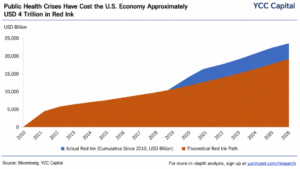
The most uncomfortable part of the transition is that traditional sectors are already carrying much of the cost.
Thirty-year mortgage rates have returned to roughly 6.8%, close to levels seen before the previous 75-basis-point easing cycle. For households trying to buy a home, refinancing theory means very little when the monthly payment is still painfully high. The earlier political promise of a rapid affordability improvement has therefore run into economic reality.
Labor-market data tell a similar story. Over the latest twelve months, nonfarm payroll growth has averaged only around 26,000 jobs per month. Aging demographics, reduced immigration and slower labor-force growth help explain why weak hiring can coexist with a relatively low unemployment rate.
A broader Structural Labor Market Indicator published by Federal Reserve researchers in 2026 suggests that labor-market tightness has fallen significantly from its post-pandemic peak and is now around neutral or modestly soft relative to the 2015–2019 equilibrium.
Meanwhile, utilization-adjusted total factor productivity moved into year-on-year contraction in the second quarter of 2026. Yet neither policymakers nor markets have treated this as evidence that the AI thesis is finished. If anything, the collective commitment has deepened. Government, Wall Street and corporate America have already invested too much capital, political credibility and strategic planning to abandon the transition easily.
That raises the likelihood of a more pronounced K-shaped economy. High-productivity firms, capital owners and regions tied to AI infrastructure may continue to outperform, while housing-sensitive households, smaller firms and traditional sectors experience much less favorable conditions.
YCC Strategic View: Policy Is Shifting From Stimulus to a Floor
The most important change in the policy framework is subtle. Traditional monetary and fiscal policy increasingly appears designed to put a floor under the economy rather than push every sector higher. Private-sector industrial investment is becoming the primary engine of transformation; government policy is increasingly tasked with preventing the weaker parts of the system from breaking.
This means policymakers may tolerate more softness in conventional economic sectors than investors became accustomed to during the post-2008 era.
Our base case is therefore a combination that may initially look uncomfortable: strategic capital expenditure remains elevated, long-term yields remain under pressure, aggregate U.S. growth retains resilience, and divergence across industries, regions and households widens further.
Manufacturing surveys and capital-spending intentions remain consistent with continued investment rather than an abrupt retrenchment. AI-related equipment and data-center investment are still rising rapidly as a share of nonresidential investment.
For markets, the implication is not that the United States has eliminated its fiscal vulnerabilities. Quite the opposite: deficits, inadequate national saving and elevated financing costs remain significant risks. But America is using the remaining policy window to build assets intended to raise future productive capacity.
That is a better problem than stagnation without investment.
The next phase of the U.S. cycle is therefore less about returning to the pre-pandemic economy than about deciding how much short-term discomfort the system can absorb while the new one is built. The United States is buying time with capital, fiscal capacity and higher interest rates. AI is the asset it hopes to receive in exchange.
We remain cautiously optimistic that this wager can work—but investors should expect the journey to remain expensive, uneven and politically noisy.
Source: Bloomberg, YCC Capital.
Editorial Board
Ken Cao, Chief Strategist, Global Investment Strategy
Le Gao, Managing Analyst
Yui Nabeshima, Strategist
Mai Ikeda, Research Analyst
IMPORTANT DISCLAIMER
This research report is provided for informational and educational purposes only and does not constitute an offer to sell or a solicitation of an offer to buy any securities, financial instruments, or investment products. It is not intended as investment, legal, accounting, or tax advice and should not be relied upon as such. The views, opinions, and projections expressed herein are those of YCC Capital Management and its research personnel as of the date of publication and are subject to change without notice. Past performance is not indicative of future results.
YCC Capital Management, its affiliates, principals, and employees may hold long or short positions in securities or instruments discussed in this report and may trade for their own accounts or for client accounts in a manner inconsistent with the recommendations herein. This report is based on publicly available information and data believed to be reliable, but YCC Capital makes no representation or warranty, express or implied, as to the accuracy, completeness, or timeliness of such information. Forward-looking statements involve risks and uncertainties that could cause actual results to differ materially from those projected.
Recipients of this report should conduct their own independent due diligence and consult with their own financial, legal, and tax advisors before making any investment decisions. YCC Capital accepts no liability for any loss or damage arising from the use of or reliance on this report or its contents.
This report is intended solely for the use of the intended recipient(s) and may not be reproduced or redistributed for commercial purposes without the prior written consent of YCC Capital. © 2026 YCC Capital. All rights reserved. YCC Capital’s flagship vehicle, the YCC International Value Fund, LP, maintains a concentrated global macro value strategy with a focus on capital-flow-driven mispricings and asymmetric hedging opportunities. The Fund is registered in the State of Delaware, U.S and structured as a 506(c) fund. Performance data, where referenced, has been verified by independent third parties including NAV Consulting; however, individual investor results may vary.
Contact Us
For research inquiries, please contact ir@yccinvest.com.
Sign up for YCC Capital’s free daily market insight at yccinvest.com.
YCC Capital Research | Sign up for free daily market insight at www.yccinvest.com
For more related research:
The AI Infrastructure Boom: Can Trillions in Investment Become Sustainable Economic Value?
America’s $40 Trillion Test Treasury Supply, Fiscal Gravity and the New Price of U.S. Credibility