YCC CAPITAL
U.S. THEMES & STRATEGY
August 5, 2026
YCC Perspective
The U.S. economy entered the second quarter looking weaker on the surface than it felt underneath. Real GDP expanded at a 1.5% annualized rate, down from 2.1% in the first quarter and below the 2.1% market consensus. Yet the headline was distorted by two of the most volatile components in the national accounts: inventories and net exports.
Strip those away, and the picture changes materially. Real final sales to private domestic purchasers—the clearest measure of household spending and private fixed investment—accelerated from 1.7% to 3.9%. In other words, the economy’s paintwork looked scratched, but the engine was still running smoothly.
YCC Capital’s conclusion is cautiously constructive. U.S. domestic demand remains resilient, consumer activity has reaccelerated, and artificial-intelligence-related capital expenditure continues to support business investment. The challenge is that this resilience is increasingly accompanied by renewed inflation pressure, leaving the Federal Reserve with less room to relax policy.
Headline GDP Understates Domestic Strength
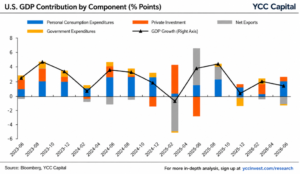
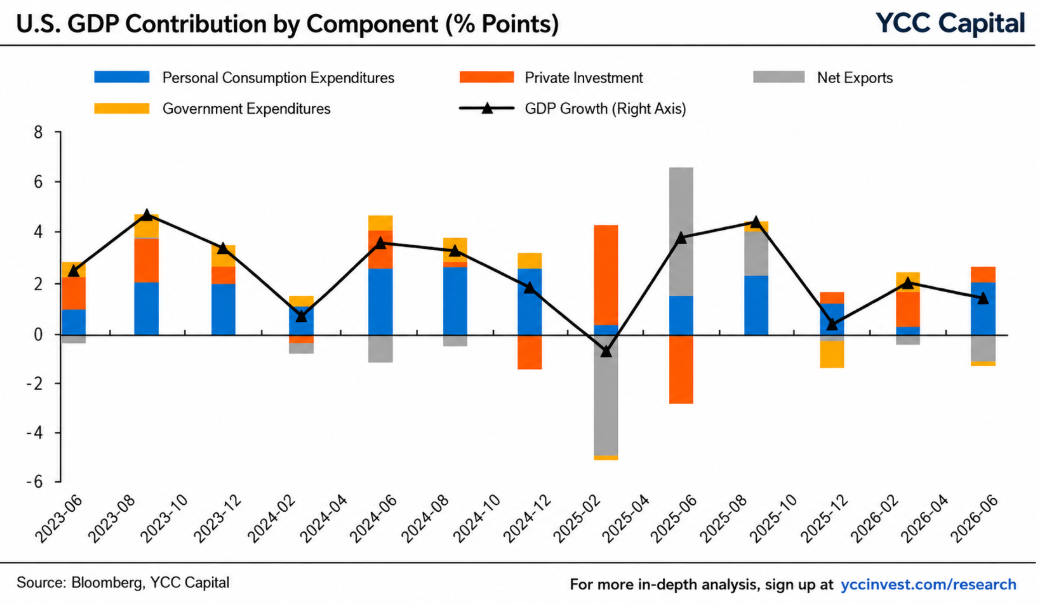
Second-quarter real GDP growth slowed to 1.5% annualized from 2.1% in the first quarter and 3.8% a year earlier. The slowdown, however, did not reflect a broad collapse in final demand.
Private inventory accumulation moved from contributing 0.23 percentage points to first-quarter growth to subtracting 0.67 percentage points in the second quarter. Net exports reduced growth by another 1.01 percentage points. Together, these volatile categories obscured a much firmer domestic economy.
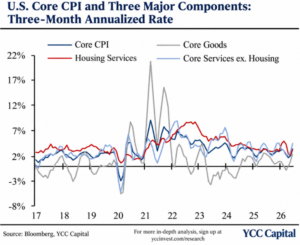
The domestic purchases price index rose at a 5.7% annualized pace, up sharply from 3.6% in the first quarter. Following the release, market pricing for a September rate increase rose from 55.4% to 61.4%. The message was uncomfortable but clear: growth was softer in the accounting sense, while underlying demand and inflation were stronger in the economic sense.
This is the kind of GDP report that rewards looking beyond the first line. Much like a household budget temporarily distorted by a large tax payment or inventory purchase, quarterly GDP can tell a misleading story when transitory components dominate the calculation.
Consumers Are Still Spending, but the Cushion Is Thinning
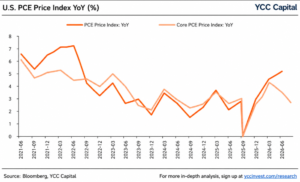
Personal consumption expenditures rose 3.2% annualized, sharply higher than 0.5% in the first quarter and 2.5% a year earlier. Consumption contributed 2.12 percentage points to overall GDP growth, making it the quarter’s principal source of strength.
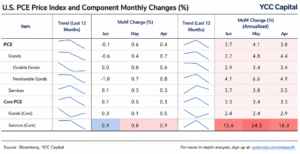
Goods spending increased 5.2%, while services spending rose 2.2%. Durable-goods consumption advanced 6.8%, outpacing the 4.4% increase in nondurable goods. Motor vehicles and parts, furniture, household durables, prescription drugs, and other nondurable goods provided the strongest support. Gasoline and other energy products, together with housing and utilities, were among the few negative contributors.
The composition is encouraging, but the financing of that consumption is less reassuring. Disposable-personal-income growth has generally slowed since 2023, while the personal saving rate has fallen to 2.7%, close to its 2022 low.
For many households, this resembles the final stretch of a long road trip: the car is still moving at speed, but the fuel gauge deserves attention. Consumers retain momentum, yet they have less savings capacity to absorb future shocks. Continued spending growth will increasingly depend on income gains, credit availability, and labor-market stability rather than further reductions in savings.
AI Capital Spending Is Broadening the Investment Cycle
Gross private domestic investment increased 3.0% annualized, down from 7.9% in the first quarter. The apparent slowdown was overwhelmingly driven by inventory adjustment. Fixed investment rose 7.0%, accelerating from 6.5% in the first quarter and 4.4% a year earlier.
Nonresidential investment remained the backbone of the expansion. Equipment investment surged 15.2%, while intellectual-property investment increased 8.8%. Demand for information-processing equipment continues to benefit from the buildout of AI infrastructure, advanced computing capacity, and data-center deployment.
Importantly, the investment expansion was not confined to a narrow group of semiconductor and cloud-computing companies. Industrial equipment and transportation-equipment investment also strengthened, suggesting that the capital-spending cycle is beginning to reach beyond the most visible AI beneficiaries.
Software and research-and-development spending remained robust, reinforcing the view that AI investment is not simply a hardware cycle. It is increasingly an organizational and intellectual-capital cycle as companies redesign workflows, automate tasks, and embed computing capacity throughout their operations.
Structures investment remained weak because of elevated financing costs and soft demand in portions of commercial real estate. Residential investment rose 1.5%, ending five consecutive quarters of decline, but housing remains constrained. The average 30-year fixed mortgage rate rose to 6.41% from 6.11% in the first quarter. Lennar’s average home-delivery price fell to approximately $371,000, its lowest level since 2017, indicating that builders continue to use price concessions to offset affordability pressure.
Trade Is a Drag, but Not for the Usual Reason
Net exports subtracted 1.01 percentage points from GDP growth. Exports rose 4.5%, down from 10.9% in the first quarter, while imports increased 11.5%.
Goods exports grew 8.9%, compared with 18.8% previously, and services exports contracted 3.3%. Travel and business services were notable areas of weakness. By contrast, goods imports rose 14.7%, driven by communications equipment, semiconductors, components, and industrial machinery.
The trade deficit therefore reflects, in part, a strong domestic investment cycle rather than simply weak competitiveness. U.S. firms are importing the physical building blocks of the AI economy. High-technology industries obtain a substantial portion of their equipment from overseas, so continued AI infrastructure investment is likely to keep capital-goods imports elevated.
This may weigh on reported GDP in the near term, but the economic interpretation is more nuanced. Imported equipment subtracts from current-quarter GDP accounting, while the productive capacity it creates may support future output and earnings.
Fiscal Support Remains Larger Than the Quarterly Data Suggest
Government consumption and investment declined 0.8% annualized after rising 4.4% in the first quarter, subtracting 0.14 percentage points from GDP growth. Federal spending fell 4.1%, led by a 12.9% decline in nondefense spending.
The weakness largely reflected increased sales from the Strategic Petroleum Reserve. Under national-accounting rules, government receipts from sales of goods reduce measured government consumption expenditures. The transaction changes the composition of GDP but does not directly reduce total GDP because corresponding entries appear elsewhere in the accounts.
The underlying fiscal position remains expansionary. The federal deficit reached $1.775 trillion in fiscal 2025, while projections for fiscal years 2026, 2027, and 2028 stand at approximately $1.853 trillion, $1.887 trillion, and $2.080 trillion, respectively. With the Strategic Petroleum Reserve already near historically low levels, the scope for repeated large releases is limited.
Fiscal policy is therefore unlikely to become a major near-term drag. The more important medium-term question is whether persistent deficits keep Treasury yields and term premiums elevated even as inflation gradually moderates.
Investment Implications: Resilience Has a Price
The second-quarter report reinforces YCC Capital’s cautiously optimistic U.S. outlook. The economy is not booming, but neither is it sliding toward recession. Consumption remains firm, fixed investment is accelerating, and the AI capital-expenditure cycle continues to provide a powerful source of demand.
The principal risk is that economic resilience delays monetary easing—or produces additional tightening—at a time when households, housing, and interest-sensitive sectors are already carrying high financing costs. Strong growth is usually welcome, but in the current cycle it comes with a policy invoice.
For markets, the environment favors selectivity over broad risk-taking. High-quality companies with durable cash flows, pricing power, and direct exposure to productivity-enhancing investment remain better positioned than heavily leveraged businesses dependent on rapid rate cuts. Treasury volatility may remain elevated as investors balance resilient demand against renewed inflation risk.
Our base case is that the U.S. expansion continues, though at an uneven pace. The economy still has fuel, but the Federal Reserve is watching the temperature gauge closely.
Key Risks
The principal risks include an escalation in geopolitical conflict, tighter-than-expected Federal Reserve policy, renewed inflation pressure, weakening household income growth, and rising costs associated with the AI investment cycle.
Sources: Bloomberg, YCC Capital.
Editorial Board
Ken Cao, Chief Strategist, Global Investment Strategy
Le Gao, Managing Analyst
Yui Nabeshima, Strategist
Mai Ikeda, Research Analyst
IMPORTANT DISCLAIMER
This research report is provided for informational and educational purposes only and does not constitute an offer to sell or a solicitation of an offer to buy any securities, financial instruments, or investment products. It is not intended as investment, legal, accounting, or tax advice and should not be relied upon as such. The views, opinions, and projections expressed herein are those of YCC Capital Management and its research personnel as of the date of publication and are subject to change without notice. Past performance is not indicative of future results.
YCC Capital Management, its affiliates, principals, and employees may hold long or short positions in securities or instruments discussed in this report and may trade for their own accounts or for client accounts in a manner inconsistent with the recommendations herein. This report is based on publicly available information and data believed to be reliable, but YCC Capital makes no representation or warranty, express or implied, as to the accuracy, completeness, or timeliness of such information. Forward-looking statements involve risks and uncertainties that could cause actual results to differ materially from those projected.
Recipients of this report should conduct their own independent due diligence and consult with their own financial, legal, and tax advisors before making any investment decisions. YCC Capital accepts no liability for any loss or damage arising from the use of or reliance on this report or its contents.
This report is intended solely for the use of the intended recipient(s) and may not be reproduced or redistributed for commercial purposes without the prior written consent of YCC Capital. © 2026 YCC Capital. All rights reserved. YCC Capital’s flagship vehicle, the YCC International Value Fund, LP, maintains a concentrated global macro value strategy with a focus on capital-flow-driven mispricings and asymmetric hedging opportunities. The Fund is registered in the State of Delaware, U.S and structured as a 506(c) fund. Performance data, where referenced, has been verified by independent third parties including NAV Consulting; however, individual investor results may vary.
Contact Us
For research inquiries, contact ir@yccinvest.com.
Sign up for free daily market insight at yccinvest.com.
YCC Capital Research | Sign up for free daily market insight at www.yccinvest.com
For more related research:
The Hike That May Never Come: Positioning for a Hawkish Fed Without Chasing the Fear
China’s Growth Engine Is Losing Altitude: Exports Still Fly, But Domestic Demand Is Running on Empty
China’s Fiscal Mirage: Tax Revenues Rebound, But Growth Engines Continue to Stall
China’s Fiscal Engine Is Losing Power: Shrinking Policy Firepower Raises the Stakes for Growth