YCC CAPITAL
U.S. Themes & Strategy
October 16, 2026
YCC Capital Macro Research
The YCC Perspective: Inflation Is Spreading, Not Retreating
The September U.S. inflation figures deliver an uncomfortable message to investors: America’s economy remains resilient, but that resilience is becoming a double-edged sword for monetary policy. The inflation problem is no longer confined to a handful of volatile categories. Price pressures are spreading across goods, housing, transportation, and consumer services.
At YCC Capital, we see the central risk as the persistence of elevated energy prices. Oil does not need to surge dramatically to disrupt the disinflation process. Simply remaining expensive for longer can steadily transmit inflation through transportation networks, production costs, and household budgets.
Consider a family whose gasoline bill increases while hotel stays, clothing, and vehicle-related expenses also become more expensive. Even if individual price increases appear manageable, their combined effect gradually erodes purchasing power. This is precisely why the breadth of September’s inflation rebound matters more than any single headline number.
Our central investment conclusion is straightforward: the U.S. economy remains fundamentally resilient, but the combination of persistent inflation, geopolitical uncertainty, and monetary-policy repricing argues for patience before materially increasing risk exposure.
1. September CPI: Inflation Exceeds Expectations Across the Board
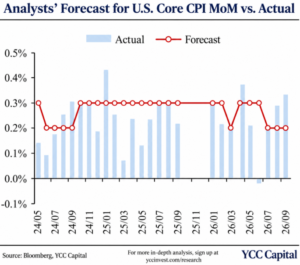
September headline CPI increased 0.65% month over month, exceeding the consensus forecast of 0.6% and accelerating from August’s 0.4%.
Core CPI, excluding food and energy, rose 0.33% month over month, above the expected 0.2% and August’s 0.29%.
On an annual basis, headline inflation reached 3.74%, compared with expectations of 3.6% and August’s 3.40%. Core inflation increased to 2.56%, exceeding the 2.5% consensus and the previous 2.45% reading.
The distinction between headline and core inflation is important. Headline CPI was relatively close to expectations, while the more persistent underlying components delivered the principal upside surprise.
Core inflation also accelerated despite an elevated comparison base in August, lifting its three-month average monthly increase. This makes it increasingly difficult to characterize September’s figures as a temporary statistical disturbance.
Financial markets reacted immediately. Traders increased the implied probability of a Federal Reserve rate increase at the October 28 meeting from approximately 20% to more than 50% at its peak. Market pricing briefly approached 1.5 rate increases over the broader policy horizon.
U.S. equities and gold declined, while Treasury yields and the dollar strengthened. Subsequent dovish comments from several Federal Reserve officials, emphasizing that an immediate rate increase was unnecessary, helped reduce the October hike probability toward 30% and brought Treasury yields lower.
This sequence illustrates a defining characteristic of the current environment: markets remain highly sensitive to even modest changes in inflation expectations.
2. Core Goods: The Price Rebound Is Broadening
Core goods inflation increased 0.25% month over month, compared with 0.11% in August, marking its strongest monthly advance since February 2025.
Three forces appear particularly relevant: renewed global supply-chain pressures, tariff-related cost transmission, and price increases across selected technology and artificial-intelligence-related products.
Used vehicles contributed approximately 9.6 basis points to monthly core-goods inflation, making them an important driver of the rebound.
Notably, used-car CPI has recently diverged from the Manheim Used Vehicle Value Index, which historically provides a leading indication of retail vehicle-price developments by approximately two months.
Such divergences complicate inflation forecasting. When established leading indicators lose explanatory power, investors must become more cautious about assuming that disinflation will automatically resume.
Tariff-sensitive categories also strengthened. Recreational goods inflation accelerated from 0.02% to 0.31% month over month, while apparel inflation increased from zero to 0.86%.
Toy prices were particularly notable, contributing approximately 6.6 basis points to monthly core CPI.
These developments suggest that goods inflation is being supported by multiple overlapping pressures rather than a single isolated shock.
3. Housing Inflation: A Stubborn Obstacle
Shelter inflation rebounded to 0.39% month over month, from 0.26% previously.
Rent inflation increased to 0.25%, while owners’ equivalent rent rose to 0.35%. Hotel accommodation inflation remained elevated at 2.04%.
Historically, home-price developments have led shelter CPI by approximately 16 months, while market-rent indicators have generally led official shelter inflation by six to eight months.
Those relationships continue to suggest some potential for shelter disinflation. Nevertheless, September’s rebound demonstrates that the transmission from market rents to official inflation statistics is neither perfectly smooth nor guaranteed.
Housing inflation also matters because shelter represents a substantial component of household spending.
For a renter negotiating a lease renewal, inflation is not an abstract economic statistic. It is a monthly cash-flow constraint that influences discretionary spending, savings, and financial confidence.
We therefore remain cautious about projecting a rapid normalization of shelter inflation, even where forward-looking indicators appear more favorable.
4. Supercore Inflation: The Warning Beneath the Surface
Non-shelter core-services inflation moderated from 0.42% to 0.34% month over month, partly reflecting the disappearance of August’s temporary telecommunications-related disturbances.
A broader supercore measure incorporating hotel accommodation similarly declined from 0.51% to 0.42%.
At first glance, these declines appear encouraging. However, the underlying momentum tells a different story.
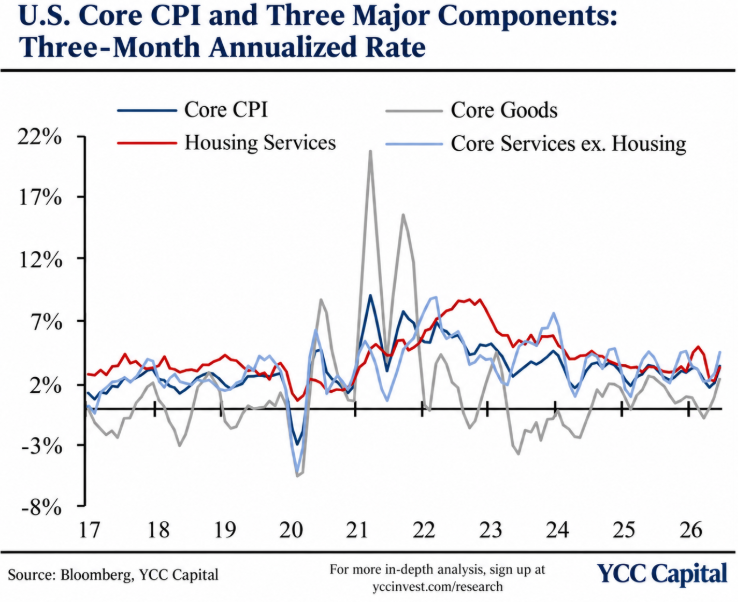
The respective three-month annualized inflation rates reached approximately 4.43% and 4.48%.
More importantly, price increases became increasingly widespread across transportation, recreation services, hotels, and other consumer-facing activities.
Inflation breadth confirms this deterioration. The share of CPI categories recording annualized monthly increases above their five-year averages rose from 17.6% to 24.76%.
Meanwhile, the share of categories experiencing annualized monthly inflation above 4% increased from 20% to 35%.
This is one of September’s most consequential developments.
A central bank can often look through isolated price shocks. Broad-based inflation, however, raises questions about the underlying balance between demand, supply, wages, and pricing power.
5. Oil Prices: The Higher-for-Longer Threat
We identify two reinforcing conditions behind persistent inflation.
The first is stronger-than-expected U.S. economic growth, which sustains consumer demand and allows businesses greater scope to pass through higher costs.
The second is prolonged elevated oil prices, which amplify inflation transmission throughout the economy.
Energy is embedded in far more than the price displayed at a gasoline station. It influences freight charges, aviation costs, manufacturing inputs, agricultural distribution, and the operating expenses of service businesses.
An important implication concerns inflation base effects.
Previously elevated oil prices can mechanically reduce annual inflation when current prices decline against a high comparison base. But if oil remains expensive and repeatedly rebounds, that disinflationary benefit becomes weaker.
Moreover, persistent energy inflation increases the probability of second-round price effects.
The critical question is therefore not simply whether oil prices decline temporarily. It is whether they fall sufficiently, and remain low enough, to prevent higher energy costs from spreading into underlying inflation.
6. The Federal Reserve and November’s Political Catalyst
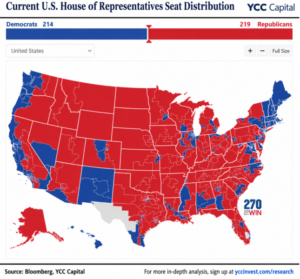
The October 28 Federal Reserve meeting arrives just days before the November 3 U.S. midterm elections.
This creates an unusually sensitive intersection between monetary policy, financial markets, and geopolitics.
A renewed increase in oil prices could strengthen expectations of tighter monetary policy precisely when political uncertainty is already elevated.
Escalation involving Iran represents a particular upside risk to energy prices, especially if regional tensions intensify during the second half of October.
We do not treat escalation as inevitable. Nevertheless, its potential inflationary consequences are sufficiently material to warrant defensive portfolio planning.
The Federal Reserve faces a difficult balancing act. Maintaining restrictive policy for too long could undermine financial-system liquidity and economic activity. Easing prematurely, however, risks allowing inflation expectations to become more persistent.
Our baseline remains cautiously constructive on the U.S. economy. Resilient growth is preferable to economic contraction, but it also means the Federal Reserve may have less room to deliver the monetary accommodation investors desire.
7. Investment Strategy: Patience Is an Asset
October’s combination of inflation uncertainty, oil-price volatility, Federal Reserve expectations, and geopolitical risk creates an unfavorable environment for aggressive directional positioning.
The November 3 midterm elections represent a potentially important turning point. Once the congressional balance becomes clearer, political uncertainty may decline and markets may be better positioned to assess the direction of monetary policy and geopolitical negotiations.
We therefore favor confirmation-based positioning rather than attempting to anticipate every short-term market reversal.
For equities, that means emphasizing earnings durability, pricing power, and balance-sheet strength. For fixed income, it means remaining alert to renewed upward pressure on Treasury yields. For currencies, persistent U.S. rate expectations could continue supporting the dollar.
The two principal downside risks are an uncontrolled oil-price increase that reignites inflation and an excessively prolonged restrictive monetary stance that triggers financial-system liquidity stress.
Neither risk requires abandoning a constructive long-term view of American assets. Both require greater discipline in entry timing, liquidity management, and portfolio hedging.
Our strategic conclusion is that U.S. economic resilience remains intact, but inflation has become too broad-based to justify complacency. Until energy-price risks diminish and the political calendar clears, capital preservation and selective deployment should take precedence over aggressive risk-taking.
Source: Bloomberg, YCC Capital
Editorial Board
Ken Cao — Chief Strategist, Global Investment Strategy
Le Gao — Managing Analyst
Yui Nabeshima — Strategist
Mai Ikeda — Research Analyst
IMPORTANT DISCLAIMER
This research report is provided for informational and educational purposes only and does not constitute an offer to sell or a solicitation of an offer to buy any securities, financial instruments, or investment products. It is not intended as investment, legal, accounting, or tax advice and should not be relied upon as such. The views, opinions, and projections expressed herein are those of YCC Capital Management and its research personnel as of the date of publication and are subject to change without notice. Past performance is not indicative of future results.
YCC Capital Management, its affiliates, principals, and employees may hold long or short positions in securities or instruments discussed in this report and may trade for their own accounts or for client accounts in a manner inconsistent with the recommendations herein. This report is based on publicly available information and data believed to be reliable, but YCC Capital makes no representation or warranty, express or implied, as to the accuracy, completeness, or timeliness of such information. Forward-looking statements involve risks and uncertainties that could cause actual results to differ materially from those projected.
Recipients of this report should conduct their own independent due diligence and consult with their own financial, legal, and tax advisors before making any investment decisions. YCC Capital accepts no liability for any loss or damage arising from the use of or reliance on this report or its contents.
This report is intended solely for the use of the intended recipient(s) and may not be reproduced or redistributed for commercial purposes without the prior written consent of YCC Capital. © 2026 YCC Capital. All rights reserved. YCC Capital’s flagship vehicle, the YCC International Value Fund, LP, maintains a concentrated global macro value strategy with a focus on capital-flow-driven mispricings and asymmetric hedging opportunities. The Fund is registered in the State of Delaware, U.S and structured as a 506(c) fund. Performance data, where referenced, has been verified by independent third parties including NAV Consulting; however, individual investor results may vary.
Contact Us
For research inquiries and investor communications, contact ir@yccinvest.com.
Receive free daily market insights, global macro perspectives, and investment strategy updates by signing up at www.yccinvest.com.
YCC Capital Research | Sign up for free daily market insight at www.yccinvest.com
For more related research:
Warsh Draws the Line: The Fed’s Rate Hike Is a Warning, Not an Ending
The Fed’s Hawkish Turn: One More Hike, Not a New Hiking Cycle