YCC CAPITAL
Commodity & Energy Strategy
August 28, 2026
YCC Perspective
Gold’s 2026 story has been a lesson in the difference between a broken trend and a crowded trade taking a necessary detour. After January’s extraordinary surge, bullion suffered a violent reset. Yet by August, something more important than price itself had changed: gold stopped responding normally to bad news.
That matters. Markets often turn before the macro narrative does. Anyone who has watched a resilient business survive a difficult year knows the pattern: the first sign of recovery is rarely spectacular growth. It is simply that the next piece of bad news no longer makes things worse. Gold increasingly looks like that business.
Our conclusion is that the current advance should initially be treated as a powerful medium-term rebound rather than an unquestioned new secular leg higher. Nevertheless, positioning is healthier, central-bank demand remains substantial, fiscal concerns have intensified, and the August technical breakout has improved the probability that gold can challenge $5,000/oz.
From Euphoria to Reset
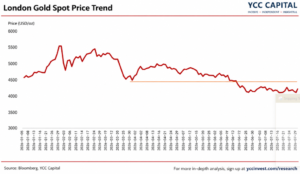
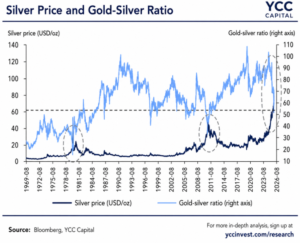
January represented the opposite of a clean entry point. Gold reached a record above $5,300/oz, while precious-metal volatility surged and silver accelerated dramatically. The gold/silver ratio compressed toward historically extreme territory. Such late-cycle silver outperformance has repeatedly accompanied periods when precious-metal enthusiasm is approaching saturation.
The subsequent correction was severe. Gold eventually fell roughly 25% from its January peak, while silver’s drawdown was substantially larger. By late June, bullion had fallen toward the psychologically important $4,000 area.
But the correction performed useful work.
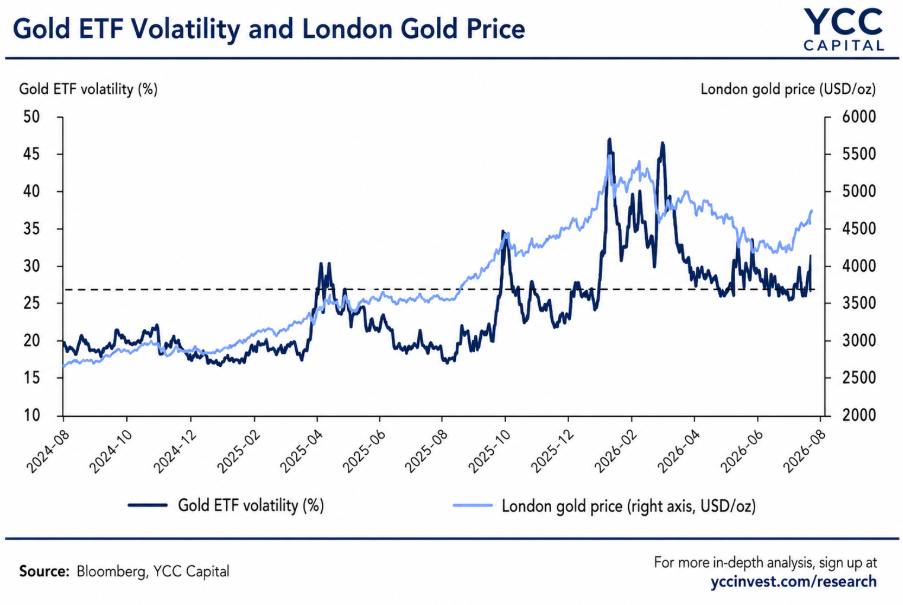
Speculative exposure declined, volatility compressed and weaker hands were forced out. By late July, gold volatility had fallen toward the lowest levels of 2026. The market entered August carrying considerably less speculative baggage than it had in January.
This is the foundation of the current rebound.
Why Rising Treasury Yields No Longer Automatically Mean Falling Gold
The conventional gold framework is straightforward: gold pays no coupon, so higher real interest rates increase its opportunity cost. A stronger dollar and higher Treasury yields should therefore pressure bullion.
That framework is useful—but incomplete.
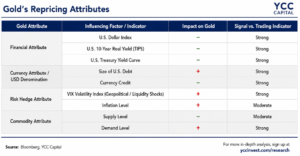
Gold has at least four overlapping identities: a financial asset, a monetary asset, a safe-haven asset and a physical commodity. At different points in the cycle, different identities dominate.
History demonstrates the asymmetry. Gold produced positive returns during portions of the 2004–2005 and 2015–2018 Federal Reserve tightening cycles. More recently, bullion began stabilizing in late 2022 even while monetary tightening remained aggressive.
Why? Because sufficiently high interest rates eventually create their own counterweight.
Higher Treasury yields make gold less attractive as a non-yielding asset, but they also increase Washington’s debt-service burden. The longer yields remain elevated, the more investors are forced to ask whether America’s fiscal trajectory can remain indefinitely painless.
U.S. gross federal debt has now exceeded $40 trillion. Interest expense has become one of the largest components of federal spending. Treasury’s August decision to expand buybacks of longer-dated securities may improve market functioning at the margin, but it does not erase the underlying arithmetic.
We remain cautiously constructive on the U.S. economy. America retains unmatched capital-market depth, technological leadership and considerable capacity to grow through fiscal pressure. A $40 trillion debt stock is therefore not synonymous with an imminent dollar crisis. But the direction of travel increases the portfolio value of assets carrying no sovereign liability.
Gold is precisely such an asset.
August Changed the Tape
Gold broke above its low-level trading range in early August after spending much of the second quarter digesting January’s excesses.
Three forces matter.
First, the monetary backdrop became less hostile. The Federal Reserve held rates steady in July, while softer labor-market and inflation readings reduced the immediacy of additional tightening. Gold therefore received relief from the combination of a less forceful dollar and diminishing expectations of near-term rate increases.
Second, fiscal anxiety became more visible. Treasury’s decision to expand long-duration bond buybacks arrived as long yields approached multi-decade highs. The immediate market reaction was revealing: yields initially declined and the dollar weakened, while scarce assets benefited.
Think of the policy response as putting a stronger pump into a boat taking on water. It can buy time and stabilize the vessel; it does not remove the reason water entered in the first place.
Third, investment flows improved. Gold-backed ETF demand strengthened as investors returned after the second-quarter washout. This is important because a rally led only by futures positioning is much easier to reverse than one increasingly supported by strategic allocations.
Source: Bloomberg, YCC Capital
Central Banks Remain the Structural Bid
Official-sector accumulation remains one of the most important differences between today’s gold market and previous cycles.
Global central banks bought roughly 289 tonnes in the second quarter, a sharp acceleration from the first quarter. Emerging-market and developing-country institutions continue to play an outsized role as reserve managers diversify assets and reassess geopolitical concentration risk.
China has been particularly aggressive. The People’s Bank of China reported approximately 20 tonnes of purchases in July, its largest monthly addition since late 2023, taking reported official holdings to roughly 2,366 tonnes.
We would not interpret China’s buying as evidence of broader Chinese economic strength. Quite the opposite: persistent gold accumulation sits alongside weak domestic confidence, subdued physical jewellery demand and an ongoing desire to diversify reserve risk. China’s wholesale gold demand remained soft in July, while high bullion prices and fragile household confidence continued to constrain jewellery consumption.
The distinction matters. Chinese official demand is bullish for gold without necessarily being bullish for China.
More broadly, gold has become increasingly important in reserve management because it carries no counterparty risk. The dollar remains the dominant reserve currency—its share of disclosed foreign-exchange reserves was approximately 57% in 2026Q1—and we do not expect that dominance to disappear. But reserve diversification does not require the dollar to collapse. It merely requires central banks to decide that holding somewhat more gold makes sense.
That process is already underway.
The $5,000 Roadmap
Gold recently traded around $4,600/oz, leaving the January record above $5,300 some distance away. Yet the structure of the market is markedly healthier than it was at the peak.
Our constructive case rests on four conditions: volatility remains contained enough to prevent another speculative blow-off; ETF allocations continue rebuilding; central-bank demand remains persistent; and gold continues demonstrating resilience even when Treasury yields rise.
Under those conditions, $5,000/oz is a credible medium-term objective rather than an extravagant forecast.
The distinction between bullion and gold equities is important. Gold miners introduce operating leverage, equity-market beta, cost inflation, jurisdiction risk and management execution. A rising gold price alone is therefore insufficient to guarantee sustained outperformance in mining shares. The strongest environment for gold equities is one in which bullion advances while the broader equity market remains supportive.
Strategic View: A Hedge That Has Learned to Climb
Gold’s most encouraging characteristic today is not simply that prices have risen. It is that the market has become progressively less sensitive to factors that previously pushed it lower.
That is often how durable reversals begin.
We would resist chasing the kind of vertical move witnessed in January. That episode showed exactly what happens when a sensible macro thesis becomes an overcrowded trade. August is different: volatility is lower, positioning is cleaner, institutional demand is rebuilding and the fiscal debate has moved from an abstract future concern to a visible market variable.
For diversified portfolios, gold should therefore be viewed less as a wager on American decline and more as insurance against an increasingly complicated interaction between fiscal deficits, inflation, monetary credibility and geopolitical fragmentation.
The United States still possesses substantial economic strengths and remains the center of global finance. Gold does not need that system to fail. It merely needs investors to assign a slightly higher price to insurance.
At present, they are doing exactly that.
Source: Bloomberg, YCC Capital
Editorial Board
Ken Cao, Chief Strategist, Global Investment Strategy
Le Gao, Managing Analyst
Yui Nabeshima, Strategist
Mai Ikeda, Research Analyst
IMPORTANT DISCLAIMER
This research report is provided for informational and educational purposes only and does not constitute an offer to sell or a solicitation of an offer to buy any securities, financial instruments, or investment products. It is not intended as investment, legal, accounting, or tax advice and should not be relied upon as such. The views, opinions, and projections expressed herein are those of YCC Capital Management and its research personnel as of the date of publication and are subject to change without notice. Past performance is not indicative of future results.
YCC Capital Management, its affiliates, principals, and employees may hold long or short positions in securities or instruments discussed in this report and may trade for their own accounts or for client accounts in a manner inconsistent with the recommendations herein. This report is based on publicly available information and data believed to be reliable, but YCC Capital makes no representation or warranty, express or implied, as to the accuracy, completeness, or timeliness of such information. Forward-looking statements involve risks and uncertainties that could cause actual results to differ materially from those projected.
Recipients of this report should conduct their own independent due diligence and consult with their own financial, legal, and tax advisors before making any investment decisions. YCC Capital accepts no liability for any loss or damage arising from the use of or reliance on this report or its contents.
This report is intended solely for the use of the intended recipient(s) and may not be reproduced or redistributed for commercial purposes without the prior written consent of YCC Capital. © 2026 YCC Capital. All rights reserved. YCC Capital’s flagship vehicle, the YCC International Value Fund, LP, maintains a concentrated global macro value strategy with a focus on capital-flow-driven mispricings and asymmetric hedging opportunities. The Fund is registered in the State of Delaware, U.S and structured as a 506(c) fund. Performance data, where referenced, has been verified by independent third parties including NAV Consulting; however, individual investor results may vary.
Contact Us
For research inquiries, contact ir@yccinvest.com.
For free daily market insight from YCC Capital, sign up at yccinvest.com.
YCC Capital Research | Sign up for free daily market insight at www.yccinvest.com
For more related research:
Gold After the Shock: Why Safe-Haven Investing Has Entered a Functional Era