October 10, 2026
YCC CAPITAL | U.S. THEMES & STRATEGY
Executive Perspective: The Election That Could Change the Rules
The November 3 U.S. midterm elections are shaping up to be more than a referendum on President Donald Trump. They could determine the trajectory of American fiscal policy, the economics of artificial intelligence, and Washington’s willingness to sustain military commitments abroad.
Our central investment thesis is that Republicans face a substantial risk of losing unified control of Congress, with the House of Representatives particularly vulnerable. Yet political gridlock should not automatically be interpreted as economic paralysis. A divided Washington can restrain fiscal excess, force greater scrutiny of spending, and create opportunities for investors who distinguish short-term political volatility from America’s enduring competitive strengths.
The crucial question is not simply which party wins. It is how the resulting distribution of power changes the cost of capital, the direction of government spending, and the regulatory environment for America’s most important industries.
1. History Is Working Against the White House
Midterm elections have historically been unforgiving to incumbent presidents. Across the 20 midterm elections between 1946 and 2022, the president’s party lost an average of 25.7 House seats and 3.3 Senate seats.
Among 11 presidents who entered their first midterm elections with unified control of the White House and both congressional chambers, only four preserved that advantage. That represents a historical success rate of just 36.36%.
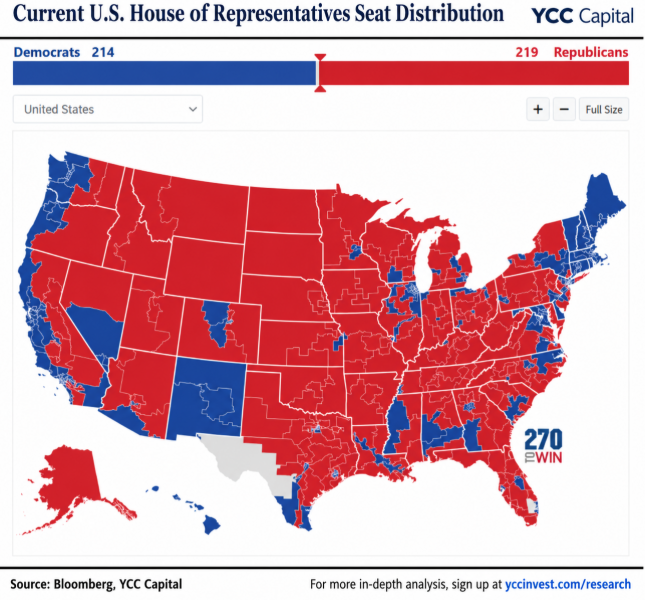
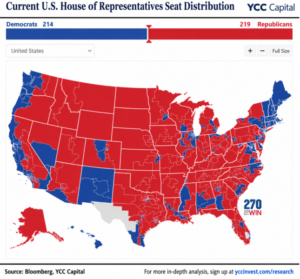
Republicans entered the current election cycle with exceptionally narrow congressional margins. The October baseline showed Republicans holding 219 House seats against 214 Democrats, with two vacancies, while the Senate stood at 53 Republicans and 47 Democrats or aligned independents.
Applying historical average losses mechanically would imply approximately 193 Republican House seats and a 50–50 Senate. History is not a forecasting machine, but it provides a powerful warning: narrow congressional majorities rarely survive a difficult political environment unscathed.
2. Inflation Is Becoming the Election’s Defining Issue
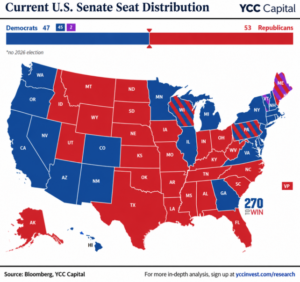
As of October 5, Trump’s aggregate approval rating had declined to approximately 38.2%, its lowest level of his second term.
The deeper problem is the perception of economic affordability. Survey findings indicate that 65% of Americans attribute elevated prices primarily to Trump’s policies, compared with 44% who attributed high prices to President Biden’s policies during the 2022 inflation episode.
The distinction matters. Voters are not merely unhappy about inflation; they increasingly associate their financial pressure with decisions made in Washington.
Consider an ordinary American family balancing mortgage payments, groceries, gasoline, and childcare. A higher oil price is not an abstract commodity-market development. It raises the cost of commuting, delivering food, booking flights, and ultimately maintaining a household budget.
The continuing U.S.–Iran confrontation has intensified this pressure. Despite a preliminary understanding reached in late June, repeated cycles of escalation and de-escalation have prevented a durable normalization of energy prices.
Polling suggests approximately 69% of respondents consider the conflict not worth fighting, compared with 64% in July, while only 28% approve of Trump’s handling of Iran.
For markets, this creates an uncomfortable feedback loop: geopolitical uncertainty supports energy prices, higher energy prices undermine consumer confidence, and declining political support increases uncertainty around fiscal and foreign policy.
3. The House Looks Vulnerable; the Senate Remains Competitive
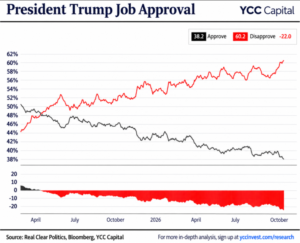
House projections point toward a meaningful Democratic advantage. RealClearPolitics’ election assessment assigns 226 seats to Democrats and 185 to Republicans, with another 24 seats competitive or unresolved.
Since 218 seats are required for a House majority, Democrats appear well positioned to gain control, although projections remain subject to polling error and late electoral shifts.
The Senate is considerably less predictable.
Only 35 of its 100 seats are being contested, limiting the extent to which national political sentiment can translate into a change in control. Competitive races in North Carolina, Ohio, Texas, Alaska, Iowa, and Maine could prove decisive.
Democratic candidates have shown a particularly substantial polling advantage in North Carolina, around nine percentage points, while margins in several other competitive states are much narrower.
Prediction-market pricing has placed the probability of Democratic Senate control near 65%, versus approximately 94% for Democratic House control. These are market-implied probabilities, not guaranteed outcomes.
Our base case is therefore a Democratic House with Senate control less certain. The investment significance is straightforward: the loss of even one chamber would materially constrain the administration’s legislative flexibility.
Election-night investors should also avoid confusing preliminary counts with certified outcomes. Mail ballots, provisional votes, overseas ballots, and recount procedures could extend uncertainty in closely contested races for one or two weeks.
4. Fiscal Policy: The Debt Ceiling Returns as a Political Weapon
The more congressional seats Republicans lose, the greater the potential pressure for fiscal compromise.
Historical comparisons suggest that larger declines in the governing party’s congressional advantage are associated with subsequent reductions in fiscal deficits and debt ratios.
A regression covering 20 midterm elections produced a positive relationship between changes in governing-party seat advantage and subsequent deficit changes, with a slope of 5.1475 and an R-squared of 0.1425. The corresponding debt-ratio regression produced a slope of 9.4452 and an R-squared of 0.1065.
These relatively low explanatory values are important. Congressional composition influences fiscal policy, but economic growth, interest rates, recessions, and extraordinary spending also matter.
The more immediate catalyst is the federal debt ceiling.
Legislation enacted in 2025 raised the statutory ceiling to approximately $41.1 trillion. Federal debt was projected to approach $39.6 trillion by the end of 2026, potentially bringing the government back into contact with the ceiling during 2027.
Under divided government, raising that ceiling could require negotiations over spending restraint, revenue measures, or both.
The precedent is 2011, when the Budget Control Act permitted approximately $2.1 trillion to $2.4 trillion in additional borrowing capacity in exchange for multiyear spending constraints and deficit-reduction mechanisms. Initial estimates envisioned at least $2.1 trillion in cumulative deficit reduction over a decade.
A similar bargain in 2027 could produce modest fiscal consolidation. However, the underlying debt trajectory remains challenging.
Long-term budget projections indicate that federal deficits could increase from 5.8% of GDP in 2026 to 6.7% by 2036, while debt held by the public could rise from 101% to 120% of GDP.
Social Security, healthcare spending, and interest costs remain central drivers.
Our interpretation is cautiously constructive for American assets: greater fiscal discipline could improve the quality of policy over time, but temporary spending agreements cannot substitute for structural reform. Treasury investors should distinguish between short-lived debt-ceiling volatility and the longer-term sustainability of federal finances.
5. Artificial Intelligence: The Next Battle Is Over Electricity
A Democratic-controlled Congress could introduce a different kind of constraint on America’s AI expansion.
The debate is shifting from whether AI should develop to who should pay for the infrastructure required to support it.
Data centers consume enormous quantities of electricity and require grid connections, transmission upgrades, cooling systems, and water resources. Policymakers increasingly question whether households should subsidize these costs through higher utility bills.
Several legislative proposals illustrate the direction of travel.
The GRID Savings Act would require large electricity users, including qualifying data centers, to cover connection and directly attributable infrastructure costs. Other proposals would increase electricity and water disclosures, eliminate selected depreciation benefits, or impose additional charges on data-center power consumption.
One proposal would introduce a baseline electricity fee of $0.01 per kilowatt-hour for qualifying facilities beginning in 2027. Another would establish reporting obligations for data centers with peak demand of at least 25 megawatts.
More aggressive progressive proposals have sought restrictions on new data-center construction and advanced AI development.
These initiatives should not be mistaken for enacted law. Presidential veto authority, congressional negotiations, and procedural hurdles remain significant constraints.
Nevertheless, their investment implications are substantial.
A data-center developer may previously have focused primarily on GPUs, servers, and buildings. Increasingly, successful projects will require secure electricity supply, grid capacity, transmission investment, and regulatory certainty.
That could raise capital expenditure per unit of computing capacity while extending construction timelines.
We remain constructive on America’s long-term AI leadership. The United States retains important advantages in technology platforms, financing, research, and innovation. But the next phase of the AI investment cycle may reward companies that control scarce infrastructure rather than those merely announcing ambitious computing targets.
6. The Republican Upside Scenario Carries Geopolitical Risks
Although Democrats hold an electoral advantage, Republican retention of both chambers remains possible.
Redistricting has reportedly provided Republicans with a net structural advantage of approximately nine House seats, creating some protection against unfavorable national polling.
If Republicans preserve unified congressional control, the administration would enjoy greater freedom to pursue defense spending and sustain military operations involving Iran.
A July 30 Senate vote on restricting unauthorized hostilities against Iran failed by 49 votes to 50, demonstrating the difficulty of imposing congressional constraints.
The administration’s proposed fiscal-year 2027 budget also signals a substantial defense expansion. It envisages approximately $1.15 trillion in discretionary defense funding and an additional $348 billion in mandatory defense resources, bringing total proposed defense funding close to $1.5 trillion.
Projected discretionary defense spending over 2027–2036 would increase by approximately $2.4 trillion relative to the existing baseline.
Unified Republican control would not guarantee military escalation. It could, however, make a prolonged, lower-intensity confrontation more financially and politically sustainable.
For investors, that scenario increases the importance of energy exposure, defense-sector positioning, and protection against geopolitical inflation shocks.
7. YCC Strategic View: Political Gridlock Is Not Economic Decline
Our central scenario combines a loss of Republican congressional dominance, somewhat tighter fiscal negotiations, and greater scrutiny of AI infrastructure investment.
The resulting environment may be less supportive of indiscriminate government spending or speculative technology capital expenditure. Yet it could also encourage greater capital discipline and strengthen the competitive position of companies with resilient balance sheets, secure energy access, and durable cash flows.
We would monitor three variables particularly closely: the final congressional seat distribution, the structure of the 2027 debt-ceiling negotiations, and the extent to which proposed AI infrastructure regulation becomes binding legislation.
The United States faces genuine fiscal and political challenges, but its innovation ecosystem, capital markets, and institutional adaptability remain formidable.
Our conclusion is that the midterms may change Washington’s rules without changing America’s long-term economic potential. For disciplined investors, the opportunity lies in understanding which assets benefit from the new rules—and which business models were built for the old ones.
Data context: Public election polling, prediction-market indications, congressional legislative proposals, and federal fiscal projections available through October 9, 2026. Figures and forecasts are subject to revision.
Editorial Board
Ken Cao — Chief Strategist, Global Investment Strategy
Le Gao — Managing Analyst
Yui Nabeshima — Strategist
Mai Ikeda — Research Analyst
IMPORTANT DISCLAIMER
This research report is provided for informational and educational purposes only and does not constitute an offer to sell or a solicitation of an offer to buy any securities, financial instruments, or investment products. It is not intended as investment, legal, accounting, or tax advice and should not be relied upon as such. The views, opinions, and projections expressed herein are those of YCC Capital Management and its research personnel as of the date of publication and are subject to change without notice. Past performance is not indicative of future results.
YCC Capital Management, its affiliates, principals, and employees may hold long or short positions in securities or instruments discussed in this report and may trade for their own accounts or for client accounts in a manner inconsistent with the recommendations herein. This report is based on publicly available information and data believed to be reliable, but YCC Capital makes no representation or warranty, express or implied, as to the accuracy, completeness, or timeliness of such information. Forward-looking statements involve risks and uncertainties that could cause actual results to differ materially from those projected.
Recipients of this report should conduct their own independent due diligence and consult with their own financial, legal, and tax advisors before making any investment decisions. YCC Capital accepts no liability for any loss or damage arising from the use of or reliance on this report or its contents.
This report is intended solely for the use of the intended recipient(s) and may not be reproduced or redistributed for commercial purposes without the prior written consent of YCC Capital. © 2026 YCC Capital. All rights reserved. YCC Capital’s flagship vehicle, the YCC International Value Fund, LP, maintains a concentrated global macro value strategy with a focus on capital-flow-driven mispricings and asymmetric hedging opportunities. The Fund is registered in the State of Delaware, U.S. and structured as a 506(c) fund. Performance data, where referenced, has been verified by independent third parties including NAV Consulting; however, individual investor results may vary.
Contact Us
For research inquiries and further information, contact ir@yccinvest.com.
Sign up for free daily market insights and global macro perspectives at www.yccinvest.com.
YCC Capital Research | Sign up for free daily market insight at www.yccinvest.com
For more related research:
Trump’s Election Playbook: Inflation, Tariffs and Geopolitics Enter a New Phase
Trump’s Political Playbook: Winning Abroad to Stabilize at Home
America’s $40 Trillion Test Treasury Supply, Fiscal Gravity and the New Price of U.S. Credibility
Investors in Xi’s China Faced a Lost Decade
China’s Growth Engine Is Losing Altitude: Exports Still Fly, But Domestic Demand Is Running on Empty