October 17, 2026
YCC CAPITAL | Emerging Markets & China Strategy
Executive Perspective: A Record Month, but Not a Clean Bill of Health
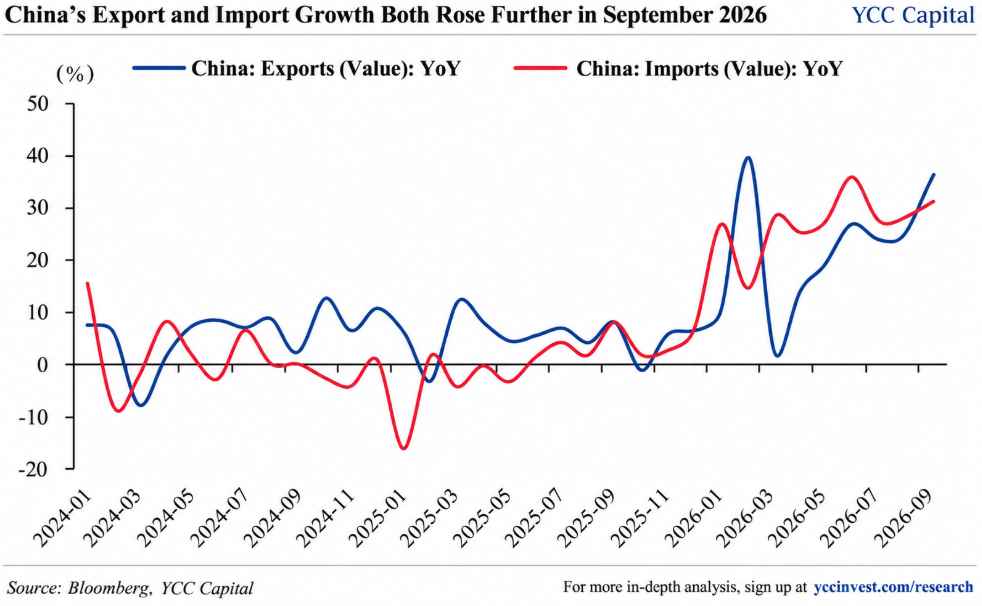
China’s export machine has shifted into a higher gear. September merchandise exports surged 36.3% year over year to a record $447.18 billion, accelerating 11.3 percentage points from August. Imports rose 31.0% to $313.65 billion, leaving a monthly merchandise trade surplus of approximately $133.53 billion. During the first nine months of 2026, exports increased 21.3%, approaching $3.4 trillion.
At first glance, these numbers suggest extraordinary economic strength. We see a more complicated story.
China is benefiting from three powerful external forces: the global artificial intelligence investment boom, rising semiconductor prices, and a recovery in traditional manufactured exports. Yet these developments should not be mistaken for a broad-based domestic economic revival.
Our central argument is that China’s export strength increasingly reflects global technology spending and pricing effects rather than a durable improvement in its underlying economic model. The distinction matters enormously for investors. A country can export more while its households, property market, and domestic businesses remain under pressure.
For anyone who has operated a business, the difference is familiar: higher revenue does not necessarily mean more customers, healthier margins, or a stronger balance sheet.
1. Global Demand Is Accelerating, but Growth Is Uneven
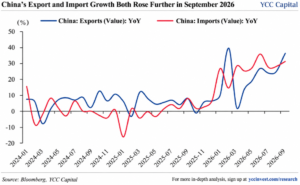
China’s export performance has benefited from improving global manufacturing activity. September’s global manufacturing purchasing managers’ index reached 53.0, up 0.7 points from August and marking the fourteenth consecutive month in expansion territory.
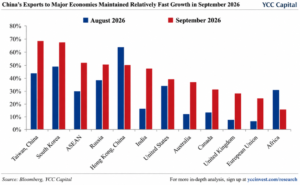
The geographical breadth of China’s export growth is impressive. September shipments to the United States increased 39.6% year over year, while exports to South Korea rose 68.2%, ASEAN 52.3%, the European Union 25.3%, and Russia 51.1%.
These markets, however, tell different economic stories.
The rebound in American demand partly reflects favorable comparisons with 2025, when tariff disputes disrupted trade flows. The late-September understanding involving approximately $30 billion in reciprocal tariff reductions may also help stabilize purchasing decisions, although implementation and political durability remain uncertain.
We remain cautiously constructive on the U.S. economy. American consumer demand, corporate innovation, and investment in computing infrastructure continue to create opportunities for global suppliers. China’s export recovery is partly a reflection of that American economic resilience.
Asia’s strength is more directly connected to technology manufacturing. During January–August, China’s AI-related exports to South Korea increased 104.4%, contributing 28.4 percentage points to overall export growth to that market and accounting for more than 80% of its incremental expansion. Comparable products represented approximately 74% of the increase in exports to Vietnam.
Russia presents another dynamic. Bilateral trade reached $214.3 billion during the first three quarters, increasing 30.6%, as Russian import substitution and the withdrawal of some Western suppliers created additional opportunities for Chinese manufacturers.
Europe remains a more contested market. Chinese manufacturers are expanding in electric vehicles, industrial equipment, and green technologies, but growing trade-defense scrutiny could limit the durability of that expansion.
2. The AI Boom Is the Real Engine—and Prices Matter More Than Volumes
The most important feature of September’s export data is the extraordinary performance of AI-related products.
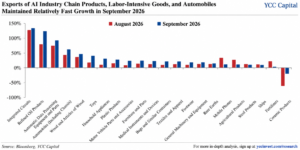
Integrated-circuit exports increased 136.0% year over year, while automatic data-processing equipment exports climbed 92.9%. Together, these categories contributed approximately 13 percentage points to China’s overall export growth.
But the composition of semiconductor growth deserves closer examination.
Integrated-circuit export prices rose 133.7%, while export quantities increased only 1%. In other words, almost the entire increase in semiconductor export value came from higher prices rather than significantly greater physical shipment volumes.
That is an important warning against treating nominal export growth as equivalent to industrial expansion.
Imagine a neighborhood electronics shop selling nearly the same number of memory chips as last year, but charging more than twice as much per chip. Its revenue would soar, even though customer traffic and unit sales barely changed.
China’s semiconductor export statistics are displaying a similar phenomenon.
Pricing pressure is also spreading into consumer electronics. September smartphone export values increased 14.2%, supported by a 30.6% increase in average prices despite a 12.6% decline in shipment quantities.
This suggests that higher component costs and product upgrades are lifting export receipts even as unit demand weakens.
We view this as a potentially fragile source of growth. Semiconductor pricing cycles can reverse, and higher selling prices eventually test consumer affordability.
3. Traditional Consumer Goods and Automobiles Are Recovering
September also brought a noticeable improvement in labor-intensive exports.
Clothing exports increased 23.8%, footwear 20.2%, luggage 22.5%, toys 40.8%, and furniture 22.0%. Together, these five categories contributed approximately 1.9 percentage points to overall export growth.
The recovery partly reflects weak comparisons with the previous year and improving U.S. trade conditions. During January–August, China’s consumer-goods exports to America, excluding cross-border e-commerce parcels, increased 6.9%, with apparel exports rising 17.5%.
Automobiles remain another important contributor. September vehicle exports increased 62.0%, while automotive parts exports grew 24.3%. During the first three quarters, electric-vehicle exports advanced 72.3%, lithium batteries 36.4%, and wind turbines and related components 22.4%.
These figures demonstrate China’s considerable manufacturing capabilities. Yet they also reveal growing dependence on overseas markets to absorb industrial production.
For investors, the question is whether Chinese manufacturers can preserve profitability as trade restrictions intensify and overseas competitors respond.
Shipbuilding provides a more durable order-book story. September ship exports increased only 2.7%, slowing 18.3 percentage points from August, but Chinese shipyards held approximately 150 million compensated gross tons of outstanding orders at the end of September, representing 68% of the global order book.
Unlike consumer electronics, shipbuilding has long production cycles, making monthly export fluctuations less informative about underlying demand.
4. Imports Reveal Both Technological Demand and Strategic Vulnerability
China’s September import growth of 31.0% might suggest strengthening domestic demand. However, the composition points toward a narrower expansion.
Imports of copper ores and concentrates increased 27.1%, integrated circuits 74.7%, and automatic data-processing equipment 296.5%. Together, these categories contributed 22.6 percentage points to import growth, representing approximately 73% of the total increase.
This concentration suggests that AI infrastructure and industrial inputs, rather than broad household consumption, are driving much of the expansion.
It also underscores China’s continuing dependence on imported technology and critical components, despite years of investment in technological self-sufficiency.
Energy imports reveal a different vulnerability.
September crude-oil import values increased 3.3%, even as volumes fell 21.5%, because average prices rose 31.6%. Natural-gas import values increased 34.0%, despite a 1.7% decline in quantities, as average prices climbed 36.2%.
Supply disruptions around the Strait of Hormuz have intensified the pressure. By late September, Brent crude spot prices had exceeded $120 per barrel, approximately 77% above their year-earlier level, while Chinese spot LNG prices reached $25 per million British thermal units, up 124.6%.
China is paying considerably more for some essential imports without necessarily receiving more physical supply. That creates potential pressure on industrial margins, household purchasing power, and economic stability.
5. Fourth-Quarter Outlook: Strong Momentum, Increasingly Fragile Foundations
China’s export growth could remain elevated through the fourth quarter. Given the strength already recorded, fourth-quarter export growth of approximately 16.4% would be sufficient to deliver full-year dollar-denominated growth of 20%.
External conditions remain supportive. The World Trade Organization’s October outlook raised its 2026 global merchandise-trade volume growth forecast from 1.9% to 3.9%, with 4.1% projected for 2027.
AI infrastructure spending remains particularly significant.
During the first half of 2026, Amazon’s capital expenditure reached approximately $98.4 billion, increasing 72%, while Google’s reached $80.6 billion, up 103%. Their respective full-year investment guidance was subsequently raised to approximately $220 billion and $195–205 billion.
For January–August, China’s AI-related exports increased 52.9%, contributing 9.7 percentage points to overall export growth and approximately 50.1% of incremental export expansion.
This demonstrates how heavily China’s trade performance depends on a relatively concentrated global investment cycle.
Traditional consumer products may also benefit from favorable comparisons: fourth-quarter 2025 exports of household appliances, furniture, and toys declined 8.9%, 9.9%, and 25.2%, respectively.
Nevertheless, several risks deserve attention. Semiconductor price inflation may moderate, trade barriers may rise, and higher energy costs could weaken overseas consumer demand. Renewed U.S. monetary tightening could also restrain credit-sensitive spending, although American technology investment and corporate adaptability remain important offsets.
YCC Capital Strategic View: Export Strength Is Not Economic Resilience
We distinguish between China’s competitiveness as a manufacturing platform and its attractiveness as a broad investment destination.
The former remains formidable. The latter requires substantially greater caution.
China’s export surge reflects genuine strengths in industrial capacity, supply-chain integration, and selected advanced manufacturing industries. However, the extraordinary contribution of semiconductor prices, AI infrastructure spending, and favorable base effects makes headline growth less reassuring than it appears.
Our preference is to seek exposure to the global AI investment cycle through businesses with durable intellectual property, pricing power, and diversified customer bases, particularly within the United States and selected allied markets, rather than treating China’s aggregate export acceleration as a signal of broad domestic recovery.
The export engine is running hot. The question is whether the rest of China’s economy can keep up.
Editorial Board
Ken Cao — Chief Strategist, Global Investment Strategy Le Gao — Managing Analyst Yui Nabeshima — Strategist Mai Ikeda — Research Analyst
IMPORTANT DISCLAIMER
This research report is provided for informational and educational purposes only and does not constitute an offer to sell or a solicitation of an offer to buy any securities, financial instruments, or investment products. It is not intended as investment, legal, accounting, or tax advice and should not be relied upon as such. The views, opinions, and projections expressed herein are those of YCC Capital Management and its research personnel as of the date of publication and are subject to change without notice. Past performance is not indicative of future results.
YCC Capital Management, its affiliates, principals, and employees may hold long or short positions in securities or instruments discussed in this report and may trade for their own accounts or for client accounts in a manner inconsistent with the recommendations herein. This report is based on publicly available information and data believed to be reliable, but YCC Capital makes no representation or warranty, express or implied, as to the accuracy, completeness, or timeliness of such information. Forward-looking statements involve risks and uncertainties that could cause actual results to differ materially from those projected.
Recipients of this report should conduct their own independent due diligence and consult with their own financial, legal, and tax advisors before making any investment decisions. YCC Capital accepts no liability for any loss or damage arising from the use of or reliance on this report or its contents.
This report is intended solely for the use of the intended recipient(s) and may not be reproduced or redistributed for commercial purposes without the prior written consent of YCC Capital. © 2026 YCC Capital. All rights reserved. YCC Capital’s flagship vehicle, the YCC International Value Fund, LP, maintains a concentrated global macro value strategy with a focus on capital-flow-driven mispricings and asymmetric hedging opportunities. The Fund is registered in the State of Delaware, U.S and structured as a 506(c) fund. Performance data, where referenced, has been verified by independent third parties including NAV Consulting; however, individual investor results may vary.
Contact Us
For research inquiries and further information, please contact ir@yccinvest.com.
Stay informed with YCC Capital’s independent global macro perspectives. Sign up for our free daily market insights newsletter at www.yccinvest.com.
YCC Capital Research | Sign up for free daily market insight at www.yccinvest.com
For more related research:
The Hike That May Never Come: Positioning for a Hawkish Fed Without Chasing the Fear
Two Economies, Two K’s: China’s Weak Domestic Loop Meets America’s AI-Led Expansion
China’s Recovery Is Losing Altitude: Exports Mask a Deepening Domestic Slowdown
Warsh Draws the Line: The Fed’s Rate Hike Is a Warning, Not an Ending