Emerging Markets & China Strategy
October 8, 2026
MACRO RESEARCH | CHINA CONSUMPTION & STRUCTURAL REFORM
Executive Perspective: Crowded Destinations, Cautious Wallets
China’s tourism economy presents a striking paradox: more people are traveling, yet each journey is generating less spending. Railway stations are crowded, highways are congested, and popular destinations attract millions of visitors. But beneath the excitement, the financial picture is considerably less encouraging.
During October 1–5, 2026, China recorded approximately 1.55 billion cross-regional passenger movements, up just 0.8% year over year. The numbers demonstrate that Chinese households retain an appetite for leisure. What remains uncertain is their willingness and ability to translate that appetite into sustained discretionary expenditure.
We see this as a revealing symptom of China’s broader economic imbalance: strong supply capacity confronting structurally constrained household demand. Tourism is no longer simply a leisure industry. It has become a useful barometer of household confidence, institutional efficiency, and the limitations of China’s domestic-demand strategy.
Our central conclusion is that China does not lack tourists. It lacks the conditions necessary to turn tourism into durable, profitable consumption.
1. Tourism Is Expanding, but Its Economic Yield Is Weakening
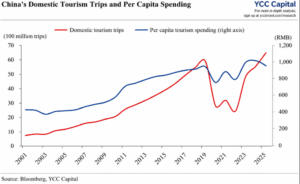
In 2025, domestic tourism reached 6.52 billion trips, an increase of 16.2% from the previous year and above the 6.01 billion recorded in 2019. Average annual travel frequency rose to approximately 4.6 trips per person, compared with 4.3 before the pandemic.
Yet domestic tourism revenue increased only 9.5%, substantially slower than visitor volumes. Average expenditure per trip declined to RMB966, from RMB1,024.8 in 2024 and RMB1,004.6 in 2023.
This divergence matters. A growing number of transactions does not necessarily translate into stronger economic value creation.
Consider a family that previously spent three nights at a destination but now chooses a one-day excursion. The family still contributes to visitor statistics, but its spending on hotels, restaurants, entertainment, and shopping may decline dramatically.
China’s tourism sector increasingly resembles a busy restaurant where every table is occupied but customers order less.
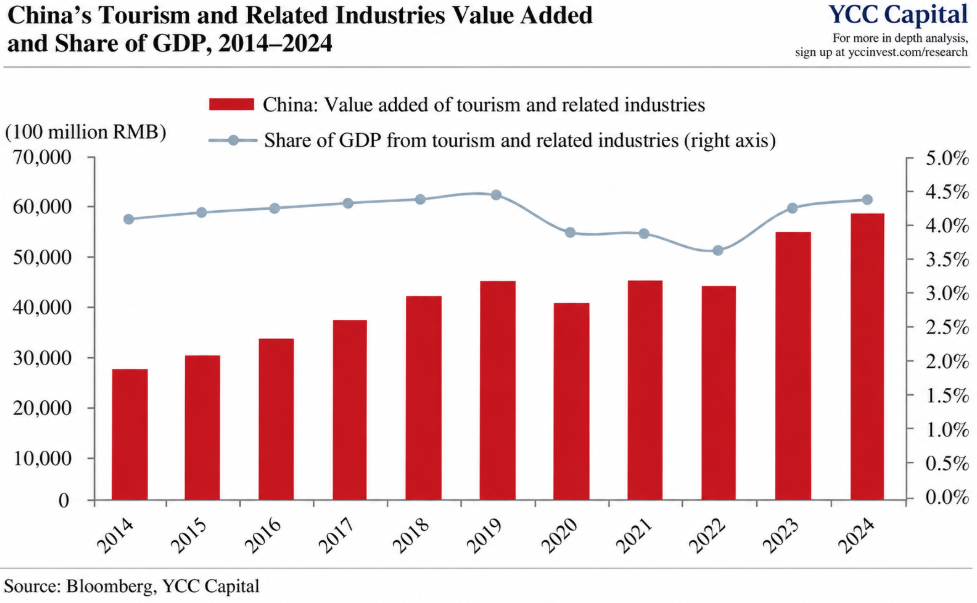
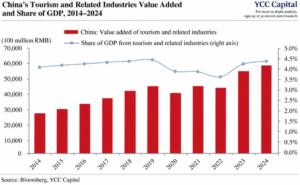
The industry remains economically significant. Tourism and related activities generated approximately RMB5.9 trillion in value added in 2024, equivalent to 4.35% of GDP, an increase of 0.11 percentage points from 2023.
At the end of 2024, cultural and tourism organizations employed 4.631 million people, including 1.653 million directly employed at A-rated tourist attractions.
Nevertheless, employment capacity and economic potential should not be confused with profitability. The fundamental challenge is improving spending intensity, overnight stays, repeat visitation, and commercially sustainable services.
2. Three Consumer Trends Are Reshaping the Market
More Frequent Travel, Less Concentrated Demand
Tourism is gradually becoming part of everyday life rather than an activity reserved for major holidays.
In 2025, travel during the five principal holiday periods totaled approximately 1.95 billion trips, representing 29.9% of annual domestic tourism, down from 33.3% in 2024.
Weekend travel is increasingly important. In 2023, weekends accounted for just 28.6% of calendar days but generated 41.1% of domestic tourism trips.
This creates opportunities for regional hospitality and entertainment businesses, but shorter journeys can constrain expenditure per visit.
The Rise of Short-Distance Tourism
In 2024, approximately 74.9% of domestic tourist movements occurred within travelers’ home provinces.
Regional concentration was especially pronounced in major metropolitan clusters: 83.5% of Shanghai’s urban visitors originated in the Yangtze River Delta, 60% of Beijing’s came from the Beijing–Tianjin–Hebei region, and 90% of Guangzhou’s came from the Pearl River Delta.
China’s transport infrastructure supports this pattern. By the end of 2025, high-speed railway mileage exceeded 50,000 kilometers, while charging infrastructure covered 98.8% of expressway service areas.
Better connectivity reduces travel costs, but it also makes same-day returns easier, limiting hotel demand and overnight consumption.
Increasingly Fragmented Consumer Preferences
China’s tourism market is dividing into distinct demographic segments.
Generation Z, representing approximately 280 million people, increasingly prioritizes concerts, sporting events, cultural experiences, and social engagement. Travelers aged 34 or younger accounted for nearly 80% of bookings associated with festivals, performances, exhibitions, and sporting events in one major travel-platform study.
In 2025, large commercial performances generated RMB32.45 billion in ticket revenue. Their estimated spillover effect was substantial: every RMB1 of ticket sales was associated with approximately RMB6.85 of additional spending, generating more than RMB220 billion in related consumption.
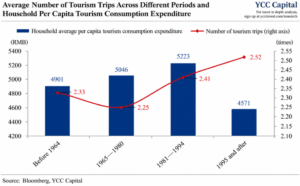
Middle-aged households emphasize safety, quality, family experiences, and educational travel. The 1981–1994 birth cohort recorded average household tourism expenditure of RMB5,223 per person, the highest among the surveyed generations.
Older consumers increasingly favor wellness, cultural tourism, and off-peak travel. Flight bookings among travelers aged 55–70 rose 52% in the week following the 2025 National Day holiday compared with the holiday period.
These differences suggest that standardized destination development is becoming less effective. Operators must understand specific customers rather than merely maximize visitor numbers.
3. China’s Tourism Economy Has a Monetization Problem
Tourism demand is not translating efficiently into hospitality revenue.
In 2025, the average room rate at star-rated hotels declined 3.1% to RMB360.2, while occupancy fell 2.4 percentage points to 46.8%.
This suggests that higher visitor traffic is not necessarily creating stronger accommodation demand.
Tourism destinations also remain heavily dependent on basic services such as transportation, parking, food, and admission-related activities.
Although admission fees represented only 18.3% of tourist-attraction operating revenue in 2023, the transition toward higher-value experiences remains incomplete.
A destination that charges separately for shuttle buses and parking has increased its revenue opportunities. It has not necessarily created a compelling reason for visitors to stay longer or return.
Repeat visitation is particularly important. Shanghai Disney Resort reported an 85% intention to revisit among its 2023 visitors, illustrating the commercial advantages of continuously refreshed experiences and recognizable intellectual property.
International tourism exposes another weakness.
China ranked eighth globally in the World Economic Forum’s 2024 Travel and Tourism Development Index and possessed 60 World Heritage sites by the end of 2025.
Yet international visitors represented only 13.2% of approximately US$1.025 trillion in combined domestic and international visitor spending in 2025, compared with roughly 30% in established destinations such as France and Italy.
China also recorded approximately US$253.8 billion in travel-service imports against just US$55.2 billion in exports.
Payment difficulties, language barriers, fragmented booking systems, and inadequate international tourism products continue to limit foreign visitor expenditure.
China has world-class tourism assets, but asset ownership alone does not guarantee world-class commercial execution.
4. The Structural Constraints Behind Weak Consumption
Households Have Too Little Flexible Leisure Time
Approximately 40% of surveyed employees were unable to access paid annual leave normally, based on labor-market survey findings disclosed in 2020.
In 2025, average weekly working hours among enterprise employees reached 48.6 hours, substantially above the standard 40-hour workweek.
Employees generally receive five to fifteen days of statutory paid annual leave, compared with at least twenty working days in Germany and generally twenty-five in France.
Even when households possess disposable income, limited leisure time restricts longer journeys and higher-value travel.
China increased statutory public holidays to thirteen days in 2025, but their uneven distribution and compensatory working-day arrangements continue to concentrate demand into narrow periods.
The result is predictable: overcrowding during major holidays, underutilized capacity during quieter periods, and volatile tourism-business cash flows.
State-Led Investment Has Not Produced Sufficient Innovation
China’s tourism development model remains influenced by local governments and state-owned enterprises.
Research published in 2018 indicated that approximately 70% of top-rated 5A attractions were locally government-led, another 15% were institution-led, and only around 9% were operated principally by non-state enterprises.
In Ningxia, approximately 78.94% of identified cultural and tourism resource sites remained undeveloped in 2024.
The difficulty is not simply insufficient investment. It is the allocation of capital and operational responsibility.
Private operators face expensive infrastructure requirements, uncertain concession rights, and limited flexibility. State-owned operators may possess financing capacity but lack incentives for experimentation, marketing, and continuous product innovation.
Zhangjiajie’s Dayong Ancient Town illustrates the risks. Developed with approximately RMB2.443 billion in investment, it accumulated losses exceeding RMB1 billion between 2021 and 2024.
Haichang Ocean Park, meanwhile, generated more than RMB1.5 billion in revenue in 2025 but recorded losses for four consecutive years from 2022 through 2025.
These examples underscore a broader concern: infrastructure construction can create impressive physical assets without generating sustainable returns.
Consumer Protection Remains Fragmented
Tourists frequently purchase transportation, accommodation, and experiences through different platforms and jurisdictions.
When services disappoint, obtaining refunds can require repeated documentation and negotiations with multiple parties.
Emerging services such as travel photography, outdoor activities, and immersive experiences also introduce ambiguous delivery standards and liability arrangements.
Weak dispute resolution raises the perceived risk of discretionary spending. For consumers already concerned about employment and income security, even modest uncertainty can discourage additional purchases.
5. Policy Priorities: From Visitor Numbers to Consumer Value
China needs a tourism strategy built around three principles: more usable leisure time, stronger commercial products, and greater consumer confidence.
First, authorities should strengthen enforcement of paid annual leave, encourage flexible scheduling, improve holiday distribution, and reduce arrangements that produce excessive consecutive working days.
Second, local governments should separate public infrastructure obligations from commercial operating concessions. Private operators need transparent pricing, enforceable contract terms, appropriate investment recovery periods, and genuine operational autonomy.
State-owned tourism companies should face performance frameworks that distinguish public-service obligations from commercial profitability while rewarding successful innovation over time.
Third, public authorities should coordinate transport connections, shared facilities, and surrounding commercial districts rather than treating attractions as isolated construction projects.
Fourth, consumer-protection systems should emphasize complaint resolution, repeat violations, service satisfaction, and accountability instead of mechanically penalizing jurisdictions with higher complaint volumes.
Finally, inbound tourism requires internationally accessible payment systems, multilingual services, integrated booking channels, and commercially attractive cross-regional itineraries.
6. YCC Capital Strategic View: Consumption Recovery Requires Institutional Reform
We remain cautious about China’s consumption-led recovery prospects.
Tourism demonstrates that latent household demand exists, but weak income expectations, excessive working hours, inefficient state-directed investment, and uneven consumer protections continue to limit monetization.
For investors, the distinction between traffic growth and earnings growth is essential. Rising passenger volumes alone do not justify optimistic forecasts for hotels, tourism developers, or local-government-linked operators.
We favor business models characterized by asset-light operations, differentiated experiences, repeat customers, disciplined capital allocation, and demonstrable pricing power.
We remain particularly skeptical of debt-intensive destination development dependent on property appreciation, government support, or perpetual visitor growth.
China’s challenge is no longer simply building more attractions. It is creating an institutional environment in which households have the time, confidence, and financial security to spend—and businesses have the incentives to serve them profitably.
A crowded destination can create the appearance of prosperity. Sustainable consumer spending is what ultimately makes prosperity real.
Source: Bloomberg, YCC Capital.
Editorial Board
Ken Cao — Chief Strategist, Global Investment Strategy
Le Gao — Managing Analyst
Yui Nabeshima — Strategist
Mai Ikeda — Research Analyst
IMPORTANT DISCLAIMER
This research report is provided for informational and educational purposes only and does not constitute an offer to sell or a solicitation of an offer to buy any securities, financial instruments, or investment products. It is not intended as investment, legal, accounting, or tax advice and should not be relied upon as such. The views, opinions, and projections expressed herein are those of YCC Capital Management and its research personnel as of the date of publication and are subject to change without notice. Past performance is not indicative of future results.
YCC Capital Management, its affiliates, principals, and employees may hold long or short positions in securities or instruments discussed in this report and may trade for their own accounts or for client accounts in a manner inconsistent with the recommendations herein. This report is based on publicly available information and data believed to be reliable, but YCC Capital makes no representation or warranty, express or implied, as to the accuracy, completeness, or timeliness of such information. Forward-looking statements involve risks and uncertainties that could cause actual results to differ materially from those projected.
Recipients of this report should conduct their own independent due diligence and consult with their own financial, legal, and tax advisors before making any investment decisions. YCC Capital accepts no liability for any loss or damage arising from the use of or reliance on this report or its contents.
This report is intended solely for the use of the intended recipient(s) and may not be reproduced or redistributed for commercial purposes without the prior written consent of YCC Capital. © 2026 YCC Capital. All rights reserved. YCC Capital’s flagship vehicle, the YCC International Value Fund, LP, maintains a concentrated global macro value strategy with a focus on capital-flow-driven mispricings and asymmetric hedging opportunities. The Fund is registered in the State of Delaware, U.S and structured as a 506(c) fund. Performance data, where referenced, has been verified by independent third parties including NAV Consulting; however, individual investor results may vary.
Contact Us
For research inquiries, institutional engagement, or further information, please contact ir@yccinvest.com.
Sign up for free daily market insights at www.yccinvest.com.
YCC Capital Research | Sign up for free daily market insight at www.yccinvest.com
For more related research:
China’s Growth Engine Loses Momentum: Why the Q2 GDP Miss Signals a Longer Road to Recovery
Two Economies, Two K’s: China’s Weak Domestic Loop Meets America’s AI-Led Expansion