YCC CAPITAL | EMERGING MARKETS & CHINA STRATEGY
October 13, 2026 | YCC Capital Macro Research
China and Europe are no longer simply trading partners. They are increasingly industrial competitors, fighting over the same customers, technologies, and manufacturing capacity. The relationship is entering a more confrontational phase, but neither side can afford a complete separation.
The YCC Perspective: A Trade Surplus That Conceals a Deeper Problem
The China–European Union economic relationship has reached a strategic turning point. What once resembled a complementary division of labor—European technology and premium manufacturing exchanged for Chinese consumer goods and lower-cost industrial production—is becoming a contest over industrial leadership.
On October 8–9, Beijing hosted the second meeting of the China–EU Trade and Investment Consultation Mechanism. Negotiators reached 16 understandings covering trade and investment imbalances, export controls, intellectual property, and World Trade Organization reform. These developments provide useful diplomatic breathing room, but they do not resolve the underlying conflict.
Our central assessment is that China’s growing manufacturing competitiveness is simultaneously strengthening its export position and intensifying its geopolitical vulnerabilities. Europe increasingly regards Chinese industrial capacity not merely as a commercial opportunity, but as a threat to domestic employment, technological sovereignty, and strategic autonomy.
For investors, the critical distinction is between export competitiveness and sustainable economic prosperity. China can dominate selected manufacturing industries while still struggling with weak domestic consumption, industrial overcapacity, and declining returns on capital.
1. An $828 Billion Relationship With a Growing Imbalance
2025 China–EU goods trade
$828.1B
13.0% of China’s total trade
Average annual Chinese surplus, 2021–25
$248.7B
86% above the 2011–20 average
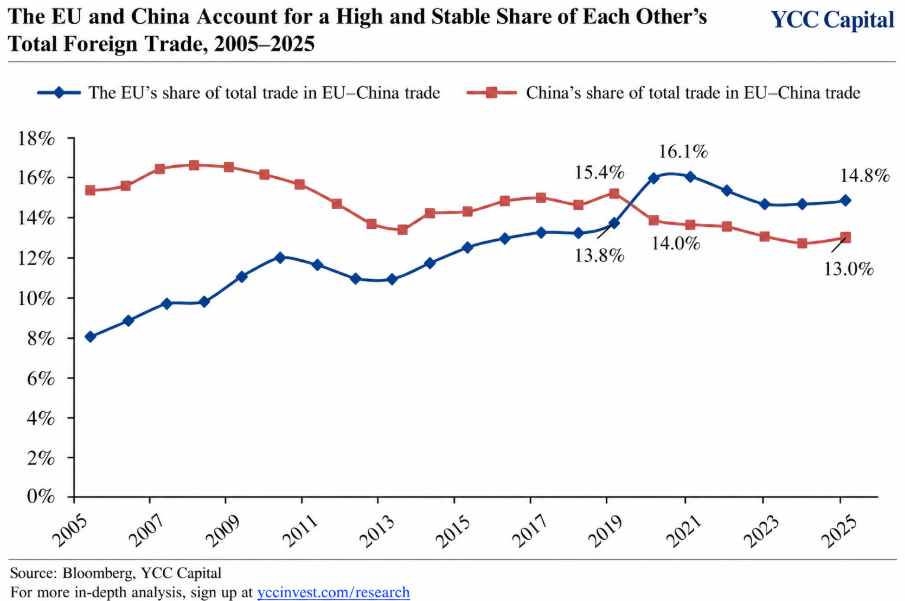
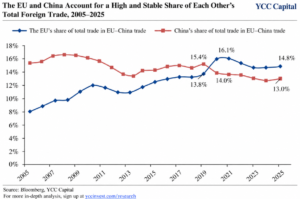
In 2025, bilateral merchandise trade reached $828.1 billion, representing 13.0% of China’s total foreign trade and 14.8% of the EU’s external trade. China was the EU’s largest import supplier and third-largest export destination, while the EU remained China’s second-largest export market and import source.
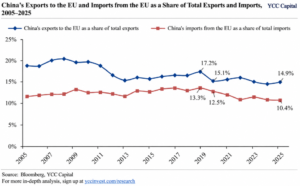
Yet the relationship has become increasingly asymmetric. Between 2020 and 2025, China’s exports to Europe grew at an average annual rate of 6.2%, compared with just 0.6% growth in imports from Europe.
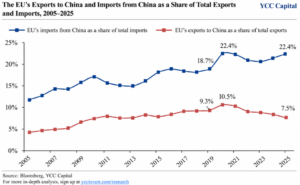
China’s share of EU merchandise imports reached 22.4% in 2025, while China’s share of EU exports stood at 7.5%. Meanwhile, the EU’s share of China’s imports declined from 12.5% in 2020 to 10.4% in 2025.
The resulting imbalance is substantial. China’s annual trade surplus with Europe averaged $248.7 billion during 2021–2025, compared with $133.7 billion during 2011–2020.
Initially, pandemic-related supply disruptions and Europe’s energy crisis helped explain this divergence. However, the persistence of the surplus suggests something more structural: Chinese manufacturers have expanded into industries once dominated by European producers, while China’s domestic economy has struggled to absorb imports at a comparable pace.
This is the paradox of China’s export model. The more successfully China exports its industrial capacity, the more aggressively its trading partners may resist.
2. Western Europe Remains the Anchor; Central Europe Becomes the Factory Floor
Germany, the Netherlands, France, Italy, and Spain accounted for 65.3% of China–EU trade in 2025. These established markets remain the commercial foundation of the relationship, but the fastest-growing opportunities are increasingly concentrated in Central and Eastern Europe.
Between 2016 and 2025, Chinese exports to Germany, the Netherlands, Italy, France, and Spain recorded compound annual growth rates of 6.1%, 5.0%, 6.9%, 6.8%, and 7.9%, respectively.
Exports to Poland and Hungary expanded at annual rates exceeding 10%. In 2025 alone, Chinese exports to Hungary jumped 43.3%, reflecting investment in electric vehicles, batteries, and related industrial supply chains.
This illustrates an important mechanism: Chinese overseas investment frequently generates additional exports of Chinese machinery, components, and intermediate goods. A factory established in Europe does not necessarily eliminate dependence on Chinese supply chains; it may simply relocate the final stage of production.
European policymakers face a difficult trade-off. Chinese investment can support local employment and industrial development, but excessive dependence on imported Chinese inputs may weaken Europe’s ambition to establish autonomous manufacturing ecosystems.
3. Germany’s Automotive Challenge Signals a Broader Industrial Transition
Perhaps the clearest evidence of changing industrial competitiveness comes from automobiles.
China’s passenger-vehicle trade balance with the EU shifted from deficit to surplus in 2024, with the surplus widening in 2025. The reversal carries considerable symbolic significance: Europe’s premium automotive industry once represented one of China’s most important sources of imported industrial technology.
Between 2023 and 2025, China’s imports of passenger vehicles from Germany fell 59.9%, reducing total Chinese imports from Germany by an estimated 8.7 percentage points.
Meanwhile, European semiconductor and pharmaceutical exporters have maintained stronger positions. Chinese imports of semiconductor-manufacturing equipment from the Netherlands rose 34.7% during 2023–2025, contributing 15.4 percentage points to growth in imports from that country.
The distinction matters. Germany’s exposure to automotive substitution contrasts with the Netherlands’ position in advanced semiconductor equipment, where technological barriers remain exceptionally high.
China’s manufacturing advances should therefore not be confused with comprehensive technological independence. The country remains dependent on foreign expertise in strategically important segments of advanced manufacturing, even as it becomes increasingly competitive in downstream products.
4. The Export Basket Has Changed—and So Has the Competitive Threat
China’s European export portfolio has moved decisively toward batteries, electric vehicles, electrical equipment, and semiconductor components.
In 2025, automatic data-processing equipment represented $32.08 billion in exports to the EU, followed by batteries at $30.36 billion, mobile phones at $29.05 billion, cross-border e-commerce parcels at $27.26 billion, and passenger vehicles at $19.11 billion.
Between 2016 and 2025, batteries increased their share of China’s EU exports by 5.0 percentage points to 5.4%. Passenger vehicles rose by 3.3 percentage points to 3.4%, while transformers gained 0.9 percentage points to reach 2.0%.
China’s imports from Europe increasingly reflect the opposite pattern: dependence on specialized technologies and higher-value products.
In 2025, EU-origin integrated circuits accounted for $17.01 billion of Chinese imports, selected chemical products for $15.13 billion, semiconductor-manufacturing equipment for $13.14 billion, and vaccines and related immunological products for $8.78 billion.
For investors, this resembles two businesses competing for the same customers while relying on each other for critical supplies. Their commercial incentives encourage continued cooperation, but their strategic ambitions increasingly pull them apart.
5. Trade Friction Is Becoming a Permanent Feature
European trade policy has become more interventionist, particularly in industries where Chinese manufacturing expansion threatens domestic producers.
The EU imposed additional countervailing duties of 7.8%–35.3% on Chinese electric vehicles in October 2024, on top of the standard 10% tariff. In 2026, further measures affected steel, industrial chemicals, aluminum-related products, tires, textiles, and low-value e-commerce shipments.
The EU’s July 2026 steel arrangements reduced the annual duty-free import quota to 18.3 million tonnes, approximately 47% below its 2024 level, with above-quota tariffs reaching 50%.
Meanwhile, the removal of the exemption for imported parcels valued below €150 introduced additional costs for cross-border e-commerce, including a transitional €3 charge per product category.
These developments signal a broader change in Europe’s industrial strategy. Market access is increasingly conditional on domestic production, employment creation, supply-chain security, and regulatory compliance.
China’s challenge is that export-led expansion cannot indefinitely compensate for insufficient domestic demand. Aggressive pricing can secure market share, but it also compresses profitability and invites political retaliation.
Europe, however, must avoid assuming tariffs alone can restore competitiveness. High energy costs, fragmented capital markets, and uneven industrial investment remain significant constraints.
6. Investment Strategy: Follow Pricing Power, Not Export Volume
We see three investment implications.
First, European businesses with technological differentiation, particularly semiconductor equipment, advanced pharmaceuticals, and specialized industrial systems, remain better positioned than manufacturers competing primarily on price.
Second, China’s industrial overcapacity creates continuing pressure on global margins. Strong shipment growth does not necessarily translate into attractive shareholder returns, particularly where competition is supported by subsidies, inexpensive financing, or local-government industrial objectives.
Third, supply-chain diversification should remain a durable investment theme. European industrial localization, selective manufacturing expansion in Central Europe, and alternative sourcing arrangements may benefit businesses providing automation, logistics, energy infrastructure, and advanced components.
The United States also stands to benefit selectively from greater attention to supply-chain resilience, particularly where American firms retain advantages in technology, intellectual property, and capital allocation. Nevertheless, protectionist measures can create additional costs for consumers and manufacturers.
YCC Capital Strategic View
The China–EU relationship is unlikely to end in comprehensive economic separation. Both sides have too much invested in existing supply chains, and cooperation remains commercially necessary in aviation, pharmaceuticals, semiconductors, and advanced industrial equipment.
The next formal consultation is scheduled for March 2027, providing another opportunity to manage disputes. Yet diplomatic dialogue should not be mistaken for a reversal of the competitive trend.
Our base case is a prolonged period of selective cooperation, persistent trade disputes, and accelerating industrial realignment.
For China, the fundamental weakness remains the gap between extraordinary production capacity and inadequate domestic absorption. For Europe, the challenge is defending industrial competitiveness without sacrificing the benefits of international trade.
The next decade will reward companies that control scarce technology, maintain pricing power, and can operate across increasingly fragmented trade regimes—not necessarily those producing the greatest volume at the lowest price.
Data references: 2016–2025 merchandise-trade statistics and trade-policy developments. Research perspective: YCC Capital.
Editorial Board
Ken Cao— Chief Strategist, Global Investment Strategy Le Gao— Managing Analyst Yui Nabeshima— Strategist Mai Ikeda— Research Analyst
IMPORTANT DISCLAIMER
This research report is provided for informational and educational purposes only and does not constitute an offer to sell or a solicitation of an offer to buy any securities, financial instruments, or investment products. It is not intended as investment, legal, accounting, or tax advice and should not be relied upon as such. The views, opinions, and projections expressed herein are those of YCC Capital Management and its research personnel as of the date of publication and are subject to change without notice. Past performance is not indicative of future results.
YCC Capital Management, its affiliates, principals, and employees may hold long or short positions in securities or instruments discussed in this report and may trade for their own accounts or for client accounts in a manner inconsistent with the recommendations herein. This report is based on publicly available information and data believed to be reliable, but YCC Capital makes no representation or warranty, express or implied, as to the accuracy, completeness, or timeliness of such information. Forward-looking statements involve risks and uncertainties that could cause actual results to differ materially from those projected.
Recipients of this report should conduct their own independent due diligence and consult with their own financial, legal, and tax advisors before making any investment decisions. YCC Capital accepts no liability for any loss or damage arising from the use of or reliance on this report or its contents.
This report is intended solely for the use of the intended recipient(s) and may not be reproduced or redistributed for commercial purposes without the prior written consent of YCC Capital. © 2026 YCC Capital. All rights reserved. YCC Capital’s flagship vehicle, the YCC International Value Fund, LP, maintains a concentrated global macro value strategy with a focus on capital-flow-driven mispricings and asymmetric hedging opportunities. The Fund is registered in the State of Delaware, U.S and structured as a 506(c) fund. Performance data, where referenced, has been verified by independent third parties including NAV Consulting; however, individual investor results may vary.
Contact Us
For research inquiries and investment-related correspondence, please contact ir@yccinvest.com.
Stay ahead of global markets with YCC Capital’s free daily market insights. Subscribe at www.yccinvest.com.
YCC Capital Research | Sign up for free daily market insight at www.yccinvest.com
For more related research:
The Yen’s Real Battle: Why BOJ Tightening Alone Will Not Be Enough
Peace Priced In, Pain Still Ahead: Why the U.S.–Iran Accord Does Not End the Economic Aftershocks