YCC CAPITAL
Global Fixed Income & Currency Strategy
August 1, 2026
YCC Capital Perspective
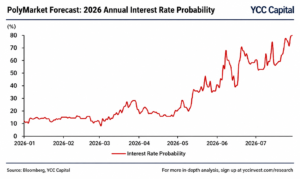
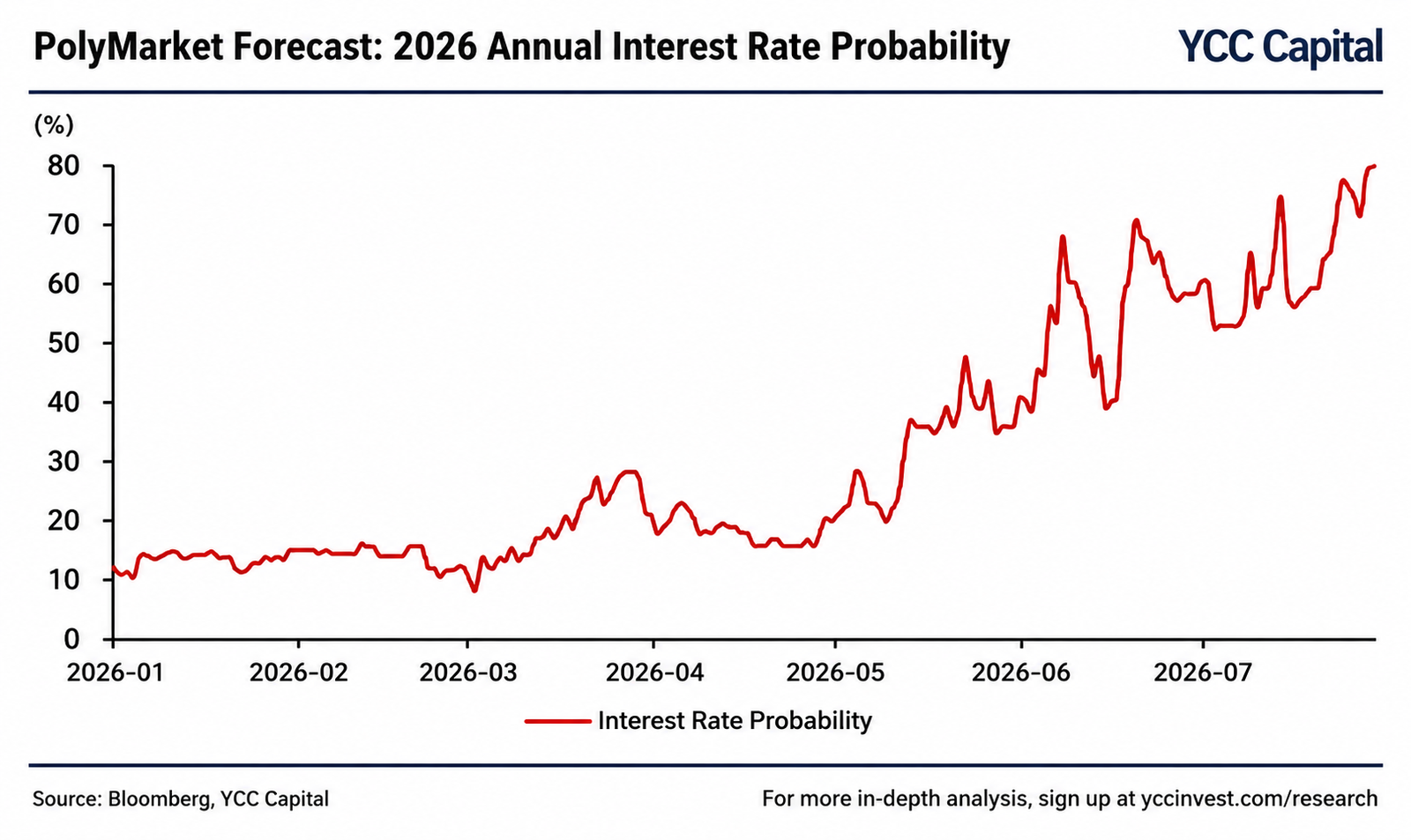
Markets have moved rapidly from debating when the Federal Reserve might cut rates to asking whether it may need to raise them again. Federal-funds futures have priced roughly 41 basis points of tightening for 2026, while prediction-market estimates of a rate increase have risen sharply from around 10% before the late-February U.S.–Iran confrontation to nearly 80%.
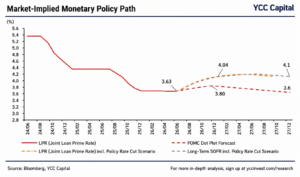
YCC Capital believes that this repricing has gone too far. The Federal Reserve has room to raise rates, but room is not the same as necessity. The U.S. economy remains resilient rather than overheated, labor-market pressures are moderate, and the recent inflation rebound has been driven primarily by energy rather than broad demand. Our base case is that the policy rate remains unchanged through year-end, accompanied by deliberately hawkish communication that allows markets to tighten financial conditions on the Fed’s behalf.
This is the monetary-policy equivalent of a parent lowering their voice rather than raising it: the message becomes more serious even when no immediate action follows. For investors, that distinction matters. A hawkish hold can hurt asset prices at first, but history suggests the damage is usually front-loaded and followed by recovery once policy uncertainty fades.
Growth Is Cooling, Not Collapsing
The U.S. economy performed better than expected during the first half of 2026, supported by delayed government expenditure, tax relief, resilient household spending and strong artificial-intelligence infrastructure investment. Real GDP growth is estimated to have reached approximately 2.6% in the first quarter and 2.3% in the second quarter.
Momentum should moderate during the second half. We expect year-over-year GDP growth of approximately 1.7% in the third quarter and 2.1% in the fourth. Household tax refunds were concentrated between February and April, so their support for consumption will fade. Higher fuel costs are also beginning to erode purchasing power. Real disposable-income growth declined from 1.4% in January to negative 1.1% in April, its first contraction in roughly three years.
Historical relationships suggest that every 10% increase in gasoline prices may reduce cumulative consumption and GDP growth over the following two to four quarters by approximately 0.23 and 0.15 percentage points, respectively. The roughly 30% increase in gasoline prices during the second quarter could therefore subtract about 0.5 percentage points from third-quarter consumption growth and 0.25 percentage points from GDP growth.
That is a slowdown, not a recession call. The American economy still has substantial internal support from investment, productivity and corporate profitability. We remain cautiously optimistic on the United States, although the path ahead is likely to feel more uneven at the household level than aggregate data imply.
The Labor Market Is Balanced Rather Than Overheated
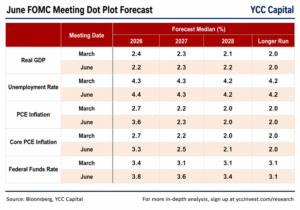
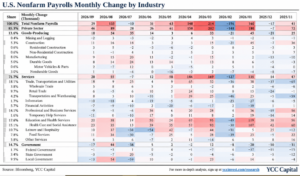
Monthly payroll growth recovered from an average of roughly 10,000 in 2025 to approximately 92,000 during the first six months of 2026. Yet the underlying indicators do not resemble the labor shortage that preceded the 2022 tightening cycle.
The ratio of job openings to unemployed workers is near 1.0, a six-year low. Average weekly hours remain around 34.3, compared with approximately 34.9 during the pandemic-era labor squeeze. Hiring, resignation and dismissal rates have fallen to 3.2%, 1.9% and 1.1%, respectively, all close to ten-year lows. Three-month average wage growth of approximately 3.5% is broadly consistent with 2% inflation when combined with productivity growth of around 1.5%.
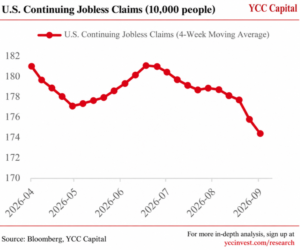
We expect unemployment to rise moderately from 4.3% to approximately 4.5% by year-end. Initial and continuing unemployment claims are already drifting upward, while AI-related substitution is becoming more visible in entry-level technology and financial-sector employment. This is not a labor market demanding higher rates.
Inflation’s Energy Spike Should Fade
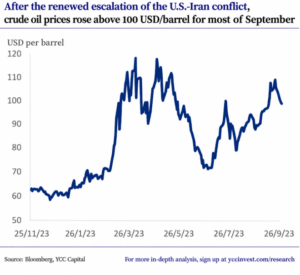
Headline CPI reached 4.2% in May, driven largely by a 23% year-over-year increase in energy prices. Energy contributed almost 60% of the headline inflation rate. As geopolitical tensions eased and oil prices retreated, gasoline prices fell by more than 10% in June, subtracting an estimated 0.5 percentage points from monthly CPI.
We expect headline and core CPI to ease from approximately 3.9% and 2.8% in the second quarter to 3.3% and 2.6% in the third quarter. Fourth-quarter readings may settle near 3.2% and 2.7%.
Core goods prices are already softening as tariff pass-through nears completion and weaker real-income growth constrains demand. Market rents also point toward further shelter disinflation. Zillow rent growth slowed to 1.7% in June, below its pre-pandemic pace of roughly 4%, while the Bureau of Labor Statistics’ new-tenant rent index suggests that official shelter inflation could decline by another 0.9 percentage points by year-end.
The distinction is critical. Monetary policy is effective against excessive demand; it is far less precise against an oil-price shock. Raising rates to offset temporary fuel inflation would be like turning down every light in the house because one room has become too warm.
Taylor Rules Show Capacity, Not Compulsion
Forward-looking Taylor Rule models incorporating policy inertia and expected inflation place an appropriate policy rate at approximately 3.6%–3.7%, almost exactly in line with the current 3.6% rate. Static models generate higher estimates, including approximately 3.9% using trimmed-mean PCE and 6.5% using headline PCE, but these backward-looking calculations are unusually vulnerable to temporary supply shocks.
The estimated 29-basis-point gap between the current rate and the trimmed-mean static-rule estimate is also smaller than the average 44-basis-point gap observed during the 2025 tariff shock, when the Fed chose not to tighten.
Under a baseline unemployment rate of 4.3%, a reliable six-month tightening signal would likely require trimmed-mean PCE inflation above 2.6% or three-month average headline PCE above 4.2%. That could require Brent crude to remain above approximately $120 per barrel for at least two months. A rate-cut signal would require trimmed-mean PCE near 2.2% or three-month headline PCE around 2.8%, broadly consistent with oil remaining in the $60–$70 range for three months.
Neither threshold has been met. The Fed can therefore maintain hawkish language while leaving the policy rate unchanged.
Investment Implications: Endure the First Wave
Across six historical hawkish-hold episodes, equities, bonds and precious metals generally weakened during the first one to three months as discount rates rose and growth expectations softened. The dollar and equity volatility often peaked after roughly two months. Investment-grade bonds tended to stabilize next, followed by equities and precious metals around the third month.
The pattern is best described as “pressure first, recovery later.” Short-term bottoming signals include weakening dollar momentum, a peak in the VIX and stabilization in gold. A durable market bottom, however, normally requires clarity on the policy path. An actual rate increase could trigger a second drawdown because markets often price the first hike accurately but underestimate subsequent tightening.
We favor short- and intermediate-duration U.S. investment-grade credit. Current yields near 5.4% provide meaningful carry, while credit spreads around 80 basis points leave limited room for further compression. Select BB-rated high-yield debt may also be attractive, but lower-quality credit remains more exposed to refinancing and liquidity risk. We expect two-year and ten-year Treasury yields to end 2026 near 3.6% and 4.2%, respectively.
In U.S. equities, defensive sectors such as consumer staples, energy, healthcare and utilities may lead during the initial tightening scare. Technology, semiconductors, autos, banks and real estate remain vulnerable to valuation compression even when earnings estimates are stable. Once rate expectations peak, industrials, capital goods, semiconductors and technology hardware should regain leadership.
Hong Kong equities face greater structural risk. Short-term valuations remain exposed to tighter dollar liquidity, while longer-term performance depends on a Chinese economy still constrained by weak domestic demand, property-sector stress, debt burdens and inconsistent policy transmission. Any rebound should be treated as selective rather than evidence of a durable macroeconomic turnaround. We prefer telecommunications, energy, financials and profitable technology franchises over highly leveraged property or discretionary-consumption exposures.
The dollar may remain firm in the near term, but we expect the broader weakening trend that began in 2025 to resume as U.S. inflation and employment cool. Although the renminbi may receive temporary support from China’s current-account surplus, structural economic weakness and policy divergence limit its appreciation potential. Precious metals may remain pressured initially by higher real yields, but gold should become more attractive once dollar momentum and rate volatility peak.
Strategic View: Do not pay the highest price for protection after the storm clouds have already appeared. Maintain quality duration, preserve liquidity and prepare to rotate gradually toward U.S. growth and cyclical assets as the market recognizes that hawkish language does not necessarily lead to another tightening cycle.
Sources: Bloomberg, YCC Capital.
Source analysis and numerical framework derived from the supplied macroeconomic research material.
Editorial Board
Ken Cao, Chief Strategist, Global Investment Strategy
Le Gao, Managing Analyst
Yui Nabeshima, Strategist
Mai Ikeda, Research Analyst
IMPORTANT DISCLAIMER
“This research report is provided for informational and educational purposes only and does not constitute an offer to sell or a solicitation of an offer to buy any securities, financial instruments, or investment products. It is not intended as investment, legal, accounting, or tax advice and should not be relied upon as such. The views, opinions, and projections expressed herein are those of YCC Capital Management and its research personnel as of the date of publication and are subject to change without notice. Past performance is not indicative of future results.
YCC Capital Management, its affiliates, principals, and employees may hold long or short positions in securities or instruments discussed in this report and may trade for their own accounts or for client accounts in a manner inconsistent with the recommendations herein. This report is based on publicly available information and data believed to be reliable, but YCC Capital makes no representation or warranty, express or implied, as to the accuracy, completeness, or timeliness of such information. Forward-looking statements involve risks and uncertainties that could cause actual results to differ materially from those projected.
Recipients of this report should conduct their own independent due diligence and consult with their own financial, legal, and tax advisors before making any investment decisions. YCC Capital accepts no liability for any loss or damage arising from the use of or reliance on this report or its contents.
This report is intended solely for the use of the intended recipient(s) and may not be reproduced or redistributed for commercial purposes without the prior written consent of YCC Capital. © 2026 YCC Capital. All rights reserved. YCC Capital’s flagship vehicle, the YCC International Value Fund, LP, maintains a concentrated global macro value strategy with a focus on capital-flow-driven mispricings and asymmetric hedging opportunities. The Fund is registered in the State of Delaware, U.S and structured as a 506(c) fund. Performance data, where referenced, has been verified by independent third parties including NAV Consulting; however, individual investor results may vary.”
Contact Us
For research inquiries, contact ir@yccinvest.com. Sign up for free daily market insight at yccinvest.com.
Running footer: YCC Capital Research | Sign up for free daily market insight at www.yccinvest.com
For more related research:
China’s Fiscal Mirage: Tax Revenues Rebound, But Growth Engines Continue to Stall
The Warsh Shock: The Fed’s Hawkish Reset Forces a Full Market Repricing
Has Peak Hawkishness Arrived? Why the Fed’s Toughest Message May Also Mark the Turning Point
Oil, Rates, and Risk: Why the Middle East Shock Is Repricing Global Fixed Income
The Fed’s Hawkish Pause Raises the Bar: Why Real Yields Now Hold the Key to Global Markets