YCC CAPITAL
Emerging Markets & China Strategy
Date: July 24, 2026
Executive Perspective
Every economy eventually reaches a moment when policymakers must decide whether to spend today to preserve tomorrow’s growth, or conserve resources at the risk of a deeper slowdown. China increasingly appears to be approaching such a crossroads.
The latest June fiscal data reinforce a message that has been quietly developing throughout 2026: despite pockets of improvement in tax collections, the government’s overall fiscal impulse continues to weaken rather than strengthen. Beneath encouraging headline tax revenues lies a much more concerning story—persistent weakness in land-related revenues, slowing government fund expenditures, and a broad contraction in China’s consolidated fiscal position.
At first glance, stronger corporate income tax receipts may suggest improving economic conditions. Yet a closer examination indicates that much of the improvement reflects cyclical price stabilization, stronger tax enforcement, and better profitability among a relatively narrow group of enterprises rather than a broad-based recovery in domestic demand. Meanwhile, the continued collapse of land-sale revenues—a cornerstone of local government financing for more than two decades—illustrates that one of China’s most important growth engines remains under severe structural pressure. These findings are consistent with the underlying source report’s emphasis on the divergence between the general public budget and the government fund budget.
From YCC Capital’s perspective, this matters well beyond China. The country’s fiscal policy has become one of the primary determinants of commodity demand, regional capital flows, Asian corporate earnings, and global manufacturing activity. If fiscal policy continues to underdeliver, markets expecting a synchronized rebound in Chinese growth may once again be disappointed.
Much like attempting to accelerate a vehicle while easing off the accelerator, fiscal policy is still providing forward momentum—but at a diminishing rate. Investors should therefore focus less on headline tax revenue improvements and more on whether government spending begins translating into real economic activity during the second half of the year.
Fiscal Data Tell Two Different Stories
June’s fiscal report presents an unusually sharp divergence between China’s two principal fiscal accounts.
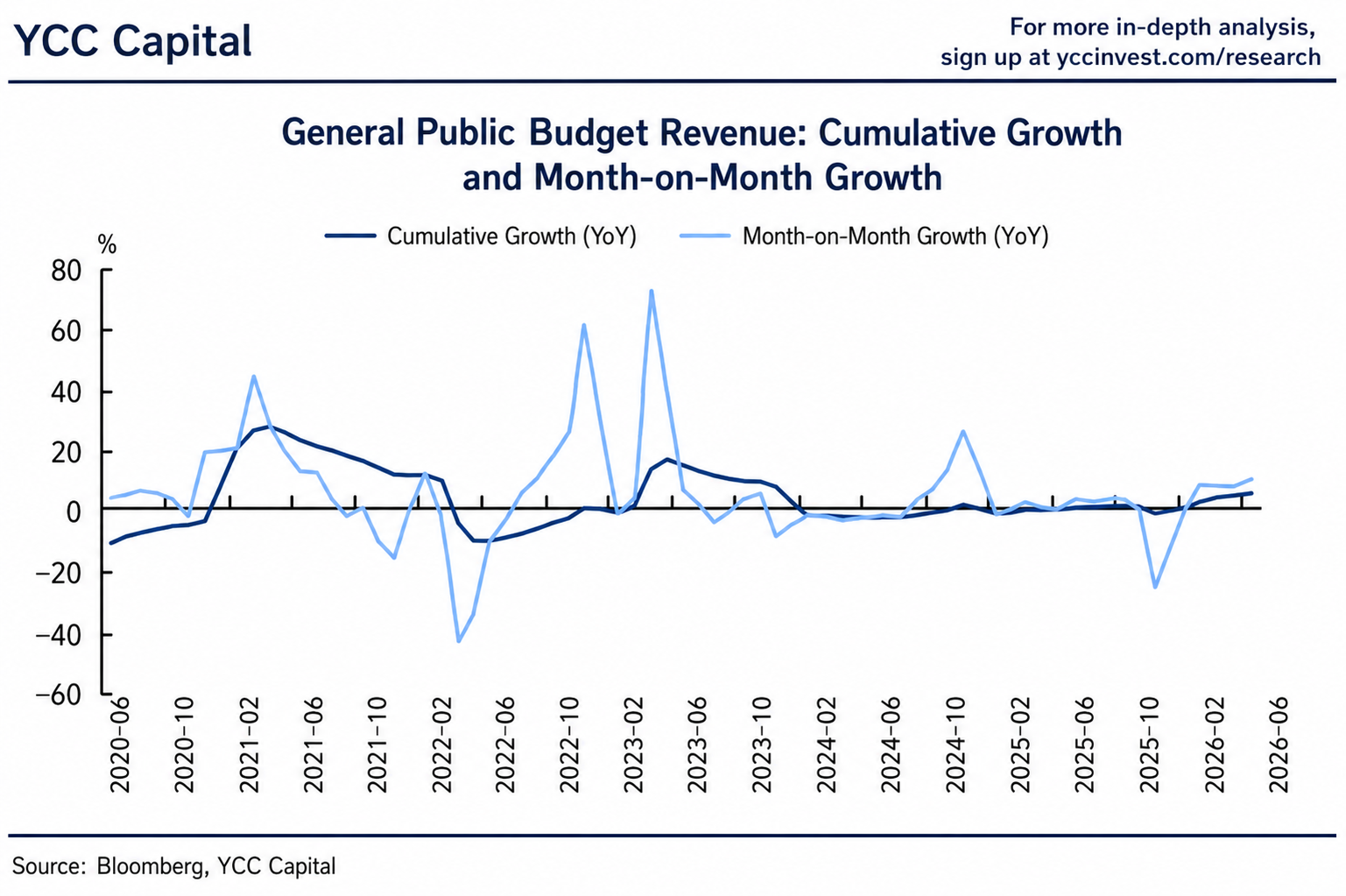
The general public budget—which captures ordinary government revenues and expenditures—showed noticeable improvement. Revenue growth accelerated, tax collections strengthened, and public expenditures returned to positive year-over-year growth after previous weakness.
In contrast, the government fund budget, heavily dependent upon land sales and infrastructure-related financing, deteriorated considerably. Both revenues and expenditures contracted more sharply than in previous months, resulting in an overall decline in China’s broad fiscal support.
This divergence is perhaps the single most important takeaway from the latest data. Investors focusing solely on improving tax receipts risk overlooking the far larger story unfolding within China’s financing model.
The broad fiscal stance, which combines both accounts, therefore continued to weaken despite encouraging developments within the ordinary budget. According to the source report, broad fiscal expenditures fell while the fiscal policy intensity index continued to decline.
General Budget Revenue Continues to Improve
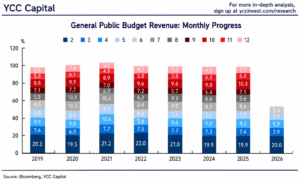
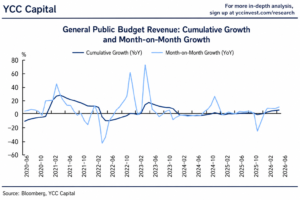
During the first half of 2026, China’s general public budget revenue reached approximately RMB 12.1 trillion, representing 4.7% year-over-year growth.
June alone recorded an even stronger 8.7% annual increase, extending several months of steady improvement.
Tax revenues grew even faster, increasing 10.8% year over year during June, marking the fourth consecutive month of robust expansion.
Several factors contributed to this acceleration.
First, producer prices have stabilized after prolonged weakness, mechanically lifting tax collections.
Second, corporate profitability improved modestly across parts of the industrial sector.
Third, tax administration and collection efforts appear to have become more effective, increasing compliance and boosting realized revenue.
Importantly, these developments should not necessarily be interpreted as evidence of a broad domestic demand recovery. Tax receipts can improve for reasons unrelated to expanding household consumption or stronger private investment.
Indeed, the composition of revenue growth suggests a recovery that remains highly uneven.
Corporate Taxes Strengthen While Consumption Remains Uneven
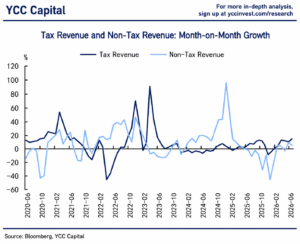
Among major tax categories, corporate income tax delivered the strongest improvement.
Corporate income tax surged nearly 30% year over year, becoming the largest contributor to total tax revenue growth.
Personal income taxes also remained relatively robust, reflecting continued labor income resilience among higher-income households.
Securities transaction stamp duties likewise maintained elevated growth, supported by healthy trading activity in China’s equity markets.
However, several consumption-related taxes painted a less encouraging picture.
Value-added tax growth slowed compared with previous months, while consumption tax revenues continued to contract.
Real estate-related taxes remained deeply negative, including property taxes and farmland occupation taxes, underscoring ongoing weakness throughout China’s property sector.
This divergence illustrates one of the defining characteristics of China’s current recovery: isolated pockets of resilience coexist alongside persistent structural weakness.
Corporate profitability may be stabilizing, but household demand and property-related activity continue to lag considerably.
Government Spending Recovers—but Not Where Markets Want It
On the expenditure side, June marked an improvement after previous softness.
General public budget expenditures increased 4% year over year, reversing earlier declines.
Yet the composition of spending deserves closer attention.
The strongest gains occurred within social and livelihood-related categories.
Education spending improved.
Healthcare expenditures remained solid.
Social security and employment spending accelerated significantly.
These categories collectively accounted for most of June’s expenditure rebound.
Infrastructure spending, however, remained notably restrained.
Transport investment improved modestly.
Urban development spending stabilized.
Agricultural and water-related expenditures, traditionally important drivers of rural investment, continued to contract and remained among the largest drags on total spending.
Environmental protection expenditures also remained weak.
For investors hoping for an aggressive infrastructure-led stimulus similar to earlier cycles, the latest data offer limited evidence that such a strategy has yet materialized. The source report specifically notes that infrastructure-related spending had not yet become the primary growth driver despite improvement in overall expenditures.
China’s Property Downturn Continues to Reshape Public Finance
Perhaps no figure better captures China’s ongoing structural adjustment than land-sale revenue.
Government fund revenue declined over 30% during June, while land-sale income itself plunged more than 40% compared with a year earlier.
During the first half of 2026, land-sale revenues totaled approximately RMB 978 billion, falling below RMB 1 trillion for the first time since comparable monthly records began in 2012.
That milestone is significant.
For decades, local governments relied heavily on land sales to finance infrastructure projects, urban expansion, and local development initiatives.
The property sector effectively functioned as the financial bridge connecting household wealth, local government finance, and infrastructure investment.
That bridge is now substantially weaker.
If current trends persist throughout the remainder of 2026, annual land-sale revenues could fall to roughly RMB 2.8 trillion, representing only around one-third of their historical peak.
From YCC Capital’s perspective, this is not merely a cyclical decline but a structural transformation of China’s fiscal model. Local governments must increasingly rely upon central government transfers, special bond issuance, and alternative financing mechanisms to replace a revenue source that once appeared inexhaustible.
Why Fiscal Impulse Still Matters
Financial markets often concentrate on budget announcements.
Economic activity, however, responds not to announced spending but to actual spending.
The report highlights that although ultra-long special sovereign bond funds have largely been allocated, they had not yet translated into meaningful physical investment during June. In other words, money has been authorized but has not yet fully entered the real economy.
This distinction is critical.
A bridge is not built when funding is approved; it is built when construction crews begin working.
Likewise, fiscal policy supports growth only when authorized funds are converted into projects, employment, procurement, and household income.
Until this transmission mechanism accelerates, China’s fiscal support will likely remain less powerful than headline announcements suggest.
July Could Become a Turning Point
Despite the disappointing June data, there are reasons to monitor the second half of the year closely.
The source report argues that July may represent an important turning point as previously approved fiscal resources begin flowing into actual investment projects.
Attention will naturally focus on the Politburo meeting scheduled toward the end of July.
Should policymakers accelerate implementation of existing fiscal programs, infrastructure investment could strengthen meaningfully during the second half.
Such acceleration would help offset slowing private investment and continued weakness in the property market.
Nevertheless, expectations should remain measured.
China’s second-quarter GDP growth slowed noticeably compared with the first quarter, while domestic demand continues to face considerable headwinds.
Simply increasing fiscal allocations will not automatically restore confidence among households or private businesses.
Investment Implications
For global investors, the latest fiscal report reinforces several important themes.
First, China’s macroeconomic recovery remains policy-dependent rather than self-sustaining.
Second, improving tax revenues should not be mistaken for broad-based economic strength.
Third, the ongoing collapse in land finance continues to constrain local government spending capacity and limits the effectiveness of traditional stimulus tools.
Fourth, infrastructure spending still possesses upside potential if implementation accelerates during the second half, but execution rather than announcement will determine market outcomes.
From an asset allocation perspective, this environment continues to favor selective exposure rather than broad optimism toward Chinese equities.
Companies benefiting from policy support, advanced manufacturing, and strategic technology initiatives may outperform, while sectors tied closely to residential property and local government investment remain vulnerable.
More broadly, weaker Chinese fiscal momentum also carries implications for commodity exporters, Asian manufacturing supply chains, and multinational companies with significant China exposure.
YCC Capital Strategic View
The June fiscal data reinforce our broader assessment that China’s economy remains caught between cyclical stabilization and structural adjustment.
The government has demonstrated its willingness to provide support, yet implementation remains gradual and increasingly constrained by deteriorating local government finances.
Unlike previous stimulus cycles, today’s policy environment is characterized by greater caution, tighter fiscal discipline, and reduced reliance on property-driven expansion.
Investors should therefore avoid assuming that every policy announcement will immediately translate into stronger growth.
Instead, attention should remain focused on measurable improvements in infrastructure execution, credit transmission, and domestic demand.
Until these indicators begin improving simultaneously, China’s growth outlook is likely to remain modest by historical standards, with policy continuing to cushion rather than fully reverse structural headwinds.
Risks to Our View
While the June fiscal data point toward a continued weakening in China’s overall fiscal impulse, several factors could produce a more constructive outcome than our base case.
The first is policy execution. As of June, a significant portion of ultra-long special sovereign bond funding had already been allocated but had yet to translate into physical investment. Should local governments accelerate project approvals and construction during the third quarter, fiscal spending could recover more quickly than recent data imply. The source report itself highlights this possibility, noting that July may become an important inflection point as previously approved fiscal resources begin entering the real economy.
Second, policymakers retain considerable flexibility to introduce targeted measures should growth deteriorate further. Additional infrastructure spending, consumption incentives, or support for local government financing vehicles could help stabilize activity, even if they fall short of the broad-based stimulus packages seen during previous downturns.
Third, external conditions remain highly uncertain. A stronger-than-expected recovery in global trade, improved demand from developed markets, or a sustained improvement in export competitiveness could partially offset weak domestic demand and reduce pressure on fiscal policy.
Conversely, downside risks remain substantial. Continued deterioration in the property market, further declines in land-sale revenues, weaker household confidence, or renewed external trade tensions would likely reinforce the fiscal challenges already evident in the latest data.
At YCC Capital, we continue to believe that the balance of risks remains tilted toward slower rather than faster domestic growth until stronger evidence emerges that fiscal resources are translating into sustained investment, employment, and private-sector confidence.
Key Takeaways
The June fiscal report provides an important reminder that headline improvements often conceal a more complicated economic reality.
Ordinary budget revenues have undoubtedly strengthened. Tax collections have exceeded expectations, corporate profitability has stabilized in several industries, and public spending has returned to positive growth. Viewed in isolation, these developments could be interpreted as signs of an economy gradually regaining momentum.
Yet beneath those encouraging figures lies a much weaker structural picture.
China’s government fund budget continues to deteriorate, land-sale revenues remain in historic decline, infrastructure investment has yet to accelerate meaningfully, and the country’s consolidated fiscal impulse continues to contract. The report estimates that the cumulative broad fiscal deficit during the first half of 2026 narrowed by roughly 13% compared with the same period last year, reflecting a reduced degree of fiscal support despite slowing economic growth.
For investors, this distinction is crucial.
Markets frequently respond to policy announcements, but economies respond to actual spending. Until approved fiscal resources begin flowing into infrastructure projects, corporate orders, household incomes, and private investment, China’s growth trajectory is likely to remain restrained.
The coming months therefore represent an important test of policy credibility. If implementation accelerates following the July Politburo meeting, fiscal support could strengthen meaningfully during the second half of the year. If execution continues to lag, however, China’s economy may increasingly rely on external demand and selective industrial resilience rather than broad domestic recovery.
Our assessment remains that China’s fiscal policy is no longer designed to engineer rapid, debt-fueled expansion. Instead, it is increasingly focused on preventing downside risks while managing a prolonged structural adjustment away from property-driven growth. That transition is likely to be gradual, uneven, and punctuated by periodic policy support rather than sustained stimulus.
For global investors, this argues for maintaining a selective approach toward China rather than assuming a broad cyclical rebound. The country’s long-term economic importance remains undeniable, but the era in which fiscal expansion could reliably generate synchronized growth across sectors appears to be fading. Going forward, investment opportunities are likely to become increasingly differentiated, rewarding careful security selection and macro discipline rather than broad market exposure.
Source: Bloomberg, YCC Capital
Editorial Board
Ken Cao
Chief Strategist, Global Investment Strategy
Le Gao
Managing Analyst
Yui Nabeshima
Strategist
Mai Ikeda
Research Analyst
IMPORTANT DISCLAIMER
This research report is provided for informational and educational purposes only and does not constitute an offer to sell or a solicitation of an offer to buy any securities, financial instruments, or investment products. It is not intended as investment, legal, accounting, or tax advice and should not be relied upon as such. The views, opinions, and projections expressed herein are those of YCC Capital Management and its research personnel as of the date of publication and are subject to change without notice. Past performance is not indicative of future results.
YCC Capital Management, its affiliates, principals, and employees may hold long or short positions in securities or instruments discussed in this report and may trade for their own accounts or for client accounts in a manner inconsistent with the recommendations herein. This report is based on publicly available information and data believed to be reliable, but YCC Capital makes no representation or warranty, express or implied, as to the accuracy, completeness, or timeliness of such information. Forward-looking statements involve risks and uncertainties that could cause actual results to differ materially from those projected.
Recipients of this report should conduct their own independent due diligence and consult with their own financial, legal, and tax advisors before making any investment decisions. YCC Capital accepts no liability for any loss or damage arising from the use of or reliance on this report or its contents.
This report is intended solely for the use of the intended recipient(s) and may not be reproduced or redistributed for commercial purposes without the prior written consent of YCC Capital.
© 2026 YCC Capital. All rights reserved.
YCC Capital’s flagship vehicle, the YCC International Value Fund, LP, maintains a concentrated global macro value strategy with a focus on capital-flow-driven mispricings and asymmetric hedging opportunities. The Fund is registered in the State of Delaware, U.S., and structured as a Rule 506(c) private fund. Performance data, where referenced, has been verified by independent third parties including NAV Consulting; however, individual investor results may vary.
Contact Us
For research inquiries, institutional partnerships, or media requests, please contact:
Email: ir@yccinvest.com
To receive our free daily macro and market insights, subscribe at:
YCC Capital Research | Sign up for free daily market insight at www.yccinvest.com
For more related research:
China’s Fiscal Engine Shifts Gears: Revenue Recovery Emerges While Spending Power Waits in the Wings
China’s Fiscal Mirage: Tax Revenues Rebound, But Growth Engines Continue to Stall
China’s Growth Engine Loses Momentum: Why the Q2 GDP Miss Signals a Longer Road to Recovery